The Best Gyuto Under $300
The rest of the page is where each dollar goes, and then the two knives I would put in your hand.

1The budget is bigger than the problem
Most buying guides treat a price cap as a constraint to work around. In gyutos it is closer to the opposite. The performance curve in Japanese kitchen knives is steep and early: almost all of the difference between a knife that impresses you and one that disappoints you is bought in the first two hundred dollars. After that the curve flattens hard.
The reason is that the thing doing the work is geometry. A gyuto (牛刀) cuts well because the steel immediately behind the cutting edge is thin, so the blade parts the food instead of wedging it apart. Thinning a blade to that point takes skilled grinding time and it wastes steel, which is why cheap knives are thick there. It is also almost invisible on a product photo, which is why it gets so little attention and matters so much.
Steel is the second lever. A hard, fine-grained core takes a keener edge and holds it. That is a heat-treatment question more than a steel-name question, and it is why two knives in the same steel can behave completely differently.
Everything after those two is preference. Damascus cladding is decoration applied to the soft outer layers, not to the part that cuts. A hand-hammered finish reduces stiction a little and looks good. An exotic handle feels lovely. None of it changes the cut, and all of it costs money, which is exactly why a $300 cap tends to produce a better-cutting knife than a $600 budget spent carelessly.
2Length is a budget decision here as much as a comfort one
At this price point, going from 210 mm to 240 mm typically costs another $20 to $50 for the same model. That is not much in isolation, but it comes out of a capped budget, and it is often the difference between leaving with a knife and leaving with a knife plus a sharpening stone.
A 210 is the right length for the overwhelming majority of home benches, and it stays comfortable on a small board. A 240 is a better knife if you break down large volumes of produce and already own a board with room for it.
If you are unsure, take the 210 and spend the difference on the stone. An unsharpened 240 cuts worse than a sharp 210 within about six months.
3What I would put in your hand
Two knives, one for almost everyone and one for the person who already knows they want carbon steel. Both are well inside the cap.
| The one to buy | If you want carbon | |
|---|---|---|
| Knife | Hatsukokoro Ginrei Ginsan Gyuto 210 mm, Nashiji Ebony | Hatsukokoro Kaijin Blue 2 Gyuto 210 mm, Migaki Curly Maple |
| Core steel | Hitachi Ginsan, also written Silver 3, run at around 61 HRC | Hitachi Blue 2 carbon core with stainless cladding |
| Length | 210 mm | 210 mm |
| Grind | Ground thin behind the edge | A thin laser-style grind |
| Handle | A single piece of octagonal ebony | Dyed and stabilised curly maple with a stainless ferrule |
| Upkeep | Low-maintenance stainless core | Reactive: the cutting edge is exposed core steel |
| Price | $199.95 | $218.00 |
The one to buy: Hatsukokoro Ginrei Ginsan Gyuto 210 mm, Nashiji Ebony, about $200

하츠코코로 긴레이 은삼강 나시지 규토(셰프나이프) 210mm 에보니 핸들. Live price and stock come from the product page.
The core is Hitachi Ginsan, also written Silver 3, run at around 61 HRC. Ginsan is the stainless that behaves least like a stainless: it takes a very fine edge and it comes back on a whetstone with far less argument than most corrosion-resistant steels, which is a real advantage for anyone who intends to learn sharpening rather than send knives out forever. The blade is ground thin behind the edge, which is the money question answered correctly. The nashiji finish gives the flats a lightly textured surface, and the handle is a single piece of octagonal ebony.

Why this one: it spends your budget where the budget matters. At about $200 you are buying grind quality and a capable core steel, with roughly a third of the cap left over for a stone and a decent board. Both matter more to your cooking than the last $100 of knife. It is one I recommend happily.
The trade-off: it is a wa handle with no bolster, which takes a week to feel normal if you are coming from a European chef's knife. The look is restrained; if you want a knife that turns heads on the bench this is not it. And the low-maintenance steel does not make the edge indestructible: it is thin and hard, so it wants a wooden or soft plastic board, and no bones, frozen food or levering.
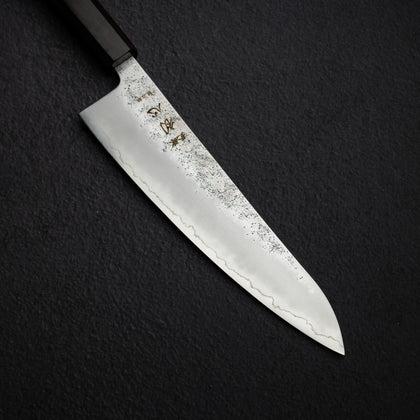
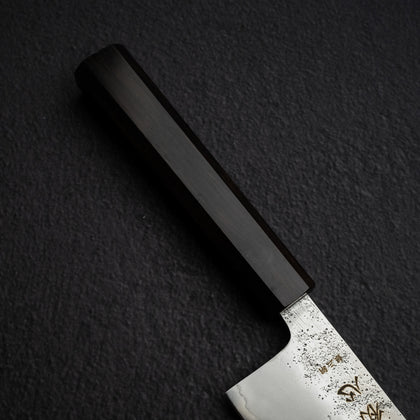
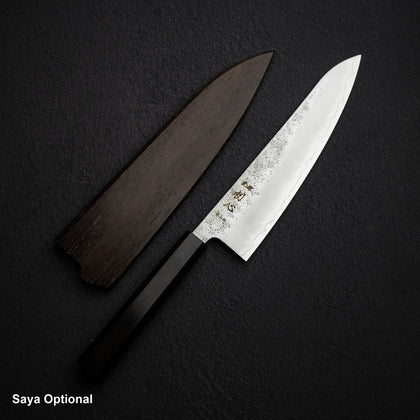
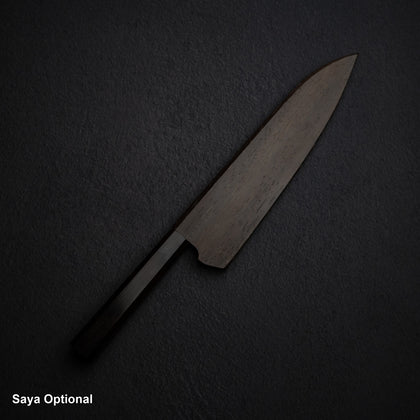
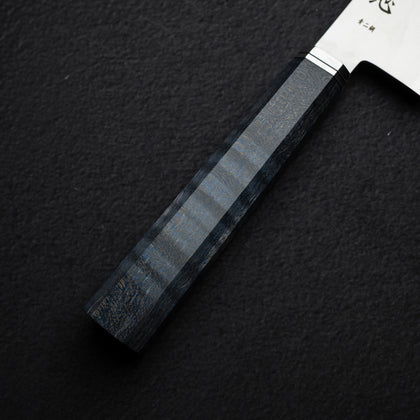
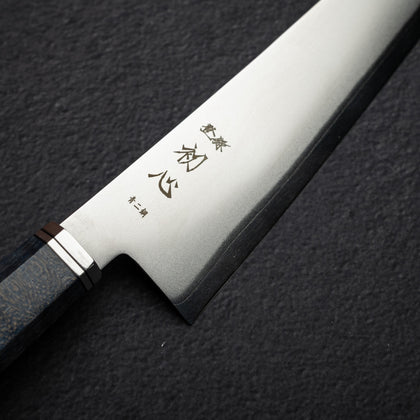
If you already know you want carbon: Hatsukokoro Kaijin Blue 2 Gyuto 210 mm, Migaki Curly Maple, about $220

하츠코코로 카이진 청2강 규토(셰프나이프) 210mm. Live price and stock come from the product page.
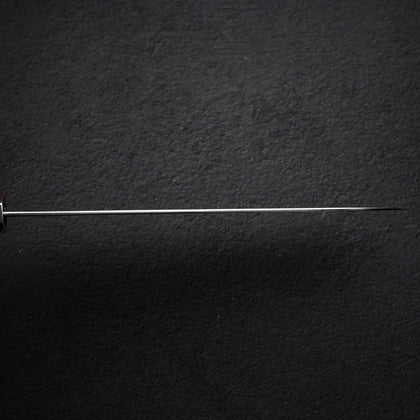
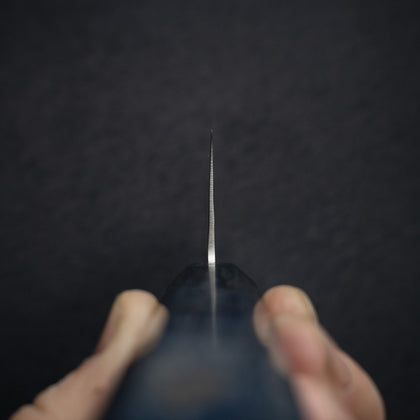
Hitachi Blue 2 carbon core with stainless cladding, a thin laser-style grind, and a dyed and stabilised curly maple handle with a stainless ferrule. Blue 2 is the steel a lot of people fall for: it sharpens quickly and takes a keen edge that holds well. The feedback on the stone is the enjoyable part.

Why this one: it is a legitimate route into carbon steel that does not require leaving the budget. You get the on-stone feel carbon converts keep describing, in a 210 mm gyuto, for about $220.
The trade-off: this is a reactive knife, and the stainless cladding does not change that. The cladding never reaches the edge. The cutting edge has to be exposed core steel, so the part touching the wet, acidic food is the carbon part. It will develop a patina and spot if you leave it wet, and one lemon is enough to shift the blade's colour before you finish the board. Wipe it dry during the cook rather than after it. If reading that felt like a chore rather than a quirk, buy the Ginrei and be happy.
4How this sits alongside our first-knife guide
Our guide to the best first Japanese kitchen knife lands on a different default, the Hatsukokoro Hayabusa VG10 Tsuchime Sanmai Gyuto 210 mm at about $190, and the difference is deliberate.
That page answers a broader question from someone who has never owned a Japanese knife. It optimises for forgiving ownership, so it leans on VG10, which is the most stain-tolerant and least demanding of the common stainless cores and asks almost nothing of a distracted owner. This page answers a narrower question from someone who has already chosen the shape and set a ceiling, so it optimises for how much cutting performance the budget returns, which points to Ginsan and its finer edge and easier stone work.
Both are 210 mm stainless-core gyutos, both sit under $200, and neither is a mistake. If you are torn, the difference between them shows up on the sharpening stone rather than on the cutting board, and the more useful question is whether you plan to sharpen your own knives.
5Spending more, and spending less
Below about $120. You are usually buying the look of a Japanese knife without the construction underneath. You get softer steel, a thicker grind and a factory edge that fades quickly. The failure here is not that you wasted $80. It is that the knife never shows you what the category is for, so you walk away convinced the hype was empty.
Around $150 to $180. A real knife, and a reasonable place to be if the cap is firm. Expect a slightly less refined grind and simpler fittings than the band above.
Around $180 to $250. The band this page is about. Grind, heat treatment and fit all land, and the knife will keep up with you as your technique improves; it will not be the thing holding you back.
Around $250 to $300. Still comfortably good value, and where you find better-known workshops, nicer handles and more finish work. This is also where the powder steels start appearing. Our own Arare SG2 gyuto, made for us by Iron Clad, sits at $299.95, right against the ceiling this page is about. SG2 is Takefu's powdered steel, run harder than either knife above at around 63 to 64 HRC, and the powdered structure is what lets it be that hard without turning chippy. The hammered arare finish helps food release a little, though the grind is flat, so potato and cheese will still cling. None of that buys you a better cut on day one. What you get is a longer stretch between sharpenings and a more pleasing object.

K&S 아라레 SG2 아이언클래드 규토(셰프나이프) 210mm 블랙 차르카테 핸들. Live price and stock come from the product page.
Above $300. You are paying for craft, rarity, exclusivity and the name of the person who made it. I sell these happily and I own some. Just be honest with yourself that the improvement is in ownership rather than in cutting, and that the next $100 after a good $200 knife returns more if you spend it on a 1000/3000 combination stone and an end-grain or soft plastic board.
You do not need to spend more than $300 here.
6Questions people ask about this
Is a $300 gyuto actually better than a $150 one?
Usually yes, and the gap is mostly in how thin the blade is behind the edge and how well the steel was heat-treated. Those two decide how the knife feels through an onion and how long it stays sharp. The gap between $300 and $600 is much smaller in cutting terms and mostly consists of finish quality, the handle and the maker's name. If your budget is $300, spend about $200 on the knife and the rest on a stone and a board.
What size gyuto should I buy if my budget is under $300?
210 mm for nearly everyone. It suits ordinary home boards and benches, covers the full range of everyday prep, and leaves room in the budget for sharpening gear. Choose 240 mm only if you regularly work through large volumes and already own a board with clearance for it, and accept that the same model usually costs another $20 to $50 in that length.
Should I get carbon or stainless steel for a gyuto under $300?
Stainless core unless you specifically want the carbon experience. Modern stainless cores like Ginsan and VG10 take an excellent edge and forgive ordinary kitchen inattention. Carbon steels sharpen beautifully and reward the person who enjoys maintenance, but they react to moisture and acid, and a stainless-clad carbon knife is not a low-maintenance knife because the cutting edge is still exposed carbon. Carbon is a great second knife and a risky first one.
Can I get a knife that will last a lifetime for under $300?
Yes, with the caveat that no knife lasts a lifetime unattended. A well-made $200 gyuto has decades of service in it if you keep it off glass and stone boards, out of the dishwasher, away from bones and frozen food, and on a sharpening stone a few times a year. Every knife is a consumable in the sense that sharpening slowly removes steel, but at home that process takes longer than most people's interest in cooking does. What kills knives at this price is chipping and neglect, not wear.
If you would rather hold one before deciding, our showroom staff can put both of these on a board for you. Stock on individual knives moves quickly, so treat the product page as the live word before you commit.