Crows Nest store now open from Friday to Tuesday, in store specials!

Knives and Stones  |  SKU: KNS_W2KU_CH200

Introductory Offer: K&S White 2 Stainless Clad Chinese Cleaver 200mm

Sale price $220.00 Regular price $249.95

IMPORTANT: Carbon steel knives can rust or patina quickly if not cared for properly. They require regular cleaning, drying, and oiling. If you are unfamiliar with carbon steel maintenance, we recommend choosing a stainless steel option instead.

Pickup available at Crows Nest

Usually ready in 24 hours

Add a saya or K&S Knife Roll to receive $20 bundle discount!

Detailed Specifications
Line Knives and Stones White 2 Tsuchime Stainless Clad
Profile Chuka (Cleaver) / Chinese Cleaver
Bevel Type Double Bevel
Weight 379 g | 13.4 oz
Edge Length 195 mm | 7 43/64″
Heel Height 95 mm | 3 47/64″
Width @ Spine 2.3 mm | 3/32″
Width @ Mid 2.1 mm | 5/64″
Width @ 1cm from Tip 2.0 mm | 5/64″
Steel White 2 / Shirogami #2 | Carbon
Blade Construction Sanmai - Stainless Clad
Hardness (HRC) 60 - 64
Surface Finish Tsuchime
Handle Cleaver Handle
Region Other
Best for
  • Pro chefs
  • First-timers
  • Enthusiasts
    • Free shipping for knives over AU$200 Australia wide.
    • World-wide shipping via DHL Express, 3 to 5 days.


    Knives and Stones’ brewed in-house knives is now joined with a new member, compared to its predecessors, this new White #2 cleaver would offer better usability, fit and finish and construction quality, only at a small cost on the price.

    This chinese cleaver we newly developed employs laminated billet produced by Sanyo Riki - a factory specialised in laminating steel to produce Sanmai(Three-piece) billets. The stainless cladding warps around the rust-prone White #2 core steel, minimising the biggest issue of the high carbon steel - maintenance. As long as the strip of exposed steel near the edge is looked after, the knife can deliver excellent cutting feel and ease of sharpening at the same time. 

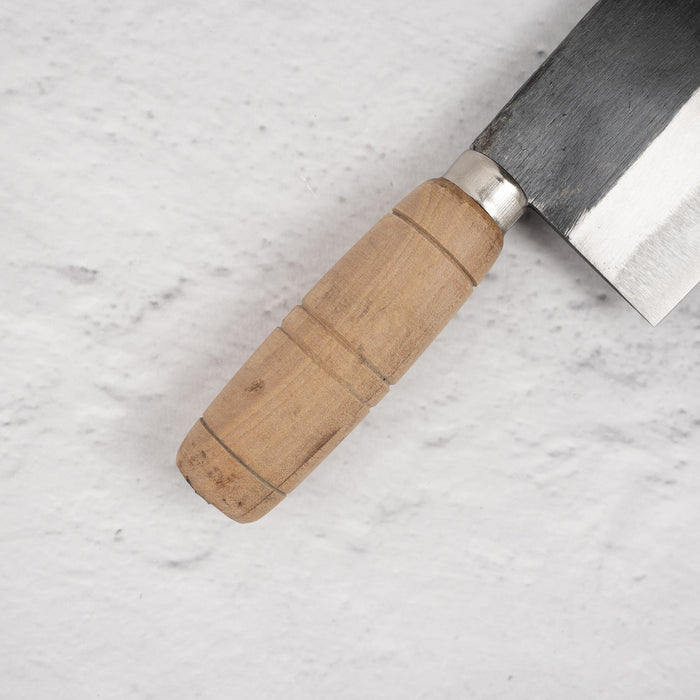
    Build quality would be the highlight of this new item. When I first received it, the solid feel in my hand was truly impressive. This isn’t about simply being heavy, it’s more about having every single part properly assembled together tightly, offering you a confidence as you know you can command the blade to go exactly where you want it to be. The secret is the integral handle construction, where the handle is cut out of the same piece of steel as the blade. The bolster and handle scale are then tightly attached to the blade using glue and pins, which is then polished to finish off the handle.

    The difference between integral handle and Through-tang handle is essentially the same difference between the “western” and “Japanese” handle. In the world of Japanese kitchen knives, the western or integral handle is often less favoured as it is heavier and leads to a backward balanced knife. But as Chinese cleavers have larger blades, a heavier integral handle can make the knife feel less tip heavy. It is harder to service and replace than the Japanese through-tang handle, but it is usually stronger, lasts much longer and feels more solid as all parts are connected through solid pins instead of glues.

    The finish of this knife is rather fascinating. Taking a closer look at the grey surface and you would find a fabric-like texture, and it’s hard to define it as Nashiji or tsuchime. This surface offers some friction for a tighter grip, while not being too deep that it would hold dirt and grease, at the same time, this roughness also makes it more resistant to scratches. This fit and finish is at a pretty high level: highly polished core steel contrasting with the cloudy cladding, rounded choil and polished spine allows a gentle feel when warping your fingers onto this knife, then, when looking closely at where the handle meets the blade, that flawlessly satin finished bolster complement the organic texture on the blade, completes the knife with a premium look. Just by visual, I can still give this knife a pretty high score.

    The sharpening is held up to Knives and Stones’ standard. The thin, slightly convexing bevel can create very thin slices effortlessly, when the slice gets thicker, the food would also fall off naturally instead of building up on the side. Although there is an  impression that chinese cleaver is designed for heavy chopping and splitting, I think it is a wrong perception misguided by the cleaver in the name. This knife, as well as most of other cleavers developed by us are designed for and excels at fine slicing, they are not to be used on dealing with hard items. If you treat them properly, you can enjoy the fun dicing, chopping, and food transfer experience offered by the chinese cleaver.

    For many people, the weight of the chinese cleaver is the major barrier of entry. If you are a carbon steel lover and can overcome that weight, I would say this cleaver would deliver an excellent user experience.

    Pros Cons
  • Excellent fit and finish
  • Excellent performance
  • Thin behind the edge
  • Prone to rust

  • Care Instruction
    1. Don't cut hard things! Japanese knives are brittle so bone hacking is a NO NO!
    2. Wash with neutral detergent after use, and wipe dry;
    3. Please don't wash knife with dishwasher, it will damage the wood handle;
    4. Be careful not to leave the knife close to a heat source for a long time;
    5. It is a lot more dangerous to cut with a blunt knife than a sharp knife!
    6. It is best to sharpen a Japanese knife regularly on a waterstone.
    7. Oil the (carbon) knife if storing for an extended period of time to prevent rust.
    Knives and Stones (K&S)

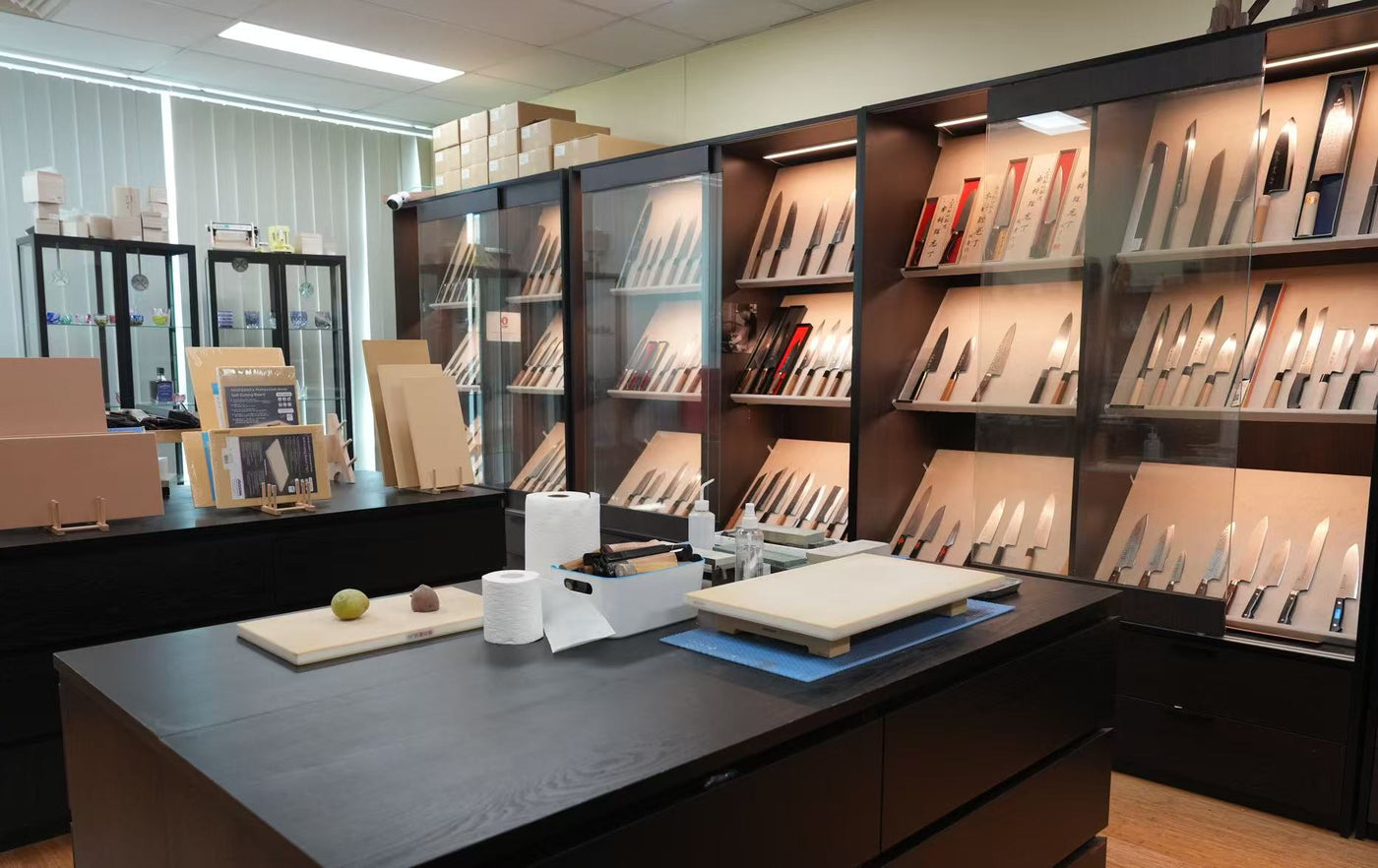
    Established in 2014 and based in Sydney, Australia, Knives and Stones (K&S) has grown into the country’s leading premium kitchen knife retailer, with a reputation recognized worldwide. Through close relationships with renowned Japanese blacksmiths, K&S directly imports some of the most sought-after Japanese kitchen knives, offering unmatched authenticity and value.

    Founder James Zhang’s Chinese heritage also brings a unique dimension to the business: collaborating with Chinese craftsmen to forge high-performance cleavers using premium Japanese steels—what James proudly calls “the real deal.”

    • Profile: Chuka (Cleaver)

      Chinese Cleaver

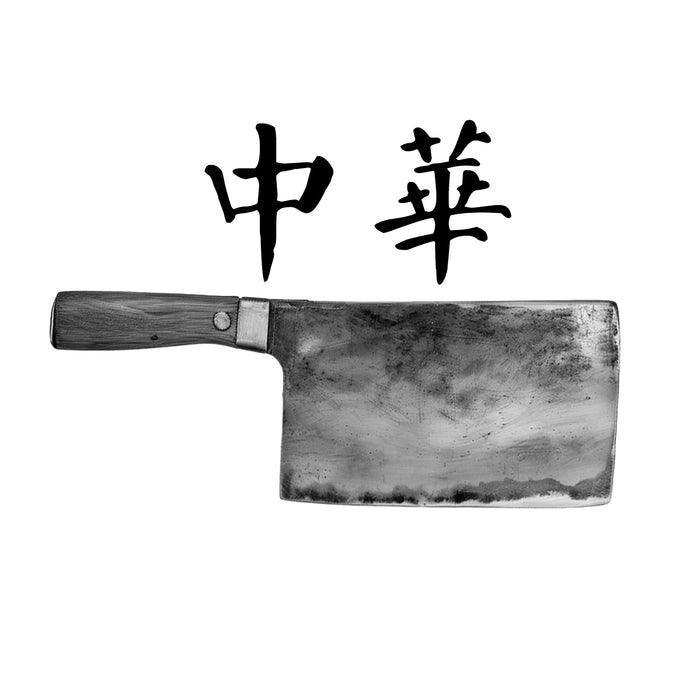
      The Chuka Bocho, or Chinese cleaver, is a large, versatile knife central to Chinese cooking, featuring a broad, rectangular blade. Beyond its primary functions of slicing, dicing, and chopping vegetables and meat, its wide blade also excels at scooping up prepared ingredients for easy transfer from cutting board to pan. Despite its formidable size, it is not intended for cutting through bone, but rather for precision tasks and handling both fine and heavy-duty chopping. Blade lengths typically range from 180mm to 220mm, offering a generous cutting surface. This knife's unique blend of functionality, including its ability to scoop up ingredients, makes it an indispensable tool in kitchens, especially where quick and precise preparation of large ingredient volumes is essential.

      Slide for more >>

    • Steel: White 2 / Shirogami #2

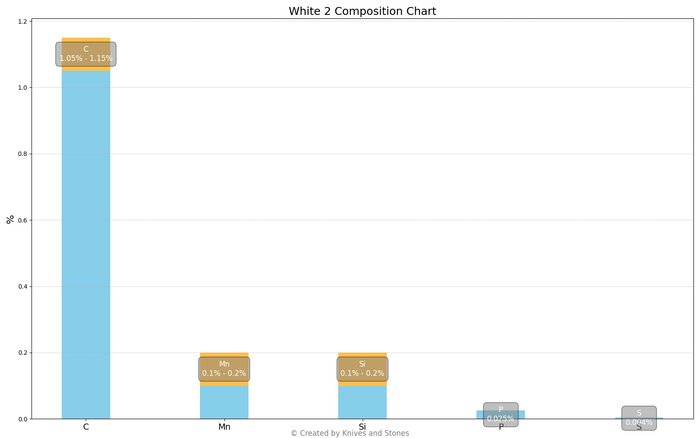
      White Steel No.2, also known as Shirogami #2 or White Paper #2, is long regarded as the go-to choice for crafting high-grade Japanese kitchen knives. This steel is celebrated for its capacity to be fashioned into knives that exhibit a sharp cutting edge, moderate tenacity, and long-lasting sharpness, alongside being notably easy to sharpen. While it possesses a slightly lower carbon content (C: 1%) compared to White Steel No.1 (C: 1.3%), it still requires a high level of craftsmanship to manipulate effectively. The expertise of a skilled blacksmith is crucial in transforming this material into a premium quality kitchen knife. Despite its excellent qualities, White Steel No.2 is known to be very reactive; hence, knives made from this steel demand meticulous care, including immediate wiping and drying after use, to prevent corrosion.

      Sanjo and Sakai are known to widely utilise Shirogami #2 in their mainstream kitchen knives.

      Manufacturer:

      • Hitachi Special Steel, Japan

      Nature: Carbon

      Hardness: 60- 64

      << Slide for more >>

    • Construction: Sanmai - Stainless Clad

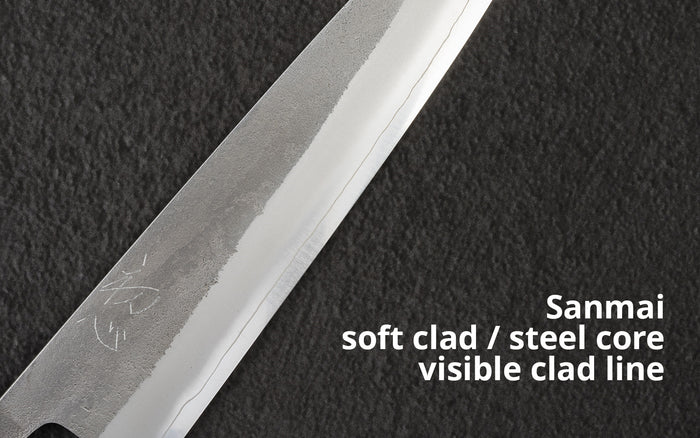
      Sanmai(Three-Piece) is a common construction for double bevel knives where two pieces of softer cladding steel are forgewelded to each side of a harder core steel. The harder but more brittle core steel will form the hard cutting edge after heat treating, and the softer cladding will support the core to increase the overall strength of the blade.

      The soft cladding enables the thinning process to be a lot easier than a honyaki or monosteel construction. And in the case where the cladding steel are stainless in nature, it can offer protection for the carbon or semi-stainless cores against rusting and discoluoring.

      << Slide for more >>

    • Finish: Tsuchime

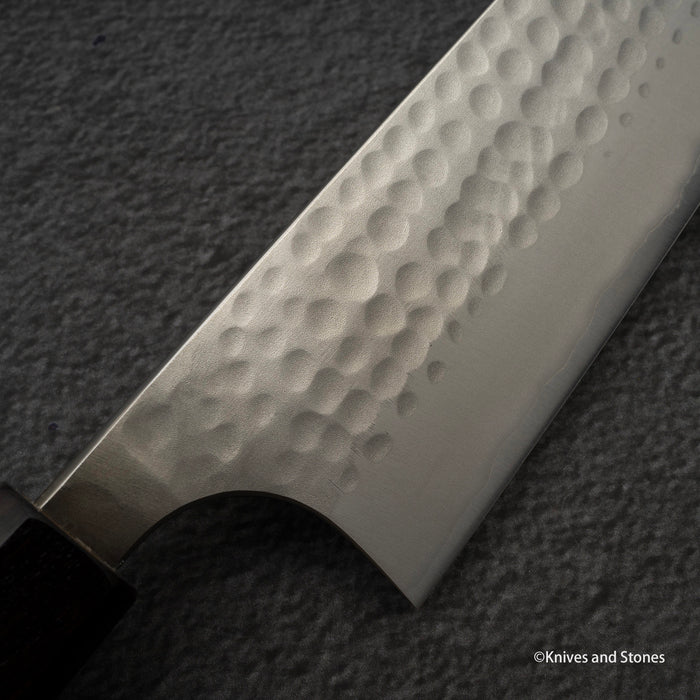
      The "Tsuchime" finish in Japanese kitchen knives refers to a distinctive hammered texture on the blade's surface. This traditional technique not only adds a unique aesthetic appeal but also provides practical benefits, such as reducing drag and preventing food from sticking to the blade during slicing. It's a hallmark of craftsmanship that blends functionality with artistry, making each knife not only a tool but a piece of art.

      << Slide for more >>

    • Handle Specs

      Profile: Chinese Cleaver Handle

      Material:

      • Ho Wood

      Traditional chinese cleaver handle, short but very easy to grip. Designed to hold with two fingers on the blade and three fingers wrapping around the small handle. The short lenght is to balance the knife into a more blade heavy position which is a desired balance point for Chinese cleavers.

      << Slide for more