Crows Nest store now open from Friday to Tuesday, in store specials!

Masamoto Sohonten  |  SKU: MASA_SW4324

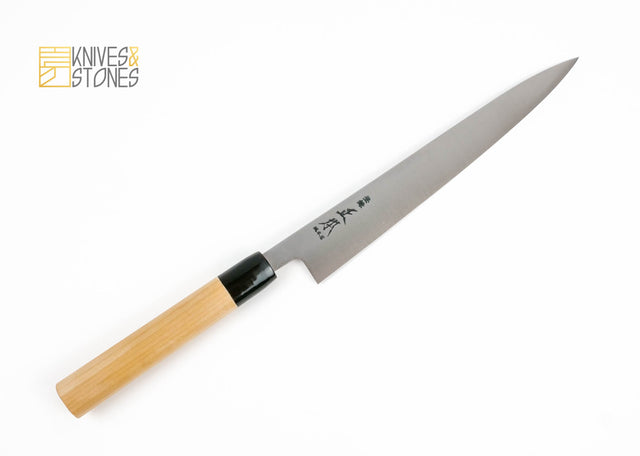
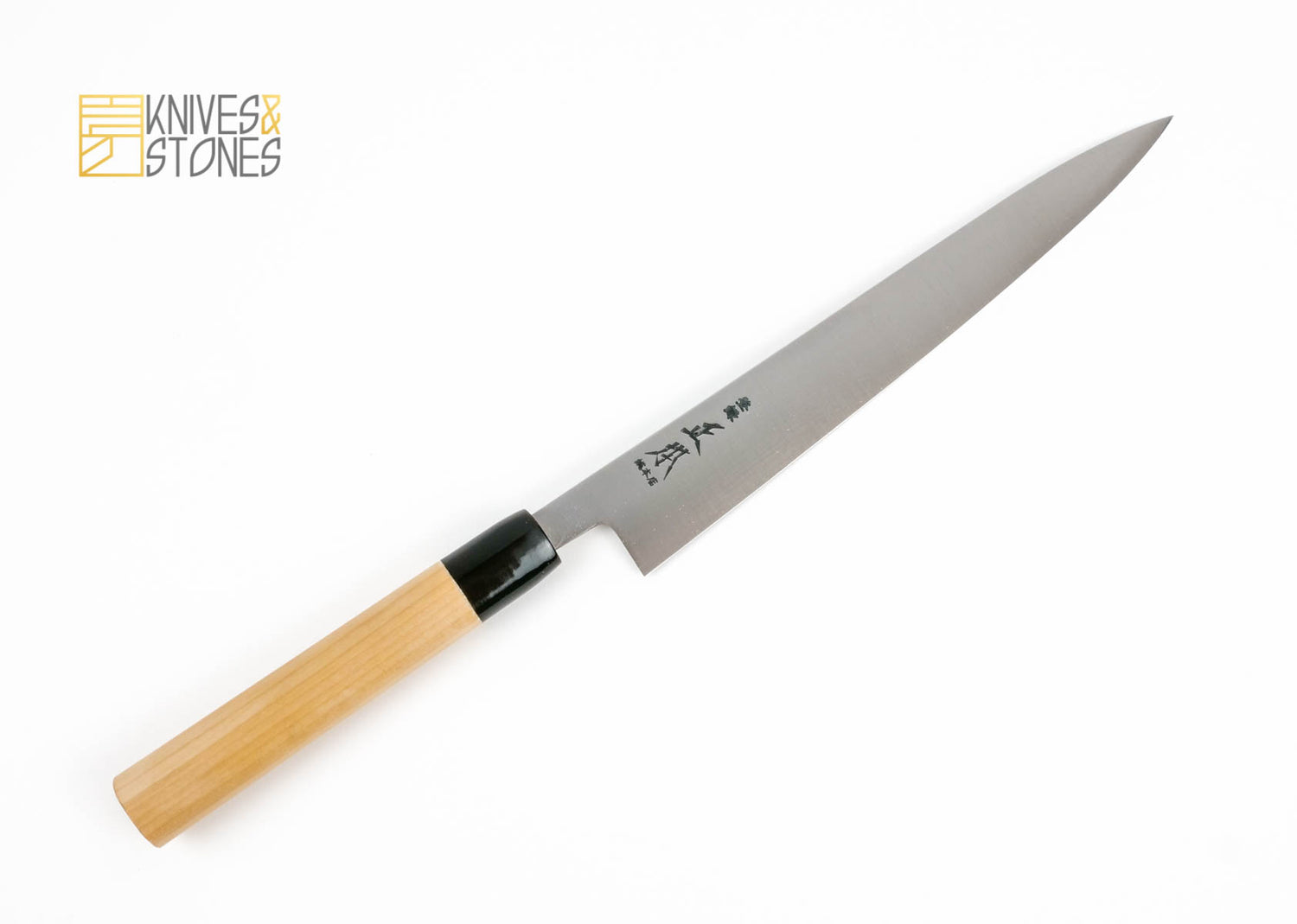
Masamoto Sohonten SW Series Sujihiki 240 mm SW4324

Regular price $669.95

Add a saya or K&S Knife Roll to receive $20 bundle discount!

Masamoto SW
Sujihiki / Slicer
Double Bevel
Weight 102 g | 3.6 oz
Edge Length 247 mm | 9 23/32″
Heel Height 35 mm | 1 3/8″
Width @ Heel 2.2 mm | 3/32″
Width @ Mid 1.8 mm | 5/64″
Width @ 1cm from Tip 0.9 mm | 1/32″
Steel Swedish Steel | Stainless
Blade Construction Monosteel
Hardness (HRC) 58 - 60
Surface Finish Migaki
Handle D Shaped Ho Wood Black Ferrule
Region Tokyo
Best for
  • Pro chefs
  • Enthusiasts
  • Free shipping for knives over AU$200 Australia wide.
  • World-wide shipping via DHL Express, 3 to 5 days.


The Masamoto KS series, particularly the KS double bevel line up, including the unicron KS 3124, is loved by many many professional chefs and enthusiasts because of its unique and excellent profile; also because it is super light and nimble.

Arguably the only problem? The rustic carbon steel used in the KS line can be problematic during the busy service sessions in a western kitchen. As a result, Masamoto created the SW series, which is the stainless equivalent of the white steel (KS) line, employing the same great cutting performance without the need to worry about the rust. The Swedish steel is very refined, offer decent hardness and excellent toughness.

Pros Cons
  • Great for professionals
  • Excellent performance
  • High budget
  • Relatively hard to sharpen
Care Instruction
  1. Don't cut hard things! Japanese knives are brittle so bone hacking is a NO NO!
  2. Wash with neutral detergent after use, and wipe dry;
  3. Please don't wash knife with dishwasher, it will damage the wood handle;
  4. Be careful not to leave the knife close to a heat source for a long time;
  5. It is a lot more dangerous to cut with a blunt knife than a sharp knife!
  6. It is best to sharpen a Japanese knife regularly on a waterstone.

Masamoto Sohonten

The Crowned King of Kanto Region

Masamoto Sohonten, the undisputed king of Japanese kitchen knives, has arrived at Knives and Stones. Started by Minosuke Matsuzawa in 1866, succeed by Kichizo Hirano in 1891 and registered its trademark in 1903, Masamoto Sohonten is now under the management of the 6th generation Masamoto: Masahiro Hirano. With more than 150 years of history, Masamoto Sohonten is recognised by almost every Japanese chef as the best kitchen knife brand in Japan, and it is often considered as the go-to tool for professionals.

“The hallmark of professionalism in single bevel knives, excellent in quality and consistency and once the dominating knife brand in the entire Kanto region.”

Est. 1866 | 慶応2年
Known for Excellently built traditional single bevel knives and KS series Gyuto
Website masamoto-sohonten.co.jp Read more about Masamoto Sohonten
Masamoto Sohonten — Tokyo
Profile: Sujihiki
Profile

Sujihiki

Slicer

The Sujihiki, also known as Sujibiki, stands out as a Japanese slicing knife, characterized by a thinner and sharper edge than those found in Western kitchens. Its long blade is ideally crafted for the artful, thin carving of proteins and for slicing terrines and patés with finesse. Blade lengths span from 210mm to 300mm (8.3 to 12 inches), with 240mm and 270mm being particularly favored for their balanced cutting length and agility. When used for their intended purpose Sujihiki has a significant advantage: the slimmer blade will have less surface contact with the soft protein, and lead to reduced frictions during the cut compare to Gyuto as this type of food would "grip" the blade from pushing forward. In addition, the generally flat profile of Sujihiki is a perfect match for slicing tasks, when paired with a carbon steel core, they are some of the best tools for portioning large piece of meat, they can also act as the perfect melon cutter occationaly.
Composition

Swedish Steel Element Composition

Compare with
    Swedish Steel
    27.0% 20.3% 13.5% 6.8% 0
    C Carbon 0.65%
    Primary hardening element. Raises hardness and wear resistance — but too much increases brittleness and corrosion susceptibility. As a reference: German 1.4112 (~0.5%) sits at the low end; VG-10 (~1.0%) is a common mid-range; SG2 (1.25–1.45%) and ZDP-189 (~3.0%) represent high and extreme ends respectively.
    C
    0.65%
    Cr Chromium 27.0%
    Raises corrosion resistance; 13%+ qualifies steel as stainless. Also improves hardenability and wear resistance. In kitchen use, higher chromium levels contribute to a slight drag or sticking sensation when cutting — a trade-off for the rust resistance it provides.
    Cr
    27.0%
    Mn Manganese 0.4%
    Aids hardenability and strength. Acts as a deoxidiser during smelting. Excess can reduce toughness.
    Mn
    0.4%
    Si Silicon 0.4%
    Strengthens the steel matrix and acts as a deoxidiser. Improves hardness and resistance to oxidation.
    Si
    0.4%
    P Phosphorus 0.003%
    Impurity from the smelting process. Even small amounts cause brittleness — steelmakers keep this as low as possible.
    P
    0.003%
    S Sulfur 0.01%
    Impurity that reduces toughness and promotes brittleness. Intentionally added only in free-machining steels.
    S
    0.01%
    C — Carbon Cr — Chromium Mn — Manganese Si — Silicon P — Phosphorus S — Sulfur
    Hardness 58–60 HRC
    555759616365+
    Steel
    Swedish Steel
    Category
    Stainless
    Manufacturer
    Sandivk, Sweden 🇸🇪 · Uddeholm, Sweden 🇸🇪
    Hardness
    58–60 HRC
    Steel

    Swedish Steel

    • Manufacturer
      • Sandivk, Sweden
      • Uddeholm, Sweden
    • Nature Stainless
    • Hardness58–60 HRC
    Swedish steel is a broad term used for a few different types of steel manufacturerd by two major Swedish steel companies: Sandivk and Uddeholm. For some unknown reason, the Japanese knife makers seem to settled for just using the term "Swdish Steel" rather than publishing their specifics however the following steel are often used in knife making:
    Uddeholm: AEB-L
    Sandvik: 12C27, 14C28, 19C27
    These steel types have similar carbon content (0.6-0.7) and are generally treated to around HRC 59-60.
    Construction: Monosteel
    Construction

    Monosteel

    A "monosteel" construction in the context of Japanese kitchen knives refers to knives that are made from a single type of steel. Unlike traditional Japanese knives that might use a layered steel construction (like "san mai," which sandwiches a hard core steel between softer steel layers), monosteel knives are crafted from a single piece of steel throughout the blade. This type of construction can offer a balance of durability, ease of sharpening, and maintenance.

    Monosteel knives are appreciated for their uniformity in material properties across the blade, providing a consistent cutting experience. This also means the characteristics of the steel will be applied to the whole blade, if a monosteel blade is made of carbon steel, the entire surface of the blade will require maintenance to prevent rust and discolouration. This too, applies to the hardness, an uniformly hardened blade can be difficult to manufacture, and can be quite difficult for uers to perform thinning.

    It should be noted that monosteel knives are usually not forged, as the forged knives, along with differential heat treatment line is called Honyaki.

    Finish: Migaki
    Finish

    Migaki

    "Migaki" means "polished" or "shined" in Japanese, The term "Migaki finish" in the context of Japanese kitchen knives indeed does not exclusively refer to a mirror polish but encompasses a broader range of polished finishes that can vary from semi-gloss to a more refined, subtle sheen, rather than a highly reflective surface. The primary goal of a Migaki finish is to enhance the knife's functionality and aesthetic appeal, focusing on a smooth finish that improves resistance to corrosion and minimizes drag during cutting, rather than achieving a purely mirror-like appearance.

    Handle
    Handle

    Handle Specs

    • Profile D Shape WA
    • Material
      • Ho Wood
      • Black Buffalo Horn

    A classic handle that Masamoto Sohonten and many Tokyo knifemakers loves to use. Light, grips well and highly functional. The problem is because of its directional nature, it has to be pre-installed with right or left hand operation in mind.

    1 / 5

    You May Also Like