PRAHRAN STORE NOW OPEN · THU–MON · 10AM–6PM

Shibata  |  SKU: TNHS_A10DA_STEAK_RED

Tsunehisa AUS10 Damascus Steak Knife Red

Sale price $93.98 Regular price $109.95

Availability

  • St Peters, NSW —
    2 Bishop St, Unit 2, St Peters NSW 2044
  • Crows Nest, NSW —
    107 West St, Shop 1, Crows Nest NSW 2065
    Pickup only
  • Prahran, VIC —
    180 Commercial Road, Shop 1, Prahran VIC 3181
    Pickup only

Goes well with

Detailed Specifications
Line Tsunehisa AUS 10 Tsuchime Damascus
Profile Steak / Steak knife
Bevel Type Double Bevel
Weight 65 g | 2.3 oz
Edge Length 85 mm | 3 11/32″
Heel Height 16 mm | 5/8″
Width @ Heel 1.9 mm | 5/64″
Width @ Mid 1.4 mm | 1/16″
Width @ 1cm from Tip 0.7 mm | 1/32″
Steel AUS-10 | Stainless
Blade Construction Sanmai - Stainless Damascus Clad
Typical hardness 58 to 60 HRC
Surface Finish Tsuchime
Handle Western Pakka Wood no Bolster
Region Fukuyama
Best for
  • First-timers
  • Students

Free shipping for knives over AU$200 Australia wide.

World-wide shipping via DHL Express, 3 to 6 days (not available in the UK).


Tsunehisa AUS10 Damascus Tsuchime line is a very textured series from this value focused brand. Equipped with highly polished hammertone Damascus cladding, the striking look presents a highly attractive offer at the entry level market when paired with a decent grind and full stainlessness.

AUS10 might not be a name that is as shiny as VG10, yet when you look at their chemical compositions, the major difference would be 0.8% of Molybdenum (adds hardenability) and 1.5% of Cobalt (adds red hardness). In practice, there is not going to be a distinct difference that you can notice, but you can easily feel the price difference when making a purchase as VG10 is often marketed as a more premium steel.

Although textured Damascus cladding is a common fabrication technique nowadays, the execution of this line still stands out. The dimple comes in an oval instead of a typical round pattern, and they are a bit deeper than the other knives out there on the market, paired with a mirror polished Damascus  surface, the high contrast created over the surface of these blades are very eye-catching.

The geometry of the line is what I would expect from Tsunehisa, it’s not incredibly performance oriented, but since it targets entry level audiences, it is not a good idea to sacrifice edge strength to seek extremely smooth cuts. In summary, you can feel some resistance once you cut into food with some density, but there will rarely be any sticking that creates unpleasant drag along the cut.

Tsunehisa’s AUS 10 is a line that adheres to the brand’s philosophy very well, decent quality, budget friendly but abundant in varieties. This is one of the item that contributes to the construction of this big family of knives, and if you are browsing through all the available options offered at this price range and fell in love to this look, feel safe to pick it as it will deliver what you’d expect.

Pros Cons
  • Budget friendly
  • Easy to look after
  • Ideal for the household
  • Non-premium steel
Care Instruction
  1. Don't cut hard things! Japanese knives are brittle so bone hacking is a NO NO!
  2. Wash with neutral detergent after use, and wipe dry;
  3. Please don't wash knife with dishwasher, it will damage the wood handle;
  4. Be careful not to leave the knife close to a heat source for a long time;
  5. It is a lot more dangerous to cut with a blunt knife than a sharp knife!
  6. It is best to sharpen a Japanese knife regularly on a waterstone.

Tsunehisa

Tsunehisa, the house brand of Shibata Knives

Tsunehisa (恒久) is the house brand of Shibata Knives, the knife company Takayuki Shibata owns and runs. It is a brand rather than a single workshop.

The name means permanence, and Shibata Knives says it chooses knives that will have a long life. Takayuki Shibata started Tsunehisa in 2015 as his third knife brand, to help manage growing orders.

Read more

Shibata Knives describes Tsunehisa as a brand that inherits traditional Japanese forging techniques while taking in the latest materials and technologies, aiming at function and design for long use. It says its experienced staff inspect each knife under strict quality control, and it offers after-sales maintenance and sharpening.

The lines we list are grouped by steel. Ginsan comes in migaki, nashiji and nawame finishes, as gyuto, santoku, nakiri and petty, with a deba in the same steel. White 1 comes stainless clad as migaki and tsuchime gyuto, Aogami Super as kurouchi tsuchime sujihiki and petty, and Blue 2 as the Samurai sakimaru sujihiki.

The Damascus lines are in VG10, AUS10 and ZA18, the AUS10 also with a tsuchime finish. The rest are AUS8 tsuchime, a VG1 gyuto and an SLD Washiji santoku. Handles come in wa and yo styles.

“The house brand of Shibata Knives; the name means permanence.”

Est. 2015 | 平成27年
Known for Knives chosen and inspected by Shibata Knives
Instagram @tsunehisa Read more about Tsunehisa

Tsunehisa · Fukuyama

Knife details

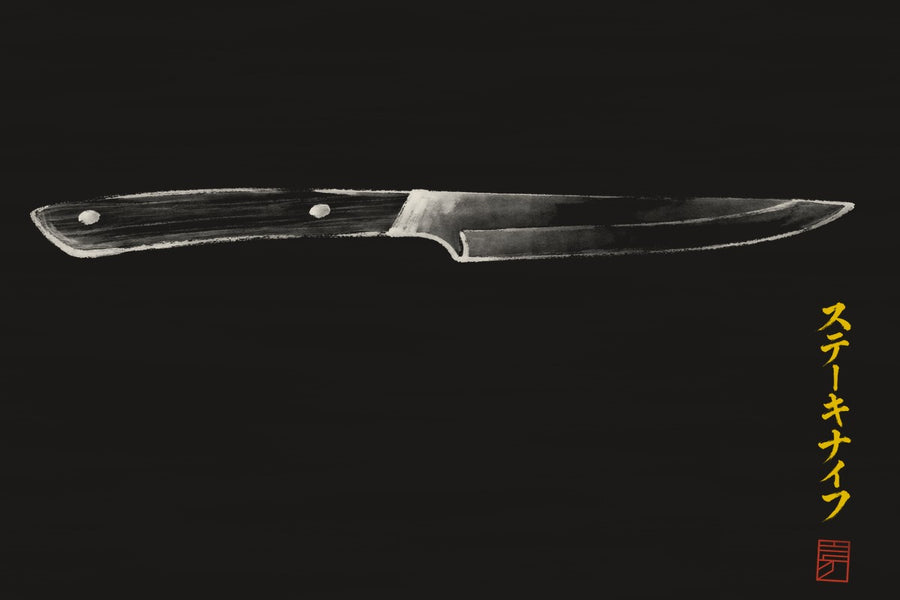
Steak — knife profile
Profile

Steak

ステーキナイフ

Steak knife · Double bevel

Short table knife for cooked steak. Plain edges can be sharpened; serrated ones saw.

Read more
Steel properties
  1. Hardness Good
  2. Edge retention Good
  3. Toughness Very high
  4. Rust resistance High
  5. Ease of sharpening Good
  6. Sharpness Good
Our ratings, inferred from published lab tests and composition.

Our edge-retention grade is a kitchen rating. It weighs the hardness each steel is sold at, which keeps a thin edge from rolling, twice as heavily as lab wear tests, and the final grade is our judgment from selling and sharpening these knives for over a decade. Lab card-cutting tests measure abrasive wear only, so they can rank carbon steels lower. Tap ? for the lab figure.

Steel

AUS-10

AUS-10

Stainless · Aichi

Aichi Steel's AUS series; Fukaumi lists 0.95 to 1.10% carbon, 13 to 14.5% chromium, 60 HRC reference.

Read more
CladdingCoreClad line
Construction

Sanmai - Stainless Damascus Clad

三枚ダマスカス

3 layers · damascus clad

Hard core between stainless damascus layers, bare at the edge. Thinning wears the pattern.

Read more
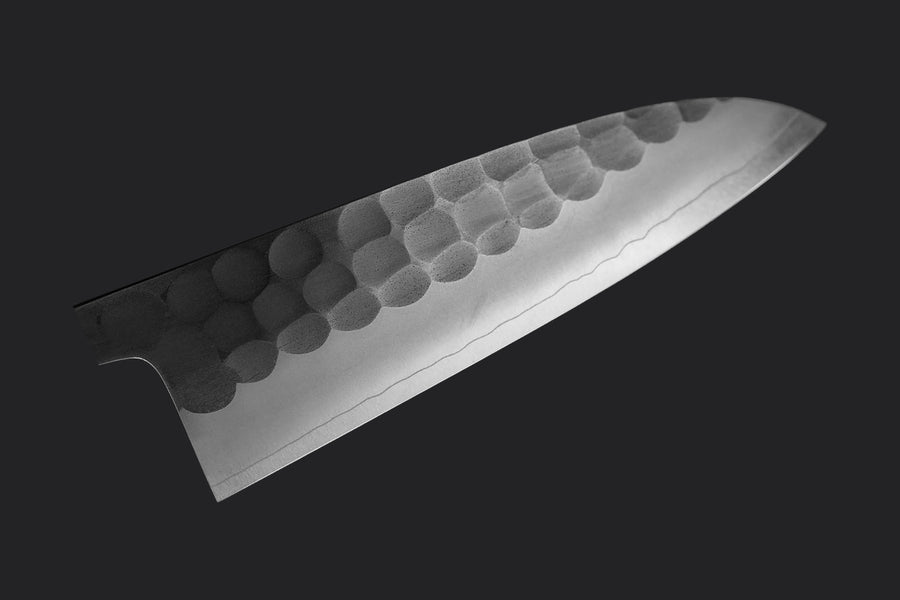
Tsuchime — blade surface finish
Finish

Tsuchime

槌目

Hammered surface

Hammer marks across the upper blade. The dimples may help food release.

Read more
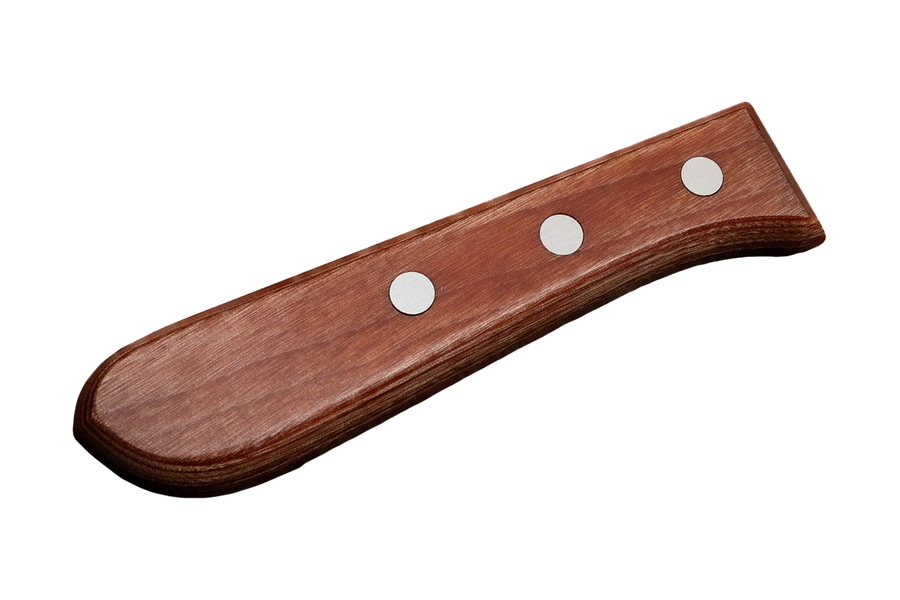
Western Pakka Wood no Bolster handle
Handle

Western Pakka Wood no Bolster

Western without bolster

Pakka wood western grip, no bolster. Light and affordable; resin-infused wood is stable.

Frequently asked questions

What is a steak knife used for?

Tojiro describes the steak knife as a knife for cutting steak and other meat. It has an upward curve at the tip, a shape Tojiro explains by the way the tip is driven into the meat, which makes it easier to cut the meat into large pieces.

Tojiro lists the steak knife as double-bevel.

Is AUS-10 a good choice for a first knife?

Yes. AUS10 is a good first Japanese knife steel, and it is the one we suggest when the knife will see busy everyday use.

Aichi Steel makes it and lists 0.95 to 1.10% carbon and 13.00 to 14.50% chromium, with vanadium and molybdenum added for hardness and wear resistance. Aichi's reference heat treatment takes AUS10 to 60 HRC, and the edge comes back quickly on a 1000 grit whetstone. You will sharpen it a bit more often than VG10 or SG2.

Stainless means it rusts less, not that it never rusts. Wash it by hand, dry it straight away and keep it out of the dishwasher. Keep the edge off bones and frozen food.

For a first knife, pick the shape first: a 210 mm gyuto or a 165 mm santoku. Our own K&S AUS10 Monosteel range has both, and we also list AUS10 knives from Tsunehisa and Yoshihiro.

What does the name Tsunehisa mean?

Tsunehisa (恒久) means permanence. Shibata Knives describes Tsunehisa as its original brand, and says it selects knives that will have a long life, inspecting each one before delivery. Its own words are that it delivers knives worthy of a permanent position in your home.

The brand is built on traditional Japanese forging techniques with modern materials, and Shibata Knives offers after-sales maintenance and sharpening for the line.

Is Tsunehisa a brand or a blacksmith?

Tsunehisa is a brand, not a single smith or a workshop. Shibata Knives describes it as an original brand of the company, run by Takayuki Shibata, and Shibata Knives does not name the workshop that makes each line. The company inherits traditional Japanese forging techniques with modern materials, and experienced staff inspect each knife before it is delivered.

What stands behind each Tsunehisa knife is that selection and inspection, and the company offers after-sales maintenance and sharpening for the line.

Are Tsunehisa knives worth it?

We think so, for a first Japanese knife in particular. Tsunehisa is the third brand of Takayuki Shibata, the Fukuyama sharpener behind Masakage and Koutetsu. His site says he started it in 2015 to keep up with orders.

Most of the Tsunehisa we stock is Ginsan (Silver #3), a stainless steel, so it needs less care than carbon steel. We list it in three finishes: Migaki, Nawame and Nashiji. We also list the SLD Washiji nakiri.

Stock changes, so check each listing. The Takayuki Shibata craftsman page has more on him.

Are Damascus knives worth it, or is it just looks?

On nearly every Japanese kitchen knife sold as Damascus, the pattern is there for looks. It sits in the soft cladding on the sides of the blade, and the plain core steel at the edge does the cutting. Pay more for Damascus if you enjoy how it looks, and for no other reason.

Most are built in three layers (sanmai): a hard core with a softer layer forge-welded to each side. On a Damascus knife that outer layer is itself made of many thin layers, etched or blasted so the pattern shows. The cladding is made separately from the core, so a maker can change the look without changing how the blade cuts. Two knives with the same core steel and the same grind perform the same, patterned or plain.

The cladding does real work, but plain cladding does it too. It supports the hard, brittle core, and when it is stainless it shields a carbon steel core from rust except at the edge. Our Damascus construction page shows the layers.

The pattern also changes with use. The contrast fades where you sharpen, and once the knife is thinned the cladding near the edge will not look as it did out of the box. If the budget is tight, spend it on the core steel and grind, or on a whetstone. If you like the pattern, buy it; wanting a good-looking knife is a fair reason to choose one.

You May Also Like