PRAHRAN STORE NOW OPEN · THU–MON · 10AM–6PM

Sugimoto  |  SKU: SUGI_CM4030_CH190

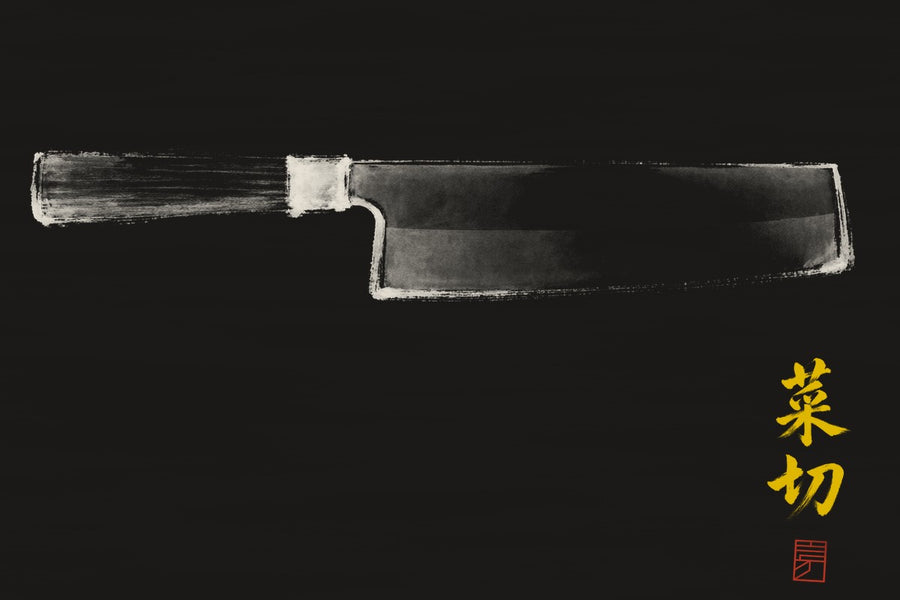
Sugimoto Stainless Steel Large Nakiri (Chuka) 190mm CM4030

Regular price $349.95

Sold out right now

Leave your email and we’ll send one message the moment it’s back in stock.

One email, no marketing. Privacy policy.

Availability

  • St Peters, NSW —
    2 Bishop St, Unit 2, St Peters NSW 2044
  • Crows Nest, NSW —
    107 West St, Shop 1, Crows Nest NSW 2065
    Pickup only
  • Prahran, VIC —
    180 Commercial Road, Shop 1, Prahran VIC 3181
    Pickup only
Detailed Specifications
Line Sugimoto Stainless Steel Large Nakiri (Chuka)
Profile Nakiri / Japanese vegetable knife
Hardness (HRC)
Handle
Region Tokyo
Best for
  • Household
  • Enthusiasts
  • Free shipping for knives over AU$200 Australia wide.
  • World-wide shipping via DHL Express, 3 to 5 days.


Sugimoto's history goes back to the 1830s, and after World War II the firm was the first to begin producing Western and Chinese-style knives. These two large nakiri carry that Chuka (Chinese cleaver) DNA in a stainless package.

The CM4040 was originally designed for slicing roasted Beijing duck skin, and it is ground very thin behind the edge. Its flat profile works as a large nakiri, and both knives share a chromium molybdenum stainless steel at HRC 57 to 58 in a sanmai stainless clad build. The CM4040 is the lighter of the pair at 245 g with a 66.2 mm heel height; the CM4030 covers more ground at 94.9 mm of height and 320 g.

Both run 190 mm edge length with a comfortable oval handle, and the stainless steel means no ritual after washing: dry the knife and put it away. For high-volume vegetable work without rust worries, this family is an easy recommendation.

Pros Cons
  • Thin behind the edge
  • Easy to look after
  • Ideal for the household
Care Instruction
  1. Don't cut hard things! Japanese knives are brittle so bone hacking is a NO NO!
  2. Wash with neutral detergent after use, and wipe dry;
  3. Please don't wash knife with dishwasher, it will damage the wood handle;
  4. Be careful not to leave the knife close to a heat source for a long time;
  5. It is a lot more dangerous to cut with a blunt knife than a sharp knife!
  6. It is best to sharpen a Japanese knife regularly on a waterstone.
  7. Error: Steel nature unknown

Sugimoto

Sugimoto Hamono (杉本刃物) is based in Tsukiji, Tokyo. On its own site, Sugimoto says it began with a sword smith of the Tenpō era of the Edo period, and that its craftsmen still forge and edge each knife one by one with that technique. Its company page lists Japanese, Western and Chinese kitchen knives.

Sugimoto says it gives every knife a full working edge (honba-tsuke) so it can be used straight after purchase, and it takes resharpening and handle repairs. The numbers on its Chinese cleavers are Sugimoto's own production numbers; its online shop groups 1 and 6 as thin, 2, 7 and 11 as medium-thick, 3 as thick and 22 as extra-thick. We list its #6 and #7 cleavers in White 2 and two stainless large nakiri.

“A Tsukiji knife maker that says it began with an Edo-period sword smith.”

Est. 1948 | 昭和23年
Known for Chinese cleavers in its own numbered series, and knives sold with a full working edge
Website sugimoto-hamono.com Read more about Sugimoto

Sugimoto · Tokyo

Knife details

Frequently asked questions

Why won't my knife cut all the way through? The slices stay joined at the bottom.

Part of the edge never reaches the board, so the cut never finishes. At our counter we put it simply: there is not enough flat at the heel. A knife with a long curve is built for rock chopping, not for the Chinese or Eastern up-and-down chop.

A straight edge, like a nakiri's, meets the board along its whole length and finishes the cut. On any knife, a dip worn near the heel or a dull section can cause the same thing.

Nakiri or usuba: what is the difference?

The bevel. A Japanese dictionary describes the nakiri (菜切包丁) as shaped like an usuba but double-bevel and relatively easy to handle; the Sakai cutlery association describes the usuba (薄刃包丁) as an acute, wide knife for vegetables, in a square Kanto type and a kamagata Kansai type.

The names overlap, since another dictionary records the usuba as also called nakiri, so check the bevel rather than the name.

What do the numbers on a Sugimoto cleaver mean?

They are Sugimoto's own production numbers, original to the company, its shop says, and its cleaver categories group them by thickness: numbers 1 and 6 thin (薄口), 2, 7 and 11 medium-thick (中厚口), 3 thick (厚口) and 22 extra-thick (極厚口).

Within that numbering system, #6 is in the thin group and #7 is in the medium-thick group.

You May Also Like