PRAHRAN STORE NOW OPEN · THU–MON · 10AM–6PM

Takeshi Saji  |  SKU: TAKE-V10RBE-SH270

Takeshi Saji VG10 Rainbow Damascus Etched Sujihiki 270mm

Sale price $594.98 Regular price $699.95

Sold out right now

Leave your email and we’ll send one message the moment it’s back in stock.

One email, no marketing. Privacy policy.

Availability

  • St Peters, NSW —
    2 Bishop St, Unit 2, St Peters NSW 2044
  • Crows Nest, NSW —
    107 West St, Shop 1, Crows Nest NSW 2065
    Pickup only
  • Prahran, VIC —
    180 Commercial Road, Shop 1, Prahran VIC 3181
    Pickup only
Detailed Specifications
Line Takeshi Saji VG10 Rainbow Damascus Kurozome
Profile Sujihiki / Slicing knife
Bevel Type Double Bevel
Weight 165 g | 5.8 oz
Edge Length 266 mm | 10 15/32″
Heel Height 40 mm | 1 37/64″
Width @ Heel 2.0 mm | 5/64″
Width @ Mid 2.0 mm | 5/64″
Width @ 1cm from Tip 1.2 mm | 3/64″
Steel VG10 | Stainless
Blade Construction Sanmai - Stainless Damascus Clad
Hardness (HRC) 59 to 61
Surface Finish Etched
Handle
Region Takefu
Best for
  • Enthusiasts
  • Collectors

Free shipping for knives over AU$200 Australia wide.

World-wide shipping via DHL Express, 3 to 6 days (not available in the UK).


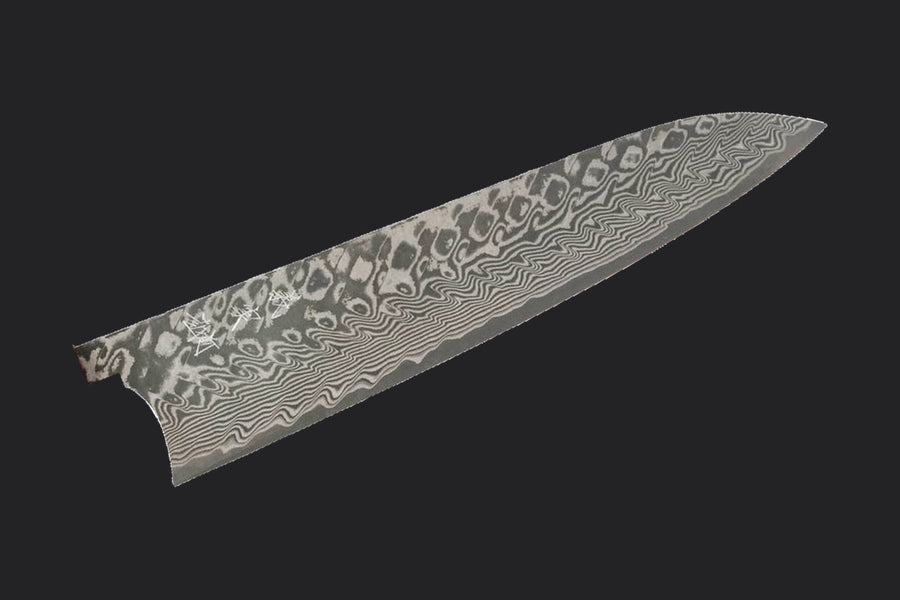
Takeshi Saji’s Rainbow Damascus VG10 line is a beautiful set of knives manufactured in Echizen, and these knives come in two different finishes. The polished version is finished in a similar way to Saji san’s classic Diamond damascus: shiny, smooth surface that is low in maintenance. The Etched version though, is almost a different species: bold colour and strong contrast catches your attention at first glance, yet this surface is more delicate and demands more care.

The fundamental construction of two lines is the same, a VG10 core cladded by stainless steel damascus cladding interweaved with copper and brass. The varying colour between different materials leads to the “rainbow” look that we see. However, utilizing the “Diamond Polish” would yield a clean, shiny surface, but this treatment would make the colour of the copper and brass look faded. The etched version sandblasts the surface of the blade instead, following it with an acid etch to further increase the contrast. As a result, the core steel, cladding steel, brass, copper and the nickel layer are clearly revealed, leading to a much more complex look compared to the polished version.

The profile of the knife carries noticeable characteristics of the Echizen knifemaking. Combining a low spine thickness with outstanding blade geometry, it leaves almost no thickness behind the edge, and the transition in thickness across the bevel is rather smooth, this ensures minimal drag when entering food, and the thin slice would be encouraged to fall off at the convexing junction between the bevel and the flat zone. If there is anything that can reduce the cutting smoothness of the knife, it would be the rough surface that is designed for the special appearance.

This knife fits well in the shelf of collectors and enthusiasts, as well as those who want a special looking item in their kitchen. It bears a rather unique look, and like often we found people are attracted to people looking for a gift with some wow factor. Like the Anmon series from Nigara, this rainbow damascus line doesn’t sacrifice practicality and performance for the appearance, the stainless core makes them rather easy to look after, as long as you take good care of it in use and avoid scratching its surface, this is a pretty beginner friendly line in the higher price range.

Pros Cons
  • Excellent performance
  • Thin behind the edge
  • Great artistic
  • High budget
  • Etched damascus can be hard to maintain
Care Instruction
  1. Don't cut hard things! Japanese knives are brittle so bone hacking is a NO NO!
  2. Wash with neutral detergent after use, and wipe dry;
  3. Please don't wash knife with dishwasher, it will damage the wood handle;
  4. Be careful not to leave the knife close to a heat source for a long time;
  5. It is a lot more dangerous to cut with a blunt knife than a sharp knife!
  6. It is best to sharpen a Japanese knife regularly on a waterstone.

Takeshi Saji

Takeshi Saji (佐治 武士), Saji Uchihamono, Echizen

Takeshi Saji (佐治 武士) is an Echizen smith and the third generation of Saji Uchihamono (佐治打刃物), a company founded in 1916 and a member of Takefu Knife Village. He is a certified traditional craftsman (伝統工芸士), and the Village calls him a pioneer of Japanese-style knives built on traditional techniques.

We stock his SG2 and VG10 damascus knives, his SRS13 knives and his maki-e lacquered VG10W knives, with handles that include ironwood, stag and turquoise.

Read more

According to Takefu Knife Village, Saji still goes to exhibitions and abroad himself, taking in new ideas and making new pieces. The Village lists what the family company makes: Japanese-style knives, custom knives, forged kitchen knives of various kinds, and nata, the Japanese hatchet.

Among the damascus knives we carry from Saji are black and diamond damascus in SG2, and rainbow damascus in VG10.

“Third generation of Saji Uchihamono, an Echizen knife company founded in 1916.”

Est. 1916 | 大正5年
Known for Japanese-style knives and damascus kitchen knives
Instagram @takeshi_saji Read more about Takeshi Saji

Takeshi Saji · Takefu

Knife details

Frequently asked questions

What size sujihiki should I buy?

Between 210 and 270 mm, depending on where it will work. One Japanese maker lists 210 to 240 mm, double-bevel, for home use and 240 to 270 mm, single- or double-bevel, for professional kitchens.

Another, in Sakai, recommends 240 mm at home, with the size of your board in mind, and 270 mm for professional use.

Sujihiki or yanagiba: which do I need?

A sujihiki is a long, double-bevel knife for dividing larger pieces of meat into their parts, and its length lets it slice sashimi too; a yanagiba is the sashimi knife.

The Sakai cutlery association describes the yanagiba (柳刃包丁) edge as so acute that it cannot be used on bone or other hard things, so choose the sujihiki for meat and the yanagiba if sashimi is the main job.

Does VG10 rust?

Yes, it can. Takefu, which makes VG10 (V金10), lists it among its stainless steels, and the JSSA notes that stainless strictly means rust-resistant, not rust-proof.

Takefu lists VG10's chromium content as 15% and describes its corrosion resistance as excellent. We recommend drying the knife after washing.

How hard is VG10?

Takefu, the steelmaker behind VG10, gives HRC 60 or more as a standard value. The hardness of a finished knife depends on its maker.

Takefu says the steel's 15% chromium, 1% molybdenum and 1.55% cobalt give it high hardness and a long-lasting edge, and that it is easy to sharpen.

What is the difference between VG10 and SG2?

Both are Takefu blade steels, and they differ in class and in what Takefu publishes about each. Takefu lists VG10 as a stainless steel with 1.00% carbon, 15.00% chromium, 1.00% molybdenum, 0.25% vanadium and 1.55% cobalt, at HRC 60 or more.

Takefu describes SG2, its Super Gold 2, as a blade steel created by powder metallurgy, lists its composition as not disclosed, and SG2 runs 61 to 65 HRC depending on the maker. Takefu also calls SG2 a powdered stainless high-speed steel.

Who is Takeshi Saji?

Takeshi Saji (佐治武士) is the third generation of Saji Uchihamono (株式会社佐治打刃物), the Echizen workshop founded in 1916.

The national register of traditional craftspersons lists him in the Echizen forged cutlery division, certified as a traditional craftsperson (伝統工芸士) on 25 February 1994. We carry a wide range of his work.

How old is Saji Uchihamono?

Saji Uchihamono was founded in 1916, according to the Takefu Knife Village page for Takeshi Saji.

The same page lists him as the third generation of the company, 佐治打刃物.

You May Also Like