PRAHRAN STORE NOW OPEN · THU–MON · 10AM–6PM

Nigara  |  SKU: NIGA_W1HYK_KYA300_CRN

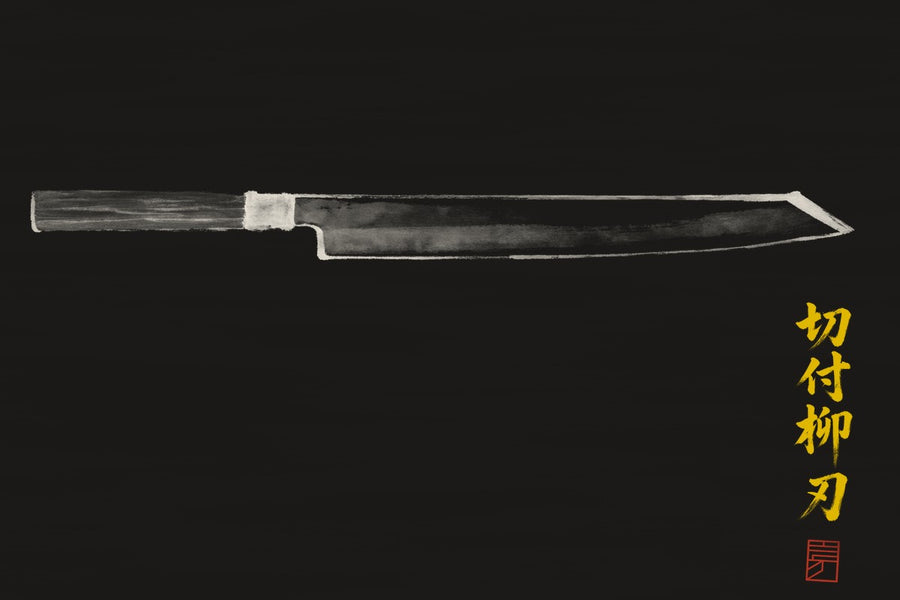
Nigara White 1 Honyaki Kirisuke Yanagiba 300mm with Octagonal Corian Handle

Regular price $4,499.00

IMPORTANT: Carbon steel knives can rust or patina quickly if not cared for properly. They require regular cleaning, drying, and oiling. If you are unfamiliar with carbon steel maintenance, we recommend choosing a stainless steel option instead.

Sold out right now

Leave your email and we’ll send one message the moment it’s back in stock.

One email, no marketing. Privacy policy.

Availability

  • St Peters, NSW —
    2 Bishop St, Unit 2, St Peters NSW 2044
  • Crows Nest, NSW —
    107 West St, Shop 1, Crows Nest NSW 2065
    Pickup only
  • Prahran, VIC —
    180 Commercial Road, Shop 1, Prahran VIC 3181
    Pickup only
Detailed Specifications
Line Nigara Honyaki
Profile K-tip Yanagiba / K-tip sashimi knife
Steel White 1 / Shirogami #1 | Carbon
Blade Construction Honyaki
Hardness (HRC) 62 - 65
Surface Finish Etched
Handle
Region Aomori
Best for
  • Collectors
  • Enthusiasts
  • Free shipping for knives over AU$200 Australia wide.
  • World-wide shipping via DHL Express, 3 to 5 days.


The Nigara Honyaki line, with their stunning etched finish and dynamic Hamon, finally start to arrive the shop in batches. These blades is another step up from the very popular Anmon(暗紋) line in terms of artistic value, which also put up a strong statement that Nigara shall glorify its 350 years of extensive sword forging history with this highly skill demanding practical art.

The Honyaki line from Nigara is made with Hitachi White 1 or Blue 2 steel, these are the more pure carbon steels with the Blue 2 have a small amount of alloy content introduced to it, they are characterised by the ability of getting a very keen edge, hold sharp for an extensive amount of time and be very easy to sharpen at the same time. Both steel belongs to the Hitach Yasugi Carbon Steel family, which is composed of different grade carbon steel, originally developed to replace the scarce Tamahagane - the steel smelted in a ancient way to make all kinds of traditional edged tools, including the Katana.

Once a regionally famous maker of Katana, Nigara as a brand have been passing down this craft for over 350 years, now headed by the 8th gen bladesmith Tsuyoshi Yoshizawa(吉澤 剛), the brand is making a comeback to this traditional skill with their Honyaki line, through some remarkable artistic features that are reminiscent to traditionally forged Katana.

The Honyaki knives are made in very similar ways to the katana, both involves extensive forging and differential hardening using clay. The shape and quality of Hamon(波紋, wavy pattern formed on the boundary of hardened edge and softer spine through applied clay)appeared on the Katana and Honyaki knives can often differentiate their artistic values. Often the kitchen knives are made with very regular pattern, with less dynamic look compare with Hamons found on Katana. However, some of the Nigara's Honyaki have clearly departed from this way and created much more dynamic Hamons with features like strong Nioi and Boushi that are very comparable with Katana. In terms of how wild the Hamon is, maybe Hashimoto's Honyaki is the only thing that is on par with these knives.

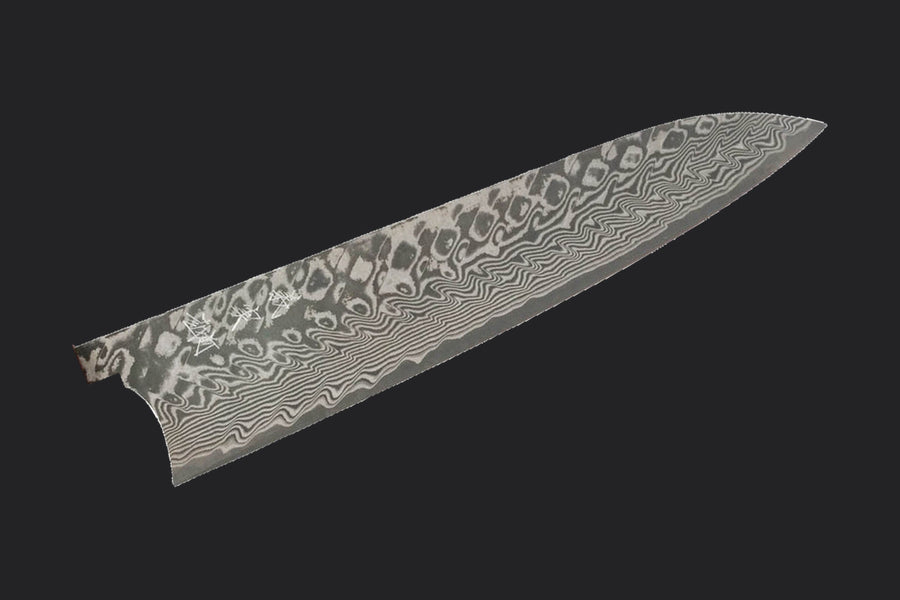
Another feature that is unique to the Katana is the pattern formed when the Tamahagane are folded over and over, this process distribute the impurities and alloys evenly across the blade to obtain a uniform strength across the blade, as the result, different elements are stretched out along with the steel and lead to various types of patterns.

Forged with a homogenous steel coming out of modern factory, the Nigara Honyaki blades requires no folding to gain the uniformity, but as they are hand forged into shape out of a billet, they need to get heated over and over under certain temperature, so they don't lose carbon content through oxidation. In this heating-forging process, the alloy content would precipitate out, as they get stretched with the forging of the blade, they will form pattern that is quite similar to the folding pattern on the Katana. This is called alloy banding, a phenomenon that can be found on only forged, not stamped blades.

The alloy banding marks the intense labour and remarkable skill behind the creation of the blade and add another layer of texture onto the blade. The Nigara Honyaki line, with all the blades receive a etching finish, reveals the banding with a high contrast so they can be observed easily in all kinds of lighting condition. Combines with the unique Hamon, I can seeNigara's a intent to proudly show the skill they possessed over the brand's long history.

These precious blades will be sold as standalone items, please refer to the specific item for the spec and pictures.

Pros Cons
  • Highly collectable
  • Great artistic
  • Excellent fit and finish
  • High budget
  • Need extra care
Care Instruction
  1. Don't cut hard things! Japanese knives are brittle so bone hacking is a NO NO!
  2. Wash with neutral detergent after use, and wipe dry;
  3. Please don't wash knife with dishwasher, it will damage the wood handle;
  4. Be careful not to leave the knife close to a heat source for a long time;
  5. It is a lot more dangerous to cut with a blunt knife than a sharp knife!
  6. It is best to sharpen a Japanese knife regularly on a waterstone.
  7. Oil the (carbon) knife if storing for an extended period of time to prevent rust.

Nigara

Hirosaki sword and knife artisan

Nigara (二唐刃物鍛造所) is a forge in Hirosaki, Aomori. Go Yoshizawa (吉澤剛) is its president and signs as the eighth generation; his father, Toshiju Yoshizawa (吉澤俊寿), the seventh generation, is chairman.

Nigara dates its line to 1803, when the family began as gunsmiths in the service of the Tsugaru domain, and it made Japanese swords for generations. In the Edo period the domain took it on as its weapons works, and it made even cannon and warships. After the Second World War the forge turned from military swords to farm tools and kitchen knives; in those years it made knives in winter and sold them in summer.

In the early Showa era a Nigara smith whose sword name was Kunitoshi (国俊) studied under Dr Kotaro Honda, director of Tohoku University's metals research institute. Nigara's company history says he excelled at sword making. He was recognised as a holder of an intangible cultural property of Aomori Prefecture and passed his skill on to the seventh generation. The sixth generation had no son, so Toshiju, a grandson through a daughter's line, joined as heir. The present company dates from 1949, and besides knives it does welding and steel construction work, with a welding department since 1963. Nigara showed at Maison et Objet in Paris in 2011 and at Ambiente in Frankfurt in 2013.

We have visited Nigara several times, once for a few days of hands-on training at the forge.

The Anmon Damascus knives we list come in SG2 as gyuto, kiritsuke gyuto, bunka, santoku, nakiri, petty and sujihiki, and as single-bevel yanagiba and takobiki in Blue 2 and Ginsan. SG2 tsuchime knives, kurouchi or matt migaki, cover gyuto, petty, santoku, nakiri, bunka and sujihiki, plus a double-bevel honesuki and a butcher. We also list VG10 Damascus tsuchime, Ginsan Kurozome Damascus and Aogami Super tsuchime knives, and an SPG STRIX tsuchime Damascus nakiri. The honyaki are Blue 2 with shaped hamon, as yanagiba, kiritsuke yanagiba and sakimaru, and a White 1 kiritsuke yanagiba.

“An Aomori knife company whose family made Japanese swords for generations, with an Anmon line of Damascus knives.”

Est. 1949 | 昭和24年
Known for Glamorous and innovative knife design, inherited forging skills.
Website nigaraknives.com Read more about Nigara

Nigara · Aomori

Knife details

Frequently asked questions

Is White 1 the hardest of the white steels?

Yes, among Shirogami 1, 2 and 3 on Proterial's pages. It describes Shirogami 1 (白紙1号) as having the highest hardness and gives it 1.25 to 1.35% carbon, compared with high hardness and 1.05 to 1.15% carbon for Shirogami 2, and middle hardness and 0.80 to 0.90% carbon for Shirogami 3.

All three are carbon steels that can rust, so wash the knife and dry it after use.

How old is Nigara, and did it make swords?

The Nigara family line began in 1803, when the family served the Tsugaru domain as gunsmiths. For generations afterwards it made Japanese swords.

After the Second World War, the forge turned to blades for everyday life, including farm tools and kitchen knives.

Who leads Nigara today?

Go Yoshizawa, president of Nigara Hamono Forge, leads it today and signs as the eighth generation of the Nigara family line.

The company is Nigara Hamono Forge (二唐刃物鍛造所), in Kanazoku-machi, Hirosaki, Aomori.

You May Also Like