PRAHRAN STORE NOW OPEN · THU–MON · 10AM–6PM

Mazaki  |  SKU: MAZA_B2MK_YANA300

Mazaki Blue 2 Migaki Yanagiba 300mm w/ Triple Spacer Ebony Handle & Saya

Regular price $799.95

IMPORTANT: Carbon steel knives can rust or patina quickly if not cared for properly. They require regular cleaning, drying, and oiling. If you are unfamiliar with carbon steel maintenance, we recommend choosing a stainless steel option instead.

Sold out right now

Leave your email and we’ll send one message the moment it’s back in stock.

One email, no marketing. Privacy policy.

Availability

  • St Peters, NSW —
    2 Bishop St, Unit 2, St Peters NSW 2044
  • Crows Nest, NSW —
    107 West St, Shop 1, Crows Nest NSW 2065
    Pickup only
  • Prahran, VIC —
    180 Commercial Road, Shop 1, Prahran VIC 3181
    Pickup only
Detailed Specifications
Line Mazaki Blue 2 Single Bevel Migaki
Profile Yanagiba / Sashimi knife
Bevel Type Single Bevel
Weight 270 g | 9.5 oz
Edge Length 293 mm | 11 17/32″
Heel Height 40 mm | 1 37/64″
Width @ Heel 4.7 mm | 3/16″
Width @ Mid 3.1 mm | 1/8″
Width @ 1cm from Tip 1.0 mm | 3/64″
Steel Blue 2 / Aogami #2 | Carbon
Blade Construction Nimai - Soft Iron Clad
Hardness (HRC) 61 - 63
Surface Finish Migaki
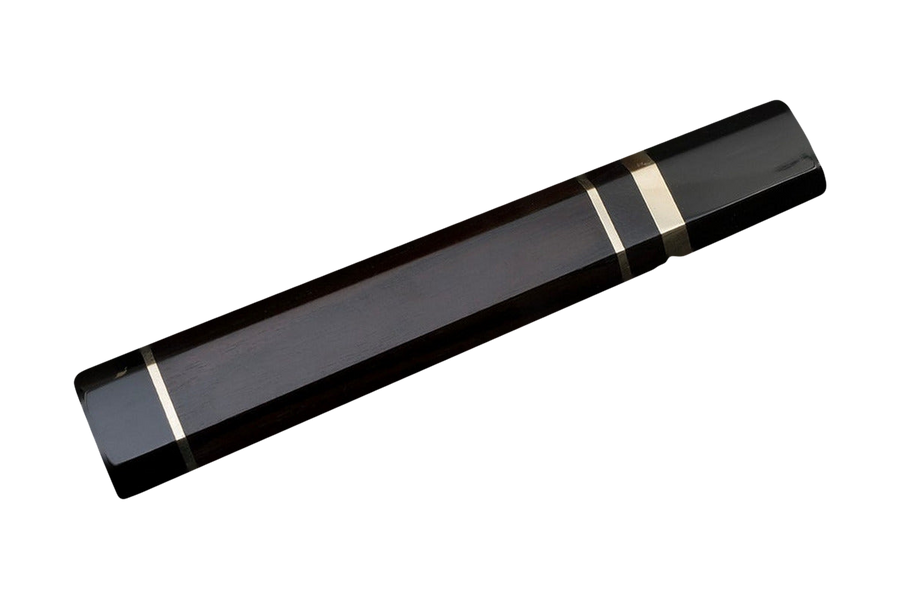
Handle triple spacer ebony
Region Sanjo
Best for
  • Enthusiasts
  • Collectors
  • Free shipping for knives over AU$200 Australia wide.
  • World-wide shipping via DHL Express, 3 to 5 days.


Mazaki is known in the Sanjo region for his double bevel knives, but his single bevel work carries the same distinctive character — and the Blue 2 Migaki line is a good example of what that means in practice. The forged taper that makes his gyuto and santoku feel so responsive translates into a single bevel knife that sits noticeably lighter in hand than a comparable Sakai blade of the same length. The weight balance leans away from the tip in a way that feels nimble and precise, which is a refreshing departure from the more forward-weighted feel of many traditionally forged single bevel knives.

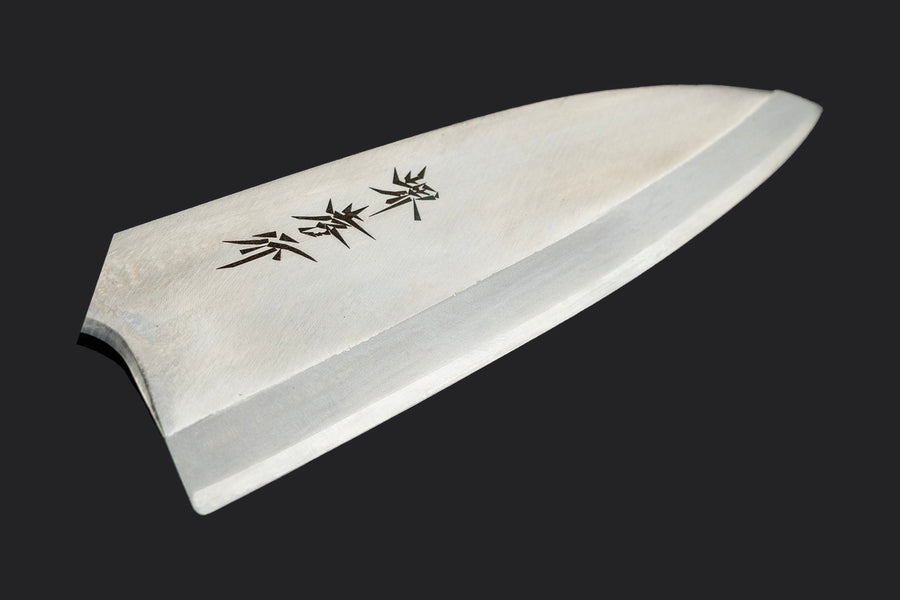
The finish is clean and considered throughout. The Hira and Ura carry a uniform Migaki polish, the spine is mirror finished, and the choil is properly chamfered — the kind of fit and finish details that speak to a maker who takes the whole knife seriously, not just the bevel. The hand forged cladding line is where Mazaki's personality really shows. Where Sakai single bevel knives typically maintain a flat, strictly parallel cladding line running close to the edge, Mazaki's has a noticeable waviness to it — more organic, more lively, and a clear reflection of his hand forging approach rather than the more controlled production methods common in Sakai.

The core steel is Blue 2 (Aogami 2) with soft iron cladding — a combination Mazaki uses across his single bevel range. Blue 2 produces a sharp, aggressive edge with good retention, and the iron cladding develops a natural patina over time that many single bevel users appreciate. The entire blade requires regular maintenance to prevent rust, which is the standard trade-off for any carbon steel single bevel knife and should be factored in before committing.

Offered in Deba and Yanagiba, this line sits at a higher price than more uniformly finished alternatives, but offers something genuinely different in character. For collectors who have grown fatigued with single bevel knives that all look the same, and for enthusiasts who want the Sanjo hand forging experience in a single bevel format, the Mazaki Blue 2 Migaki is a compelling and characterful choice.

Pros Cons
  • Great artistic
  • Exceptional profile
  • Great OOTB
  • Prone to rust
  • High budget
Care Instruction
  1. Don't cut hard things! Japanese knives are brittle so bone hacking is a NO NO!
  2. Wash with neutral detergent after use, and wipe dry;
  3. Please don't wash knife with dishwasher, it will damage the wood handle;
  4. Be careful not to leave the knife close to a heat source for a long time;
  5. It is a lot more dangerous to cut with a blunt knife than a sharp knife!
  6. It is best to sharpen a Japanese knife regularly on a waterstone.
  7. Oil the (carbon) knife if storing for an extended period of time to prevent rust.

Mazaki

Mazaki: Naoki Mazaki's One-Man Forge in Sanjo

Mazaki is a one-man operation based in Sanjo, Niigata. His knife is artistically beautiful, and from the very beginning with very high level of Fit and Finish. I didn't look further into it as its cutting style was not my preference. 

A while ago I was able to sample his latest work and was thoroughly impressed by how much it has improved. His knife now cuts much better than his earlier ones. I am particularly impressed that Mazaki's knife is largely finished on a stone by hand, while it is a much more time consuming process, such process ensures the knife is straight and flat with minimal low spots. We are talking about a type of finishing that is very much like Shigefusa's final handle sharpening process (albeit not the same level of polishing), rather than a water grinder sharpening process, which creates unevenness and low spots along the blade road, and sometimes even worse: over-grind. Given the effort that Mazaki-san has put in, the production is understandably very limited, and given the low price, I am sure his work will be highly thought after very soon. 

“A one-man forge in Sanjo, Niigata. Naoki Mazaki trained under Kiyoshi Kato.”

Known for White 2 and Blue steel knives, largely finished on a stone by hand
Instagram @mazaki Read more about Mazaki

Mazaki · Sanjo

Knife details

Frequently asked questions

What is a yanagiba knife used for in sushi preparation?

A yanagiba (柳刃包丁) is a sashimi knife for slicing raw fish. A knife maker's guide says a sashimi knife cuts without breaking the fibres of the flesh, and that it is longer and narrower than other knives because slicing sashimi with crisp edges needs the length.

The whole length goes through one pulling cut. The Sakai cutlery association calls the yanagiba the sashimi knife used mainly in the Kansai region.

What size yanagiba should I buy?

Size a yanagiba to the fish you prepare: a knife maker's guide gives 270 to 360 mm for professional use and 240 to 270 mm for home use, with 270 mm at home if you slice larger fish.

The guide says the whole length goes through one pulling cut, so do not choose too short a knife, and at home it points to the size of your board and your work space. We list the yanagiba (柳刃) from 210 to 360 mm, some made for left-handed use.

Can a yanagiba cut through fish bones?

No. The Sakai cutlery association describes the yanagiba (柳刃包丁) edge as so acute that it cannot be used on hard things such as bones.

For bones the association describes the deba (出刃包丁), whose heel is used to hit them.

Will a carbon steel knife rust, and how do I look after it?

Yes, carbon steels such as Aogami (Blue) and Shirogami (White) are not stainless steels, so left wet they can spot or rust.

Care is simple once it becomes habit. Wipe the blade as you go, especially after acidic food like citrus, tomato or onion. When you finish, wash it in warm water with a little soap and dry it straight away with a towel. Do not let it air dry, leave it in the sink or the dish rack, or put it in the dishwasher. Store it dry: on a magnetic strip, in a saya or in a block in a dry spot.

If the knife will sit unused for a while, wipe on a thin layer of oil before storing. In our video James shows that mineral oil can stand in for camellia (tsubaki) oil, and he picks one labelled medical grade; we list the Kitchen Knife / Cutting Board Mineral Oil Medical Grade for this. If you find light rust, lift it with a rust eraser and a little water, then dry and oil the blade; we list the CKK and Naniwa rust erasers.

What is the difference between Blue 2 and White 2 steel?

Proterial lists 1.05 to 1.15% carbon for both steels; its Blue 2 table lists 0.20 to 0.50% chromium and 1.00 to 1.50% tungsten, while its White 2 table lists neither.

Proterial describes White 2 as a carbon steel with minimum impurities and high hardness, and Blue 2 as an alloy steel with tungsten and chromium to improve heat-treatment properties and wear resistance, with a hardening hardness of over 60 HRC for both. Neither steel is close to the JSSA's 10.5% minimum for stainless.

You May Also Like