PRAHRAN STORE NOW OPEN · THU–MON · 10AM–6PM

Drag to spin · pinch or scroll to zoom

Hatsukokoro  |  SKU: HT-G3DMKURO-ST170CF

Hatsukokoro Ginsan Kurouchi Damascus Santoku 170mm Carbon Fibre Handle

Sale price $679.98 Regular price $799.95

Sold out right now

Leave your email and we’ll send one message the moment it’s back in stock.

One email, no marketing. Privacy policy.

Availability

  • St Peters, NSW —
    2 Bishop St, Unit 2, St Peters NSW 2044
  • Crows Nest, NSW —
    107 West St, Shop 1, Crows Nest NSW 2065
    Pickup only
  • Prahran, VIC —
    180 Commercial Road, Shop 1, Prahran VIC 3181
    Pickup only

Goes well with

Detailed Specifications
Line Hatsukokoro Ginsan Kurouchi Damascus Special
Profile Santoku / Santoku
Bevel Type Double Bevel
Weight 194 g | 6.8 oz
Edge Length 170 mm | 6 11/16″
Heel Height 51 mm | 2 1/64″
Width @ Heel 3.1 mm | 1/8″
Width @ Mid 2.7 mm | 7/64″
Width @ 1cm from Tip 1.1 mm | 3/64″
Steel Ginsan / Silver #3 | Stainless
Blade Construction Sanmai - Stainless Damascus Clad
Typical hardness 60 to 62 HRC
Surface Finish Kurouchi
Handle
Region Hyogo
Best for
  • Pro chefs
  • Enthusiasts

Free shipping for knives over AU$200 Australia wide.

World-wide shipping via DHL Express, 3 to 6 days (not available in the UK).


What makes the Hatsukokoro Ginsan Kurouchi Damascus particularly interesting is the contrast between its rather rugged appearance and the practicality of the steel underneath. The combination of a dark forged surface and flowing Damascus pattern gives these knives a distinctly traditional character, yet at the heart of the blade is Ginsan (Silver #3), one of our favourite stainless steels. Ginsan is known for its fine grain structure, allowing it to take a very clean, sharp edge while remaining relatively easy to sharpen on whetstones. It offers good edge retention and a pleasant sharpening feel, making it an excellent choice for those who appreciate the characteristics of traditional Japanese carbon steels without having to worry about rust and patina.

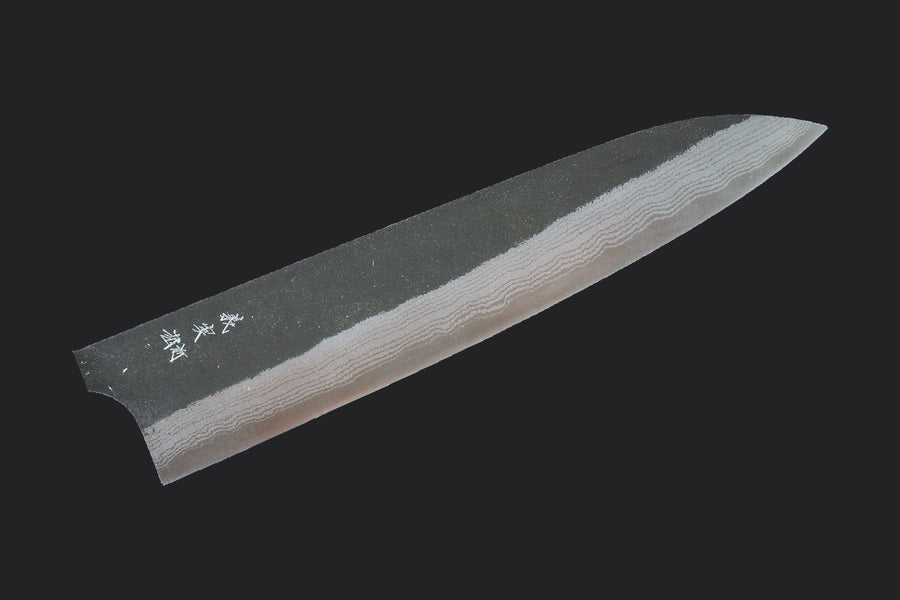
The most striking feature is undoubtedly the Kurouchi Damascus finish. Unlike the more commonly seen polished Damascus, the blade features two distinctly different surface finishes. The upper section retains the dark, textured oxide scale formed during forging, while the lower section reveals an intricate, flowing Damascus pattern. The two finishes are separated by a clearly defined boundary, creating a striking contrast between the raw, almost rugged appearance of the Kurouchi and the more refined, decorative Damascus underneath. I particularly like how this combination gives the blade two very different personalities without making the overall design feel overly complicated. The small variations in the forged surface and Damascus pattern also give each knife its own individual character.

Another defining characteristic of this line is its rather unusual blade geometry. These are genuinely heavy knives, featuring a thick, substantial spine that gives them a very solid feeling in hand. However, starting from around the middle of the blade height, the grind tapers aggressively towards an exceptionally thin cutting edge. The result is a rather interesting combination of weight and cutting performance. The substantial mass of the blade helps drive the edge through ingredients with very little effort from the user, while the thin geometry towards the edge allows it to pass through food remarkably smoothly. When cutting through ingredients such as potatoes or carrots, you can really feel how the weight of the knife does much of the work, while the fine edge geometry keeps the initial cutting resistance low. Despite its rather bulky appearance, the actual cutting experience is surprisingly effortless. Of course, the thick upper blade can still cause some wedging in particularly tall and dense ingredients, but for most everyday cutting tasks, this weight-assisted cutting feel is extremely satisfying.

I think the biggest appeal of this line is that it manages to offer two rather different qualities in one package. On one hand, you have the bold aesthetics, substantial weight and reassuring feeling of a traditionally forged Japanese knife; on the other, you get a stainless Ginsan cutting edge that is straightforward to maintain and enjoyable to sharpen. It is certainly not a lightweight laser, but rather a knife that uses its weight and aggressive grind together to deliver an impressive cutting experience. For anyone who appreciates a heavier knife without wanting to sacrifice cutting performance, this is a particularly interesting offering.

Pros Cons
  • Workhorse grind
  • Easy to look after
  • Heavy
Care Instruction
  1. Don't cut hard things! Japanese knives are brittle so bone hacking is a NO NO!
  2. Wash with neutral detergent after use, and wipe dry;
  3. Please don't wash knife with dishwasher, it will damage the wood handle;
  4. Be careful not to leave the knife close to a heat source for a long time;
  5. It is a lot more dangerous to cut with a blunt knife than a sharp knife!
  6. It is best to sharpen a Japanese knife regularly on a waterstone.

Hatsukokoro

Hatsukokoro, a knife brand from Amagasaki

Hatsukokoro (初心) is a knife brand from Amagasaki, Hyogo, launched in 2019. It is a brand rather than a forge: it works with knife makers instead of forging itself.

The name comes from the proverb 初心忘るべからず, roughly never forget your beginner's mind. For the same characters the brand chose the gentler reading hatsukokoro over shoshin.

The brand's own catalogue names the place behind some of its lines, and the maker behind a few: Shinkiro comes from Fukushima, and Hayabusa HAP40, Saihyo and Sunaarashi from Seki City, while for others the maker or the place stays private. Some of our listing titles also carry the maker alongside the brand, such as Hatsukokoro x Yoshikane and the Hatsukokoro x Yoshihiro Yauji collaboration.

The Hatsukokoro lines we list include both carbon and stainless steels. Our listings include Hayabusa in SG2 and Aogami Super, Saihyo in SG2 and Ginrei in Ginsan. Carbon steel kurouchi lines include Aosagi, Aokitae, Kurokaze and Kurogane.

“A knife brand from Amagasaki that works with knife makers rather than forging.”

Est. 2019 | 令和元年
Known for Lines made with partner makers, from Seki City to Fukushima
Website handk.co Instagram @handk_official Read more about Hatsukokoro

Hatsukokoro · Hyogo

Knife details

Santoku — knife profile
Profile

Santoku

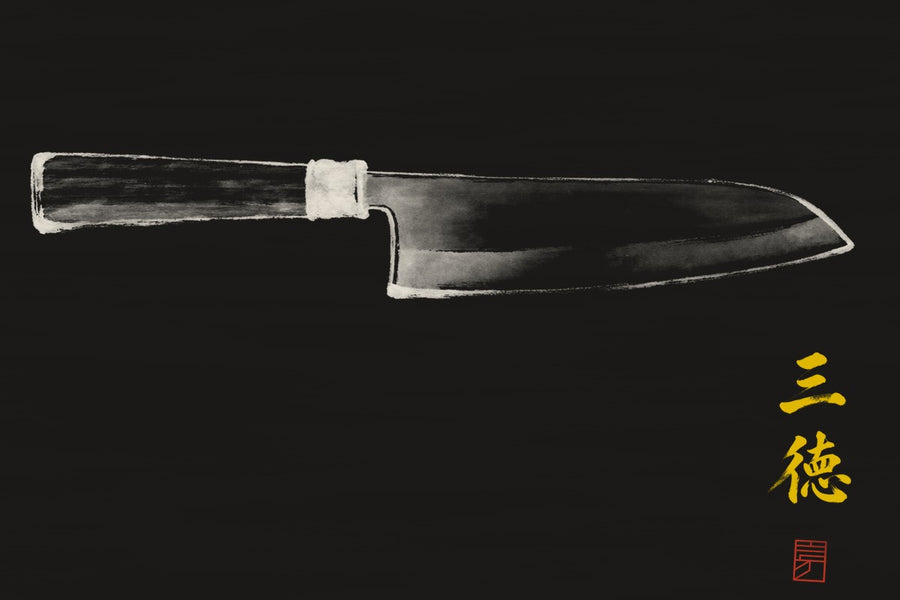
三徳

Santoku · Double bevel

An all-purpose knife for meat, fish and vegetables, with a wide blade and a rounded tip.

Read more
Steel properties
  1. Hardness Fair
  2. Edge retention Fair
  3. Toughness High
  4. Rust resistance High
  5. Ease of sharpening High
  6. Sharpness High

Our ratings, inferred from published lab tests and composition.

Steel

Ginsan / Silver #3

GIN3

Stainless · Hitachi Metals (now Proterial)

Proterial's GIN 3 stainless: 0.95 to 1.10% carbon, 13.00 to 14.50% chromium, hardening hardness over 59 HRC.

Read more
CladdingCoreClad line
Construction

Sanmai - Stainless Damascus Clad

三枚ダマスカス

3 layers · damascus clad

Hard core between stainless damascus layers, bare at the edge. Thinning wears the pattern.

Read more
Kurouchi — blade surface finish
Finish

Kurouchi

Black forge scale

Dark forge scale left on the upper blade. The bevel and edge still need care.

Read more

Frequently asked questions

Gyuto or santoku: which should I choose?

The gyuto came to Japan with the beef-eating culture of the Meiji era, and that is where its name comes from. Tojiro says it is used for all kinds of cooking, which is why it is also called the chef's knife.

The santoku is a household knife that combines the good points of the nakiri and the gyuto. Tojiro describes it as all-purpose, from vegetables to meat and fish, double-bevel and built on the same construction as a Western knife.

Choose a gyuto if you want more length and reach. Choose a santoku if you want a shorter all-purpose knife. Tojiro's own size figures: gyuto 150 to 210mm for household use and up to 360mm for professional use, santoku 165 to 170mm for household use.

Rock chop or up-and-down chop: which knife shape suits me?

Match the shape to your stroke. Rock chopping keeps the tip on the board and rolls the curved belly through the food, so a gyuto or a Western chef's knife suits it, and Japanese knives rock fine as long as you rock gently.

Up-and-down chopping, the Chinese style, wants a straight run of edge, so a nakiri, usuba, santoku or bunka suits it better; a curved edge chopped straight down easily leaves pieces joined. Neither shape is better; it depends on how you cut.

What does santoku mean?

A Japanese dictionary explains the name of the santoku (三徳包丁) as coming from the three things it handles: meat, fish and vegetables. The same dictionary entry points from the santoku to the bunka (文化包丁), treating the two as one knife.

One Japanese knife maker guide distinguishes the two by the tip. It says that in the Showa era the bunka was made with its tip cut at an angle, and the santoku came after it by rounding that tip.

What is Ginsan steel, and why do some Japanese knives use it?

Ginsan, also known as Silver 3, is a stainless steel from Proterial, the Yasugi Specialty Steel division. Proterial describes it as a stainless steel which has hardness and sharpness comparable to carbon steel, and lists its uses as kitchen knives and scissors.

Knife makers use it when they want the corrosion resistance of a stainless together with the hardness and sharpness that Proterial compares to carbon steel. The steel maker lists 59 HRC or over after hardening, but that is a heat treatment figure, not a finished knife figure.

Dry it after use, like any stainless knife. Its performance depends on the heat treatment and construction of the specific knife, not the steel name alone.

Is Ginsan stainless?

Yes. Proterial lists the steel as GIN 3 with 13.00 to 14.50% chromium, above the Japan Stainless Steel Association's 10.5% minimum for stainless steel.

Proterial describes it as a stainless steel with hardness and sharpness comparable to carbon steel, used in various kitchen knives and scissors, and the association notes that stainless, strictly, means it rusts less. Wash the knife and dry it after use.

Is Hatsukokoro a maker or a brand, and who makes the knives?

Hatsukokoro (初心) is a brand, not a forge. H&K, a company founded in 2013 and based in Amagasaki, Hyogo, created it in 2019.

H&K names the producer for some lines, for example Shinkiro by Takahiro Nihei in Fukushima, Ginyou by Yoshihiro Yauji in Echizen and Kurosagi by Motokyuichi Hamono in Nagasaki, and keeps others confidential. Some knives we stock carry the maker in the title, such as Hatsukokoro x Yoshikane SKD Nashiji.

What does the name Hatsukokoro mean?

The name comes from the Japanese proverb 初心忘るべからず, which means don't forget your original intention. The company read it gently as hatsukokoro rather than shoshin.

H&K created the brand in 2019, six years after the company was founded, and chose the name for its knife line.

Which Hatsukokoro line should I pick, carbon or stainless?

Pick by how much care you want to give. The carbon lines, Blue 1, Blue 2 and AS kurouchi, need drying and a little oil after use. The SG2, HAP40, Ginsan and VG10 lines are low maintenance, so they suit a busy kitchen or someone who just wants to cook.

Neither is better; it depends on your routine. If you will dry and oil the blade after each use, a carbon line can suit you, and if you want the least fuss, a stainless line is the easier choice.

You May Also Like