PRAHRAN STORE NOW OPEN · THU–MON · 10AM–6PM

Yoshikazu Tanaka  |  SKU: YSKZ_W1DA_GY210

Yoshikazu Tanaka White 1 Damascus Gyuto 210mm

Regular price $649.95

IMPORTANT: Carbon steel knives can rust or patina quickly if not cared for properly. They require regular cleaning, drying, and oiling. If you are unfamiliar with carbon steel maintenance, we recommend choosing a stainless steel option instead.

Sold out right now

Leave your email and we’ll send one message the moment it’s back in stock.

One email, no marketing. Privacy policy.

Availability

  • St Peters, NSW —
    2 Bishop St, Unit 2, St Peters NSW 2044
  • Crows Nest, NSW —
    107 West St, Shop 1, Crows Nest NSW 2065
    Pickup only
  • Prahran, VIC —
    180 Commercial Road, Shop 1, Prahran VIC 3181
    Pickup only
Detailed Specifications
Line Kawamura White 1 Damascus "Wide Bevel" by Yoshikazu Tanaka
Profile Gyuto / Chef's knife
Bevel Type Double Bevel
Weight 178 g | 6.3 oz
Edge Length 206 mm | 8 7/64″
Heel Height 52 mm | 2 3/64″
Width @ Heel 2.5 mm | 3/32″
Width @ Mid 2.0 mm | 5/64″
Width @ 1cm from Tip 1.0 mm | 3/64″
Steel White 1 / Shirogami #1 | Carbon
Blade Construction Sanmai - Soft Iron Damascus Clad
Hardness (HRC) 62 - 65
Surface Finish Mirror Polish
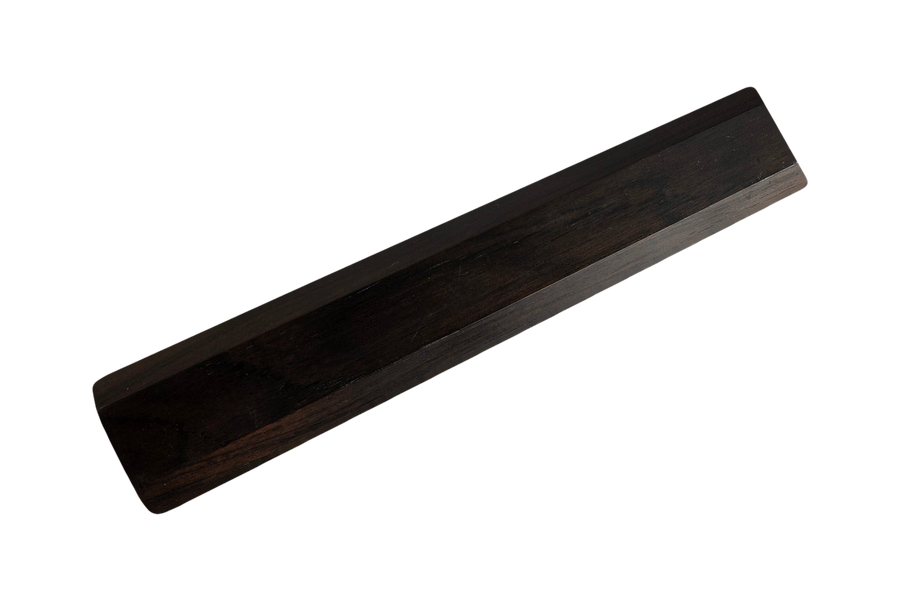
Handle Octagonal Ebony
Region Sakai
Best for
  • Pro chefs
  • Collectors
  • Enthusiasts
  • Free shipping for knives over AU$200 Australia wide.
  • World-wide shipping via DHL Express, 3 to 5 days.


This White 1 Damascus line is a classic design that Kawamura have employed for many years, forged by Yoshikazu Tanaka, one of the most renowned blacksmiths in Sakai that excels in both single and double bevel forging. These blades are built with exceptional quality that you would expect from Sakai, on top of that, the master behind these amazing creations may soon retire, giving some collecting value to these knives.

The beautiful Damascus cladding gives the knife a striking appearance at first glance, it flows organically from the spine to the edge, and the even cladding lines that end up very close to the edge just shows the level of control Tanaka san has over the steel in the forge welding process. The sharpener is not disclosed by Kawamura, but it is executed at an equally high level, the blade has a thin, flat bevel that gradually torn into a convex that converge at a relatively low thickness behind the edge, give the knife a great performance when paired with the aggressive edge produced by the White 1 steel.

There is a clear line that divides the surface of the knife into two parts, forming a Hira with a darker grey finish and the bevel with brighter finish that has more contrast. This appears to be a Wide Bevel design that is not often used by Sakai makers, but once you have your hands on the blade, you will realize that this line is achieved by different finishing techniques. The blade doesn’t have a clear geometrical corner at the Shinogi line, instead, a different sandblasting treatment is applied with a mask. It wouldn’t affect the performance but it is an interesting design element that does make the knife more interesting to look at.

The Gyuto of this line uses a Sakai profile, which has a spine that drops down gradually and a cutting edge that rises up in a pronounced curve at the tip. This is a profile that has less focus on the slicing but is pretty good at rocking cut, paired with the generous heel height, it can chop and mince smoothly through all kinds of material. 

This line is perfectly capable as a working tool, but due to the upcoming retirement of master Yoshikazu Tanaka, it may be chased by collectors who want a piece of work from the blacksmith. It is the type of the knife that characterises Sakai’s knifemaking: elegant and refined like a piece of art while highly functional and great in performance. For anyone who steps up into the more bespoke knife game, this should be one of the items on your wishlist. 

Pros Cons
  • Thin behind the edge
  • Great artistic
  • Excellent fit and finish
  • Prone to rust
  • Mirror polish can be hard to maintain
Care Instruction
  1. Don't cut hard things! Japanese knives are brittle so bone hacking is a NO NO!
  2. Wash with neutral detergent after use, and wipe dry;
  3. Please don't wash knife with dishwasher, it will damage the wood handle;
  4. Be careful not to leave the knife close to a heat source for a long time;
  5. It is a lot more dangerous to cut with a blunt knife than a sharp knife!
  6. It is best to sharpen a Japanese knife regularly on a waterstone.
  7. Oil the (carbon) knife if storing for an extended period of time to prevent rust.

Kawamura Hamono

Kawamura Hamono, maker of Sakai Kikumori knives

Kawamura Hamono (河村刃物) is a Sakai knife company, founded in 1926 by its own account, whose knives carry the Sakai Kikumori (堺菊守) mark. It makes and sells professional and home kitchen knives, other blades and kitchen equipment, and also supplies professional kitchens as a general trading company. In April 2011 the Sakai Chamber of Commerce certified it under its Sakai brand, Sakai Gishu (堺技衆).

Choyo (重陽) was developed in 2013 as the top knife of the Sakai Kikumori brand, and Kikuzuki (菊月) followed in 2021 as a series derived from it, according to the designer of their marks. The same page says Choyo is the chrysanthemum festival on 9 September, a name drawn from Kikumori, keeper of chrysanthemums; Kikuzuki is an old name for September.

We list its White 1 Damascus wide bevel gyuto, forged by the Sakai smith Yoshikazu Tanaka, in 210 mm and 240 mm.

“Sakai knife company, home of the Sakai Kikumori brand.”

Est. 1926 | 昭和元年
Known for The Sakai Kikumori brand and its Choyo (重陽) and Kikuzuki (菊月) series
Website kikumori.co.jp Instagram @sakai_kikumori Read more about Kawamura Hamono

Kawamura Hamono · Sakai

Knife details

Frequently asked questions

Gyuto or santoku: which should I choose?

The gyuto came to Japan with the beef-eating culture of the Meiji era, and that is where its name comes from. Tojiro says it is used for all kinds of cooking, which is why it is also called the chef's knife.

The santoku is a household knife that combines the good points of the nakiri and the gyuto. Tojiro describes it as all-purpose, from vegetables to meat and fish, double-bevel and built on the same construction as a Western knife.

Choose a gyuto if you want more length and reach. Choose a santoku if you want a shorter all-purpose knife. Tojiro's own size figures: gyuto 150 to 210mm for household use and up to 360mm for professional use, santoku 165 to 170mm for household use.

What is a gyuto knife used for?

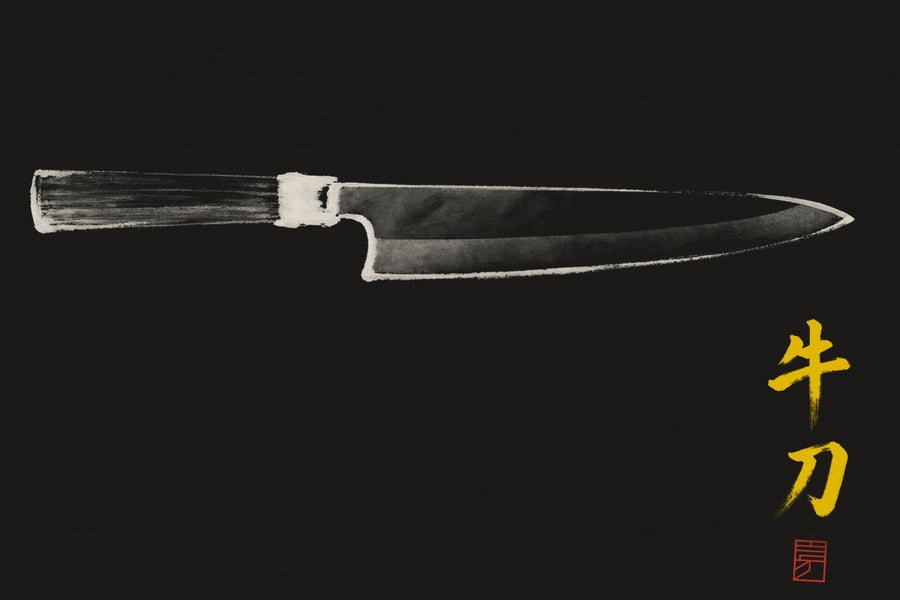
The gyuto (牛刀) is a chef's knife for all kinds of cooking, and it is basically double-bevel. A knife maker's guide says it came to Japan in the Meiji era with the culture of eating beef, which gave it its name, but it does not cut only meat.

A Japanese dictionary describes the gyuto as slimmer than a santoku, with a pointed tip, used widely for meat, fish and vegetables.

What gyuto length should I choose?

A knife maker's guide lists 150 to 210 mm, double-bevel, for home use, and 180 to 360 mm, single- or double-bevel, for professional kitchens.

We suggest starting with a 210 mm gyuto for a home kitchen, and stepping up to 240 mm if you regularly cut large pieces and have the board for it.

240mm vs 210mm gyuto: which size should I choose?

Get the 210mm. We only point people to a 240mm when they have about 45cm of usable board, cook in volume, and regularly break down big roasts or whole fish.

On the gyutos we've measured for our product pages, the extra length is real. As of October 2026, the 210mm gyutos we list have a median edge of 213mm from heel to tip, across the 111 we have measured; the 240mm ones have a median of 240mm, across 100. The 240s are also heavier, 212g against 175g at the median, and a touch taller at the heel, 50mm against 48mm, across the same 100 and 111 knives.

Weight overlaps between the two sizes. As of October 2026, 11 of the 100 measured 240s weigh less than the median 210 at 175g. The 240s we measured weigh 146 to 323g, and the 111 measured 210s 121 to 255g. The number in the name does not decide how heavy a knife is, so check the measured weight on the product page.

Japanese or German kitchen knives: which should I buy?

Our advice: choose a Japanese knife if you want the keenest edge and do not mind caring for a harder blade, and a German knife if you want a tougher, more forgiving knife you can hone casually and use for heavy prep. On two Japanese knife steels, the steel makers' own figures start at 60 HRC: Takefu Special Steel rates VG10 at 60 HRC or more, and Proterial lists the hardening hardness of Aogami 2 (Blue 2) as over 60 HRC.

Our care advice for a Japanese knife: keep it off bone, frozen food and very hard squash, and use a wooden or plastic board.

What is the flat spot on a knife, and is it the same as the "sweet spot"?

The flat spot is the straight run of edge from the heel towards the middle, the part that meets the board along its length. At our counter we call it the sweet spot; elsewhere "sweet spot" often means the balance point, so ask which one someone means.

Past the flat, the edge curves up towards the tip (the belly), which suits a swinging or pulling stroke. Sharpeners also say "flat spot" for a worn patch of edge, so when you mean the shape, "the flat part of the edge" is clearer.

Is White 1 the hardest of the white steels?

Yes, among Shirogami 1, 2 and 3 on Proterial's pages. It describes Shirogami 1 (白紙1号) as having the highest hardness and gives it 1.25 to 1.35% carbon, compared with high hardness and 1.05 to 1.15% carbon for Shirogami 2, and middle hardness and 0.80 to 0.90% carbon for Shirogami 3.

All three are carbon steels that can rust, so wash the knife and dry it after use.

What is the difference between White 1, White 2 and White 3?

White 1, White 2 and White 3 are Proterial's Shirogami 1, Shirogami 2 and Shirogami 3. Proterial lists carbon at 1.25 to 1.35% for Shirogami 1, 1.05 to 1.15% for Shirogami 2 and 0.80 to 0.90% for Shirogami 3, with the same silicon and manganese ranges for all three and no chromium listed.

Proterial describes all three as carbon steel with minimum impurities, at highest, high and middle hardness in that order, and gives a hardening hardness of over 60 HRC for each.

You May Also Like