PRAHRAN STORE NOW OPEN · THU–MON · 10AM–6PM

Yoshimi Kato Kintaro  |  SKU: KT-ASKUDM-PT150

Yoshimi Kato Aogami (Blue) Super Kurouchi Damscus Petty 150 mm

Sale price $254.99 Regular price $299.95

IMPORTANT: Carbon steel knives can rust or patina quickly if not cared for properly. They require regular cleaning, drying, and oiling. If you are unfamiliar with carbon steel maintenance, we recommend choosing a stainless steel option instead.

Sold out right now

Leave your email and we’ll send one message the moment it’s back in stock.

One email, no marketing. Privacy policy.

Availability

  • St Peters, NSW —
    2 Bishop St, Unit 2, St Peters NSW 2044
  • Crows Nest, NSW —
    107 West St, Shop 1, Crows Nest NSW 2065
    Pickup only
  • Prahran, VIC —
    180 Commercial Road, Shop 1, Prahran VIC 3181
    Pickup only
Detailed Specifications
Line Yoshimi Kato Aogami Super Kurouchi Damascus
Profile Petty / Utility knife
Steel Blue Super / Aogami Super | Carbon
Blade Construction Sanmai - Soft Iron Damascus Clad
Hardness (HRC) 62 - 65
Surface Finish Kurouchi
Handle
Region Echizen
Best for
  • Pro chefs
  • Enthusiasts
  • Free shipping for knives over AU$200 Australia wide.
  • World-wide shipping via DHL Express, 3 to 5 days.


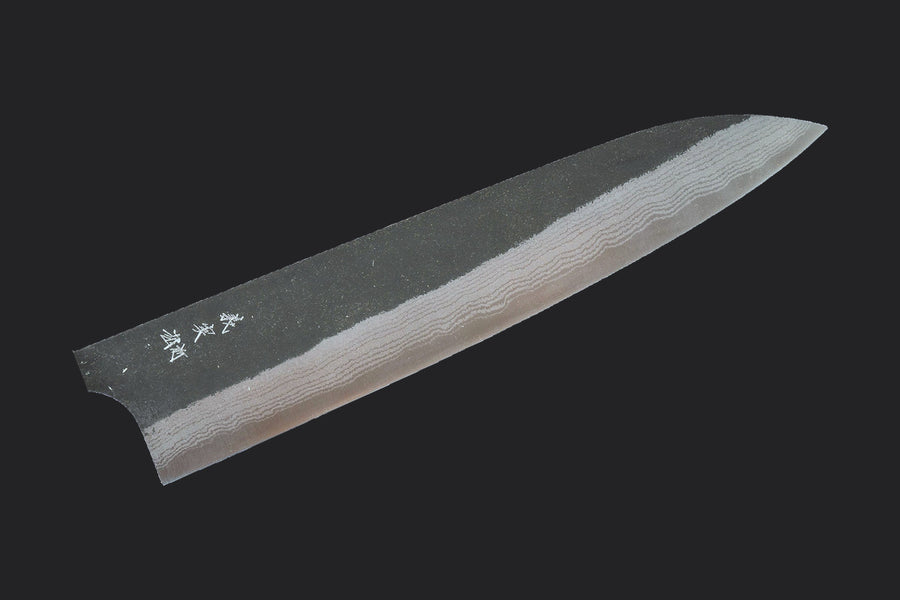
This Aogami Super(Blue Super) Damascus line by Yoshimi Kato is quite a refined take on the classic Kurouchi form, while keeping the authentic features that defines the Kurouchi knife, it pushes other aspects of the knife to a higher level than average, leading to a very pleasing set of blades that are very usable while maintaining a very affordable price.

If you are not familiar with Yoshimi Kato, he is currently the head of Kato Uchihamono (formerly Kintaro) in Takefu, located in the Fukui area. As the third generation bladesmith, he works closely with Kurosaki Yu, and their blades share some similar traits: thin behind edge, very clean grind and nimble in hand.

This too applies to this Kurouchi line. The subtle damascus on the bevel is polished very well and the blade geometry is cleanly defined. The spine/choil are well finished before heat treating so they won't create hot spots, there is no further polishing needed in those areas so the Kurouchi finish is kept throughout the top half of the blade, giving that classic dark look and rust resistance.

In many cases, the Kurouchi finish is considered as a way to reduce cost as there are no further labour going into finishing after the grinding of the bevel is done. This is true to this line but through some of the details we can know, the amount of attention goes into this line is totally on a different level. The performance of the knives also demonstrate this: the food penetration is superb, and the thin edge glides effortlessly into potato, using the tip for slicing is also a breeze, maybe the only complaint I can have about this line is that the super clean grind of the bevel can create some stickness.

The steel that enables this wicked edge is nothing but the Aogami Super, also known as Blue super, being listed as a Hitachi Carbon steel, it went quite far in its composition to the point it start to deviate from a typical carbon steel. A very high level of Tungsten, along with other alloys have given the AS steel an incredible ability to harden and retain its edge, they are often seen being heat treated to 65HRC which is quite incredible. With this hardness the cutting edge can be grind very thin, and enable great food penetration.

The heat treating on this line seems to be very good, although I don't have a long term experience using this line, I can tell the edge on this line is quite a bit harder to sharpen than my personal AS knife and Hayabusa AS line, which might translate to a higher wear resistance. If maintaining a iron cladding carbon knife isn't a trouble and you like the Kurouchi look, this line is definitely a great choice.

Pros Cons
  • Excellent performance
  • Thin behind the edge
  • Excellent fit and finish
  • Prone to rust
Care Instruction
  1. Don't cut hard things! Japanese knives are brittle so bone hacking is a NO NO!
  2. Wash with neutral detergent after use, and wipe dry;
  3. Please don't wash knife with dishwasher, it will damage the wood handle;
  4. Be careful not to leave the knife close to a heat source for a long time;
  5. It is a lot more dangerous to cut with a blunt knife than a sharp knife!
  6. It is best to sharpen a Japanese knife regularly on a waterstone.
  7. Oil the (carbon) knife if storing for an extended period of time to prevent rust.

Yoshimi Kato

Yoshimi Kato — The Master of Damascus in Takefu

Kato Knife Manufacturing Inc., spearheaded by Yoshimi Kato, is a renowned entity in the Takefu Knife Village, known for its exquisite craftsmanship in knife-making. Yoshimi Kato, originally a construction project manager, married into the Kato family and apprenticed under his father-in-law Hiroshi Kato — one of the co-founders of Takefu Knife Village. Despite his unconventional start, Yoshimi took over the smithy after just five years and earned his traditional craftsman certification (伝統工芸士) in 2008. The company's focus on hand-forged Damascus and masterful heat treatment of high-end steels has made Kato one of the most sought-after makers in Echizen.

Read more

Kato Knife Manufacturing — or カトウ打刃物製作所 — has its roots in the postwar era of Echizen blade-making. The workshop traces back to 1948, when the Kato family first established themselves in what would eventually become the Takefu Knife Village cooperative. Hiroshi Kato (加藤 弘), the second-generation master, spent over fifty years at the anvil and was instrumental in co-founding the Takefu Knife Village itself — the cooperative that would bring together some of Echizen's finest blacksmiths under one roof.

Yoshimi Kato's path to the forge is one of the more unusual ones in the industry. Before picking up a hammer, he worked as a project manager in construction. It was only after marrying into the Kato family that he began his apprenticeship under Hiroshi. What makes his story remarkable is the speed — Yoshimi took over the smithy after just five years, a timeline that typically takes fifteen or more. He trained alongside Yu Kurosaki and other masters at Takefu Knife Village, absorbing decades of collective knowledge at an extraordinary pace. In 2008, he earned his certification as a traditional craftsman (伝統工芸士), and in 2018 he formally took over the business.

Today, Kato is best known internationally as the “Master of Damascus.” His multi-layer Damascus patterns are among the most striking in the industry, but what sets him apart is the consistency of his heat treatment across a wide range of steels — from SG2 and VG10 to Aogami Super and Ginsan. Every step of production happens in-house, giving him complete control over the final product. The Kintaro and Kanehiro lines, both produced under the Kato workshop, have built a devoted following among enthusiasts who value the combination of visual artistry and genuine cutting performance.

“Echizen's master of Damascus — three generations of forging excellence from Takefu Knife Village.”

Est. 1948 | 昭和23年
Known for Hand-forged Damascus, masterful heat treatment of SG2 and Aogami Super
Website kato-knife-mfg.jp Read more about Yoshimi Kato

Yoshimi Kato · Echizen

Knife details

Frequently asked questions

What is a petty knife and when do I need one?

A petty knife is a small Japanese utility knife, typically with a blade between 120mm and 180mm, designed for precision tasks like peeling, trimming, and slicing fruits and vegetables. You need one when your main chef’s knife feels too large for detail work, think deveining shrimp, cutting garnishes, or any in-hand peeling where a bigger blade gets in the way. Its slightly longer and slimmer profile than a Western paring knife gives you more control for intricate cuts without sacrificing the nimble feel you want for small jobs. If you regularly find yourself reaching for a smaller blade for finishing work, a petty fills that gap cleanly.

A petty is not a replacement for a gyuto or santoku. It lacks the blade length and belly for efficient chopping, rocking, or breaking down larger proteins. If your work is mostly bulk prep, like dicing onions or slicing roasts, a petty will feel slow and underpowered. It also won’t handle heavy tasks like splitting bones or prying, so treat it as a precision tool, not an all-rounder.

The petty’s role in a Japanese kitchen is as the smaller counterpart to the gyuto, built for tasks where a full-size blade is clumsy. At Knives and Stones, the petty category covers a range of steels including VG10, White#2, Swedish Steel, VG5, SG2, and MV, from makers like Sakai Takayuki, Masamoto Sohonten, Ryusen, Nigara, Hatsukokoro, and Sentan. Most are double-beveled, and the blade length runs from 120mm to 180mm, which is what gives it that balance of reach and precision. For more on how this fits into your knife kit, see the Knives and Stones Education Centre.

Will a carbon steel knife rust, and how do I look after it?

Yes - carbon steels such as Aogami (Blue) and Shirogami (White) react with food, moisture, and acids. Left wet they can spot or rust, and with normal use they develop a grey-blue patina. That patina is expected and is part of owning a carbon-steel knife; it is not damage.

Care is simple once it becomes habit: hand-wash in warm water, never leave the knife soaking or sitting in a wet sink, and dry it thoroughly the moment you finish. Avoid the dishwasher entirely, and wipe the blade between tasks when you are cutting acidic foods like citrus, tomato, or onion.

If the knife will sit unused for a while, wipe a very thin film of food-safe camellia oil (or a neutral mineral oil) onto the blade before storing it. A light surface rust spot lifts easily with a rust eraser or a little Bar Keepers Friend; sustained neglect is the only thing to really avoid.

Carbon steel rewards this small amount of attention with a keener edge and easier sharpening than most stainless. If you would rather not think about maintenance at all, ask us about stainless or stainless-clad options instead.

What is Aogami Blue steel and why do chefs like it?

Aogami Blue steel, specifically Aogami Super (Blue Super), is a high-carbon Japanese knife steel made by Hitachi that chefs value for its ability to take an extremely sharp edge and hold it longer than most other carbon steels, thanks to a composition with 1.45% carbon, 2.25% tungsten, and added vanadium.

The "Blue" in Aogami refers to the color of the paper the steel is wrapped in at the mill, not the steel itself. Aogami Super is an upgraded version of Blue Steel No. 1, with higher carbon and tungsten content plus vanadium, which refines the grain structure. This lets the steel be hardened to HRC 62–65 without becoming overly brittle, giving you a blade that can be ground very thin for aggressive cutting performance while still resisting chipping in normal use. The trade-off is that, like all high-carbon steels, it is not stainless—it will rust if left wet or acidic, so you need to wipe it down and keep it dry.

How do I keep aogami carbon steel from rusting?

Dry it as soon as you finish, keep it somewhere dry, and let a patina build. Do that and aogami (Blue) steel will hardly ever rust.

Aogami #1, #2 and Super all have less than half a percent of chromium, nowhere near what a stainless steel needs, so water left sitting on the blade will spot it.

The routine:

  • Wipe the blade as you go, especially after onion, citrus or tomato.
  • When you finish, wash it in warm water with a little soap and dry it straight away with a towel. Don't let it air dry or leave it in the sink or the dish rack, and never put it in the dishwasher.
  • Store it dry: on a magnetic strip, in a saya or in a block in a dry spot. A damp drawer is the worst place for it.
  • If it's going to sit unused for a while, wipe on a thin film of camellia or mineral oil.
  • Let a patina form. The grey, blue and brown colours you get from cutting meat and vegetables are a stable oxide layer, and it slows rust down. Orange or red specks are rust.

If you do find rust, lift light orange spots with a rust eraser and a little water, then dry and oil the blade. We stock the CKK and Naniwa rust erasers. Rust on the edge itself comes off the next time you sharpen. Deep pitting is a job for us, so bring the knife in.

On a stainless-clad knife only the thin line of aogami along the edge can rust; the cladding stays clean. A carbon-clad or honyaki blade can rust over its whole face and needs the same care all over.

Yoshimi Kato knives — what are they known for?

Yoshimi Kato is known for hand-forged Damascus knives with thin geometry and strong cutting performance, working primarily in SG2 and Aogami Super steels from his workshop in Echizen's Takefu Knife Village. He is a certified traditional craftsman (伝統工芸士, earned 2008) and the third-generation blacksmith at Kato Knife Manufacturing, which was established in 1948. His reputation rests on precise heat treatment of premium steels and distinctive Damascus patterns.

Kato also produces knives for the Masakage brand. In recent years he has drawn inspiration from his friend Yu Kurosaki, another Takefu Knife Village smith, and developed newer designs such as the Hyo line. His new gallery and workshop recently opened next to Kurosaki's gallery in Takefu, reflecting the close creative relationship between the two makers.

You May Also Like