


Nigara Blue/White Steel Corelss Etched Black Damascus Sakimaru Takohiki 330mm w/ Triple Spacer Ebony Handle
Nigara Blue/White Steel Corelss Etched Black Damascus Sakimaru Takohiki 330mm w/ Triple Spacer Ebony Handle is backordered and will ship as soon as it is back in stock.
Sold out right now
Leave your email and we’ll send one message the moment it’s back in stock.
One email, no marketing. Privacy policy.
We match the item price, not shipping, of in-stock products from reputable specialist knife retailers. Clearance and pre-owned items excluded. Each request is checked by our team.
Availability
Delivery unavailable for this item. Available for in-store pickup only.
-
St Peters, NSW —2 Bishop St, Unit 2, St Peters NSW 2044
-
Crows Nest, NSW —107 West St, Shop 1, Crows Nest NSW 2065Pickup only
-
Prahran, VIC —180 Commercial Road, Shop 1, Prahran VIC 3181Pickup only
Goes well with
Detailed Specifications
| Profile | Sakimaru Takohiki / Round-tip sashimi knife |
| Weight | 333 g 11.75 oz |
| Edge Length | 327 mm .12.87 inch |
| Heel Height | 43 mm .1.69 inch |
| Width @ Spine | 5.0 mm 0.2 inch |
| Width @ Mid | 3.8 mm 0.15 inch |
| Width @ 1cm from Tip | 1.3 mm 0.05 inch |
| Steel | Blue 2 / Aogami #2 | Carbon |
| Typical hardness | 61 to 63 HRC |
| Handle | triple spacer ebony |

Nigara has always been a maker that is willing to push the boundary of traditional Japanese forging, and this Sakimaru Yanagiba is a pretty good example of just how far they can take it. Coming from Hirosaki in Aomori Prefecture, where Nigara has a forging heritage stretching back over 350 years, this is a knife that brings together some rather demanding techniques in a single blade. The first thing that catches your eye is the striking Anmon Damascus pattern, with its intricate, flowing layers resembling the contours of a landscape or ripples across water. The dark etched finish brings out the contrast between different layers of steel, creating a level of visual complexity that I find particularly impressive.
What makes this knife truly special, however, is its coreless Damascus construction, combining Aogami #2 (Blue 2) and Shirogami #2 (White 2) carbon steels. Unlike conventional Sanmai construction, where a single hard cutting core is surrounded by softer cladding, the two carbon steels here are forge-welded into alternating layers that extend all the way to the cutting edge. Both are well-regarded Japanese carbon steels, with White 2 known for its fine edge and ease of sharpening, while Blue 2 offers improved wear resistance through its additional alloying elements. Heat-treated to approximately 63–64 HRC, the blade offers the fine cutting edge expected of a high-end Japanese slicer. Of course, the Damascus construction doesn't automatically make it cut better than a conventional blade, but the difficulty of creating such a large, consistent piece of layered carbon steel is precisely what makes it so interesting.
At 330mm, the Sakimaru Yanagiba provides plenty of length for drawing through a large piece of fish in a single continuous stroke, helping preserve the smooth surface and texture of sashimi. Its traditional single-bevel geometry is designed for precise slicing, while the distinctive rounded Sakimaru tip gives it a more understated and elegant appearance compared to the pointed tip of a conventional Yanagiba. The blade also has a substantial spine, giving it a reassuring sense of rigidity and presence in hand. Completing the knife is an octagonal ebony handle with triple decorative spacers, a fitting match for the complex Damascus blade.
This is certainly not an everyday kitchen knife, nor is it intended to be. The fully reactive carbon steel construction requires proper care, and maintaining the appearance of the etched finish takes some attention. However, for an experienced sushi chef or a collector who appreciates the more artistic side of Japanese forging, this is a particularly interesting piece from Nigara. It demonstrates how traditional blade-making techniques can be taken beyond their practical purpose and turned into something genuinely special.
- Don't cut hard things! Japanese knives are brittle so bone hacking is a NO NO!
- Wash with neutral detergent after use, and wipe dry;
- Please don't wash knife with dishwasher, it will damage the wood handle;
- Be careful not to leave the knife close to a heat source for a long time;
- It is a lot more dangerous to cut with a blunt knife than a sharp knife!
- It is best to sharpen a Japanese knife regularly on a waterstone.
- Oil the (carbon) knife if storing for an extended period of time to prevent rust.
-

Profile: Sakimaru Takohiki
Round-tip sashimi knife
Slide for more >>
-
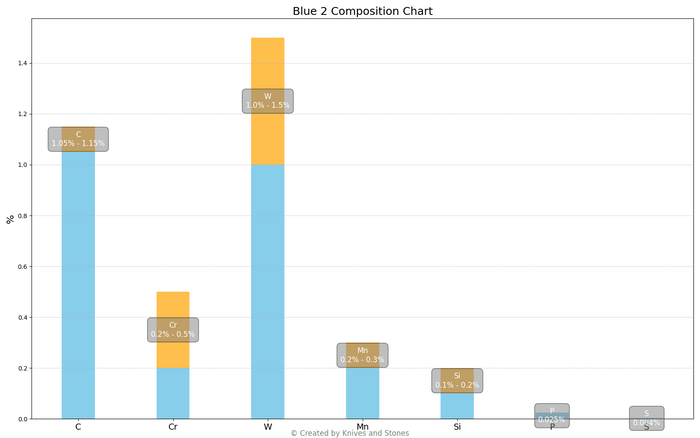
Steel: Blue 2 / Aogami #2
Manufacturer:
Nature: Carbon
Typical hardness: 61 to 63 HRC
<< Slide for more >>
-

Handle Specs
Profile: Octagonal WA
Material:
<< Slide for more


