PRAHRAN STORE NOW OPEN · THU–MON · 10AM–6PM

Tojiro  |  SKU: TJ-DPVG10-F803-HONES150

Tojiro DP VG10 F-803 Honesuki 150mm

Sale price $110.98 Regular price $129.95

Sold out right now

Leave your email and we’ll send one message the moment it’s back in stock.

One email, no marketing. Privacy policy.

Availability

  • St Peters, NSW —
    2 Bishop St, Unit 2, St Peters NSW 2044
  • Crows Nest, NSW —
    107 West St, Shop 1, Crows Nest NSW 2065
    Pickup only
  • Prahran, VIC —
    180 Commercial Road, Shop 1, Prahran VIC 3181
    Pickup only

Goes well with

Detailed Specifications
Line Tojiro DP
Profile Honesuki / Poultry boning knife
Bevel Type Double Bevel
Weight 180 g | 6.3 oz
Edge Length 150 mm | 5 29/32″
Heel Height 39 mm | 1 17/32″
Width @ Heel 2.7 mm | 7/64″
Width @ Mid 2.7 mm | 7/64″
Width @ 1cm from Tip 1.3 mm | 3/64″
Steel VG10 | Stainless
Blade Construction Sanmai - Stainless Clad
Maker's hardening hardness 60 HRC or more
Surface Finish Migaki
Handle Western Pakka Wood with Bolster
Region Tsubame
Best for
  • First-timers
  • Students

Free shipping for knives over AU$200 Australia wide.

World-wide shipping via DHL Express, 3 to 6 days (not available in the UK).


Tojiro DP is what I consider as the white Toyota equivalent in the Japanese knife market, it is affordable, massively produced by reputable manufacture with a long track record of being reliable for what you pay.

The core steel is the Takefu VG10, a middle to high tier stainless stainless steel that is widely adopted by many makers. However, Tojiro managed to get these knives to a very low price, to a price point where you can only find steel like AUS-8. The lowered price isn't achieved by compromising on performance, as the scale of the manufacturing can still ensure the quality of the heat treating and grinding, therefore, you are still getting a blade with sharpness and edge retention on par with some other VG-10 knives that are quite more expensive.

The trade-offs are the fit and finish of these knives, they are fine at first glance, but a closer inspection will reveals some small issues. The spine sometimes have scratches, same for joint between blade and bolsters, glue can be seen on the edge of handle scales and the choil is not rounded and you can peel potato with it... You can usually find one or two tiny unfinished details like these on a Tojiro DP, but usually they aretn't something that can't be fixed by a set of sandpaper in 20mins.

At the end of the day, the Tojiro DP will stay sharp and serve you well on chopping board, its low price and relative easy of sharpening can make it a good knife to learn sharpening on, the stainless Migaki finish can handle some beating and scratches, these features combine into a very good entry level user knife with outstanding affordability. Just like your first generic white Toyota, it may not have Alcntara interior, twin-turbo V8 and 4WD, but it is reliable, and able to handle 99% of the task with a very low price.

Pros Cons
  • Budget friendly
  • Easy to look after
  • Ideal for the household
  • Fit and finish can be improved
Care Instruction
  1. Don't cut hard things! Japanese knives are brittle so bone hacking is a NO NO!
  2. Wash with neutral detergent after use, and wipe dry;
  3. Please don't wash knife with dishwasher, it will damage the wood handle;
  4. Be careful not to leave the knife close to a heat source for a long time;
  5. It is a lot more dangerous to cut with a blunt knife than a sharp knife!
  6. It is best to sharpen a Japanese knife regularly on a waterstone.

Tojiro

Tojiro (藤次郎), Tsubame, Niigata

Tojiro (藤次郎株式会社) is a knife maker in Tsubame, Niigata, founded on 1 May 1953. Its president's message says that since its founding the company has pursued sharpness, the basic quality of a knife, carrying on traditional techniques while taking on new ones.

Read more

We stock Tojiro's DP3 knives in shapes from a paring knife to a sujihiki, its Zen series, its SG2 powdered steel gyuto and santoku, and its MV stainless deba and yanagiba, along with some of its kitchen tools.

“Tsubame knife maker since 1953.”

Est. 1953 | 昭和28年
Known for The DP, Zen and SG2 knife lines
Website tojiro-japan.com Instagram @tojiro_jp Read more about Tojiro

Tojiro · Tsubame

Knife details

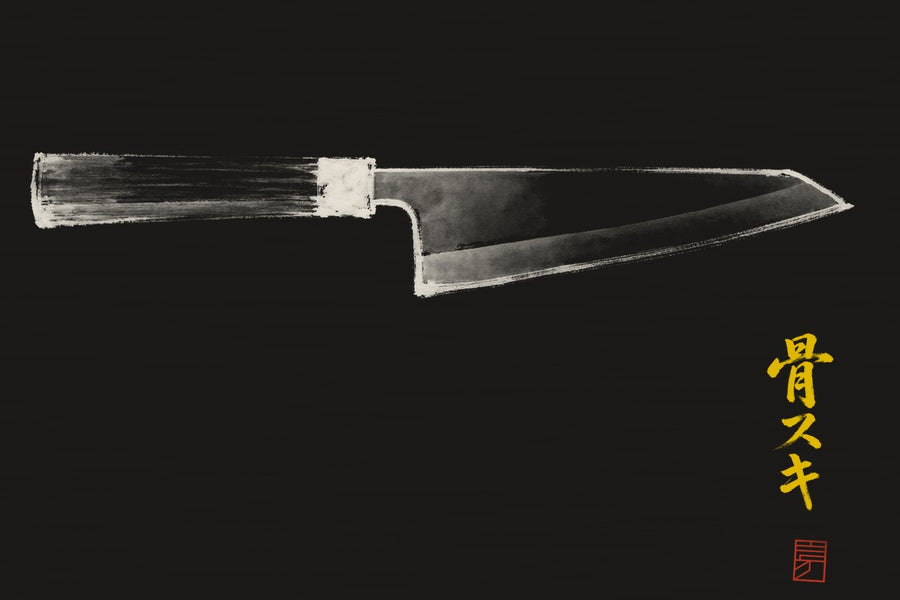
Honesuki — knife profile
Profile

Honesuki

骨スキ

Poultry boning knife · Single or double bevel

Strips meat from bone; a Seki maker lists its square honesuki for fowl and fish.

Read more
Steel properties
  1. Hardness Fair
  2. Edge retention Good
  3. Toughness Fair
  4. Rust resistance High
  5. Ease of sharpening Good
  6. Sharpness Good

Our ratings, inferred from published lab tests and composition.

Steel

VG10

V金10

Stainless · Takefu Special Steel

Takefu stainless, 1% carbon, 15% chromium, 1.55% cobalt. Easy to sharpen.

Read more
CladdingCoreClad line
Construction

Sanmai - Stainless Clad

三枚

3 layers · stainless clad

Hard core between two stainless layers, bare only at the edge; the cladding resists rust.

Read more
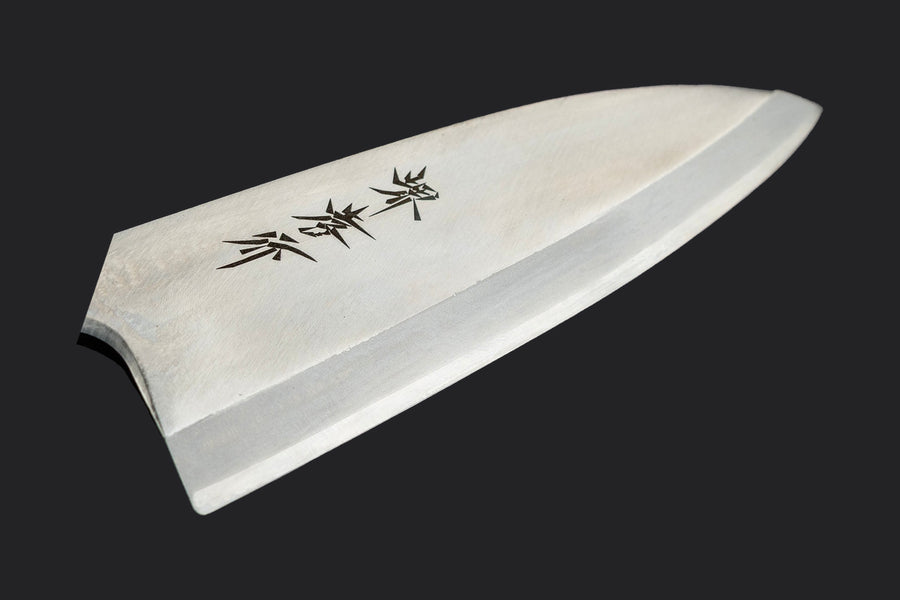
Migaki — blade surface finish
Finish

Migaki

Polished satin

Smooth polished surface, satin to soft sheen rather than mirror. Scratches show.

Read more
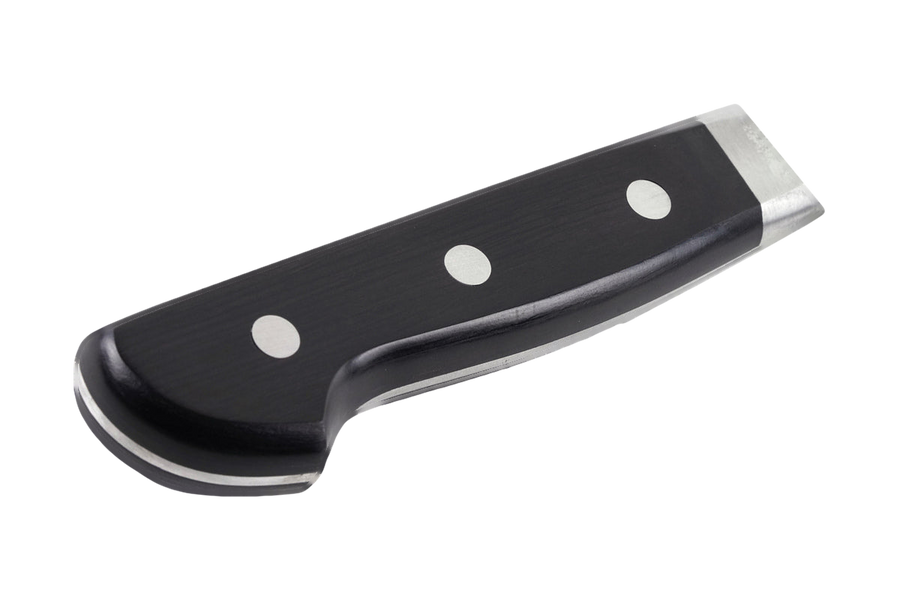
Western Pakka Wood with Bolster handle
Handle

Western Pakka Wood with Bolster

Western with bolster

Pakka wood western grip with a bolster. Resin-laminated wood resists water; entry-level.

Frequently asked questions

What is a honesuki for?

A honesuki (骨スキ) strips meat from the bone, the job a boning knife does elsewhere.

One Japanese knife maker describes the traditional honesuki as a shape unique to Japan, made with Japanese knife techniques and ground single-bevel (片刃), so it can also be used to prepare fish.

Can left-handed cooks use single bevel knives?

A standard single bevel knife is ground for right-handed use, and a left-handed one is made with the bevel reversed. Some makers offer left-handed versions.

Contact us and we will check what we can order or have in stock.

What is a garasuki?

A garasuki is the bigger, heavier brother of the Japanese poultry boning knife (honesuki), made for larger birds and heavier cuts.

To picture one, start with the honesuki. It is short, stiff and triangular, with a thick spine and a straight edge running to a pointed tip, typically 145mm to 165mm long with 150mm the standard. It works by rigidity where a Western boning knife works by flex: the tip finds the gap in a joint, the heel pops through cartilage, and the stiff blade scrapes meat off the bone.

What you break down decides which one you need. For jointing whole chickens and ducks the honesuki is the knife. A garasuki earns its place only if you regularly work on larger birds. For large cuts of red meat, look at a butcher knife, which is heavier and rounder at the front and made for primals more than joints.

Our honesuki guide covers the shape and how it is used, and the butcher knife guide covers the heavier meat knife.

Does VG10 rust?

Yes, it can. Takefu, which makes VG10 (V金10), lists it among its stainless steels, and the JSSA notes that stainless strictly means rust-resistant, not rust-proof.

Takefu lists VG10's chromium content as 15% and describes its corrosion resistance as excellent. We recommend drying the knife after washing.

How hard is VG10?

Takefu, the steelmaker behind VG10, gives HRC 60 or more as its hardening hardness, measured straight after quenching. The hardness of a finished knife depends on its maker.

Takefu says the steel's 15% chromium, 1% molybdenum and 1.55% cobalt give it high hardness and a long-lasting edge, and that it is easy to sharpen.

What is the difference between VG10 and SG2?

Both are Takefu blade steels, and they differ in class and in what Takefu publishes about each. Takefu lists VG10 as a stainless steel with 1.00% carbon, 15.00% chromium, 1.00% molybdenum, 0.25% vanadium and 1.55% cobalt, at a hardening hardness of HRC 60 or more.

Takefu describes SG2, its Super Gold 2, as a blade steel created by powder metallurgy, lists its composition as not disclosed, and SG2 runs 61 to 65 HRC depending on the maker. Takefu also calls SG2 a powdered stainless high-speed steel.

Is VG-10 a good steel for a first Japanese knife?

Yes. VG-10 is our default suggestion for a first Japanese knife, because it is stainless and easy to sharpen, and it holds a good working edge through everyday home cooking.

VG-10 is made by Takefu Special Steel, with about 1% carbon, 15% chromium and 1.55% cobalt, and is usually hardened to around 60 HRC. Takefu describes it as corrosion resistant and easy to sharpen. Day to day you rinse it and wipe it dry, with none of the rust watching carbon steel asks for.

It is also a kind steel to learn sharpening on. It takes an edge readily on a basic waterstone, so you can feel when your technique is working. A harder steel such as SG2 holds its edge longer but is less forgiving on the stone, as our VG-10 vs SG2 comparison explains.

Stainless steel can still stain: VG-10 will spot if it is left wet with acidic food on the edge, and it should never go in the dishwasher. Like any hard, thin Japanese edge, it should also stay away from bones, frozen food and glass boards. If your household is rough on knives, the slightly softer AUS-10 is the safer choice.

Steel is only part of the decision. Heat treatment and grind change how the same VG-10 cuts from one maker to the next, so choose the shape and size first. Our first Japanese knife guide walks through that.

What steel is the Tojiro DP?

Tojiro's own site lists model numbers such as F-808 and F-503 in its CLASSIC series, and describes those blades as VG10 (V金10号) at the core with 13-chrome stainless steel on the sides.

The honesuki we list in this line is titled Tojiro DP VG10 F-803 Honesuki 150mm.

You May Also Like