PRAHRAN STORE NOW OPEN · THU–MON · 10AM–6PM

Tsunehisa  |  SKU: TNHS_W1KA_GY24_EB

Tsunehisa White 1 Stainless Clad Migaki Gyuto 240 mm Ebony Handle

Regular price $349.95

IMPORTANT: Carbon steel knives can rust or patina quickly if not cared for properly. They require regular cleaning, drying, and oiling. If you are unfamiliar with carbon steel maintenance, we recommend choosing a stainless steel option instead.

Sold out right now

Leave your email and we’ll send one message the moment it’s back in stock.

One email, no marketing. Privacy policy.

Availability

  • St Peters, NSW —
    2 Bishop St, Unit 2, St Peters NSW 2044
  • Crows Nest, NSW —
    107 West St, Shop 1, Crows Nest NSW 2065
    Pickup only
  • Prahran, VIC —
    180 Commercial Road, Shop 1, Prahran VIC 3181
    Pickup only
Detailed Specifications
Line Tsunehisa S/S Clad White 1 Migaki
Profile Gyuto / Chef's knife
Bevel Type Double Bevel
Weight 191 g | 6.7 oz
Edge Length 243 mm | 9 9/16″
Heel Height 48 mm | 1 57/64″
Width @ Heel 3.1 mm | 1/8″
Width @ Mid 1.7 mm | 1/16″
Width @ 1cm from Tip 0.8 mm | 1/32″
Steel White 1 / Shirogami #1 | Carbon
Blade Construction Sanmai - Stainless Clad
Hardness (HRC) 62 - 65
Surface Finish Migaki
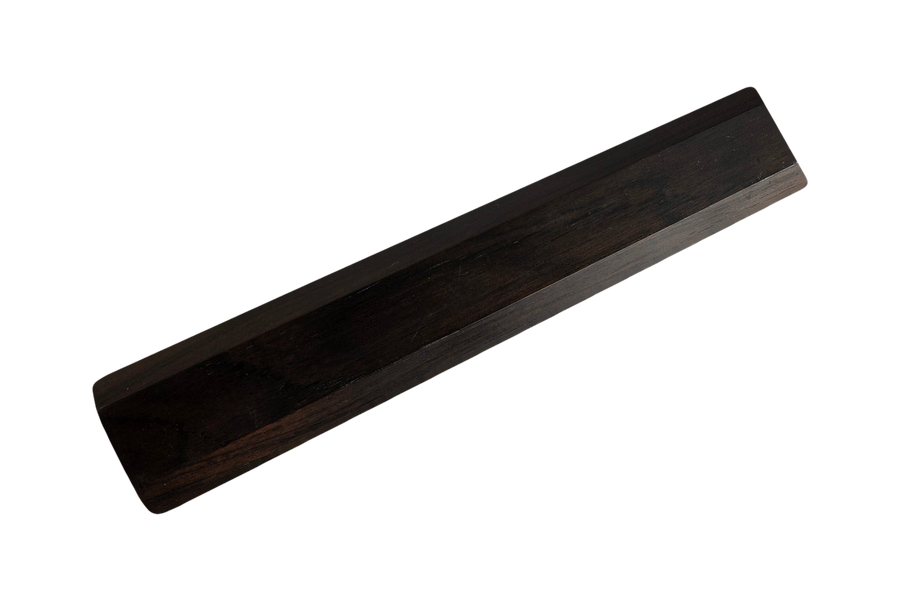
Handle Octagonal Ebony
Region Fukuyama
Best for
  • Pro chefs
  • Enthusiasts
  • Free shipping for knives over AU$200 Australia wide.
  • World-wide shipping via DHL Express, 3 to 5 days.


Tsunehisa White 1 Stainless clad is a highly practical and good performing lineup that has a deceivingly simple look, it is the type of the knife that you would need to hold in hand to appreciate the attention to details that are put into designing it.

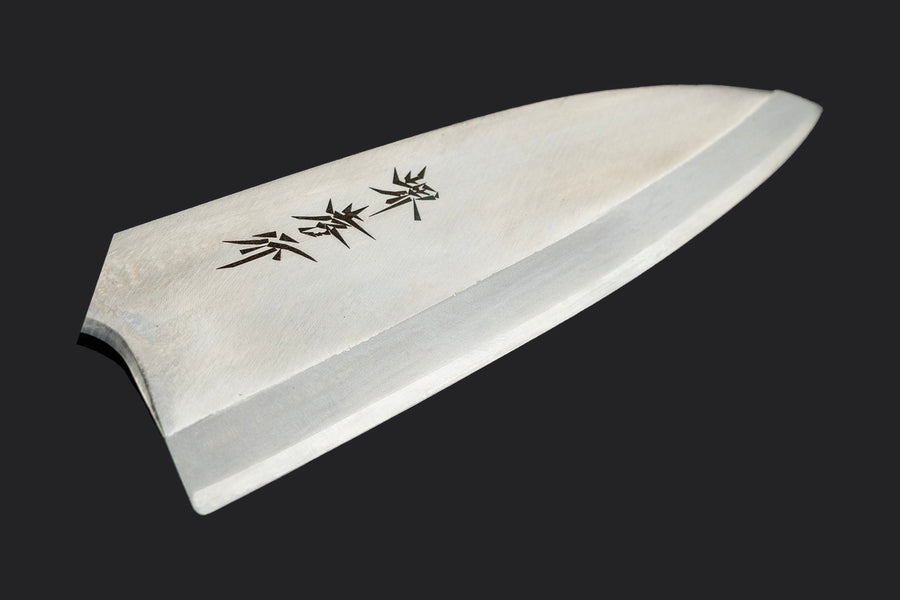
At the first glance, this line features a brushed/Migaki blade with a sandblasted Kasumi bevel, and the cladding has zero decorative elements to it. It is very easy to confuse it with an average mass manufactured knife, until you pick it up and make your first cut. The cutting smoothness is top notch in all of the Tsunehisa knives that I’ve tried, and it is not only due to the sharp edge produced on a White 1 steel. 

Despite the clear junction present on the bevel, there is actually no geometrical corner at the “Shinogi Line”. It is a result of a different surface finish that is done over a really well tuned convex grind bevel. This is a grind with pretty low thickness behind the edge that slowly turns into a bulging convex surface 1cm below that Shinogi Line, which results in beautiful food penetration and separation that leads to minimal resistance in the cut. On top of that, the spine of the blade has a distal taper, and it tapers all the way from the tip to the tang. It is likely not a result of forging but a precisely controlled grinding. Regardless of the method used, this taper lightens the front of the blade and creates a paper thin tip that sinks into any food upon contact.

Upon closer inspection, you would also notice that the corners are all well treated, despite having no chamfer or rounding, the sharp edge on the corner is properly knocked down so they don’t bite into your hand, similarly the choil have a slightly rounded corner so it wouldn’t hurt to put your middle finger against it. The factory sharpening might be the only thing I would complain about as it is not the most uniform ones out there, but surely it delivers the cutting performance that you can expect from a White 1 steel.

These knives have a clear focus on the performance instead of the appearance, and the stainless cladding makes them easier to look after whether in a home or kitchen setting. If you are considering trying out a carbon steel knife, then I would point this line out, not only you would be getting the authentic pure carbon steel cutting and sharpening experience, you would also feel a knife with carefully designed and sculpted geometry that hides its performance under the low-key, plain finish.

Pros Cons
  • Excellent performance
  • Thin behind the edge
  • Great for professionals
  • Prone to rust
Care Instruction
  1. Don't cut hard things! Japanese knives are brittle so bone hacking is a NO NO!
  2. Wash with neutral detergent after use, and wipe dry;
  3. Please don't wash knife with dishwasher, it will damage the wood handle;
  4. Be careful not to leave the knife close to a heat source for a long time;
  5. It is a lot more dangerous to cut with a blunt knife than a sharp knife!
  6. It is best to sharpen a Japanese knife regularly on a waterstone.
  7. Oil the (carbon) knife if storing for an extended period of time to prevent rust.

Tsunehisa

Tsunehisa, the house brand of Shibata Knives

Tsunehisa (恒久) is the house brand of Shibata Knives, the knife company Takayuki Shibata owns and runs. It is a brand rather than a single workshop.

The name means permanence, and Shibata Knives says it chooses knives that will have a long life. Takayuki Shibata started Tsunehisa in 2015 as his third knife brand, to help manage growing orders.

Read more

Shibata Knives describes Tsunehisa as a brand that inherits traditional Japanese forging techniques while taking in the latest materials and technologies, aiming at function and design for long use. It says its experienced staff inspect each knife under strict quality control, and it offers after-sales maintenance and sharpening.

The lines we list are grouped by steel. Ginsan comes in migaki, nashiji and nawame finishes, as gyuto, santoku, nakiri and petty, with a deba in the same steel. White 1 comes stainless clad as migaki and tsuchime gyuto, Aogami Super as kurouchi tsuchime sujihiki and petty, and Blue 2 as the Samurai sakimaru sujihiki.

The Damascus lines are in VG10, AUS10 and ZA18, the AUS10 also with a tsuchime finish. The rest are AUS8 tsuchime, a VG1 gyuto and an SLD Washiji santoku. Handles come in wa and yo styles.

“The house brand of Shibata Knives; the name means permanence.”

Est. 2015 | 平成27年
Known for Knives chosen and inspected by Shibata Knives
Read more about Tsunehisa

Tsunehisa · Fukuyama

Knife details

Frequently asked questions

Gyuto or santoku: which should I choose?

Both are all-purpose Japanese knives, and for most home cooks either will handle the bulk of daily prep. The choice comes down to length, blade shape, and how you like to cut.

A gyuto is the Japanese chef's knife, with a gently curved edge that lets you rock and slide through cuts as well as chop. Tojiro's guide to Western knife shapes gives 150 to 210mm as the household size for a gyuto and up to 360mm for professional use. The extra length and pointed tip give you reach and versatility, from proteins to large produce.

Tojiro's guide to Japanese knife shapes gives 165 to 170mm as the household size for a santoku, which has a flatter profile and a rounded sheep's-foot tip. It rewards a straight up-and-down push cut, feels nimble in smaller hands or tight kitchens, and is the classic Japanese household knife.

Rule of thumb: choose a gyuto if you want one do-everything knife with more reach, or a santoku if you prefer a compact, easy-to-control blade. Plenty of our customers end up owning both.

What is a gyuto knife used for?

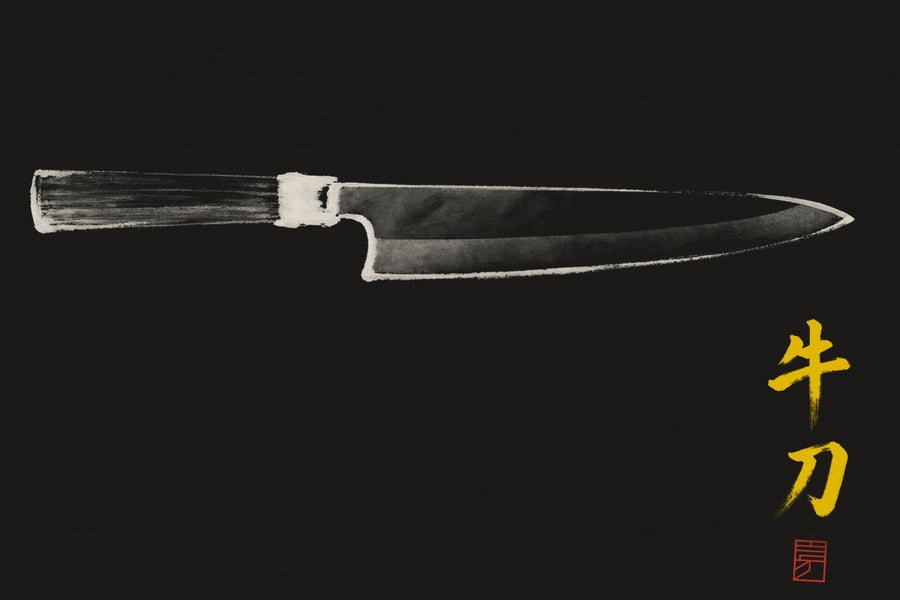
The gyuto (牛刀) is a chef's knife for all kinds of cooking, and it is basically double-bevel. A knife maker's guide says it came to Japan in the Meiji era with the culture of eating beef, which gave it its name, but it does not cut only meat.

A Japanese dictionary describes the gyuto as slimmer than a santoku, with a pointed tip, used widely for meat, fish and vegetables.

What gyuto length should I choose?

A knife maker's guide lists 150 to 210 mm, double-bevel, for home use, and 180 to 360 mm, single- or double-bevel, for professional kitchens.

We suggest starting with a 210 mm gyuto for a home kitchen, and stepping up to 240 mm if you regularly cut large pieces and have the board for it.

240mm vs 210mm gyuto: which size should I choose?

Get the 210mm. We only point people to a 240mm when they have about 45cm of usable board, cook in volume, and regularly break down big roasts or whole fish.

On the gyutos we've measured for our product pages, the extra length is real. As of October 2026, the 210mm gyutos we list have a median edge of 213mm from heel to tip, across the 111 we have measured; the 240mm ones have a median of 240mm, across 100. The 240s are also heavier, 212g against 175g at the median, and a touch taller at the heel, 50mm against 48mm.

That length buys you a longer stroke. A 240 goes through a big piece of meat in one or two pulls and moves a board of chopped vegetables with less shuffling. It costs you board space and control. On a small board the tip hangs off the edge, and fine work like herbs and shallots feels like more knife than the job needs.

Japanese or German kitchen knives: which should I buy?

Our advice: choose a Japanese knife if you want the keenest edge and do not mind caring for a harder blade, and a German knife if you want a tougher, more forgiving knife you can hone casually and use for heavy prep. On two Japanese knife steels, the steel makers' own figures start at 60 HRC: Takefu Special Steel rates VG10 at 60 HRC or more, and Proterial lists the hardening hardness of Aogami 2 (Blue 2) as over 60 HRC.

Our care advice for a Japanese knife: keep it off bone, frozen food and very hard squash, and use a wooden or plastic board.

What is the flat spot on a knife, and is it the same as the "sweet spot"?

The flat spot is the straight run of edge from the heel towards the middle, the part that meets the board along its length. At our counter we call it the sweet spot; elsewhere "sweet spot" often means the balance point, so ask which one someone means.

Past the flat, the edge curves up towards the tip (the belly), which suits a swinging or pulling stroke. Sharpeners also say "flat spot" for a worn patch of edge, so when you mean the shape, "the flat part of the edge" is clearer.

Is White 1 the hardest of the white steels?

Yes, among Shirogami 1, 2 and 3 on Proterial's pages. It describes Shirogami 1 (白紙1号) as having the highest hardness and gives it 1.25 to 1.35% carbon, compared with high hardness and 1.05 to 1.15% carbon for Shirogami 2, and middle hardness and 0.80 to 0.90% carbon for Shirogami 3.

All three are carbon steels that can rust, so wash the knife and dry it after use.

What does the name Tsunehisa mean?

Tsunehisa (恒久) means permanence. Shibata Knives describes Tsunehisa as its original brand, and says it selects knives that will have a long life, inspecting each one before delivery. Its own words are that it delivers knives worthy of a permanent position in your home.

The brand is built on traditional Japanese forging techniques with modern materials, and Shibata Knives offers after-sales maintenance and sharpening for the line.

You May Also Like