PRAHRAN STORE NOW OPEN · THU–MON · 10AM–6PM

Hatsukokoro  |  SKU: HATS_SGRHR_BU180

Hatsukokoro Ryuhyo SG2 Damascus Rainbow Bunka 180mm

Regular price $359.95

Sold out right now

Leave your email and we’ll send one message the moment it’s back in stock.

One email, no marketing. Privacy policy.

Availability

  • St Peters, NSW —
    2 Bishop St, Unit 2, St Peters NSW 2044
  • Crows Nest, NSW —
    107 West St, Shop 1, Crows Nest NSW 2065
    Pickup only
  • Prahran, VIC —
    180 Commercial Road, Shop 1, Prahran VIC 3181
    Pickup only
Detailed Specifications
Line Hatsukokoro Ryuhyo SG2 Damascus Coated
Profile Bunka / K-tip santoku
Bevel Type Double Bevel
Weight 123 g | 4.3 oz
Edge Length 176 mm | 6 59/64″
Heel Height 49 mm | 1 59/64″
Width @ Heel 2.1 mm | 5/64″
Width @ Mid 1.6 mm | 1/16″
Width @ 1cm from Tip 0.8 mm | 1/32″
Steel SG2 / R2 | Powdered | Stainless
Blade Construction Sanmai - Stainless Damascus Clad
Hardness (HRC) 62 - 64
Handle Special Handle
Region Hyogo
Best for
  • Pro chefs
  • Students
  • Free shipping for knives over AU$200 Australia wide.
  • World-wide shipping via DHL Express, 3 to 5 days.


The Ryuhyo(流冰, Flowing Ice) is a line that looks familiar but feels different. At first glance, it carries the same elegant SG2 Damascus identity as the existing Saihyo line, but once in hand, the difference quickly becomes clear. The improved sharpening, smoother cutting feel, and compelling value have already made Ryuhyo one of the easiest recommendations in the intermediate to high-end Japanese knife market.

Now, the new Coated Series takes that familiar formula a step further. Available in striking Blue and Rainbow finishes — with Orange arriving in the future — this version adds a completely different visual personality to the already flowing Damascus pattern. Depending on the light, the coating shifts subtly across the blade surface, almost like reflected light moving across drifting ice. The finish feels modern and expressive without losing the refined aesthetic expected from Japanese kitchen knives.

Hatsukokoro's earlier Saihyo SG2 series has been around for quite some time, but one criticism was always the somewhat conservative grind and sharpening. The blade geometry featured a relatively standard flat grind with a polished sandblasted Damascus finish, and the thickness behind the edge was not particularly thin. While visually attractive, many knives in the same price range could outperform it in cutting feel and food release.

The Ryuhyo series seems to be Hatsukokoro’s direct answer to this issue. Not only does it come at a more approachable price point, but the cutting performance itself feels noticeably smoother and more refined. The geometry transitions more like a sabre/V-grind without a defined shinogi line, allowing food to glide naturally across the blade surface while preserving the uninterrupted flow of the Damascus pattern. Perhaps this flowing transition is exactly where the name “Ryuhyo” comes from.

The coated finish itself is achieved through electroplating, giving the blade its vibrant blue or rainbow appearance while maintaining good durability in daily use. Unlike painted coatings, the surface remains clean and metallic in feel, complementing the smooth grind underneath rather than masking it. As with most coated finishes, gentle hand-washing and avoiding abrasive materials is recommended to preserve the appearance over time.

The steel remains the trusted SG2 powdered steel, which many users would consider an ideal balance for both professional kitchens and serious home cooking. It offers excellent edge retention and wear resistance while remaining far less troublesome to sharpen or maintain compared to many ultra-hard stainless steels. Combined with the improved geometry, the Ryuhyo Coated Series positions itself extremely well: visually unique, high performing, and significantly more accessible than many fully hand-crafted SG2 knives.

In summary, the Ryuhyo Coated Series represents the continuing evolution of Hatsukokoro’s manufacturing and finishing techniques. While handcrafted knives will always have their place, it is exciting to see more production-oriented knives reaching this level of cutting performance, refinement, and visual creativity. The result is a knife that not only cuts smoothly, but also brings a sense of individuality and atmosphere to the kitchen — something that feels increasingly rare at this price point.

Pros Cons
  • Excellent performance
  • Thin behind the edge
  • Easy to look after
  • A little bit brittle
Care Instruction
  1. Don't cut hard things! Japanese knives are brittle so bone hacking is a NO NO!
  2. Wash with neutral detergent after use, and wipe dry;
  3. Please don't wash knife with dishwasher, it will damage the wood handle;
  4. Be careful not to leave the knife close to a heat source for a long time;
  5. It is a lot more dangerous to cut with a blunt knife than a sharp knife!
  6. It is best to sharpen a Japanese knife regularly on a waterstone.

Hatsukokoro

Hatsukokoro, a knife brand from Amagasaki

Hatsukokoro (初心) is a knife brand from Amagasaki, Hyogo, launched in 2019. It is a brand rather than a forge: it works with knife makers instead of forging itself.

The name comes from the proverb 初心忘るべからず, roughly never forget your beginner's mind. For the same characters the brand chose the gentler reading hatsukokoro over shoshin.

The brand's own catalogue names the place behind some of its lines, and the maker behind a few: Shinkiro comes from Fukushima, and Hayabusa HAP40, Saihyo and Sunaarashi from Seki City, while for others the maker or the place stays private. Some of our listing titles also carry the maker alongside the brand, such as Hatsukokoro x Yoshikane and the Hatsukokoro x Yoshihiro Yauji collaboration.

The Hatsukokoro lines we list include both carbon and stainless steels. Our listings include Hayabusa in SG2 and Aogami Super, Saihyo in SG2 and Ginrei in Ginsan. Carbon steel kurouchi lines include Aosagi, Aokitae, Kurokaze and Kurogane.

“A knife brand from Amagasaki that works with knife makers rather than forging.”

Est. 2019 | 令和元年
Known for Lines made with partner makers, from Seki City to Fukushima
Website handk.co Instagram @handk_official Read more about Hatsukokoro

Hatsukokoro · Hyogo

Knife details

Frequently asked questions

Why is it called a bunka knife?

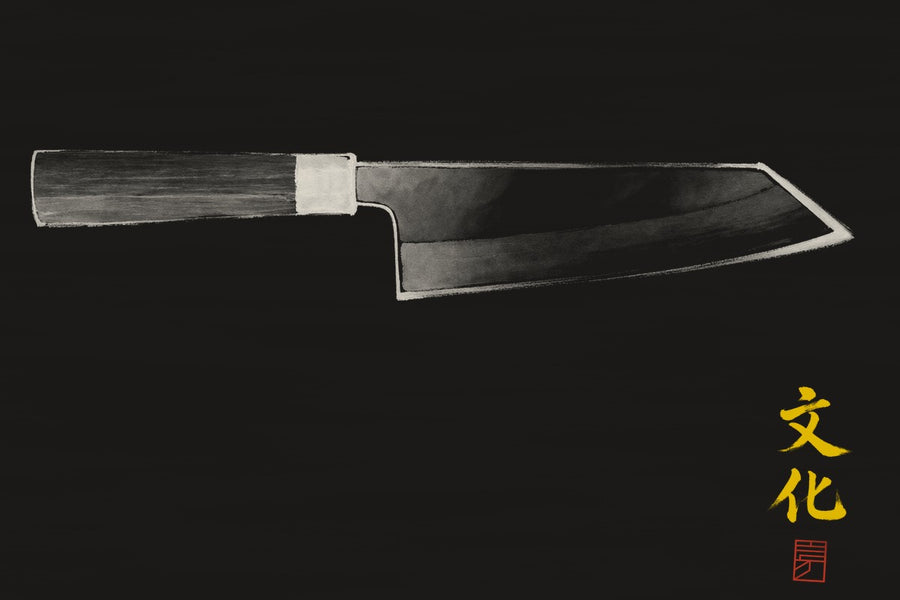
The bunka knife (文化包丁) takes its name from bunka, culture. A Sakai knife maker ties the name to Japan's modernisation, when Western culture and Japanese tradition merged, and says it stands for that new era and for the knife's wide range of uses.

The same maker says that as diets broadened to meat, fish and vegetables, an all-purpose knife was wanted, and the bunka took features from both Japanese and Western knives.

What is the difference between a bunka and a santoku?

The tip. One Japanese knife maker describes the bunka (文化包丁, kengata) as combining the good points of the gyuto and the nakiri with the tip cut at an angle, and the santoku as coming after it, by rounding that tip.

Both are all-purpose knives for the home; santoku (三徳) means three virtues, for the three foods it cuts: meat, fish and vegetables.

SG2 steel knives at Knives and Stones

SG2 (Super Gold 2, which Takefu writes as SPG2) is Takefu Special Steel's own blade steel, made by powder metallurgy. Takefu says it meets all four of what it calls the major requirements for a blade: high hardness, high toughness, good wear resistance and excellent corrosion resistance.

Takefu gives its hardness as HRC 62 or more and does not publish its composition. As of 18 October 2026, 291 of the knives we list have SG2 in their title.

SG2 vs AS steel for kitchen knives — which is better?

Neither is objectively better, it just depends on whether you value stainless convenience or a laser-sharp carbon edge. Go with SG2 if you want a knife that holds a screaming edge without any babysitting. Choose AS if you are chasing the thinnest possible edge and don't mind wiping the blade down after every use.

SG2 is a powdered stainless steel from Takefu, rated at 62 HRC or more. It is tough and resists corrosion, which is why I reach for it when working with acidic foods. Aogami Super is high carbon, and Proterial gives it a hardening hardness of over 60 HRC. It sharpens to a hair-whittling edge that lasts slightly longer than SG2, but it will rust if you neglect it.

R2 steel vs SG2: are they the same?

We can't confirm that from a steelmaker. SG2 (Super Gold 2, which Takefu writes as SPG2) is Takefu Special Steel's own blade steel, made by powder metallurgy. Takefu does not publish its composition and gives its hardness as HRC 62 or more.

As of 18 October 2026, we found no steelmaker page for a steel called R2. Some knives on our shelf are listed as SG2/R2: six as of 18 October 2026, from Kurosaki, Shiro Kamo and Yoshimi Kato.

What is the difference between VG10 and SG2?

Both are Takefu blade steels, and they differ in class and in what Takefu publishes about each. Takefu lists VG10 as a stainless steel with 1.00% carbon, 15.00% chromium, 1.00% molybdenum, 0.25% vanadium and 1.55% cobalt, at HRC 60 or more.

Takefu describes SG2, its Super Gold 2, as a blade steel created by powder metallurgy, lists its composition as not disclosed, and gives HRC 62 or more. Takefu also calls SG2 a powdered stainless high-speed steel.

What is the difference between SG2 and ZDP-189?

They come from different steelmakers, and both are made by powder metallurgy. Takefu lists SG2 as a blade steel created by powder metallurgy, with its composition not disclosed and hardness at HRC 62 or more.

Proterial describes ZDP-189 as a stainless blade steel made by powder metallurgy, lists 3.00% carbon and 20.00% chromium with its other elements not published, and gives a hardening hardness of over 65 HRC.

You May Also Like