Crows Nest store now open from Friday to Tuesday, 10am till 6pm.

Nakagawa Hamono  |  SKU: NAKA_B1KA_GY240EB

Nakagawa Blue 1 Wide Bevel Kasumi Gyuto 240mm Ebony Handle

Regular price $669.95

IMPORTANT: Carbon steel knives can rust or patina quickly if not cared for properly. They require regular cleaning, drying, and oiling. If you are unfamiliar with carbon steel maintenance, we recommend choosing a stainless steel option instead.

Availability

  • St Peters
    2 Bishop St Unit 2 St Peters NSW 2044
  • Crows Nest
    107 West St, Crows Nest NSW 2065
    Pickup only
Detailed Specifications
Line Hatsukokoro By Nakagawa Blue 1 Wide Bevel Kasumi
Profile Gyuto / Chefs Knife
Bevel Type Double Bevel
Weight 258 g | 9.1 oz
Edge Length 243 mm | 9 9/16″
Heel Height 52 mm | 2 3/64″
Width @ Heel 3.7 mm | 9/64″
Width @ Mid 3.0 mm | 1/8″
Width @ 1cm from Tip 0.8 mm | 1/32″
Steel Blue 1 / Aogami #1 | Carbon
Blade Construction Sanmai - Soft Iron Clad
Hardness (HRC) 61 - 64
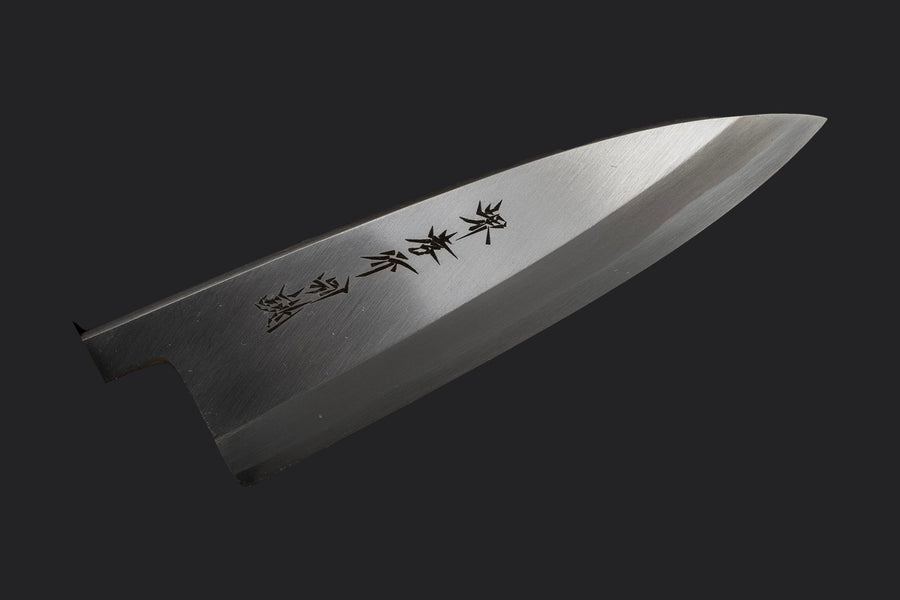
Surface Finish Kasumi
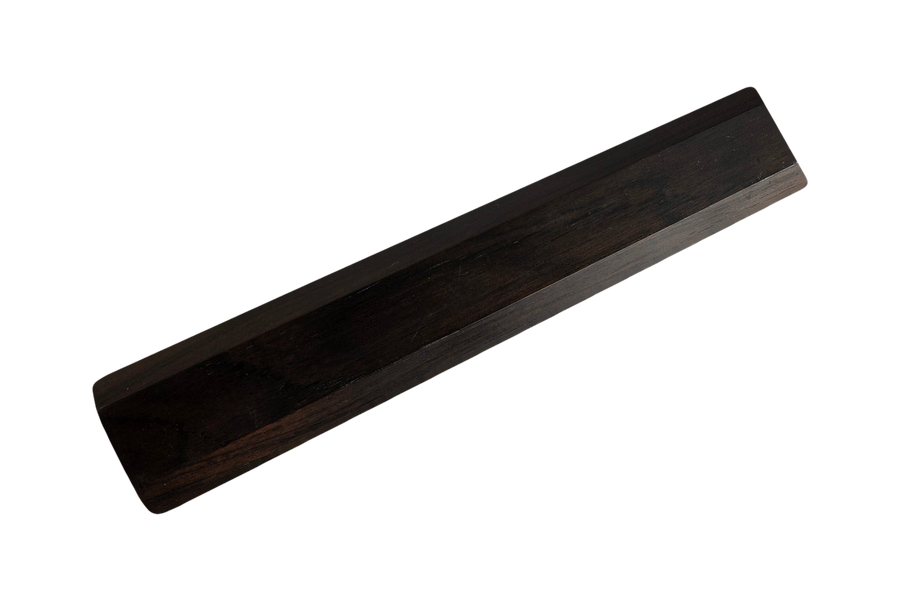
Handle Octagonal Ebony
Region Sakai
Best for
  • Pro chefs
  • Enthusiasts
  • Free shipping for knives over AU$200 Australia wide.
  • World-wide shipping via DHL Express, 3 to 5 days.


The Nakagawa Blue 1 Wide Bevel is a line commissioned by Hatsukokoro that offers a series of very solid blades that are good for professional works. This line combines moderate thickness, decent profile and good detail finish, with a defined look that separate it from the typicall guyto. And as an upgrade from the Blue 2 line, the Blue 1 steel offer more carbon, more hardness and more edge retention, provide that extra performance for a very similar price.

The wide bevel in the name refers to the grind that these blades takes on. Usually Japanese double bevel knives will have a flat grind, where the secondary bevel starts all the way at the spine, in cases where the secondary bevels start halfway, they tend to blends into the flat zone slightly. This line however, have a very distinct boundary at the begining of its secondary bevel,creating a very sharp and geometrycall look, especially on the Kiritsuke Gyuto, which distinct the entire line from other plain Migaki finish knives.

Performance of the kinfe on the chopping board is great, as the bevel takes a concave grind, it is of a good sharpness even the thickness of the spine is not as thin as some "laser" knives, though there is a slight tendency for the food to stick due to this grind. This combination allows the edge to be thin, while having more material behind the bevel to provide toughtness in a professional setting.

Unlike its Ginsan sibling, this line is constructed with carbon core steel with soft iron cladding, so the entire blade is prone to rust and discolouration, which is why I would only recommend this line to who are willing to take care a carbon steel. In exchange, the ease of sharpening, absolute sharpness and edge retention of Blue 1 wouldn't let you down, especially when considering that the heat treating is done by Nakagawa-san, who have more than 20 years of experience under the legendary bladesmith Kenichi Shiraki.

I believe this line make perfect sense for who what a more refined carbon steel knife made by a renowned maker, althought the pricing is on the higher end, the experience of the maker behind these blades are there to back it up. And for those who want this knife in a stainless package, there is the Ginsan option, made with same level of craftmanship by Nakagawa too.

Pros Cons
  • Excellent performance
  • Thin behind the edge
  • Exceptional profile
  • Prone to rust
  • High budget
Care Instruction
  1. Don't cut hard things! Japanese knives are brittle so bone hacking is a NO NO!
  2. Wash with neutral detergent after use, and wipe dry;
  3. Please don't wash knife with dishwasher, it will damage the wood handle;
  4. Be careful not to leave the knife close to a heat source for a long time;
  5. It is a lot more dangerous to cut with a blunt knife than a sharp knife!
  6. It is best to sharpen a Japanese knife regularly on a waterstone.
  7. Oil the (carbon) knife if storing for an extended period of time to prevent rust.

Satoshi Nakagawa

Satoshi Nakagawa Hamono - Sakai's New Power House (Est. 2021)

Nakagawa Hamono, established by Satoshi Nakagawa (中川悟志) in April 2021, carries on the legacy of the renowned Shiraki Hamono under the guidance of Nakagawa-san, a dedicated disciple of the legendary craftsman Kenichi Shiraki. With nearly two decades of experience, primarily under Shiraki-san, Nakagawa-san has been instrumental in creating some of the finest honyaki blades in the last five years of Shiraki-san's work.

His expertise is not limited to Shiraki Hamono’s offerings but extends to forging top-tier knives for Sakai’s esteemed brands such as Sakai Takayuki, Kikumori to name a few. Based in Sakai City, Osaka, Nakagawa Hamono specializes in Ginsan and blue steel knives with wide bevels.

Read more

Satoshi Nakagawa Hamono was founded in April 2021 by Satoshi Nakagawa, a skilled craftsman from Sakai City, Osaka, who embarked on his journey into the world of knife-making at the tender age of 18. After high school, he was introduced to Kenichi Shiraki, a legendary master craftsman, and subsequently joined Shiraki Hamono. Under Shiraki-san's tutelage, Nakagawa-san honed his skills for nearly two decades, playing a pivotal role in the creation of many of Shiraki-san's renowned works, particularly in the latter years. His expertise extends to forging exclusive knives for prestigious Sakai retailers such as Sakai Kikumori and Sakai Jikko, showcasing his mastery across various top-tier lines.

Upon the retirement of Kenichi Shiraki, Nakagawa-san assumed leadership of Shiraki Hamono, now rebranded as Nakagawa Hamono. This transition marked the continuation of a storied legacy, with Nakagawa-san bringing his innovative vision to the fore. His current offerings are primarily forged from Ginsan steel, known for their distinctive wide bevels, with plans to expand the range to include diverse profiles and steels. Nakagawa-san's approach to knife-making is deeply rooted in tradition yet forward-looking, embracing new materials and trends while preserving the manual, labor-intensive processes that define the craftsmanship of his knives. His work on crest forging with blue steel No. 2 and No. 1 is a testament to his commitment to beauty and excellence, despite the challenges and heartbreaks encountered in the painstaking process of honyaki forging. Nakagawa Hamono stands as a beacon of traditional craftsmanship, blending timeless techniques with contemporary innovation, under the stewardship of one of Sakai's most promising craftsmen.

“Sakai's leading blacksmith of the new generation. ”

Est. 2021 | 令和3年
Known for single bevels, high production and great heat treatment on various hitachi steels.
Website nakagawa-knives.com Instagram @nakagawa_kajiya Read more about Satoshi Nakagawa
Satoshi Nakagawa — Sakai
Profile: Gyuto
Profile

Gyuto

Chefs Knife

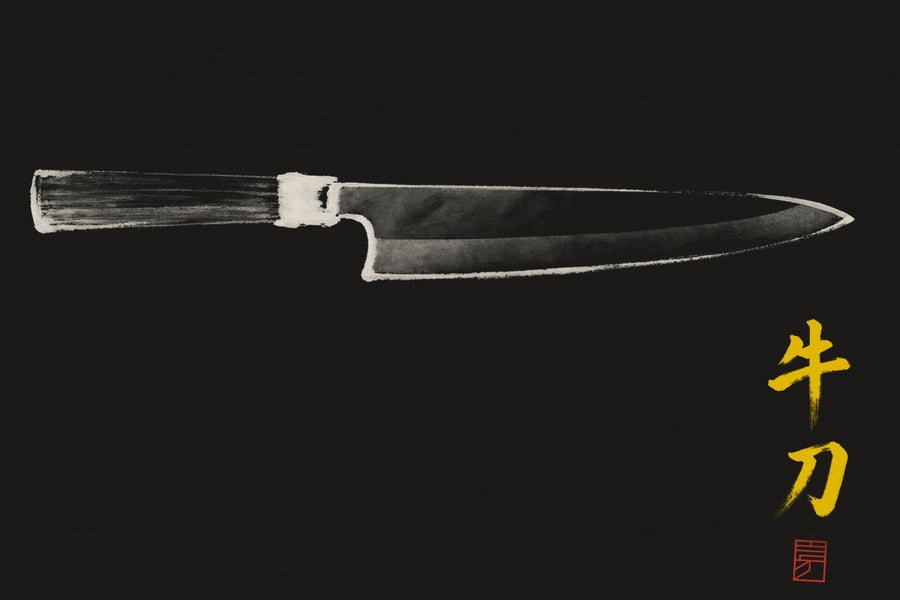
A Japanese chef's knife is known as a gyuto (牛刀 ぎゅうとう) gyūtō), literally meaning 'beef knife'. Its blade resembles a flatter version of a French chef's knife. Japanese cutlery is known for sharpness due to its acute blade geometry, and the hardness of the steel used, sometimes exceeding 60 HRC on the Rockwell Scale A typical western chef's knife may be sharpened to an edge angle of 20-22°, while a Japanese gyuto generally has a sharper edge angle of 15-18° (or even lower), which requires a harder, more brittle grade of steel. In recent years Japanese gyuto have gained in popularity with western chefs.

A modern chef's knife is a multi-purpose knife designed to perform well at many differing kitchen tasks, rather than excelling at any one in particular. It can be used for mincing, slicing, and chopping vegetables, slicing meat, and disjointing large cuts.
Composition

Blue 1 / Aogami #1 Element Composition

Compare with
    Blue 1 / Aogami #1
    1.5% 1.1% 0.8% 0.4% 0
    C Carbon 1.3%
    Primary hardening element. Raises hardness and wear resistance — but too much increases brittleness and corrosion susceptibility. As a reference: German 1.4112 (~0.5%) sits at the low end; VG-10 (~1.0%) is a common mid-range; SG2 (1.25–1.45%) and ZDP-189 (~3.0%) represent high and extreme ends respectively.
    C
    1.3%
    Cr Chromium 0.3%
    Raises corrosion resistance; 13%+ qualifies steel as stainless. Also improves hardenability and wear resistance. In kitchen use, higher chromium levels contribute to a slight drag or sticking sensation when cutting — a trade-off for the rust resistance it provides.
    Cr
    0.3%
    W Tungsten 1.5%
    Forms hard carbides for wear resistance and edge retention. Gives the steel hardness even at elevated temperatures.
    W
    1.5%
    Mn Manganese 0.2%
    Aids hardenability and strength. Acts as a deoxidiser during smelting. Excess can reduce toughness.
    Mn
    0.2%
    Si Silicon 0.1%
    Strengthens the steel matrix and acts as a deoxidiser. Improves hardness and resistance to oxidation.
    Si
    0.1%
    P Phosphorus 0.025%
    Impurity from the smelting process. Even small amounts cause brittleness — steelmakers keep this as low as possible.
    P
    0.025%
    S Sulfur 0.004%
    Impurity that reduces toughness and promotes brittleness. Intentionally added only in free-machining steels.
    S
    0.004%
    C — Carbon Cr — Chromium W — Tungsten Mn — Manganese Si — Silicon P — Phosphorus S — Sulfur
    Hardness 61–64 HRC
    555759616365+
    Steel
    Blue 1 / Aogami #1
    Category
    Carbon
    Manufacturer
    Hitachi Special Steel, Japan 🇯🇵
    Hardness
    61–64 HRC
    Steel

    Blue 1 / Aogami #1

    • Manufacturer
      • Hitachi Special Steel, Japan
    • Nature Carbon
    • Hardness61–64 HRC
    Blue Steel No.1, also known as Aogami #1 or Yasugi #1 Blue Steel, is a premium high carbon steel from Hitachi Metals Ltd, celebrated for its exceptional edge retention and toughness. This steel is an upgrade from Blue Steel No.2, enriched with higher carbon and tungsten content, making it a favorite for high-grade Japanese traditional single-bevel knives. It's known for being easy to sharpen, achieving a very fine edge that lasts. Despite its susceptibility to rust, with proper care and maintenance, including regular wiping and drying, it can develop a protective patina that minimizes rusting. Blue Steel No.1 is highly regarded among knife makers for its ability to achieve a mirror finish and maintain a sharp edge over extended periods, offering an outstanding balance of performance and durability.
    Construction: Sanmai - Soft Iron Clad
    Construction

    Sanmai - Soft Iron Clad

    Sanmai iron cladding is a traditional Japanese knife construction technique where a hard steel core is sandwiched between two layers of softer iron or steel. This method combines the superior edge retention and sharpness of high-carbon steel with the durability and ease of maintenance provided by the softer outer layers. The sanmai structure offers a balanced knife that is both flexible and resistant to breaking, ideal for precision cutting tasks. The softer outer layers also facilitate easier sharpening and contribute to the aesthetic appeal of the knife through the development of a unique patina over time. While sanmai-clad knives require careful maintenance to prevent rust, their exceptional performance and distinctive appearance make them often a desirable feature of Japanese knives.

    Finish: Kasumi
    Finish

    Kasumi

    A Kasumi finish refers to a traditional Japanese blade-finishing technique used on knives, particularly those made from a combination of soft iron and harder steel. The term "Kasumi" means "mist" in Japanese, aptly describing the hazy, matte appearance achieved on the blade's bevel where the two metals meet. This effect is not only aesthetic but also showcases the craftsmanship involved in blending these materials, highlighting the skill in creating a knife that is both beautiful and functional.

    Handle
    Handle

    Handle Specs

    • Profile Octagonal WA
    • Material
      • Ebony

    This handle, crafted from a single piece of ebony, exemplifies minimalist elegance and functional design. Its unique octagonal shape, featuring a subtle taper, offers a comfortable grip and a visually appealing geometric profile. The ebony wood, known for its deep, rich color and durability, has been meticulously milled from a single block, ensuring a seamless construction that highlights the wood's natural beauty and grain. The handle's surface has been highly polished, achieving a glossy finish that not only enhances the ebony's luxurious dark hue but also provides a smooth, tactile experience for the user. This design choice reflects a minimalist approach, focusing on simplicity, quality, and usability. The combination of the octagonal shape with the taper adds a modern twist to the classic material, making it a standout piece that blends traditional craftsmanship with contemporary aesthetics.

    1 / 5

    You May Also Like