PRAHRAN STORE NOW OPEN · THU–MON · 10AM–6PM

Drag to spin · pinch or scroll to zoom

Iron Clad  |  SKU: HIGONOKAMI_B2_M

Higonokami Aogami Folding Knife - Medium

Regular price $55.95

IMPORTANT: Carbon steel knives can rust or patina quickly if not cared for properly. They require regular cleaning, drying, and oiling. If you are unfamiliar with carbon steel maintenance, we recommend choosing a stainless steel option instead.

Sold out right now

Leave your email and we’ll send one message the moment it’s back in stock.

One email, no marketing. Privacy policy.

Availability

  • St Peters, NSW —
    2 Bishop St, Unit 2, St Peters NSW 2044
  • Crows Nest, NSW —
    107 West St, Shop 1, Crows Nest NSW 2065
    Pickup only
  • Prahran, VIC —
    180 Commercial Road, Shop 1, Prahran VIC 3181
    Pickup only
Detailed Specifications
Line Higonokami Aogami
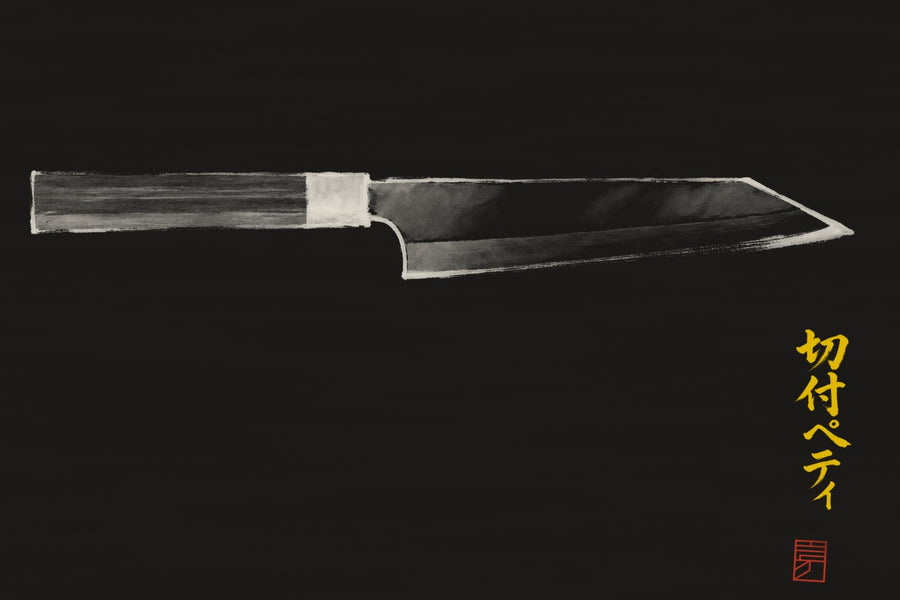
Profile K-tip Petty / K-tip utility knife
Weight 47 g | 1.7 oz
Edge Length 73 mm | 2 7/8″
Heel Height 15 mm | 19/32″
Width @ Heel 2.9 mm | 7/64″
Width @ Mid 2.9 mm | 7/64″
Width @ 1cm from Tip 2.6 mm | 7/64″
Steel Blue 2 / Aogami #2 | Carbon
Blade Construction Warikomi - Soft Iron Clad
Hardness (HRC) 61 - 63
Handle
Region Miki
Best for
  • Enthusiasts
  • Gift buyers
  • Free shipping for knives over AU$200 Australia wide.
  • World-wide shipping via DHL Express, 3 to 5 days.


Few Japanese knives have remained as simple and recognisable as the Higonokami. Created in the late 19th century in Miki, Hyogo, this traditional folding knife was once an everyday tool in Japan — used for everything from sharpening pencils and small craft work to the countless little cutting jobs where carrying a full-sized knife simply made no sense. More than a century later, the construction has barely changed, and that simplicity is really the charm.

The blade uses Aogami, or Blue Paper carbon steel, in a traditional warikomi construction, where the hard cutting steel is sandwiched into softer supporting material. It is a very straightforward combination, but also a very effective one: Aogami takes a keen edge, holds it well and remains pleasant to sharpen on normal whetstones. The blade is double bevelled, so there is no left- or right-handed limitation.

There is almost nothing unnecessary in the construction. A single sheet of brass is folded to form the handle, the blade rotates directly around the pivot, and the extended chikiri tang is used to open the knife and held under the thumb during use. There is no spring and no mechanical blade lock. Compared with a modern pocket knife it can initially feel almost primitive, but that simplicity is exactly what has allowed the design to survive for well over a century.

These are also knives that tend to look better with use. The brass handle gradually darkens and develops its own patina, while the carbon-steel blade will do the same. That also means it needs some care: Aogami is not stainless, so the blade should be wiped clean and dried after use, and occasional oiling is worthwhile if the knife is being stored for a long period.

Today there are countless folding knives that are more complicated, more polished and more mechanically sophisticated. A genuine Higonokami is appealing for almost the opposite reason. It is a small piece of Japanese tool-making history that remains inexpensive, practical and entirely usable — a knife reduced to little more than good carbon steel, brass and a pivot.

Pros Cons
  • Budget friendly
  • Ideal entry point to Japanese knives
  • Prone to rust
Care Instruction
  1. Don't cut hard things! Japanese knives are brittle so bone hacking is a NO NO!
  2. Wash with neutral detergent after use, and wipe dry;
  3. Please don't wash knife with dishwasher, it will damage the wood handle;
  4. Be careful not to leave the knife close to a heat source for a long time;
  5. It is a lot more dangerous to cut with a blunt knife than a sharp knife!
  6. It is best to sharpen a Japanese knife regularly on a waterstone.
  7. Oil the (carbon) knife if storing for an extended period of time to prevent rust.

Nagao Kanekoma Factory

Nagao Kanekoma Factory (永尾かね駒製作所), Miki, maker of the Higonokami

Nagao Kanekoma Factory (株式会社 永尾かね駒製作所) is a knife maker in Miki, Hyogo, and the maker of the Higonokami (肥後守) folding knife. Its own site says the first generation, Komataro Nagao, began making knives in 1894, and that its current head, Mitsuo Nagao (永尾光雄), is the fifth generation.

We stock its Higonokami folding knives in pocket, small, medium and large sizes.

Read more

The company's history page says knives were first made in Hirata, now part of Miki, in the Meiji 20s, and names Komataro Nagao among the first makers. Around 1894, it says, a hardware wholesaler, Shigematsu (重松太三郎), is said to have devised the chikiri, the lever that lets the blade fold into the handle, working from a knife brought back from Kagoshima.

The page says the knife was sold as the Higonokami because most customers were in southern Kyushu, mainly Kumamoto. According to the page, a Higonokami knife cooperative formed in 1899 and grew to 40 registered makers at its peak, and in 1910 the name was registered as a trademark that only members of the Miki cutlery makers' cooperative could use.

Box cutters, electric pencil sharpeners and a campaign against knives in the Showa 30s hit production and sales, the page says, and Nagao Kanekoma Factory is now the only company that can use the Higonokami trademark.

“A Miki maker of Higonokami folding knives. The company says its knife making spans five generations.”

Est. 1894 | 明治27年
Known for The Higonokami (肥後守) folding knife
Website higonokami.jp Instagram @higonokami.kanekoma Facebook 肥後守 Read more about Nagao Kanekoma Factory

Nagao Kanekoma Factory · Miki

Knife details

Frequently asked questions

Will a carbon steel knife rust, and how do I look after it?

Yes, carbon steels such as Aogami (Blue) and Shirogami (White) react with food, moisture, and acids, so left wet they can spot or rust. With normal use they develop a grey, blue and brown patina, and that patina is expected on a carbon knife rather than damage.

Aogami has only a little chromium, far below what a stainless steel needs, so water left sitting on the blade will spot it. A patina is a stable oxide layer that slows rust down; orange or red specks are rust.

Care is simple once it becomes habit:

  • Wipe the blade as you go, especially after onion, citrus or tomato.
  • When you finish, wash it in warm water with a little soap and dry it straight away with a towel. Don't let it air dry or leave it in the sink or the dish rack, and never put it in the dishwasher.
  • Store it dry: on a magnetic strip, in a saya or in a block in a dry spot.
  • If it's going to sit unused for a while, wipe on a thin film of food-safe mineral oil before storing it.

If you do find rust, lift light orange spots with a rust eraser and a little water, then dry and oil the blade. We stock the CKK and Naniwa rust erasers, and the Koyo Sunlite Polishing Paste (Blue for Steel) lifts light surface rust or refreshes a finish. Rust on the edge itself comes off the next time you sharpen. Deep pitting needs a professional sharpener. Avoid steel wool and harsh scouring on a polished or kurouchi finish, because they scratch it.

On a stainless-clad knife only the thin line of carbon steel along the edge can rust; the cladding stays clean. A carbon-clad or honyaki blade can rust over its whole face and needs the same care all over.

Carbon steel rewards this small amount of attention with a keener edge and easier sharpening than most stainless.

What is the difference between Blue 2 and White 2 steel?

Proterial lists 1.05 to 1.15% carbon for both steels; its Blue 2 table lists 0.20 to 0.50% chromium and 1.00 to 1.50% tungsten, while its White 2 table lists neither.

Proterial describes White 2 as a carbon steel with minimum impurities and high hardness, and Blue 2 as an alloy steel with tungsten and chromium to improve heat-treatment properties and wear resistance, with a hardening hardness of over 60 HRC for both. Neither steel is close to the JSSA's 10.5% minimum for stainless.

Is Nagao Kanekoma the maker of the Higonokami?

Yes. The Higonokami (肥後守), a folding pocket knife, is made by Nagao Kanekoma in Miki City, Hyogo.

The company's own site dates its start to 1894 and counts five generations of makers down to Mitsuo Nagao, saying its line is the only one passed down among Higonokami makers.

You May Also Like