PRAHRAN STORE NOW OPEN · THU–MON · 10AM–6PM

Drag to spin · pinch or scroll to zoom

Tsunehisa  |  SKU: TNHS_B2KU_SU27

Tsunehisa Blue 2 "Samurai" Sakimaru Sujihiki 270mm, Nenox-style Handle

Regular price $399.95

IMPORTANT: Carbon steel knives can rust or patina quickly if not cared for properly. They require regular cleaning, drying, and oiling. If you are unfamiliar with carbon steel maintenance, we recommend choosing a stainless steel option instead.

Sold out right now

Leave your email and we’ll send one message the moment it’s back in stock.

One email, no marketing. Privacy policy.

Availability

  • St Peters, NSW —
    2 Bishop St, Unit 2, St Peters NSW 2044
  • Crows Nest, NSW —
    107 West St, Shop 1, Crows Nest NSW 2065
    Pickup only
  • Prahran, VIC —
    180 Commercial Road, Shop 1, Prahran VIC 3181
    Pickup only
Detailed Specifications
Line Tsunehisa Samurai Blue2 Kurouchi
Profile Sujihiki / Slicing knife
Bevel Type Double Bevel
Weight 284 g | 10.0 oz
Edge Length 285 mm | 11 7/32″
Heel Height 38 mm | 1 1/2″
Width @ Heel 4.8 mm | 3/16″
Width @ Mid 3.1 mm | 1/8″
Width @ 1cm from Tip 1.2 mm | 3/64″
Steel Blue 2 / Aogami #2 | Carbon
Blade Construction Sanmai - Soft Iron Clad
Hardness (HRC) 61 - 63
Surface Finish Kurouchi
Handle
Region Fukuyama
Best for
  • Enthusiasts
  • Collectors
  • Free shipping for knives over AU$200 Australia wide.
  • World-wide shipping via DHL Express, 3 to 5 days.


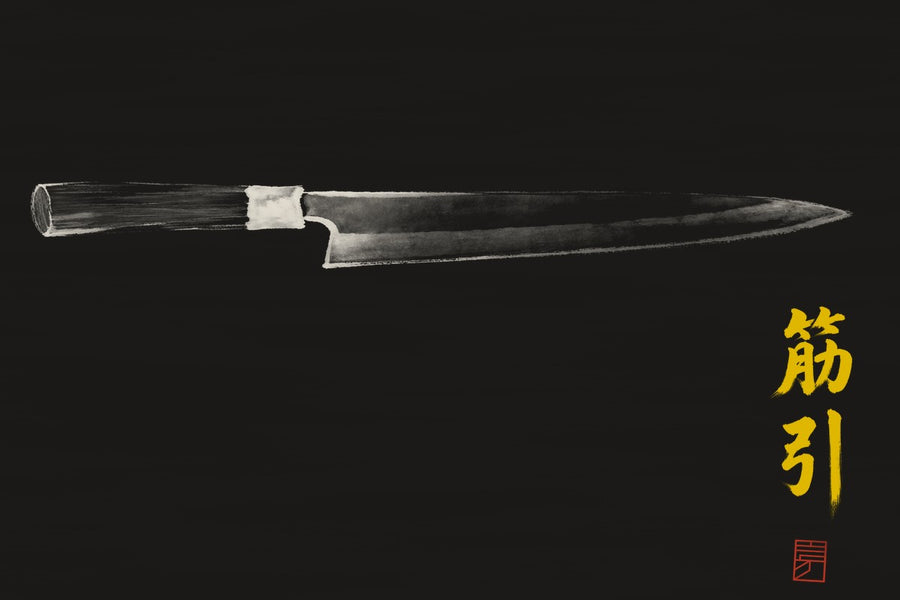
There is something quite unapologetic about the Tsunehisa Samurai B2 Sakimaru. Most sujihiki are made light and slender, almost disappearing in the hand during a long slicing stroke. This one goes in a different direction. The blade carries a noticeably substantial spine and some real weight, combined with the long sweeping edge and distinctive Sakimaru tip that give the knife its almost sword-like appearance. It isn't trying to be a laser slicer; instead, the mass of the blade helps carry it smoothly through a long draw cut, particularly when portioning larger pieces of meat or fish.

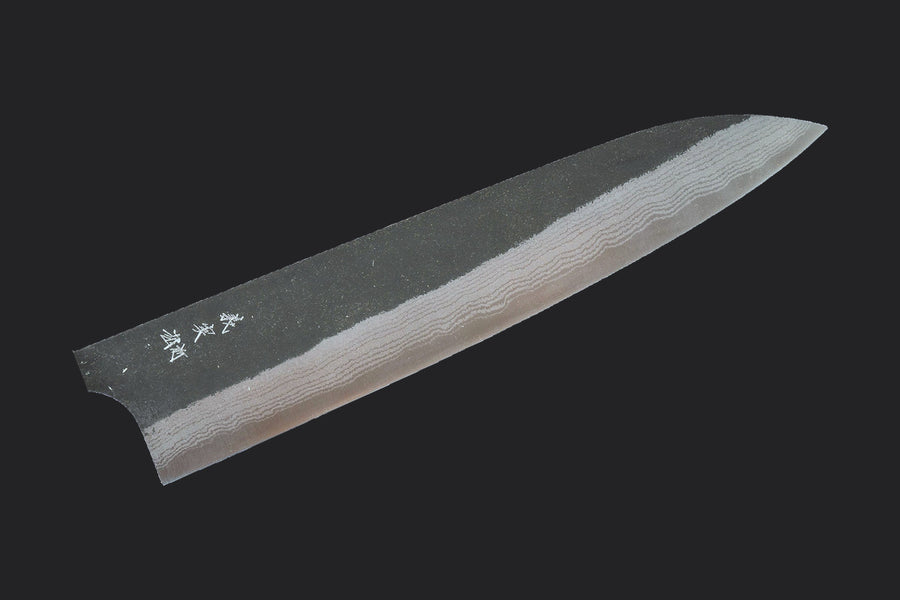
At the centre is Aogami #2, or Blue #2 carbon steel, hardened to around 62 HRC. Blue #2 remains one of my favourite traditional Japanese carbon steels because it sits in a very practical middle ground: it takes a very keen edge, holds it well, but is still relatively friendly on the stones when it eventually needs sharpening. The core is clad in soft iron with a dark kurouchi finish, giving the Samurai a very traditional, almost rustic appearance that suits the shape surprisingly well. This is a fully reactive construction, though, so both the exposed core and iron cladding need to be kept clean and dry. Patina is very much part of owning one of these.

Despite the Sakimaru appearance, this should be understood as a double-bevel Sakimaru Sujihiki rather than a traditional single-bevel Sakimaru Yanagiba. That makes it considerably more approachable for anyone already familiar with normal double-bevel Japanese knives. The long curved profile works particularly nicely with a draw-cutting motion, while the elevated rounded tip gives you plenty of control when starting or finishing a slice and is also useful for finer scoring work.

For me, the appeal of the Samurai is really the combination of presence and practicality. It has the dramatic profile people normally associate with much more specialised Japanese slicers, but underneath that appearance is a straightforward Blue #2 double-bevel knife that can actually be used without learning an entirely different sharpening technique. If you want a lightweight, delicate sujihiki, there are better options. If you want a serious carbon-steel slicer with some weight behind the cut and a lot of personality, this one makes considerably more sense.

Pros Cons
  • Great artistic
  • Workhorse grind
  • Need extra care
  • Heavy
Care Instruction
  1. Don't cut hard things! Japanese knives are brittle so bone hacking is a NO NO!
  2. Wash with neutral detergent after use, and wipe dry;
  3. Please don't wash knife with dishwasher, it will damage the wood handle;
  4. Be careful not to leave the knife close to a heat source for a long time;
  5. It is a lot more dangerous to cut with a blunt knife than a sharp knife!
  6. It is best to sharpen a Japanese knife regularly on a waterstone.
  7. Oil the (carbon) knife if storing for an extended period of time to prevent rust.

Tsunehisa

Tsunehisa, the house brand of Shibata Knives

Tsunehisa (恒久) is the house brand of Shibata Knives, the knife company Takayuki Shibata owns and runs. It is a brand rather than a single workshop.

The name means permanence, and Shibata Knives says it chooses knives that will have a long life. Takayuki Shibata started Tsunehisa in 2015 as his third knife brand, to help manage growing orders.

Read more

Shibata Knives describes Tsunehisa as a brand that inherits traditional Japanese forging techniques while taking in the latest materials and technologies, aiming at function and design for long use. It says its experienced staff inspect each knife under strict quality control, and it offers after-sales maintenance and sharpening.

The lines we list are grouped by steel. Ginsan comes in migaki, nashiji and nawame finishes, as gyuto, santoku, nakiri and petty, with a deba in the same steel. White 1 comes stainless clad as migaki and tsuchime gyuto, Aogami Super as kurouchi tsuchime sujihiki and petty, and Blue 2 as the Samurai sakimaru sujihiki.

The Damascus lines are in VG10, AUS10 and ZA18, the AUS10 also with a tsuchime finish. The rest are AUS8 tsuchime, a VG1 gyuto and an SLD Washiji santoku. Handles come in wa and yo styles.

“The house brand of Shibata Knives; the name means permanence.”

Est. 2015 | 平成27年
Known for Knives chosen and inspected by Shibata Knives
Read more about Tsunehisa

Tsunehisa · Fukuyama

Knife details

Frequently asked questions

What size sujihiki should I buy?

Between 210 and 270 mm, depending on where it will work. One Japanese maker lists 210 to 240 mm, double-bevel, for home use and 240 to 270 mm, single- or double-bevel, for professional kitchens.

Another, in Sakai, recommends 240 mm at home, with the size of your board in mind, and 270 mm for professional use.

Sujihiki or yanagiba: which do I need?

A sujihiki is a long, double-bevel knife for dividing larger pieces of meat into their parts, and its length lets it slice sashimi too; a yanagiba is the sashimi knife.

The Sakai cutlery association describes the yanagiba (柳刃包丁) edge as so acute that it cannot be used on bone or other hard things, so choose the sujihiki for meat and the yanagiba if sashimi is the main job.

Will a carbon steel knife rust, and how do I look after it?

Yes, carbon steels such as Aogami (Blue) and Shirogami (White) react with food, moisture, and acids, so left wet they can spot or rust. With normal use they develop a grey, blue and brown patina, and that patina is expected on a carbon knife rather than damage.

Aogami has only a little chromium, far below what a stainless steel needs, so water left sitting on the blade will spot it. A patina is a stable oxide layer that slows rust down; orange or red specks are rust.

Care is simple once it becomes habit:

  • Wipe the blade as you go, especially after onion, citrus or tomato.
  • When you finish, wash it in warm water with a little soap and dry it straight away with a towel. Don't let it air dry or leave it in the sink or the dish rack, and never put it in the dishwasher.
  • Store it dry: on a magnetic strip, in a saya or in a block in a dry spot.
  • If it's going to sit unused for a while, wipe on a thin film of food-safe mineral oil before storing it.

If you do find rust, lift light orange spots with a rust eraser and a little water, then dry and oil the blade. We stock the CKK and Naniwa rust erasers, and the Koyo Sunlite Polishing Paste (Blue for Steel) lifts light surface rust or refreshes a finish. Rust on the edge itself comes off the next time you sharpen. Deep pitting needs a professional sharpener. Avoid steel wool and harsh scouring on a polished or kurouchi finish, because they scratch it.

On a stainless-clad knife only the thin line of carbon steel along the edge can rust; the cladding stays clean. A carbon-clad or honyaki blade can rust over its whole face and needs the same care all over.

Carbon steel rewards this small amount of attention with a keener edge and easier sharpening than most stainless.

What is the difference between Blue 2 and White 2 steel?

Proterial lists 1.05 to 1.15% carbon for both steels; its Blue 2 table lists 0.20 to 0.50% chromium and 1.00 to 1.50% tungsten, while its White 2 table lists neither.

Proterial describes White 2 as a carbon steel with minimum impurities and high hardness, and Blue 2 as an alloy steel with tungsten and chromium to improve heat-treatment properties and wear resistance, with a hardening hardness of over 60 HRC for both. Neither steel is close to the JSSA's 10.5% minimum for stainless.

What does the name Tsunehisa mean?

Tsunehisa (恒久) means permanence. Shibata Knives describes Tsunehisa as its original brand, and says it selects knives that will have a long life, inspecting each one before delivery. Its own words are that it delivers knives worthy of a permanent position in your home.

The brand is built on traditional Japanese forging techniques with modern materials, and Shibata Knives offers after-sales maintenance and sharpening for the line.

Is Tsunehisa a brand or a blacksmith?

Tsunehisa is a brand, not a single smith or a workshop. Shibata Knives describes it as an original brand of the company, run by Takayuki Shibata, and Shibata Knives does not name the workshop that makes each line. The company inherits traditional Japanese forging techniques with modern materials, and experienced staff inspect each knife before it is delivered.

What stands behind each Tsunehisa knife is that selection and inspection, and the company offers after-sales maintenance and sharpening for the line.

You May Also Like