PRAHRAN STORE NOW OPEN · THU–MON · 10AM–6PM

Tosa  |  SKU: TOSA_BKSSK_YG270

Tosa Tanren SK Steel Yanagiba 270mm

Regular price $169.95

IMPORTANT: Carbon steel knives can rust or patina quickly if not cared for properly. They require regular cleaning, drying, and oiling. If you are unfamiliar with carbon steel maintenance, we recommend choosing a stainless steel option instead.

Sold out right now

Leave your email and we’ll send one message the moment it’s back in stock.

One email, no marketing. Privacy policy.

Availability

  • St Peters, NSW —
    2 Bishop St, Unit 2, St Peters NSW 2044
  • Crows Nest, NSW —
    107 West St, Shop 1, Crows Nest NSW 2065
    Pickup only
  • Prahran, VIC —
    180 Commercial Road, Shop 1, Prahran VIC 3181
    Pickup only
Detailed Specifications
Line Tosa Tanren SK Steel Single Bevels
Profile Yanagiba / Sashimi knife
Bevel Type Single Bevel
Weight 199 g | 7.0 oz
Edge Length 264 mm | 10 25/64″
Heel Height 34 mm | 1 11/32″
Width @ Heel 3.6 mm | 9/64″
Width @ Mid 3.2 mm | 1/8″
Width @ 1cm from Tip 1.2 mm | 3/64″
Steel SK Steel | Carbon
Blade Construction Nimai - Soft Iron Clad
Hardness (HRC) 58 - 62
Surface Finish Kasumi
Handle Octagonal Teak Handle
Region Tosa
Best for
  • First-timers
  • Pro chefs
  • Free shipping for knives over AU$200 Australia wide.
  • World-wide shipping via DHL Express, 3 to 5 days.


The Tosa Tanren(土佐鍛錬, Tosa Forging) SK Steel is some of the best entry level option for single bevel knives. Despite not having the most premium steel and the fancy look, it is a very competent tool for the job, and an even better tool for people to learn how to live with a traditional deba.

The SK steel may not be a commonly seen grade. It is a JIS grade high carbon steel that is not a part of the Hitachi Yasugi steel family, but have a similar carbon content as White #3 at 0.8-0.9%. It may not seem to be a lot but in typical western smithy the 1084 and 1095(with 0.84% and 0,95% carbon respectively) would already be seen as pretty high carbon steel. So, although it might not be premium, the SK is not gonna be anywhere near a poor steel to make knife with. Instead, since it's priced to be very beginner friendly, a steel that is easier to sharpen will pair very well with an entry level stone and allows a beginner to learn how to sharpen single bevel knives much easier.

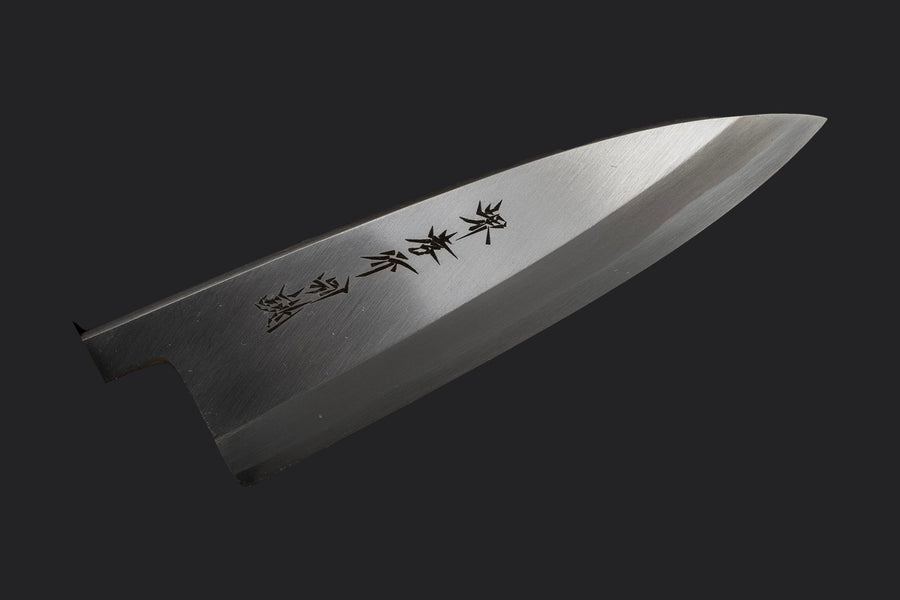
The highlight is the sharpener, which is the renowned Myojin Riki Sesakusho. As far as we know, the sharpening and polishing of the single bevels are not done by Naohito Myojin, but the level of finish achieved on these blades are pretty high. You can rarely spot any defects of unevenness over the Migaki finished Urasuki and the flat hira, and the corner on the spine is lightly touched up to smoothen out the sharp edge. I really can’t ask much for an entry level knife lineup at this price.

This is a line that aimed clearly towards the beginner market, and for a single bevel user, I would highly recommend getting a set of properly built knives so you could understand and familiarise yourself with how a traditional Japanese blade behaves, whether when using it or when sharpening it. The SK line is a humble beginning that is well suited for this purpose, and along with the great fit and finish, they’ve got great value too.

Pros Cons
  • Excellent fit and finish
  • Budget friendly
  • Great for professionals
  • Prone to rust
  • Non-premium steel
Care Instruction
  1. Don't cut hard things! Japanese knives are brittle so bone hacking is a NO NO!
  2. Wash with neutral detergent after use, and wipe dry;
  3. Please don't wash knife with dishwasher, it will damage the wood handle;
  4. Be careful not to leave the knife close to a heat source for a long time;
  5. It is a lot more dangerous to cut with a blunt knife than a sharp knife!
  6. It is best to sharpen a Japanese knife regularly on a waterstone.
  7. Oil the (carbon) knife if storing for an extended period of time to prevent rust.

Myojin Riki

Myojin Riki Seisakusho, a Tosa knife workshop

Myojin Riki Seisakusho (明神利器製作所) is a knife workshop in Uranouchi, Susaki, Kochi. It is headed by Naohito Myojin, son of Tateo Myojin.

Kochi City's page on Tosa crafts describes the workshop as carrying work from forging to finishing in one continuous process. The page says it sharpens a hamaguri-ba (蛤刃) edge, ground convex, a technique learned through several years of training in Fukui, and that it also takes sharpening-only orders from outside Kochi Prefecture.

Among the lines we list, the Hatsukokoro x Myojin Shirasagi single-bevel knives cover Blue 2 kurouchi yanagiba, K-tip yanagiba, sakimaru yanagiba and honesuki, White 2 deba, left-handed mioroshi deba, left-handed yanagiba and honesuki, and a Ginsan yanagiba. We also list Myojin Cobalt Special gyuto, santoku and bunka.

“A Tosa workshop in Susaki, Kochi, described by Kochi City's craft page as working from forging through finishing.”

Known for A convex hamaguri-ba edge, as Kochi City's craft page describes
Instagram @tetsujin_labo Read more about Myojin Riki

Myojin Riki · Tosa

Knife details

Frequently asked questions

What is a yanagiba knife used for in sushi preparation?

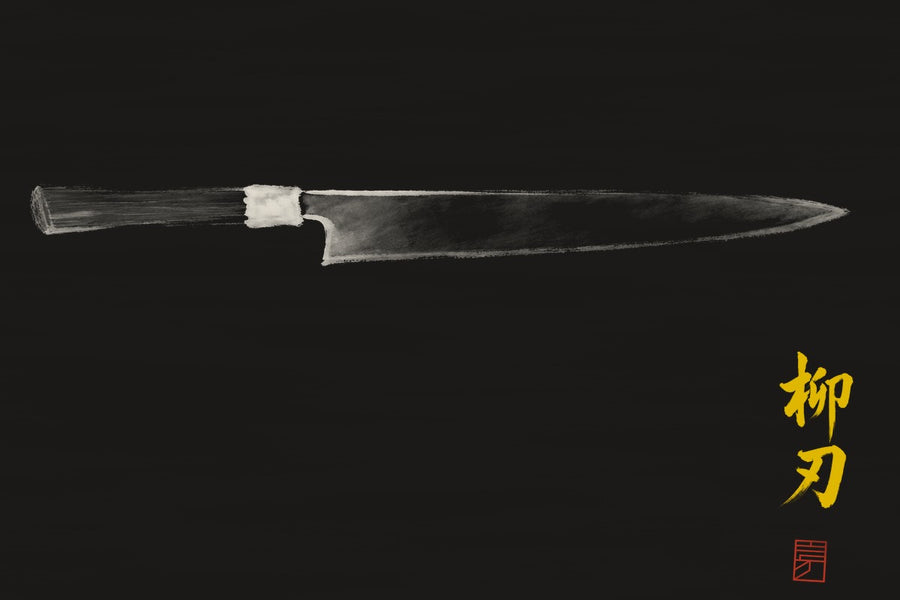
A yanagiba (柳刃包丁) is a sashimi knife for slicing raw fish. A knife maker's guide says a sashimi knife cuts without breaking the fibres of the flesh, and that it is longer and narrower than other knives because slicing sashimi with crisp edges needs the length.

The whole length goes through one pulling cut. The Sakai cutlery association calls the yanagiba the sashimi knife used mainly in the Kansai region.

What size yanagiba should I buy?

Size a yanagiba to the fish you prepare: a knife maker's guide gives 270 to 360 mm for professional use and 240 to 270 mm for home use, with 270 mm at home if you slice larger fish.

The guide says the whole length goes through one pulling cut, so do not choose too short a knife, and at home it points to the size of your board and your work space. We list the yanagiba (柳刃) from 210 to 360 mm, some made for left-handed use.

Can a yanagiba cut through fish bones?

No. The Sakai cutlery association describes the yanagiba (柳刃包丁) edge as so acute that it cannot be used on hard things such as bones.

For bones the association describes the deba (出刃包丁), whose heel is used to hit them.

Is SK steel stainless?

No. SK is the symbol for the carbon tool steels in JIS G 4401, and in the table Kobe Steel publishes, chromium may not exceed 0.30% in any SK grade.

The Japan Stainless Steel Association defines stainless steel as an alloy with at least 10.5% chromium, so SK steel is not stainless. We suggest washing and drying the knife after use.

What does a Myojin Riki hamaguri-ba (clam) edge mean?

A hamaguri-ba edge, written 蛤刃, is a convex edge shape, and it is the shape the workshop 明神利器製作所 sharpens its knives to. Kochi City's craft page records that Myojin Riki learned it over several years of training in Fukui.

The same page says the workshop also takes sharpening-only orders from outside Kochi.

Does Myojin Riki forge its own knives?

Yes. Kochi City's craft page for his workshop 明神利器製作所 says the work runs from forging through finishing in one continuous process, 鍛造から仕上げまで一貫して行う.

That page lists the workshop in Susaki, Kochi.

You May Also Like