PRAHRAN STORE NOW OPEN · THU–MON · 10AM–6PM

Hatsukokoro  |  SKU: HT-KMOB1D-PT165

Hatsukokoro Komorebi Blue 1 Damascus Petty 165mm

Sale price $339.98 Regular price $399.95

IMPORTANT: Carbon steel knives can rust or patina quickly if not cared for properly. They require regular cleaning, drying, and oiling. If you are unfamiliar with carbon steel maintenance, we recommend choosing a stainless steel option instead.

Sold out right now

Leave your email and we’ll send one message the moment it’s back in stock.

One email, no marketing. Privacy policy.

Availability

  • St Peters, NSW —
    2 Bishop St, Unit 2, St Peters NSW 2044
  • Crows Nest, NSW —
    107 West St, Shop 1, Crows Nest NSW 2065
    Pickup only
  • Prahran, VIC —
    180 Commercial Road, Shop 1, Prahran VIC 3181
    Pickup only

Goes well with

Detailed Specifications
Line Hatsukokoro Komorebi Blue 1 Damascus
Profile Petty / Utility knife
Bevel Type Double Bevel
Weight 113 g | 4.0 oz
Edge Length 155 mm | 6 7/64″
Heel Height 34 mm | 1 11/32″
Width @ Heel 3.3 mm | 1/8″
Width @ Mid 1.5 mm | 1/16″
Width @ 1cm from Tip 1.0 mm | 3/64″
Steel Blue 1 / Aogami #1 | Carbon
Blade Construction Sanmai - Soft Iron Damascus Clad
Typical hardness 61 to 64 HRC
Surface Finish Kasumi
Handle Octagonal Ebony with Black Horn Ferrule
Region Hyogo
Best for
  • Collectors
  • Enthusiasts

Free shipping for knives over AU$200 Australia wide.

World-wide shipping via DHL Express, 3 to 6 days (not available in the UK).


Hatsukokoro's Komorebi(木漏れ日) Blue 1 Damascus line is something completely new to the market when it was first brought to the market in 2022. The name in Japanese describes the sunlight that streams through the trees, which is a very clam and peaceful natural scene. And the reason behind this name is the beautiful natural stone finish that the blade been put through, complemented by the organic cladding line across the edge.

Natural stone finish. Rarely a Japanese kitchen knife is finished on a natural stone. Shigefusa probably being the only one that I could name on top of my head. Doing it this way significantly increases the overall level of the F&F of the knife, and is very unique given that Shigs can’t be easily obtained these days.

Many of the knife enthusiasts prefer the larger Sanjo / Echizen profile to the shorter Sakai profile, as a result we are offering the Komoberi in a more traditional Sanjo profile that is very tall, and the length is true edge length rather than tip to machi length. The heel is also quite significant along with a pronounced distal taper, translating into a very thin thickness behind the edge.

These features really make the Komorebi line stand out, and in some sense a one-of-a-kind line, yet the presentation of these blades are done in a subtile way, while in my opinion aligns with the poetic Japanese aesthetic very well.

Pros Cons
  • Great artistic
  • Highly collectable
  • Exceptional profile
  • Prone to rust
  • Need extra care
Care Instruction
  1. Don't cut hard things! Japanese knives are brittle so bone hacking is a NO NO!
  2. Wash with neutral detergent after use, and wipe dry;
  3. Please don't wash knife with dishwasher, it will damage the wood handle;
  4. Be careful not to leave the knife close to a heat source for a long time;
  5. It is a lot more dangerous to cut with a blunt knife than a sharp knife!
  6. It is best to sharpen a Japanese knife regularly on a waterstone.
  7. Oil the (carbon) knife if storing for an extended period of time to prevent rust.

Hatsukokoro

Hatsukokoro, a knife brand from Amagasaki

Hatsukokoro (初心) is a knife brand from Amagasaki, Hyogo, launched in 2019. It is a brand rather than a forge: it works with knife makers instead of forging itself.

The name comes from the proverb 初心忘るべからず, roughly never forget your beginner's mind. For the same characters the brand chose the gentler reading hatsukokoro over shoshin.

The brand's own catalogue names the place behind some of its lines, and the maker behind a few: Shinkiro comes from Fukushima, and Hayabusa HAP40, Saihyo and Sunaarashi from Seki City, while for others the maker or the place stays private. Some of our listing titles also carry the maker alongside the brand, such as Hatsukokoro x Yoshikane and the Hatsukokoro x Yoshihiro Yauji collaboration.

The Hatsukokoro lines we list include both carbon and stainless steels. Our listings include Hayabusa in SG2 and Aogami Super, Saihyo in SG2 and Ginrei in Ginsan. Carbon steel kurouchi lines include Aosagi, Aokitae, Kurokaze and Kurogane.

“A knife brand from Amagasaki that works with knife makers rather than forging.”

Est. 2019 | 令和元年
Known for Lines made with partner makers, from Seki City to Fukushima
Website handk.co Instagram @handk_official Read more about Hatsukokoro

Hatsukokoro · Hyogo

Knife details

Petty — knife profile
Profile

Petty

ペティ

Utility knife · Double bevel

Small, slim double-bevel utility knife for peeling, trimming and small board jobs.

Read more
Steel properties
  1. Hardness Good
  2. Edge retention Low
  3. Toughness Good
  4. Rust resistance Low
  5. Ease of sharpening High
  6. Sharpness Very high

Our ratings, inferred from published lab tests and composition.

Steel

Blue 1 / Aogami #1

青一鋼

Carbon · Hitachi Metals (now Proterial)

Proterial carbon steel, 1.25 to 1.35% carbon with chromium and tungsten; not stainless.

Read more
CladdingCoreClad line
Construction

Sanmai - Soft Iron Damascus Clad

三枚・軟鉄ダマスカス

3 layers · iron damascus clad

Hard core between two soft iron damascus layers. The iron patinas and rusts; keep it dry.

Read more
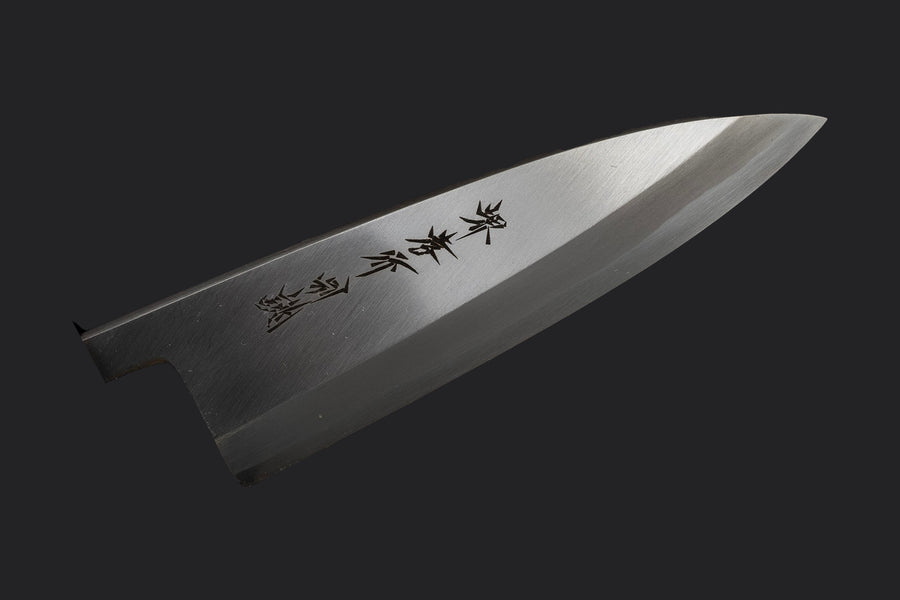
Kasumi — blade surface finish
Finish

Kasumi

Misty polish

Hazy, matte bevel where soft iron meets hard core steel. The iron patinas and rusts.

Read more
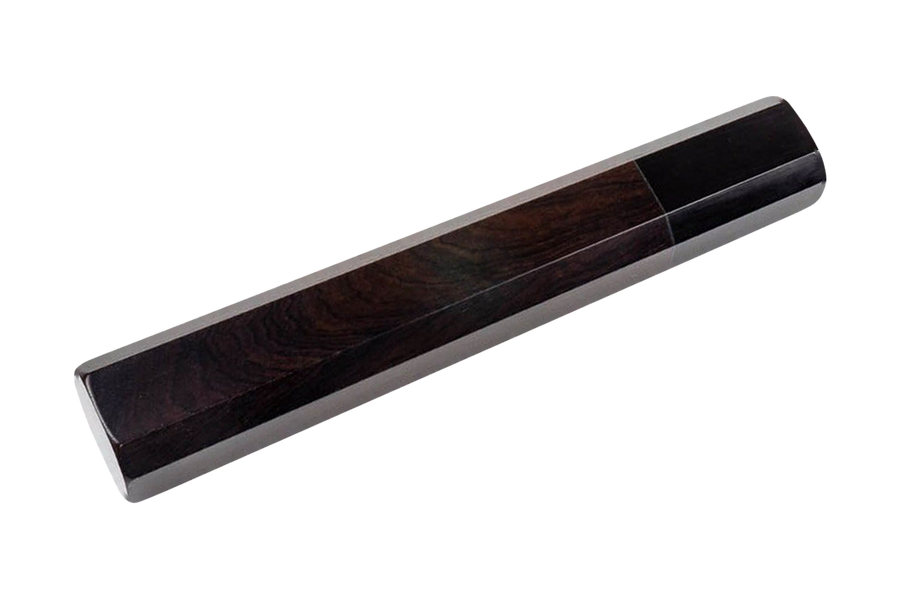
Octagonal Ebony with Black Horn Ferrule handle
Handle

Octagonal Ebony with Black Horn Ferrule

Octagonal WA

Ebony, eight-sided, with a black buffalo horn ferrule: the standard all-black wa handle.

Frequently asked questions

What is a petty knife and when do I need one?

A petty is a small utility knife, from the French petit. It is commonly shaped like a small gyuto and runs from 120 to 150 mm, up to 180 mm. Its clearest role is detailed work where a larger knife feels cumbersome: fruit peeling, garnish work, condiments, and small board work beside a gyuto or santoku.

A knife maker, Tojiro, frames the petty as a useful second knife, not an automatic necessity, and recommends santoku plus petty or gyuto plus petty combinations. It is not a replacement for a full size chef's knife; it lacks the blade length and belly for efficient chopping, rocking, or breaking down larger proteins. Treat it as a precision tool, not an all-rounder.

How long is a petty knife?

Petty knife lengths vary by maker: KAI's guide defines a petty (ペティナイフ) as a small knife with a narrow blade measuring 150 mm or under. Its table gives 90 to 150 mm, and it describes the shape as a smaller gyuto with a pointed tip.

We list petty knives from 70 mm to 165 mm, including lengths above the limit used in KAI's guide.

Will a carbon steel knife rust, and how do I look after it?

Yes, carbon steels such as Aogami (Blue) and Shirogami (White) are not stainless steels, so left wet they can spot or rust.

Care is simple once it becomes habit. Wipe the blade as you go, especially after acidic food like citrus, tomato or onion. When you finish, wash it in warm water with a little soap and dry it straight away with a towel. Do not let it air dry, leave it in the sink or the dish rack, or put it in the dishwasher. Store it dry: on a magnetic strip, in a saya or in a block in a dry spot.

If the knife will sit unused for a while, wipe on a thin layer of oil before storing. In our video James shows that mineral oil can stand in for camellia (tsubaki) oil, and he picks one labelled medical grade; we list the Kitchen Knife / Cutting Board Mineral Oil Medical Grade for this. If you find light rust, lift it with a rust eraser and a little water, then dry and oil the blade; we list the CKK and Naniwa rust erasers.

What is the difference between Blue 1 and Blue 2?

Proterial, which makes both, describes each the same way: an alloy steel with tungsten and chromium added to improve heat-treatment properties and wear resistance, hardening to over 60 HRC. In its Japanese materials, Proterial calls its Aogami (青紙) steels high-carbon steel (高炭素鋼).

Its figures give Blue 1 more carbon and tungsten, 1.25 to 1.35% carbon and 1.50 to 2.00% tungsten against Blue 2's 1.05 to 1.15% and 1.00 to 1.50%, with chromium of 0.30 to 0.50% against 0.20 to 0.50%.

Is Hatsukokoro a maker or a brand, and who makes the knives?

Hatsukokoro (初心) is a brand, not a forge. H&K, a company founded in 2013 and based in Amagasaki, Hyogo, created it in 2019.

H&K names the producer for some lines, for example Shinkiro by Takahiro Nihei in Fukushima, Ginyou by Yoshihiro Yauji in Echizen and Kurosagi by Motokyuichi Hamono in Nagasaki, and keeps others confidential. Some knives we stock carry the maker in the title, such as Hatsukokoro x Yoshikane SKD Nashiji.

What does the name Hatsukokoro mean?

The name comes from the Japanese proverb 初心忘るべからず, which means don't forget your original intention. The company read it gently as hatsukokoro rather than shoshin.

H&K created the brand in 2019, six years after the company was founded, and chose the name for its knife line.

Which Hatsukokoro line should I pick, carbon or stainless?

Pick by how much care you want to give. The carbon lines, Blue 1, Blue 2 and AS kurouchi, need drying and a little oil after use. The SG2, HAP40, Ginsan and VG10 lines are low maintenance, so they suit a busy kitchen or someone who just wants to cook.

Neither is better; it depends on your routine. If you will dry and oil the blade after each use, a carbon line can suit you, and if you want the least fuss, a stainless line is the easier choice.

You May Also Like