PRAHRAN STORE NOW OPEN · THU–MON · 10AM–6PM

Myojin Riki  |  SKU: MYOJ_SGMG_NA180

Myojin Riki Seisakusho SG2 Kasumi Nakiri 180mm Ebony Handle

Sale price $509.98 Regular price $599.95

Sold out right now

Leave your email and we’ll send one message the moment it’s back in stock.

One email, no marketing. Privacy policy.

Availability

  • St Peters, NSW —
    2 Bishop St, Unit 2, St Peters NSW 2044
  • Crows Nest, NSW —
    107 West St, Shop 1, Crows Nest NSW 2065
    Pickup only
  • Prahran, VIC —
    180 Commercial Road, Shop 1, Prahran VIC 3181
    Pickup only

Goes well with

Detailed Specifications
Line Myojin Riki Seisakusho SG2
Profile Nakiri / Japanese vegetable knife
Bevel Type Double Bevel
Weight 184 g | 6.5 oz
Edge Length 170 mm | 6 11/16″
Heel Height 50 mm | 1 31/32″
Width @ Heel 2.2 mm | 3/32″
Width @ Mid 2.2 mm | 3/32″
Width @ 1cm from Tip 1.9 mm | 5/64″
Steel SG2 / R2 | Powdered | Stainless
Blade Construction Sanmai - Stainless Clad
Typical working hardness 61 to 65 HRC
Surface Finish Kasumi
Handle Octagonal Ebony
Region Tosa
Best for
  • Pro chefs
  • Enthusiasts
  • Collectors

Free shipping for knives over AU$200 Australia wide.

World-wide shipping via DHL Express, 3 to 6 days (not available in the UK).


Myojin Riki Seisakusho as a father-and-son workshop is operated by Myojin family, the son Naohito is the sharpener and polisher of the double bevel knives in the workshop and the level of fit and finish achieved is top notch in the industry. Famous work that Naohito works on includes Konosuke Fujiyama FM series, the Tetsujin brand and some of the really rare blades forged by Hashimoto Shoichi. Aside from these collaborations, Naohito also keeps some personal lineups, which include a Ukiba Cobalt Special steel line and this Kasumi SG2 line.

The sharpening approach for these SG2 knives are not nearly as aggressive as the Tetsujin knives, the bevel is a bit thicker, but is still in a very comfortable convex grind that would flow through most foods without much resistance. Although it would wedge more in very dense roots like carrot and sweet potatoes, but in a more succulent food like a fresh white potato, the stronger convex resulted from a thicker blade can encourage food separation, and I feel these SG2 is bit less sticky than the Tetsujin when dealing with these kind of food.

The SG2 doesn’t need much introduction, it is still one of the best kitchen knife steels you can find without going to the steels that are impossible to sharpen. It scores pretty high in edge retention while being fully stainless, which makes a good material for professionals as it requires sharpening less frequently and doesn't need special care.

The fit and finish is phenomenal, but also what you would expect from Naohito Myojin. The super consistent Kasumi finish covers the entire soft steel cladding, which just makes the polished core steel and spine pops out on the edge. Every sharp corner is cleanly chamfered and despite the crisp boundary between each surface, the choil and spine doesn’t feel sharp at all. This silky smooth Kasumi has just the right reaction when cutting food as it is not too rough to create friction and not too smooth to stick.

As the Naohito Myojin is now recognised as the top sharpener of the industry, he is very caught up in all kinds of jobs, and being the only person working on these different projects, any of his knives would be highly sought after. This SG2 is one of those items and it has the best steel(edge retention wise), which makes it very hard to come by. Whether you are a collector, knife enthusiast or pro chef looking for a good tool, this line is something you would want to try out if the opportunities come by.

Pros Cons
  • Excellent performance
  • Thin behind the edge
  • Excellent fit and finish
  • A little bit brittle
Care Instruction
  1. Don't cut hard things! Japanese knives are brittle so bone hacking is a NO NO!
  2. Wash with neutral detergent after use, and wipe dry;
  3. Please don't wash knife with dishwasher, it will damage the wood handle;
  4. Be careful not to leave the knife close to a heat source for a long time;
  5. It is a lot more dangerous to cut with a blunt knife than a sharp knife!
  6. It is best to sharpen a Japanese knife regularly on a waterstone.

Myojin Riki

Myojin Riki Seisakusho, a Tosa knife workshop

The workshop 明神利器製作所, whose knives we list as Myojin Riki, is in Susaki, Kochi. Kochi City's craft page names its second generation as 明神 直人.

Kochi City's page on Tosa crafts describes the workshop as carrying work from forging to finishing in one continuous process. The page says it sharpens a hamaguri-ba (蛤刃) edge, ground convex, a technique the workshop's second generation learned through several years of training in Fukui, and that it also takes sharpening-only orders from outside Kochi Prefecture.

Among the lines we list, the Hatsukokoro x Myojin Shirasagi single-bevel knives cover Blue 2 kurouchi yanagiba, K-tip yanagiba, sakimaru yanagiba and honesuki, White 2 deba, left-handed mioroshi deba, left-handed yanagiba and honesuki, and a Ginsan yanagiba. We also list Myojin Cobalt Special gyuto, santoku and bunka.

“A Tosa workshop in Susaki, Kochi, described by Kochi City's craft page as working from forging through finishing.”

Known for A convex hamaguri-ba edge, as Kochi City's craft page describes
Instagram @tetsujin_labo Read more about Myojin Riki

Myojin Riki · Tosa

Knife details

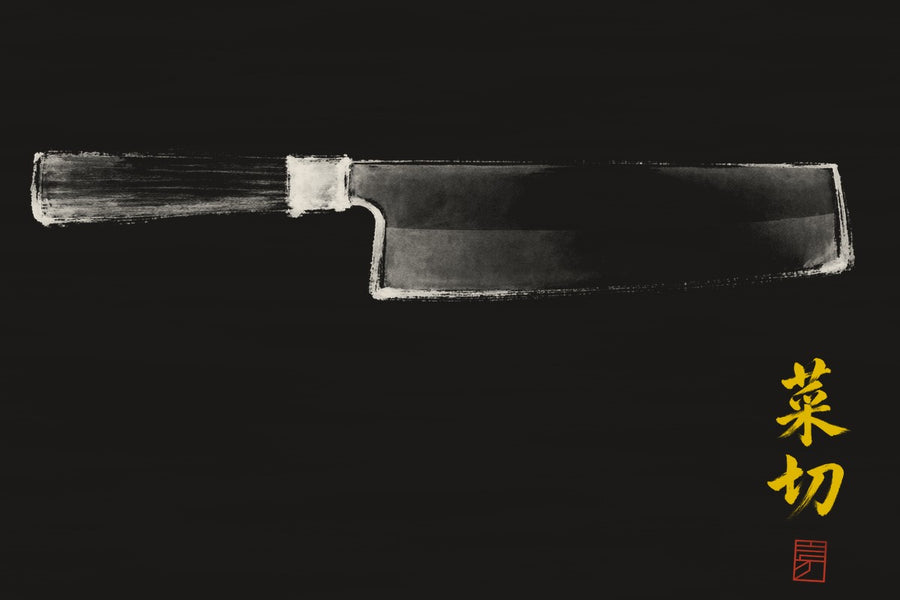
Nakiri — knife profile
Profile

Nakiri

菜切

Japanese vegetable knife · Double bevel

Thin, wide vegetable knife with no point; Tojiro says its straight edge sits flat on the board.

Read more
Steel properties
  1. Hardness Good
  2. Edge retention Good
  3. Toughness Fair
  4. Rust resistance High
  5. Ease of sharpening Fair
  6. Sharpness High

Our ratings, inferred from published lab tests and composition.

Steel

SG2 / R2

スーパーゴールド2

Stainless · Takefu Special Steel

Takefu powder stainless, 61 to 65 HRC. Long edge; resists rust.

Read more
CladdingCoreClad line
Construction

Sanmai - Stainless Clad

三枚

3 layers · stainless clad

Hard core between two stainless layers, bare only at the edge; the cladding resists rust.

Read more
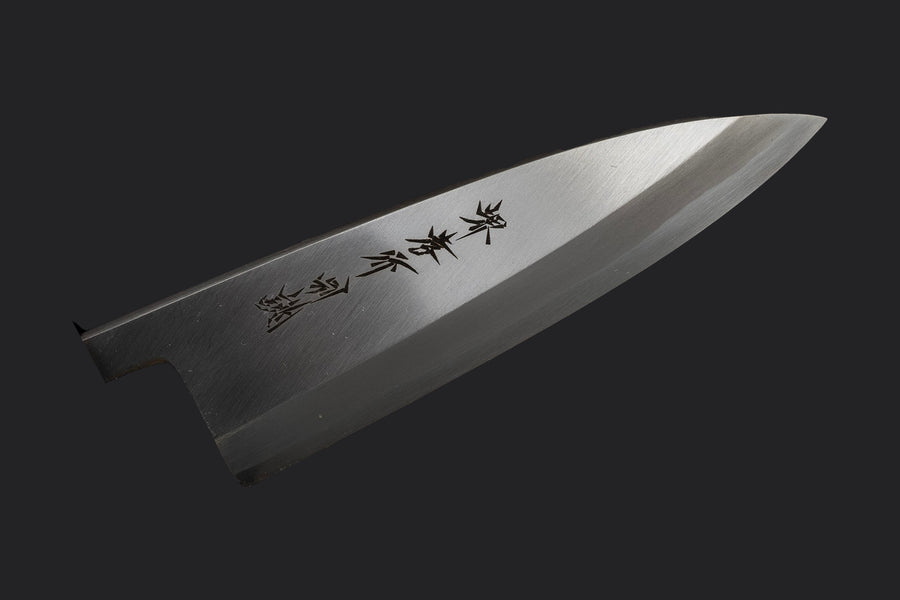
Kasumi — blade surface finish
Finish

Kasumi

Misty polish

Hazy, matte bevel where soft iron meets hard core steel. The iron patinas and rusts.

Read more
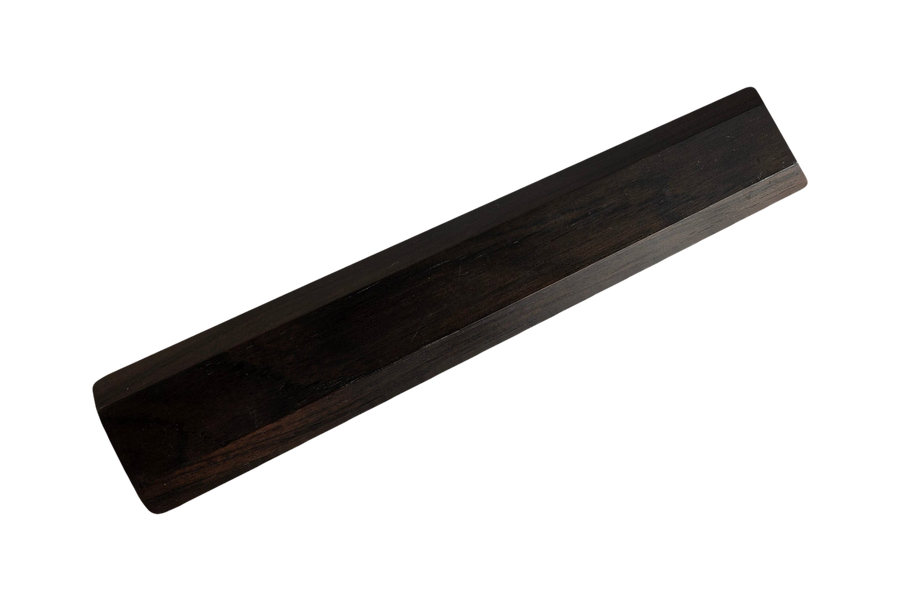
Octagonal Ebony handle
Handle

Octagonal Ebony

Octagonal WA

Dense, dark ebony in the eight-sided wa shape. The flats give a sure grip for either hand.

Frequently asked questions

Why won't my knife cut all the way through? The slices stay joined at the bottom.

Part of the edge never reaches the board, so the cut never finishes. At our counter we put it simply: there is not enough flat at the heel. A knife with a long curve is built for rock chopping, not for the Chinese or Eastern up-and-down chop.

A straight edge, like a nakiri's, meets the board along its whole length and finishes the cut. On any knife, a dip worn near the heel or a dull section can cause the same thing.

Nakiri or usuba: what is the difference?

The bevel. A Japanese dictionary describes the nakiri (菜切包丁) as shaped like an usuba but double-bevel and relatively easy to handle; the Sakai cutlery association describes the usuba (薄刃包丁) as an acute, wide knife for vegetables, in a square Kanto type and a kamagata Kansai type.

The names overlap, since another dictionary records the usuba as also called nakiri, so check the bevel rather than the name.

SG2 steel knives at Knives and Stones

SG2 (Super Gold 2, which Takefu writes as SPG2) is Takefu Special Steel's own blade steel, made by powder metallurgy. Takefu says it meets all four of what it calls the major requirements for a blade: high hardness, high toughness, good wear resistance and excellent corrosion resistance.

SG2 runs 61 to 65 HRC depending on the maker, and Takefu does not publish its composition. As of 18 October 2026, 291 of the knives we list have SG2 in their title.

SG2 vs AS steel for kitchen knives: which is better?

Neither is objectively better, it just depends on whether you value stainless convenience or a laser-sharp carbon edge. Go with SG2 if you want a knife that holds a screaming edge without any babysitting. Choose AS if you are chasing the thinnest possible edge and don't mind wiping the blade down after every use.

SG2 is a powdered stainless steel from Takefu, 61 to 65 HRC depending on the maker. It is tough and resists corrosion, which is why I reach for it when working with acidic foods. Aogami Super is high carbon, and Proterial gives it a hardening hardness of over 60 HRC. It takes a very keen edge, but it will rust if you neglect it.

R2 steel vs SG2: are they the same?

We can't confirm that from a steelmaker. SG2 (Super Gold 2, which Takefu writes as SPG2) is Takefu Special Steel's own blade steel, made by powder metallurgy. Takefu does not publish its composition; SG2 runs 61 to 65 HRC depending on the maker.

As of 18 October 2026, we found no steelmaker page for a steel called R2. Some knives on our shelf are listed as SG2/R2: six as of 18 October 2026, from Kurosaki, Shiro Kamo and Yoshimi Kato.

What is the difference between VG10 and SG2?

Both are Takefu blade steels, and they differ in class and in what Takefu publishes about each. Takefu lists VG10 as a stainless steel with 1.00% carbon, 15.00% chromium, 1.00% molybdenum, 0.25% vanadium and 1.55% cobalt, at a hardening hardness of HRC 60 or more.

Takefu describes SG2, its Super Gold 2, as a blade steel created by powder metallurgy, lists its composition as not disclosed, and SG2 runs 61 to 65 HRC depending on the maker. Takefu also calls SG2 a powdered stainless high-speed steel.

What is the difference between SG2 and ZDP-189?

They come from different steelmakers, and both are made by powder metallurgy. Takefu lists SG2 as a blade steel created by powder metallurgy, with its composition not disclosed; SG2 runs 61 to 65 HRC depending on the maker.

Proterial describes ZDP-189 as a stainless blade steel made by powder metallurgy, lists 3.00% carbon and 20.00% chromium with its other elements not published, and gives a hardening hardness of over 65 HRC.

You May Also Like