PRAHRAN STORE NOW OPEN · THU–MON · 10AM–6PM

Drag to spin · pinch or scroll to zoom

Takeshi Saji

Takeshi Saji Maki-e Urushi VG10W Santoku 170mm

Regular price $1,599.95

Sold out right now

Leave your email and we’ll send one message the moment it’s back in stock.

One email, no marketing. Privacy policy.

Availability

  • St Peters, NSW —
    2 Bishop St, Unit 2, St Peters NSW 2044
  • Crows Nest, NSW —
    107 West St, Shop 1, Crows Nest NSW 2065
    Pickup only
  • Prahran, VIC —
    180 Commercial Road, Shop 1, Prahran VIC 3181
    Pickup only
Detailed Specifications
Line Takeshi Saji VG10W Rainbow Damascus Kurozome
Profile Santoku / Santoku
Bevel Type Double Bevel
Weight 160 g | 5.6 oz
Edge Length 167 mm | 6 37/64″
Heel Height 45 mm | 1 49/64″
Width @ Heel 2.0 mm | 5/64″
Width @ Mid 2.0 mm | 5/64″
Width @ 1cm from Tip 1.1 mm | 3/64″
Steel VG10W | Stainless
Blade Construction Sanmai - Stainless Damascus Clad
Hardness (HRC) 61 - 63
Surface Finish Etched
Handle
Region Takefu
Best for
  • Collectors
  • Enthusiasts
  • Free shipping for knives over AU$200 Australia wide.
  • World-wide shipping via DHL Express, 3 to 5 days.


Takeshi Saji's VG10W Rainbow Damascus Kurozome is a direct update to the well-established VG10 Rainbow Damascus Kurozome line, and if you're already familiar with that knife the change is a focused one. The core steel is now VG10W, Takefu Special Steel's tungsten-enhanced iteration of VG10. The addition of tungsten forms harder tungsten carbides within the steel matrix, which improves wear resistance and edge retention without pushing the hardness rating higher. In practical terms the edge holds up longer between sharpenings — a meaningful upgrade for anyone using this knife regularly.

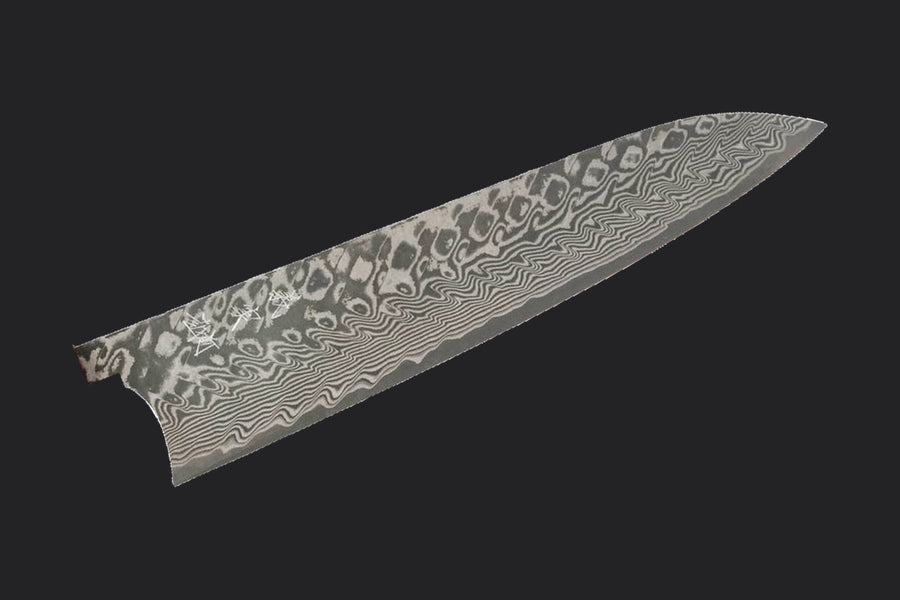
The multi-metal Damascus cladding is what draws the eye first, and looking at it closely reveals just how complex the surface is. The etching brings out a warm, earthy palette across the Hira — muted grey as the dominant tone, with organic cell-like islands of copper and brass outlined in lighter cream borders scattered across the surface. Toward the cladding line, the layers compress into tight wavy bands of copper, brass and silver that flow together like contour lines, and the engraving catches the light with fine metallic detail. It's a surface that rewards close inspection and looks different every time the light changes. The etched finish is more delicate than a polished surface and benefits from careful handling to preserve that depth of colour over time.

The rainbow lines sit noticeably thinner in overall blade thickness compared to other Saji lines like the SG2 Kurozome or the Strix — the convex grind still provides good food release and gives the knife more presence than a typical thin blade, but it doesn't carry the same weighty, substantial feel of those heavier lines. For many users that's a welcome trade-off, making it more approachable for extended prep sessions.

For collectors and enthusiasts who already own or have considered the VG10 version, the W upgrade makes this the more compelling long-term choice — same character, same aesthetics, better edge longevity. And for anyone coming to the rainbow lines fresh, it's the version worth starting with.

Pros Cons
  • Thin behind the edge
  • Great artistic
  • Highly collectable
  • High budget
Care Instruction
  1. Don't cut hard things! Japanese knives are brittle so bone hacking is a NO NO!
  2. Wash with neutral detergent after use, and wipe dry;
  3. Please don't wash knife with dishwasher, it will damage the wood handle;
  4. Be careful not to leave the knife close to a heat source for a long time;
  5. It is a lot more dangerous to cut with a blunt knife than a sharp knife!
  6. It is best to sharpen a Japanese knife regularly on a waterstone.

Takeshi Saji

Takeshi Saji (佐治 武士), Saji Uchihamono, Echizen

Takeshi Saji (佐治 武士) is an Echizen smith and the third generation of Saji Uchihamono (佐治打刃物), a company founded in 1916 and a member of Takefu Knife Village. He is a certified traditional craftsman (伝統工芸士), and the Village calls him a pioneer of Japanese-style knives built on traditional techniques.

We stock his SG2 and VG10 damascus knives, his SRS13 knives and his maki-e lacquered VG10W knives, with handles that include ironwood, stag and turquoise.

Read more

According to Takefu Knife Village, Saji still goes to exhibitions and abroad himself, taking in new ideas and making new pieces. The Village lists what the family company makes: Japanese-style knives, custom knives, forged kitchen knives of various kinds, and nata, the Japanese hatchet.

Among the damascus knives we carry from Saji are black and diamond damascus in SG2, and rainbow damascus in VG10.

“Third generation of Saji Uchihamono, an Echizen knife company founded in 1916.”

Est. 1916 | 大正5年
Known for Japanese-style knives and damascus kitchen knives
Instagram @takeshi_saji Read more about Takeshi Saji

Takeshi Saji · Takefu

Knife details

Frequently asked questions

Gyuto or santoku: which should I choose?

The gyuto came to Japan with the beef-eating culture of the Meiji era, and that is where its name comes from. Tojiro says it is used for all kinds of cooking, which is why it is also called the chef's knife.

The santoku is a household knife that combines the good points of the nakiri and the gyuto. Tojiro describes it as all-purpose, from vegetables to meat and fish, double-bevel and built on the same construction as a Western knife.

Choose a gyuto if you want more length and reach. Choose a santoku if you want a shorter all-purpose knife. Tojiro's own size figures: gyuto 150 to 210mm for household use and up to 360mm for professional use, santoku 165 to 170mm for household use.

Rock chop or up-and-down chop: which knife shape suits me?

Match the shape to your stroke. Rock chopping keeps the tip on the board and rolls the curved belly through the food, so a gyuto or a Western chef's knife suits it, and Japanese knives rock fine as long as you rock gently.

Up-and-down chopping, the Chinese style, wants a straight run of edge, so a nakiri, usuba, santoku or bunka suits it better; a curved edge chopped straight down easily leaves pieces joined. Neither shape is better; it depends on how you cut.

What does santoku mean?

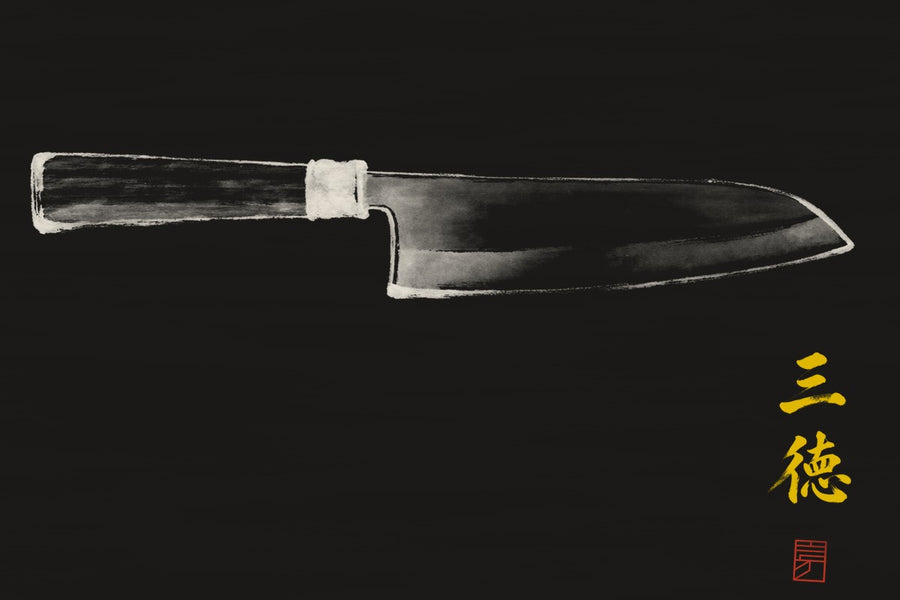
A Japanese dictionary explains the name of the santoku (三徳包丁) as coming from the three things it handles: meat, fish and vegetables. The same dictionary entry points from the santoku to the bunka (文化包丁), treating the two as one knife.

One Japanese knife maker guide distinguishes the two by the tip. It says that in the Showa era the bunka was made with its tip cut at an angle, and the santoku came after it by rounding that tip.

How is VG10W different from VG10?

Takefu makes VG10W by adding tungsten, 0.40%, to VG10, and its other published composition figures are the same as the figures Takefu publishes for VG10. Takefu says the tungsten forms hard, fine carbides that contribute to improved wear resistance and ease of sharpening.

Takefu lists HRC 61 or more for VG10W against HRC 60 or more for VG10. Takefu also states that VG10W has 20% higher durability/strength and 25% higher cutting performance than VG10, while maintaining the same corrosion resistance.

What does Takefu say about VG10W's sharpening properties, and how should I care for the knife?

Takefu, which makes VG10W, adds tungsten to its VG10 and says the hard, fine carbides this forms improve both wear resistance and ease of sharpening. Takefu lists VG10W among its stainless steels, with 15% chromium and a hardness of HRC 61 or more.

The JSSA notes that stainless strictly means a steel that rusts less, not one that never rusts. We suggest rinsing and drying the knife after use, storing it dry and keeping it out of the dishwasher.

Who is Takeshi Saji?

Takeshi Saji (佐治武士) is the third generation of Saji Uchihamono (株式会社佐治打刃物), the Echizen workshop founded in 1916.

The national register of traditional craftspersons lists him in the Echizen forged cutlery division, certified as a traditional craftsperson (伝統工芸士) on 25 February 1994. We carry a wide range of his work.

How old is Saji Uchihamono?

Saji Uchihamono was founded in 1916, according to the Takefu Knife Village page for Takeshi Saji.

The same page lists him as the third generation of the company, 佐治打刃物.

You May Also Like