PRAHRAN STORE NOW OPEN · THU–MON · 10AM–6PM

Takeshi Saji  |  SKU: TAKE_B2RDNA_SH270

Takeshi Saji VG10 Gold Damascus Sujihiki 270mm

Regular price $699.95

Sold out right now

Leave your email and we’ll send one message the moment it’s back in stock.

One email, no marketing. Privacy policy.

Availability

  • St Peters, NSW —
    2 Bishop St, Unit 2, St Peters NSW 2044
  • Crows Nest, NSW —
    107 West St, Shop 1, Crows Nest NSW 2065
    Pickup only
  • Prahran, VIC —
    180 Commercial Road, Shop 1, Prahran VIC 3181
    Pickup only
Detailed Specifications
Line Saji VG10 Gold Damascus
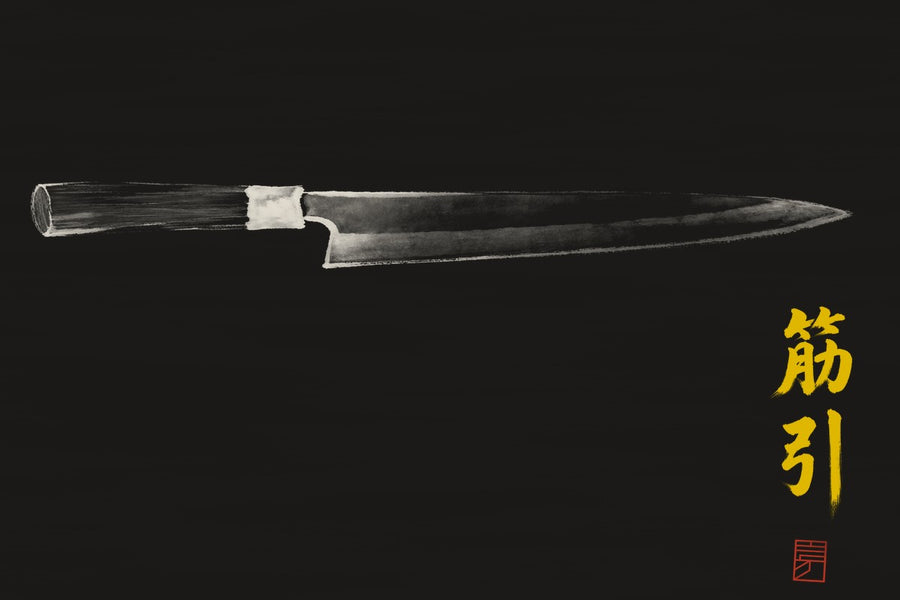
Profile Sujihiki / Slicing knife
Bevel Type Double Bevel
Weight 157 g | 5.5 oz
Edge Length 265 mm | 10 7/16″
Heel Height 40 mm | 1 37/64″
Width @ Heel 1.9 mm | 5/64″
Width @ Mid 1.9 mm | 5/64″
Width @ 1cm from Tip 1.1 mm | 3/64″
Steel VG10 | Stainless
Blade Construction Sanmai - Stainless Damascus Clad
Hardness (HRC) 59 - 61
Surface Finish Etched
Handle
Region Takefu
Best for
  • Enthusiasts
  • Pro chefs
  • Collectors
  • Free shipping for knives over AU$200 Australia wide.
  • World-wide shipping via DHL Express, 3 to 5 days.


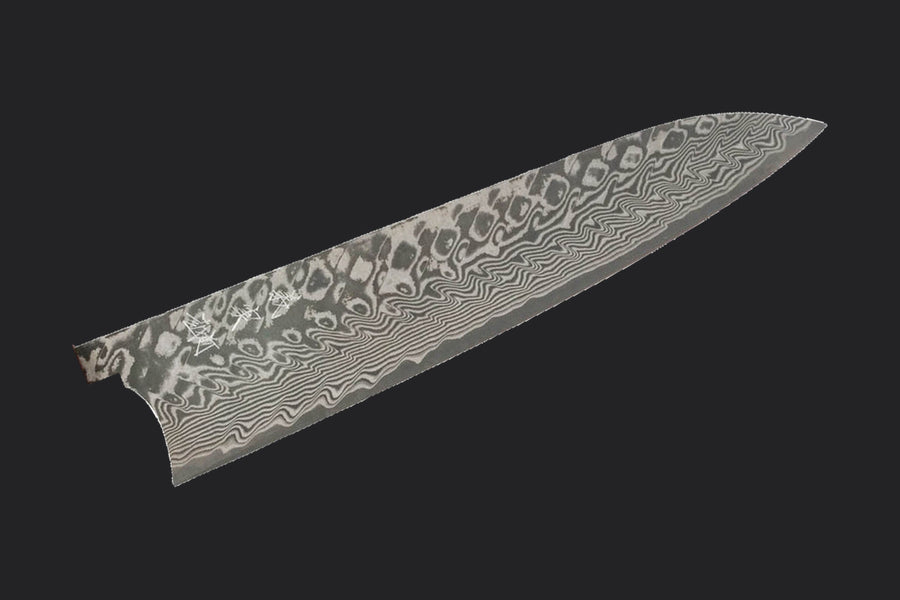
Takeshi Saji's VG10 Gold Damascus is one of those lines where the appearance and the cutting behaviour tell two quite different stories, and both are worth hearing. The cladding is a Damascus of stainless steel and brass, and after etching, the surface takes on a dark, almost brooding base tone with streaks of warm gold running through it. If you're familiar with Saji's Rainbow Damascus, think of this as a quieter, more restrained cousin — the same level of finish and craftsmanship, but with one fewer colour in the mix, which gives it a more focused and perhaps more wearable look.

The core steel is VG10, one of the most well-rounded stainless steels in the industry and still a benchmark that many newer steels are measured against. At around 60-61 HRC it takes a keen edge and holds it reliably through extended use, and being fully stainless, it asks very little of you in terms of maintenance. As an alternative to the Rainbow Damascus at a similar price point, the Gold Damascus offers a different aesthetic without asking you to compromise on material quality or performance.

Where this line diverges from the typical Takefu approach is in the geometry. Rather than chasing the laser-thin profile that Echizen makers are often associated with, the Gold Damascus takes a convex grind without a pronounced Shinogi line, and leans more heavily on food release than minimal resistance. The edge itself is kept thin enough for good penetration, so the knife enters food cleanly, but as the blade follows through, the convex bevel does the work of pushing the slice away from the surface. It is not the knife you reach for when splitting a dense daikon in half, but for most everyday prep it handles itself very well and the food release is genuinely satisfying.

For collectors and enthusiasts who want something from Saji's catalogue that is visually interesting without being outright theatrical, the Gold Damascus hits a comfortable middle ground. The construction is complex enough to justify its price, the performance is solid, and the gold-streaked surface gives it a character that is hard to find elsewhere at this price point.

Pros Cons
  • Excellent performance
  • Great artistic
  • Easy to look after
  • Excellent fit and finish
  • High budget
Care Instruction
  1. Don't cut hard things! Japanese knives are brittle so bone hacking is a NO NO!
  2. Wash with neutral detergent after use, and wipe dry;
  3. Please don't wash knife with dishwasher, it will damage the wood handle;
  4. Be careful not to leave the knife close to a heat source for a long time;
  5. It is a lot more dangerous to cut with a blunt knife than a sharp knife!
  6. It is best to sharpen a Japanese knife regularly on a waterstone.

Takeshi Saji

Takeshi Saji (佐治 武士), Saji Uchihamono, Echizen

Takeshi Saji (佐治 武士) is an Echizen smith and the third generation of Saji Uchihamono (佐治打刃物), a company founded in 1916 and a member of Takefu Knife Village. He is a certified traditional craftsman (伝統工芸士), and the Village calls him a pioneer of Japanese-style knives built on traditional techniques.

We stock his SG2 and VG10 damascus knives, his SRS13 knives and his maki-e lacquered VG10W knives, with handles that include ironwood, stag and turquoise.

Read more

According to Takefu Knife Village, Saji still goes to exhibitions and abroad himself, taking in new ideas and making new pieces. The Village lists what the family company makes: Japanese-style knives, custom knives, forged kitchen knives of various kinds, and nata, the Japanese hatchet.

Among the damascus knives we carry from Saji are black and diamond damascus in SG2, and rainbow damascus in VG10.

“Third generation of Saji Uchihamono, an Echizen knife company founded in 1916.”

Est. 1916 | 大正5年
Known for Japanese-style knives and damascus kitchen knives
Instagram @takeshi_saji Read more about Takeshi Saji

Takeshi Saji · Takefu

Knife details

Frequently asked questions

What size sujihiki should I buy?

Between 210 and 270 mm, depending on where it will work. One Japanese maker lists 210 to 240 mm, double-bevel, for home use and 240 to 270 mm, single- or double-bevel, for professional kitchens.

Another, in Sakai, recommends 240 mm at home, with the size of your board in mind, and 270 mm for professional use.

Sujihiki or yanagiba: which do I need?

A sujihiki is a long, double-bevel knife for dividing larger pieces of meat into their parts, and its length lets it slice sashimi too; a yanagiba is the sashimi knife.

The Sakai cutlery association describes the yanagiba (柳刃包丁) edge as so acute that it cannot be used on bone or other hard things, so choose the sujihiki for meat and the yanagiba if sashimi is the main job.

Does VG10 rust?

Yes, it can, though it rusts less readily. VG10 (V金10号) is a stainless steel, and stainless strictly means a steel that rusts less, not one that never rusts.

Takefu, which makes VG10, lists 15% chromium, above the 10.5% that defines stainless steel, and describes its corrosion resistance as excellent. Dry the knife after washing.

How hard is VG10?

Takefu, the steelmaker behind VG10, gives HRC 60 or more as a standard value. The hardness of a finished knife depends on its maker.

Takefu says the steel's 15% chromium, 1% molybdenum and 1.55% cobalt give it high hardness and a long-lasting edge, and that it is easy to sharpen.

How old is Saji Uchihamono?

Saji Uchihamono was founded in 1916, according to the Takefu Knife Village page for Takeshi Saji.

The same page lists him as the third generation of the company, 佐治打刃物.

You May Also Like