PRAHRAN STORE NOW OPEN · THU–MON · 10AM–6PM

Yamawaki Hamono  |  SKU: YW-G3MRDF-360

Yoshihiro Ginsan Yanagiba 360mm w/ Double Fullers and Ebony Handle

Sale price $1,359.98 Regular price $1,599.95

Availability

  • St Peters, NSW —
    2 Bishop St, Unit 2, St Peters NSW 2044
  • Crows Nest, NSW —
    107 West St, Shop 1, Crows Nest NSW 2065
    Pickup only
  • Prahran, VIC —
    180 Commercial Road, Shop 1, Prahran VIC 3181
    Pickup only

Goes well with

Detailed Specifications
Line Yamawaki Ginsan Yanagiba Mirror Hira / Kasumi Kireha
Profile Yanagiba / Sashimi knife
Bevel Type Single Bevel
Weight 372 g | 13.1 oz
Edge Length 355 mm | 13 31/32″
Heel Height 39 mm | 1 17/32″
Width @ Heel 4.2 mm | 11/64″
Width @ Mid 4.0 mm | 5/32″
Width @ 1cm from Tip 1.6 mm | 1/16″
Steel Ginsan / Silver #3 | Stainless
Blade Construction Nimai - Stainless Clad
Typical hardness 60 to 62 HRC
Surface Finish Mirror Polish
Handle Special Handle
Region Sakai
Best for
  • Pro chefs
  • Enthusiasts
  • Collectors

Free shipping for knives over AU$200 Australia wide.

World-wide shipping via DHL Express, 3 to 6 days (not available in the UK).


What makes a premium single bevel knife stand out isn't always immediately obvious. Beyond the choice of steel, much of its character comes from the skill of the blacksmith, the precision of the sharpening, and the attention given to the finishing. This Yamawaki Ginsan Yanagiba brings these elements together in a rather elegant way, combining traditional Sakai craftsmanship with a distinctive contrast between mirror and Kasumi finishes. It has the refinement you would expect from a high-end Japanese knife, without relying on elaborate decoration to make an impression.

The forging behind this line comes from the Yamatsuka family in Sakai — a name that serious knife enthusiasts will recognise immediately. A multi-generational blacksmithing lineage with family members still active across different generations today, the Yamatsuka name carries real weight in a city that takes its knifemaking traditions seriously. The sharpening is handled in-house by Yamawaki's own team, with a beautiful combination of a mirror-polished Hira and a traditional Kasumi finish on the Kireha. The highly reflective upper blade contrasts with the soft, misty appearance of the primary bevel, creating a distinct visual separation along the Shinogi line. Personally, I find this combination particularly appealing, as it offers the refinement of mirror polishing while preserving the traditional character of Kasumi finishing.

The core steel is Ginsan (Silver #3), a fully stainless steel that offers a fine cutting edge, good edge retention and relatively straightforward sharpening. For a Yanagiba that regularly comes into contact with raw fish and moisture, the stainless nature of Ginsan is a welcome convenience, particularly compared to traditional carbon steels that require constant attention to prevent oxidation. The carefully finished single bevel geometry is designed to produce clean, controlled slices with minimal damage to the delicate surface of the fish. While the mirror-polished Hira will show fingerprints and fine scratches more readily, the Kasumi Kireha is generally more forgiving when it comes to regular sharpening and refinishing.

Compared to more accessible Ginsan single bevel offerings such as the Gintan series from Sakai Takayuki, this Yamawaki line sits firmly in the premium category. Its appeal comes from the Yamatsuka forging pedigree, Yamawaki's sharpening work, and the attention given to the contrasting finishes. For professional chefs and enthusiasts who appreciate the finer details of Sakai knifemaking, this is a compelling balance between traditional craftsmanship, practical stainless performance and understated elegance.

Pros Cons
  • Great for professionals
  • Great artistic
  • Excellent fit and finish
  • High budget
  • Mirror polish can be hard to maintain
Care Instruction
  1. Don't cut hard things! Japanese knives are brittle so bone hacking is a NO NO!
  2. Wash with neutral detergent after use, and wipe dry;
  3. Please don't wash knife with dishwasher, it will damage the wood handle;
  4. Be careful not to leave the knife close to a heat source for a long time;
  5. It is a lot more dangerous to cut with a blunt knife than a sharp knife!
  6. It is best to sharpen a Japanese knife regularly on a waterstone.

Yamawaki Hamono

Yamawaki Hamono (山脇刃物製作所), Sakai

Yamawaki Hamono is a very typical Sakai maker, operating alongside other brands like Kawamura and Takayuki, they built deep connections with a great number of blacksmiths and sharpeners across Sakai and offers all manners of designs that utilise the talent of these craftsmen. And they are well known for their house brand named after a Kamakura period blacksmith - Goh Umanosuke Yoshihiro.

From the basic iron-clad Sanmai knives to carefully forged and polished Honyaki. Yamawaki can find the right individual for achieving a specific task. On the other hand, the blacksmith families and sharpeners alike, fully trust Yamawaki and their relations cultivated over literally generations of collaborations.

The key offering by Yamawaki is the assortment of Honyaki knives. The company spends a good amount of effort delegating the work schedule and certification for each unique piece, making their origin trackable. They also look after sought-after billet forged by makers like Yoshikazu Ikeda or Genkai Masakuni, so they get proper treatment they deserve after these blacksmiths retire. 

Aside from the Honyaki, unique techniques like Kito-polished Kasumi, mirror polishing on single bevel knives and fuller machining are cherished at Yamawaki, in a sense, it is Yamawaki that helps these blacksmiths with unique skill set so they can focus on their craft to pass it down without worrying about the business end of things. That is why organisations like Yamawaki are so important in the industry.

“A Sakai knife maker behind the Goh Umanosuke Yoshihiro brand.”

Est. 1927 | 昭和2年
Known for The Goh Umanosuke Yoshihiro brand
Website yamawaki-hamono.co.jp Instagram @yamawakisharpeningfactory Read more about Yamawaki Hamono

Yamawaki Hamono · Sakai

Knife details

Yanagiba — knife profile
Profile

Yanagiba

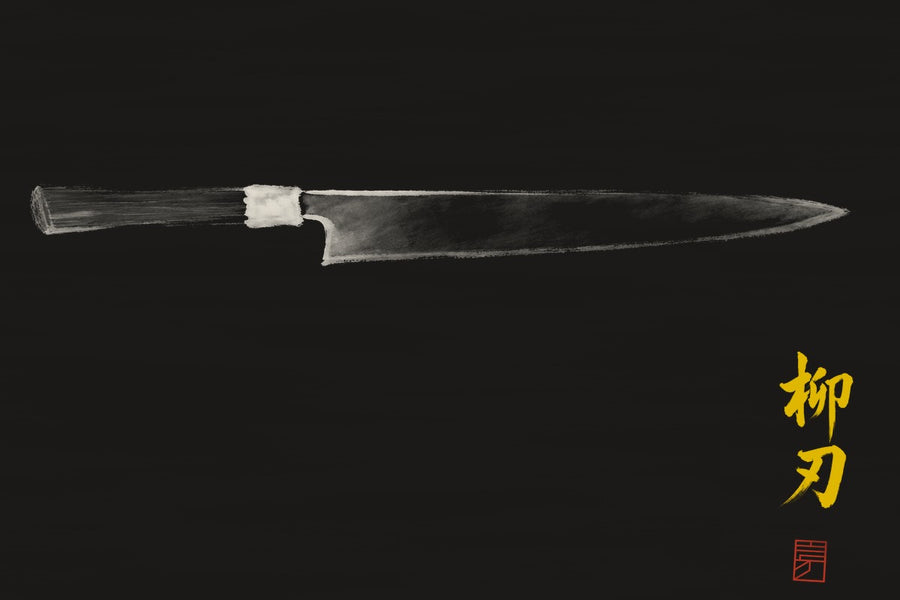
柳刃

Sashimi knife · Single bevel

Long single-bevel sashimi slicer with a pointed tip. One clean draw cuts raw fish.

Read more
Steel properties
  1. Hardness Good
  2. Edge retention Good
  3. Toughness Very high
  4. Rust resistance High
  5. Ease of sharpening High
  6. Sharpness High
Our ratings, inferred from published lab tests and composition.

Our edge-retention grade is a kitchen rating. It weighs the hardness each steel is sold at, which keeps a thin edge from rolling, twice as heavily as lab wear tests, and the final grade is our judgment from selling and sharpening these knives for over a decade. Lab card-cutting tests measure abrasive wear only, so they can rank carbon steels lower. Tap ? for the lab figure.

Steel

Ginsan / Silver #3

GIN3

Stainless · Hitachi Metals (now Proterial)

Proterial's GIN 3 stainless: 0.95 to 1.10% carbon, 13.00 to 14.50% chromium, hardening hardness over 59 HRC.

Read more
ShinogiCladdingClad lineHard steelHollow back
Construction

Nimai - Stainless Clad

二枚・ステンレス

2 layers · single bevel

Two layers, single bevel: hard steel on the back, stainless cladding over the other.

Read more
Mirror Polish — blade surface finish
Finish

Mirror Polish

鏡面

Mirror polish

Polished to a true mirror that shows hamon or damascus clearly. Every scratch shows.

Read more
Handle

Special Handle

Octagonal WA

The maker's own handle; material not disclosed. See the product photos for its look.

Frequently asked questions

What is a yanagiba knife used for in sushi preparation?

A yanagiba (柳刃包丁) is a sashimi knife for slicing raw fish. A knife maker's guide says a sashimi knife cuts without breaking the fibres of the flesh, and that it is longer and narrower than other knives because slicing sashimi with crisp edges needs the length.

The whole length goes through one pulling cut. The Sakai cutlery association calls the yanagiba the sashimi knife used mainly in the Kansai region.

What size yanagiba should I buy?

Size a yanagiba to the fish you prepare: a knife maker's guide gives 270 to 360 mm for professional use and 240 to 270 mm for home use, with 270 mm at home if you slice larger fish.

The guide says the whole length goes through one pulling cut, so do not choose too short a knife, and at home it points to the size of your board and your work space. We list the yanagiba (柳刃) from 210 to 360 mm, some made for left-handed use.

Can a yanagiba cut through fish bones?

No. The Sakai cutlery association describes the yanagiba (柳刃包丁) edge as so acute that it cannot be used on hard things such as bones.

For bones the association describes the deba (出刃包丁), whose heel is used to hit them.

Takohiki or yanagiba: what is the difference?

An encyclopedia describes sashimi knives as thin and narrow, calling the pointed ones yanagiba and the unpointed ones takohiki. A sakimaru takohiki is the rounded-tip variant, so it has a rounded point despite its takohiki name.

A trade body, the Sakai cutlery association, calls the takohiki (たこ引き包丁) the Kanto-type sashimi knife, and the yanagiba the sashimi knife used mainly in Kansai, with an acute edge that is not for bone.

Sujihiki or yanagiba: which do I need?

Most home cooks need the sujihiki. Choose the yanagiba when slicing raw fish for sashimi and sushi is the main job and you are prepared to learn single bevel sharpening.

A sujihiki is a long, narrow, double bevel slicer. Tojiro describes it as the knife for dividing large pieces of meat, known abroad as a slicer or carving knife, and says its length lets it cut sashimi as well. It carves roasts, trims sinew and portions fish, works in either hand and sharpens like any double bevel knife. Sujihiki run from about 210 to 300 mm, and 240 mm suits most home boards.

A yanagiba is the single bevel sashimi knife. It is ground on one side with a hollow back, and each slice is one long pull from heel to tip, so raw fish is cut cleanly rather than sawn. The edge is too fine for bones or anything hard. It is made for one hand and most are right handed, so check the listing if you are left handed. Sharpening means working the whole bevel and keeping the back flat. Yanagiba run from about 240 to 330 mm, with 270 and 300 mm the common sizes.

So for roasts, portioning meat and the occasional side of fish, buy a sujihiki. For regular sashimi and sushi work, buy a yanagiba and keep it for fish.

Why is the back of a single-bevel knife hollow, and how do I sharpen it?

The shallow hollow in the back is called urasuki (裏スキ). Tojiro explains that it means the whole back never has to be ground when you sharpen, makes it easier to keep the back flat, and stops sharpening the back from affecting the edge. Only the thin flat rim around the hollow touches the stone.

Sharpen the front bevel first, laying it flat on the stone. Then lay the back completely flat and take a few light strokes, just enough to remove the burr. Never lift the spine to put an angle on the back, and keep the stone itself flat.

Which knife do I need for sushi and sashimi at home?

For occasional sushi at home, a sharp sujihiki (筋引) does the job. Tojiro describes it as a long, double-bevel slicer that can also be used for sashimi, and a double bevel works in either hand.

If sashimi is the point of the meal, choose a yanagiba (柳刃). Tojiro calls it the Kansai-style sashimi knife, now used across Japan, and it slices in one long pull from heel to tip. It is single bevel, so buy the one made for your hand.

If you start from whole fish, add a deba (出刃). Tojiro describes it as very thick and heavy, made for breaking fish down. The deba takes the fish apart and the slicer then cuts the fillets.

What is Ginsan steel, and why do some Japanese knives use it?

Ginsan, also known as Silver 3, is a stainless steel from Proterial, the Yasugi Specialty Steel division. Proterial describes it as a stainless steel which has hardness and sharpness comparable to carbon steel, and lists its uses as kitchen knives and scissors.

Knife makers use it when they want the corrosion resistance of a stainless together with the hardness and sharpness that Proterial compares to carbon steel. The steel maker lists 59 HRC or over after hardening, but that is a heat treatment figure, not a finished knife figure.

Dry it after use, like any stainless knife. Its performance depends on the heat treatment and construction of the specific knife, not the steel name alone.

You May Also Like