
Craftsman
中川悟志

Satoshi Nakagawa
The story
Sakai runs on a division of labour: smiths forge, sharpeners finish, brands sell. Satoshi Nakagawa (中川悟志) is the youngest face of the forging side. His company, Nakagawa Uchihamono, works out of Nishi-ku, Sakai, and the national programme has certified him a Traditional Craftsman (dentō kōgeishi) in the forging division. Sakai City's register records the cycle; the trade press records the detail that matters: at thirty-six, nobody in the history of Sakai uchihamono had done it younger.
The forge was not the first dream. He played soccer from grade school through junior high and wanted the professional's life, then let it go in high school with a clear eye: there is always someone above you, and they got there by outworking you. He carries the same arithmetic into the smithy. "Having chosen the blacksmith's life," he wrote recently, "I can't reach the top unless I work harder than anyone." And the post ends with the real audience: his own child, watching the father's back.
He earned the forge the hard way. Sixteen years at Shiraki Hamono under Kenichi Shiraki (白木健一), the only disciple the master ever recognised. When Shiraki retired in 2020 the workshop, its machines and its future passed to him, and in April 2021 the sign over the door changed to Nakagawa Uchihamono. Ask him about those years and he doesn't varnish them: "My master was an old-school craftsman straight out of a picture, and a genuinely strict man. I came in with zero knowledge and zero experience. But watching, learning, practising, I began to understand how magnificent his smithing really was."
The working method is distinct enough that the trade press calls it the Nakagawa way: heated iron and steel go straight under the belt hammer and are forge-welded there, no hand-hammering first. The forge runs at about 1,200 degrees and he reads it by eye and skin, not by thermometer. The day a magazine came to watch, he put fifty White #2 deba through the fire before shaping and quenching had even begun.
Then there is the range. White steel #3 through #1, Blue #2 and #1, stainless Ginsan and VG10, and honyaki. "I pride myself on being the smith who handles the widest range of steels in Japan," he says, laughing. The crown of it is mizu-honyaki, water-quenched the old way; only a handful of smiths in Japan still make them, and he says the thrill when painstaking work comes out right is what keeps him at it. The signature pieces book out years ahead. His reverse-clove (逆丁子) mizu-honyaki yanagiba is limited to thirty a year, and the 2022 allocation sold out the day reservations opened. One Fuji-wave (富士波) yanagiba carries a full moon in the hamon on one face and a crescent on the other.
You have probably held his work without knowing it. He forged for Sakai Takayuki at one point, though which lines was never recorded, and in our own shop his fire sits behind a dozen lines, from the Hatsukokoro collaborations to his honyaki. That is Sakai: the smith's name is often the last thing to reach the customer.
That 1,200-degree forge? James has stood right in front of it. In April 2022 he spent an afternoon at Nakagawa Uchihamono watching the work up close; the photos on this page are from that visit, and his own account of it, Fifty minutes at the forge, is just below in Stories.
Owners on the forums talk about him the way we'd want them to: plainly. The consensus gathers around his Ginsan; "most high-end ginsan is forged either by Nakagawa or Yamatsuka," as one collector put it, and the Kagekiyo blades attributed to his forge draw a small chorus of "absolutely love mine." The old Shiraki hands vouch hardest. One owns a honyaki bearing Shiraki's name that he knows Nakagawa forged, and reasons that if it was good enough for the master's signature, it's good enough for him. And, fairly: one buyer's knife arrived without a finished edge and wouldn't slide-cut paper out of the box; the forum's own answer was that his wide-bevel knives often leave the final edge to your sharpener. We'd rather show you that conversation than sand it down.
A note on records, because we checked. Some say only three smiths in Japan can make true mizu-honyaki; others say four, or five. Nobody agrees and nobody publishes a list, so we'll say "a handful" and leave the digit to the folklore. What is on the record is narrower and better: the city's own register of Traditional Craftsmen, forging division, his name in the FY2022 cohort, effective February 2023. The youngest-ever part we take from the trade press, who printed his age with the story.
In photographs
From our April 2022 visit to Nakagawa Uchihamono in Nishi-ku, Sakai.


Works with
Owns
Forges for
The relationship map 職人系譜
Masters, family, and the brands between them. Every line is a verified fact from our research. Tap a node to light up its connections and read its story.
Frequently asked questions
Who is Satoshi Nakagawa?
Reviewed by James Zhang · Last updated 27 July 2026
Who did Satoshi Nakagawa train under?
Reviewed by James Zhang · Last updated 27 July 2026
What steel does Satoshi Nakagawa work in?
Reviewed by James Zhang · Last updated 27 July 2026
Does Satoshi Nakagawa forge honyaki?
Reviewed by James Zhang · Last updated 27 July 2026
Did Satoshi Nakagawa forge for Sakai Takayuki?
Reviewed by James Zhang · Last updated 27 July 2026
Is Satoshi Nakagawa a certified traditional craftsman?
Reviewed by James Zhang · Last updated 27 July 2026
From the forge, in stock
 Hatsukokoro by Nakagawa Ginsan Single Bevel Mirror Polish
Nakagawa Ginsan Yanagiba 270 / 300 / 330 mm Mirror Polished Finish, Left-Handed
$749.00
Hatsukokoro by Nakagawa Ginsan Single Bevel Mirror Polish
Nakagawa Ginsan Yanagiba 270 / 300 / 330 mm Mirror Polished Finish, Left-Handed
$749.00
 Hatsukokoro x Nakagawa Blue 1 Kasumi
Nakagawa Blue 1 Kiritsuke Yanagiba 270/ 300/ 330 mm
$589.00
Hatsukokoro x Nakagawa Blue 1 Kasumi
Nakagawa Blue 1 Kiritsuke Yanagiba 270/ 300/ 330 mm
$589.00
 Hatsukokoro x Nakagawa Blue 1 Kasumi
Nakagawa Blue 1 Sakimaru Yanagiba 270 / 300 / 330 mm (wide version)
$609.95
Hatsukokoro x Nakagawa Blue 1 Kasumi
Nakagawa Blue 1 Sakimaru Yanagiba 270 / 300 / 330 mm (wide version)
$609.95
 Hatsukokoro x Nakagawa Blue 1 Kasumi
Nakagawa Blue 1 Yanagiba 270 / 300 / 330 mm
$559.95
Hatsukokoro x Nakagawa Blue 1 Kasumi
Nakagawa Blue 1 Yanagiba 270 / 300 / 330 mm
$559.95
 Hatsukokoro x Nakagawa Blue 1 Damascus Single Bevel
Nakagawa Left Handed Blue 1 Damascus Yanagiba 240/270/300/300 mm
$779.95
Hatsukokoro x Nakagawa Blue 1 Damascus Single Bevel
Nakagawa Left Handed Blue 1 Damascus Yanagiba 240/270/300/300 mm
$779.95
 Hatsukokoro x Nakagawa Blue 1 Damascus Single Bevel
Nakagawa Blue 1 Damascus Yanagiba 240/270/300 /330 mm
$599.95
Hatsukokoro x Nakagawa Blue 1 Damascus Single Bevel
Nakagawa Blue 1 Damascus Yanagiba 240/270/300 /330 mm
$599.95
 Nakagawa Blue 1 Damascus Traditional Double Bevel
Hatsukokoro x Satoshi Nakagawa Blue 1 Damascus Santoku 170mm
$599.95
Nakagawa Blue 1 Damascus Traditional Double Bevel
Hatsukokoro x Satoshi Nakagawa Blue 1 Damascus Santoku 170mm
$599.95
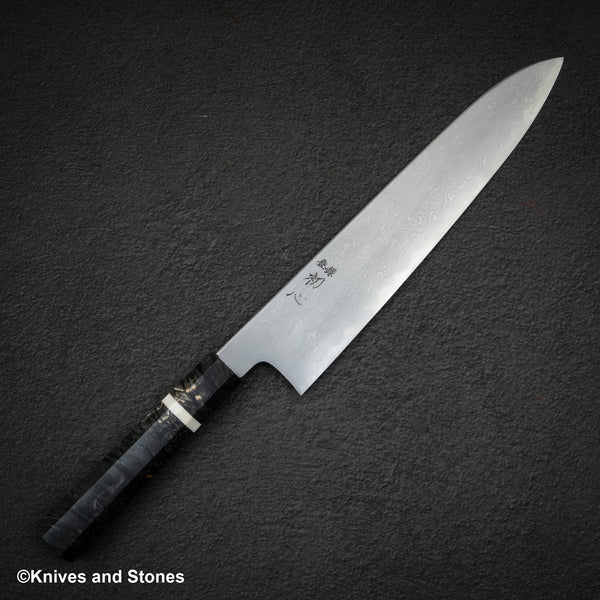 Nakagawa Blue 1 Damascus Traditional Double Bevel
Hatsukokoro x Satoshi Nakagawa Blue 1 Damascus Gyuto 270mm
$849.95
Nakagawa Blue 1 Damascus Traditional Double Bevel
Hatsukokoro x Satoshi Nakagawa Blue 1 Damascus Gyuto 270mm
$849.95

