
Japanese Knife Gift Guide: Which Knife to Give, and How to Give It
1Is a knife a good gift?

In Japan, yes, and the reasoning is old. A blade is traditionally called a lucky thing to give, "cutting off misfortune and carving open the future" (災いを断ち切り、未来を切り開く), and knives are presented to mark a new job, a new home, an opening, a wedding. One large maker welcomes new staff with a name-engraved santoku.
A minority reading exists. The word "cut" can be avoided at celebrations, and at a wedding a knife can be talked of as cutting the bond between two people. Yet there is almost no record of knives actually being avoided as gifts for that reason, and the practical advice is simple: explain the good meaning as you hand the knife over.
Two coin customs ride on top of the gift. The Japanese one is a pun: the words for bond (ご縁, go-en) and for five yen (五円, also go-en) sound the same, so either the recipient hands back a five-yen coin, "returning the bond", or the giver tucks one into the gift. Practice varies, and many people know neither version. The Western custom runs the other way: the recipient gives the giver a small coin, so the knife is "bought" and the blade never cuts the friendship. It is documented in English folklore from at least the 1700s, in the language of a pin, a farthing or some trifling recompense, and it is still practised in Europe and Australia.
2Which knife to give
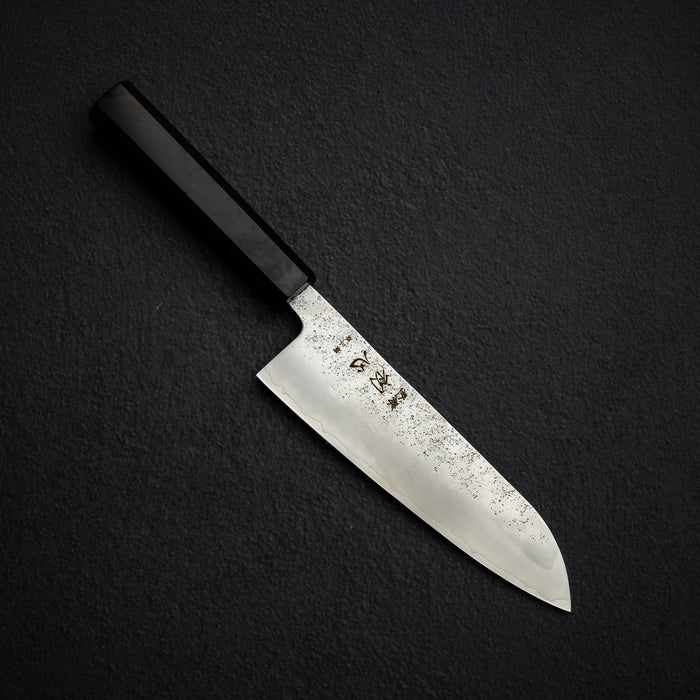
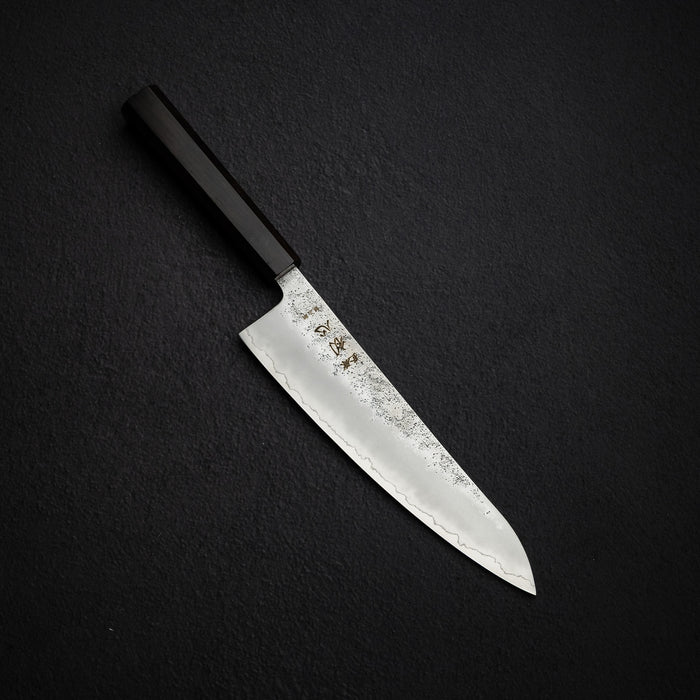
Makers and specialist shops point a gift for an unknown cook at the same thing: a double-bevel all-rounder, ground on both sides. A santoku in the 165 to 180 mm band is the safe gift, the one makers describe as suiting whoever uses it, whatever their experience. A 210 mm gyuto suits a cook you know is keener. The shape choice is on our gyuto vs santoku page, and picking a first Japanese knife has its own page.
Steel matters more than shape when you do not know the user. Choose stainless, or a stainless-clad knife, unless you know the recipient looks after carbon steel; carbon rusts if it is left wet, and rust on a gift is an awkward conversation.
What to avoid as a first gift is a single-bevel knife, a yanagiba (a long slicing knife) or a deba (a fish knife). Makers themselves present these as chefs' tools: they take practice to use, and most are made for right-handed cooks.
3What to add
A small second gift in the box costs little and shows care. A saya (the wooden sheath the blade rides in) or a plain edge guard protects the edge in the drawer, and a wooden board gives the knife a good surface to cut on. A whetstone is the classic addition, but a sharpening is the same gift with none of the learning curve: our sharpening service is a real item to give.
4Engraving the name
In Japan, name engraving is a trade of its own. The traditional method is a tagane, a chisel worked letter by letter by hand with light taps; laser engraving is the modern route. On full-steel Western-style knives, a chisel cannot do the work, so a rotary tool or a laser is used instead.
Our own engraving: A$22 on a knife under A$200, free on a knife of A$200 and over, and only on knives bought from us, added in the same order. The reason is simple: if anything went wrong on a knife we did not sell, we could not put it right. You give us the knife's name, the name to engrave, the font type and size, and the location on the knife.
One consequence decides the whole question. An engraved knife is a custom product under our policy and is non-refundable: no return, no swap. So engrave when you are sure of the knife. When you are not, the next section is for you.
5When you are not sure
Two answers carry the gift when the knife itself is a guess. A gift card covers the choice: ours run from A$50 to A$500, they arrive by email, and there is no physical card to wrap. And if the knife you chose turns out to be wrong, an unused knife with no engraving can come back within 30 days of delivery, resellable as it arrived, for a refund or an exchange under our returns policy. The engraved knife is the exception; a card is the safer gift.
6The care card to tuck in the box
The kindest addition to a gift knife is a card with five lines on it, taken straight from our care guide. Makers give the same advice on the first four.
- Wash by hand and dry it straight away.
- Never the dishwasher.
- No glass boards, no marble or granite surfaces.
- No bones, joints or frozen food, and no twisting or prying with the edge.
- A saya goes on only a fully dry knife, and for regular sharpening we recommend a #1000 and a #3000 stone.
7Questions people actually ask
Is it bad luck to give a knife as a gift?
No, and Japan is the strongest evidence against the idea: blades are traditional lucky gifts there, said to cut off misfortune and carve open the future. A minority reading exists at weddings, where "cut" can sound like cutting a bond, but there is almost no record of knives being avoided for that reason. Explain the good meaning as you give it.
Should I give a coin with a knife?
There are two customs, and you may follow either. In Japan the pun is on the words for bond and for five yen, both go-en: the recipient hands back a five-yen coin, returning the bond, or the giver tucks one in with the gift. In the West the recipient gives the giver a small coin, so the knife counts as bought and the blade cuts no friendship. It is old in English folklore and still practised in Australia.
Which Japanese knife is best as a gift?
A santoku of about 165 to 180 mm, in stainless, is the one makers recommend for whoever will use it, whatever their experience. Go for a 210 mm gyuto when you know the recipient is a keener cook. Leave carbon steel for people you know keep their blades dry, because rust on a gift is a hard thing to explain.
Can I return an engraved knife?
No. Engraving makes a knife a custom product under our policy, and custom items are non-refundable: it cannot come back or be swapped. An unused, unengraved knife can be returned or exchanged within 30 days of delivery, resellable as it arrived. When the knife is a guess, a gift card beats it.
If you would rather choose by hand, our shops in Crows Nest and Prahran are glad for you to come in and hold a few before you decide.
