PRAHRAN STORE NOW OPEN · THU–MON · 10AM–6PM

Drag to spin · pinch or scroll to zoom

Myojin Riki  |  SKU: MYOJ_G3KTM_GY240EB

Tetsujin Ginsan Kasumi Gyuto 240mm Ebony Handle

Sale price $586.99 Regular price $689.95

🚨 PRE-ORDER NOTICE 🚨

These items are currently on their way from Japan to Australia! We're making them available for pre-order so you won't miss out on our BFCM discounts.

Expected arrival: Early December.

Please note that if you order any in-stock items together with these pre-order items, your entire order will be dispatched together once the new stock arrives at our warehouse.

In Stock Now

Availability

  • St Peters, NSW —
    2 Bishop St, Unit 2, St Peters NSW 2044
  • Crows Nest, NSW —
    107 West St, Shop 1, Crows Nest NSW 2065
    Pickup only
  • Prahran, VIC —
    180 Commercial Road, Shop 1, Prahran VIC 3181
    Pickup only

Goes well with

Detailed Specifications
Line Tetsujin Ginsan Kasumi
Profile Gyuto / Chef's knife
Bevel Type Double Bevel
Weight 221 g | 7.8 oz
Edge Length 228 mm | 8 31/32″
Heel Height 48 mm | 1 57/64″
Width @ Heel 3.0 mm | 1/8″
Width @ Mid 2.9 mm | 7/64″
Width @ 1cm from Tip 0.6 mm | 1/32″
Steel Ginsan / Silver #3 | Stainless
Blade Construction Sanmai - Stainless Clad
Typical hardness 60 to 62 HRC
Surface Finish Kasumi
Handle Octagonal Ebony
Region Tosa
Best for
  • Pro chefs
  • Students
  • First-timers

Free shipping for knives over AU$200 Australia wide.

World-wide shipping via DHL Express, 3 to 6 days (not available in the UK).


The finish is the first thing that catches your attention with the Tetsujin Ginsan Kasumi. Naohito Myojin’s kasumi work is remarkably even, with a soft, silky surface that contrasts beautifully with the mirror-polished spine. Along the blade, the organic cladding line brings some movement to that otherwise restrained appearance—a lovely detail from Toru Tamura’s forging. There’s plenty to appreciate here without needing a dramatic pattern or a heavily decorated blade.

What makes this line particularly appealing, though, is how that finishing work carries through to the cutting geometry. The blade is very thin behind the edge, with the low resistance you’d expect from a laser. It really shines when moving through dense, firm ingredients, where a thicker blade can take noticeably more effort to push through. The chamfered, polished spine and smoothed choil also help reduce hot spots where your fingers contact the blade, making the attention to detail useful as well as attractive.

The core is Ginsan, also known as Silver #3, in a stainless-clad sanmai construction. Edge retention isn’t its strongest selling point, but the ease of sharpening makes that a trade-off worth considering. Just as importantly, the thin geometry continues to offer low cutting resistance even after the edge has lost some of its initial sharpness. You’re getting a knife whose performance depends on more than a freshly sharpened edge.

Coming out of Tosa, this is a sought-after line with limited availability. It makes sense for cooks who value fine geometry and careful finishing, and who are happy to sharpen a little more often in exchange for a blade that is easy to bring back to form.

Pros Cons
  • Budget friendly
  • Great for professionals
  • Thin behind the edge
  • Non-premium steel
Care Instruction
  1. Don't cut hard things! Japanese knives are brittle so bone hacking is a NO NO!
  2. Wash with neutral detergent after use, and wipe dry;
  3. Please don't wash knife with dishwasher, it will damage the wood handle;
  4. Be careful not to leave the knife close to a heat source for a long time;
  5. It is a lot more dangerous to cut with a blunt knife than a sharp knife!
  6. It is best to sharpen a Japanese knife regularly on a waterstone.

Myojin Riki

Myojin Riki Seisakusho, a Tosa knife workshop

The workshop 明神利器製作所, whose knives we list as Myojin Riki, is in Susaki, Kochi. Kochi City's craft page names its second generation as 明神 直人.

Kochi City's page on Tosa crafts describes the workshop as carrying work from forging to finishing in one continuous process. The page says it sharpens a hamaguri-ba (蛤刃) edge, ground convex, a technique the workshop's second generation learned through several years of training in Fukui, and that it also takes sharpening-only orders from outside Kochi Prefecture.

Among the lines we list, the Hatsukokoro x Myojin Shirasagi single-bevel knives cover Blue 2 kurouchi yanagiba, K-tip yanagiba, sakimaru yanagiba and honesuki, White 2 deba, left-handed mioroshi deba, left-handed yanagiba and honesuki, and a Ginsan yanagiba. We also list Myojin Cobalt Special gyuto, santoku and bunka.

“A Tosa workshop in Susaki, Kochi, described by Kochi City's craft page as working from forging through finishing.”

Known for A convex hamaguri-ba edge, as Kochi City's craft page describes
Instagram @tetsujin_labo Read more about Myojin Riki

Myojin Riki · Tosa

Knife details

Gyuto — knife profile
Profile

Gyuto

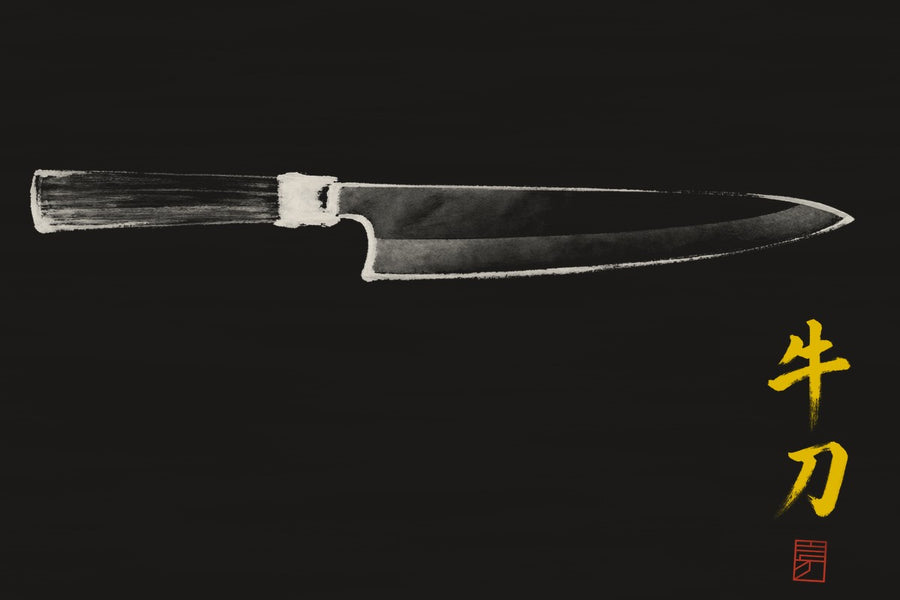
牛刀

Chef's knife · Double bevel

Double-bevel all-purpose chef's knife with a pointed tip; thinner than a Western one.

Read more
Steel properties
  1. Hardness Good
  2. Edge retention Good
  3. Toughness Very high
  4. Rust resistance High
  5. Ease of sharpening High
  6. Sharpness High
Our ratings, inferred from published lab tests and composition.

Our edge-retention grade is a kitchen rating. It weighs the hardness each steel is sold at, which keeps a thin edge from rolling, twice as heavily as lab wear tests, and the final grade is our judgment from selling and sharpening these knives for over a decade. Lab card-cutting tests measure abrasive wear only, so they can rank carbon steels lower. Tap ? for the lab figure.

Steel

Ginsan / Silver #3

GIN3

Stainless · Hitachi Metals (now Proterial)

Proterial's GIN 3 stainless: 0.95 to 1.10% carbon, 13.00 to 14.50% chromium, hardening hardness over 59 HRC.

Read more
CladdingCoreClad line
Construction

Sanmai - Stainless Clad

三枚

3 layers · stainless clad

Hard core between two stainless layers, bare only at the edge; the cladding resists rust.

Read more
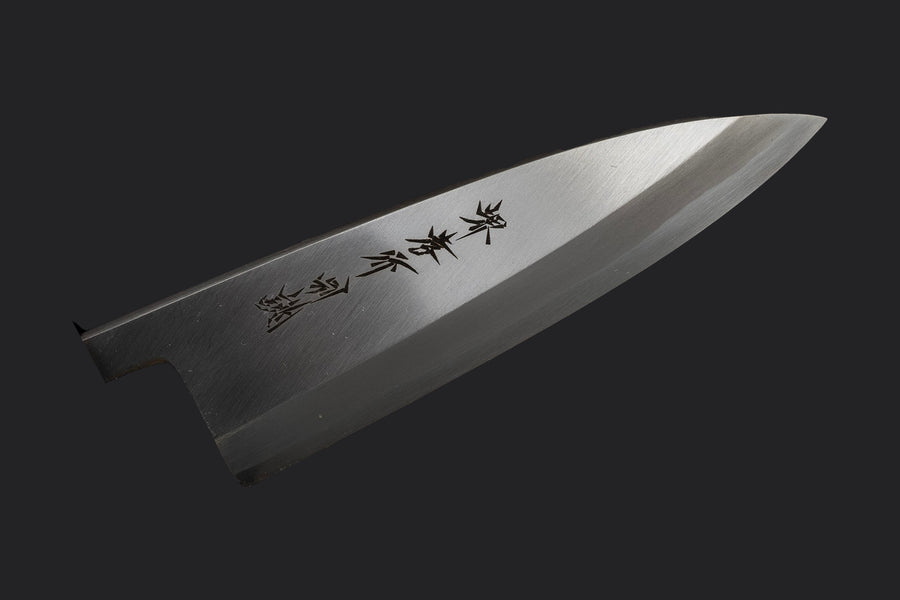
Kasumi — blade surface finish
Finish

Kasumi

Misty polish

Hazy, matte bevel where soft iron meets hard core steel. The iron patinas and rusts.

Read more
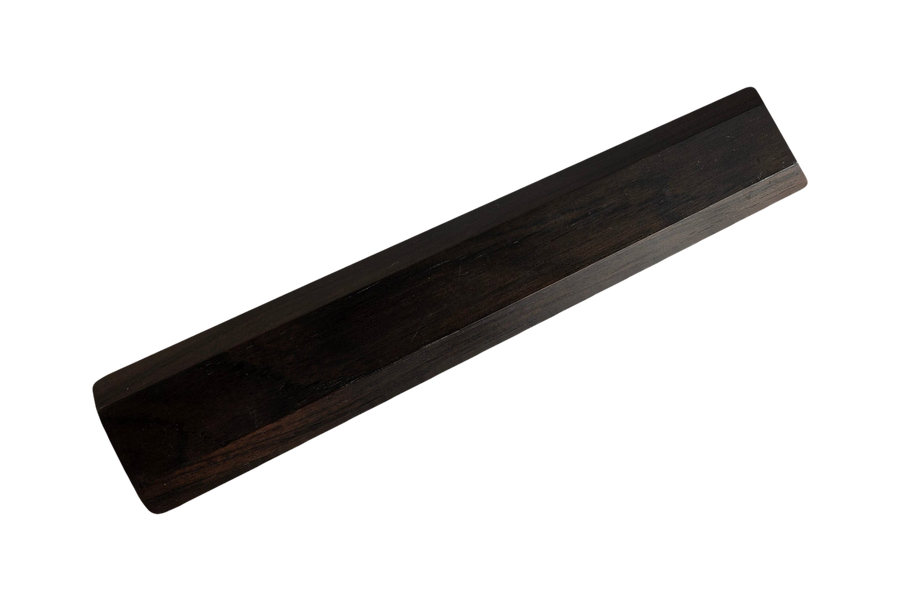
Octagonal Ebony handle
Handle

Octagonal Ebony

Octagonal WA

Dense, dark ebony in the eight-sided wa shape. The flats give a sure grip for either hand.

Frequently asked questions

Gyuto or santoku: which should I choose?

The gyuto came to Japan with the beef-eating culture of the Meiji era, and that is where its name comes from. Tojiro says it is used for all kinds of cooking, which is why it is also called the chef's knife.

The santoku is a household knife that combines the good points of the nakiri and the gyuto. Tojiro describes it as all-purpose, from vegetables to meat and fish, double-bevel and built on the same construction as a Western knife.

Choose a gyuto if you want more length and reach. Choose a santoku if you want a shorter all-purpose knife. Tojiro's own size figures: gyuto 150 to 210mm for household use and up to 360mm for professional use, santoku 165 to 170mm for household use.

What is a gyuto knife used for?

The gyuto (牛刀) is a chef's knife for all kinds of cooking, and it is basically double-bevel. A knife maker's guide says it came to Japan in the Meiji era with the culture of eating beef, which gave it its name, but it does not cut only meat.

A Japanese dictionary describes the gyuto as slimmer than a santoku, with a pointed tip, used widely for meat, fish and vegetables.

What gyuto length should I choose?

A knife maker's guide lists 150 to 210 mm, double-bevel, for home use, and 180 to 360 mm, single- or double-bevel, for professional kitchens.

We suggest starting with a 210 mm gyuto for a home kitchen, and stepping up to 240 mm if you regularly cut large pieces and have the board for it.

240mm vs 210mm gyuto: which size should I choose?

Get the 210mm. We only point people to a 240mm when they have about 45cm of usable board, cook in volume, and regularly break down big roasts or whole fish.

On the gyutos we've measured for our product pages, the extra length is real. As of October 2026, the 210mm gyutos we list have a median edge of 213mm from heel to tip, across the 111 we have measured; the 240mm ones have a median of 240mm, across 100. The 240s are also heavier, 212g against 175g at the median, and a touch taller at the heel, 50mm against 48mm, across the same 100 and 111 knives.

Weight overlaps between the two sizes. As of October 2026, 11 of the 100 measured 240s weigh less than the median 210 at 175g. The 240s we measured weigh 146 to 323g, and the 111 measured 210s 121 to 255g. The number in the name does not decide how heavy a knife is, so check the measured weight on the product page.

Japanese or German kitchen knives: which should I buy?

These are two design families, not a national specification, and many modern knives mix both. Japanese profiles are typically thinner, so they suit push and pull cuts; German profiles carry a fuller belly, which suits rocking. A given knife is its own evidence, so look at the blade you would buy rather than the country label.

Edges follow the same pattern. Many German knives ship at about 15 degrees per side, while many Japanese knives run about 10 to 15; check the model you are buying. A smaller angle is sharper but less forgiving. Hardness is a per model figure too. On two common Japanese steels the steel makers' own figures start at 60 HRC: Takefu Special Steel rates VG10 at 60 HRC or more, and Proterial lists the hardening hardness of Aogami 2 (Blue 2) as over 60 HRC.

A Japanese knife suits precision work where a sharp edge and nimble handling matter; a German knife suits heavier prep and rocking cuts where a substantial feel and a more forgiving edge matter. Whichever you choose, keep the edge off bone, frozen food and very hard squash, and use a wooden or plastic board.

What is the flat spot on a knife, and is it the same as the "sweet spot"?

The flat spot is the straight run of edge from the heel towards the middle, the part that meets the board along its length. It is commonly known as the sweet spot; some people also use "sweet spot" for the balance point, so ask which one someone means.

Past the flat, the edge curves up towards the tip (the belly), which suits a swinging or pulling stroke. Sharpeners also say "flat spot" for a worn patch of edge, so when you mean the shape, "the flat part of the edge" is clearer.

Gyuto or chef's knife: what is the difference?

A gyuto is a chef's knife, and its shape is largely modelled on the French chef's knife: a fairly flat run of edge near the heel, then a curve up to the tip. A German-style chef's knife has a bigger belly and curves along much more of its edge.

The flat run suits push and pull cuts, and the belly is made for rocking. That flat run is commonly known as the sweet spot.

Is a Japanese knife set worth buying, or should I buy knives one at a time?

Buy one at a time. Start with a chef's knife (gyuto) or a santoku and add a knife only when you notice you are missing one. A boxed set makes you pay for knives you will rarely pick up to get the one you use daily, and we sell very few of them.

If you want knives that match, build a small set yourself.

  • The main knife is a 210mm gyuto, or a 165 to 180mm santoku if your board is small. It does most of the work.
  • Add a small utility knife (petty) of about 150mm for peeling, trimming and other close work.
  • Add a third only if your cooking calls for it: a vegetable knife (nakiri) for daily vegetable prep, or a slicing knife (sujihiki) for carving roasts and portioning meat or fish.

Our Knife Bundles collection groups knives by line, such as the Hatsukokoro Hayabusa VG10 and our own K&S AUS-10 Monosteel, so handles and finish match.

A set bought in one go only makes sense when you know you will use every knife in it. If you already own a chef's knife you are happy with, skip a second all-purpose knife and put the money into a whetstone. Our first Japanese knife guide covers choosing the first one.