PRAHRAN STORE NOW OPEN · THU–MON · 10AM–6PM

Takeshi Saji  |  SKU: TAKE-V10RB-PE150-COS

EOFY2025 SPECIAL: Saji VG10 Rainbow Damascus Petty 130mm with Cosmic Swirl Handle

Regular price $439.95

Sold out right now

Leave your email and we’ll send one message the moment it’s back in stock.

One email, no marketing. Privacy policy.

Availability

  • St Peters, NSW —
    2 Bishop St, Unit 2, St Peters NSW 2044
  • Crows Nest, NSW —
    107 West St, Shop 1, Crows Nest NSW 2065
    Pickup only
  • Prahran, VIC —
    180 Commercial Road, Shop 1, Prahran VIC 3181
    Pickup only
Detailed Specifications
Line Takeshi Saji VG10 Rainbow Damascus Diamond Polish
Profile Petty / Utility knife
Bevel Type Double Bevel
Weight 63 g | 2.2 oz
Edge Length 132 mm | 5 13/64″
Heel Height 29 mm | 1 9/64″
Width @ Heel 1.8 mm | 5/64″
Width @ Mid 1.7 mm | 1/16″
Width @ 1cm from Tip 0.8 mm | 1/32″
Steel VG10 | Stainless
Blade Construction Sanmai - Stainless Damascus Clad
Hardness (HRC) 59 - 61
Surface Finish Migaki
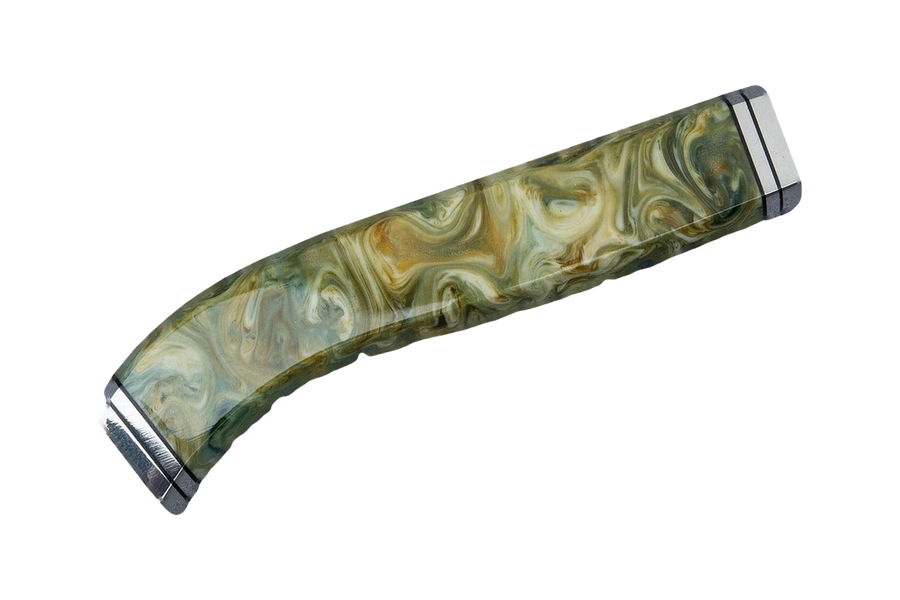
Handle Nenox Cosmic Swirl Dual Ferrule
Region Takefu
Best for
  • Pro chefs
  • Enthusiasts
  • Free shipping for knives over AU$200 Australia wide.
  • World-wide shipping via DHL Express, 3 to 5 days.


Takeshi Saji’s VG10 Rainbow Damascus was a unique creation at its time, being one of the first makers who took advantage of the copper/brass laminated VG10 billet, Saji could create these knives with a stunning look and great practicality. 

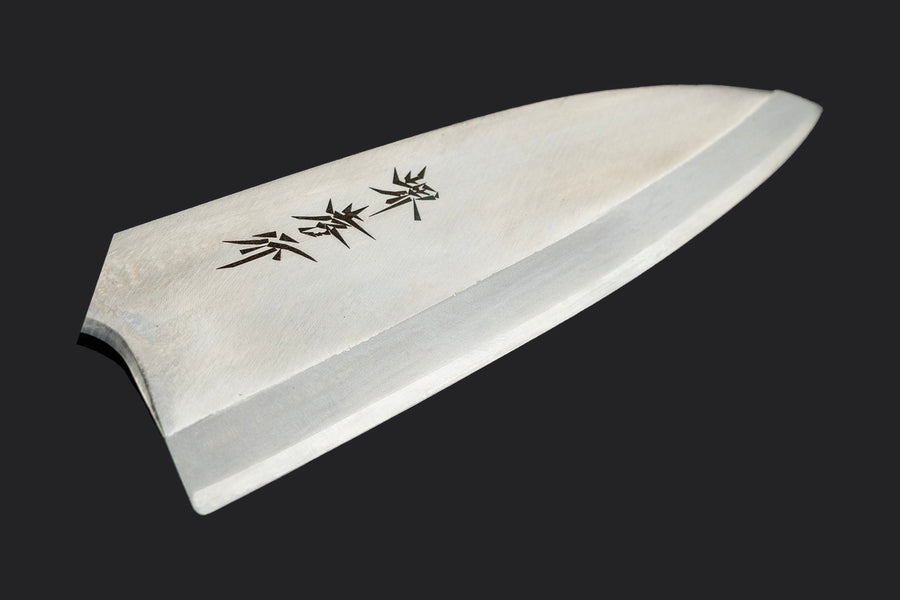
The surface finish of these blades are rather simple, there isn't any etching or sandblasting that used to increase the contrast between the steel, copper and brass, and the polish just left the texture of the damascus on the surface. This finish is named “Diamond Migaki” and it has been used by Saji extensively in his SG2 Damascus lineup. We found this is a particularly good finish for the cutting smoothness as there is very little friction and sticking due to the combination of low evenness and high smoothness.

As for the geometry itself, these knives still hold up their standard as a Takeshi Saji knife, the spine is on the thinner side and it comes down to the edge that has almost no thickness in a slight convex grind. This design has been proven as one the smoothest cutting geometry and when paired with the aforementioned Migaki finish, can guarantee you a very pleasing experience when preparing your next meal.

For a knife with great performance and great look forged by a rather famous blacksmith, this VG10 line does come in at a relatively high price point. For the same price, you could easily find some other options with better steel like SG2. I would recommend this line to those who truly love beautiful and unique items, and are willing to pay a little extra for a work by a legendary blacksmith.

Pros Cons
  • Excellent performance
  • Great artistic
  • Thin behind the edge
  • High budget
Care Instruction
  1. Don't cut hard things! Japanese knives are brittle so bone hacking is a NO NO!
  2. Wash with neutral detergent after use, and wipe dry;
  3. Please don't wash knife with dishwasher, it will damage the wood handle;
  4. Be careful not to leave the knife close to a heat source for a long time;
  5. It is a lot more dangerous to cut with a blunt knife than a sharp knife!
  6. It is best to sharpen a Japanese knife regularly on a waterstone.

Takeshi Saji

Takeshi Saji (佐治 武士), Saji Uchihamono, Echizen

Takeshi Saji (佐治 武士) is an Echizen smith and the third generation of Saji Uchihamono (佐治打刃物), a company founded in 1916 and a member of Takefu Knife Village. He is a certified traditional craftsman (伝統工芸士), and the Village calls him a pioneer of Japanese-style knives built on traditional techniques.

We stock his SG2 and VG10 damascus knives, his SRS13 knives and his maki-e lacquered VG10W knives, with handles that include ironwood, stag and turquoise.

Read more

According to Takefu Knife Village, Saji still goes to exhibitions and abroad himself, taking in new ideas and making new pieces. The Village lists what the family company makes: Japanese-style knives, custom knives, forged kitchen knives of various kinds, and nata, the Japanese hatchet.

Among the damascus knives we carry from Saji are black and diamond damascus in SG2, and rainbow damascus in VG10.

“Third generation of Saji Uchihamono, an Echizen knife company founded in 1916.”

Est. 1916 | 大正5年
Known for Japanese-style knives and damascus kitchen knives
Instagram @takeshi_saji Read more about Takeshi Saji

Takeshi Saji · Takefu

Knife details

Frequently asked questions

What is a petty knife and when do I need one?

A petty knife is a small Japanese utility knife, typically with a blade between 120mm and 180mm, designed for precision tasks like peeling, trimming, and slicing fruits and vegetables. You need one when your main chef’s knife feels too large for detail work, think deveining shrimp, cutting garnishes, or any in-hand peeling where a bigger blade gets in the way. Its slightly longer and slimmer profile than a Western paring knife gives you more control for intricate cuts without sacrificing the nimble feel you want for small jobs. If you regularly find yourself reaching for a smaller blade for finishing work, a petty fills that gap cleanly.

A petty is not a replacement for a gyuto or santoku. It lacks the blade length and belly for efficient chopping, rocking, or breaking down larger proteins. If your work is mostly bulk prep, like dicing onions or slicing roasts, a petty will feel slow and underpowered. It also won’t handle heavy tasks like splitting bones or prying, so treat it as a precision tool, not an all-rounder.

The petty’s role in a Japanese kitchen is as the smaller counterpart to the gyuto, built for tasks where a full-size blade is clumsy. At Knives and Stones, the petty category covers a range of steels including VG10, White#2, Swedish Steel, VG5, SG2, and MV, from makers like Sakai Takayuki, Masamoto Sohonten, Ryusen, Nigara, Hatsukokoro, and Sentan. Most are double-beveled, and the blade length runs from 120mm to 180mm, which is what gives it that balance of reach and precision. For more on how this fits into your knife kit, see the Knives and Stones Education Centre.

How long is a petty knife?

Petty knife lengths vary by maker: KAI's guide defines a petty (ペティナイフ) as a small knife with a narrow blade measuring 150 mm or under. Its table gives 90 to 150 mm, and it describes the shape as a smaller gyuto with a pointed tip.

We list petty knives from 70 mm to 165 mm, including lengths above the limit used in KAI's guide.

Does VG10 rust?

Yes, it can, though it rusts less readily. VG10 (V金10号) is a stainless steel, and stainless strictly means a steel that rusts less, not one that never rusts.

Takefu, which makes VG10, lists 15% chromium, above the 10.5% that defines stainless steel, and describes its corrosion resistance as excellent. Dry the knife after washing.

How hard is VG10?

Takefu, the steelmaker behind VG10, gives HRC 60 or more as a standard value. The hardness of a finished knife depends on its maker.

Takefu says the steel's 15% chromium, 1% molybdenum and 1.55% cobalt give it high hardness and a long-lasting edge, and that it is easy to sharpen.

How old is Saji Uchihamono?

Saji Uchihamono was founded in 1916, according to the Takefu Knife Village page for Takeshi Saji.

The same page lists him as the third generation of the company, 佐治打刃物.

You May Also Like