Genkai Masakuni

Exotic: Genkai Masakuni (玄海正國) Mizu-Honyaki Maguro Kiri 450mm Mt. Fuji Hamon

Sale price $4,600.00 Regular price $5,411.00

IMPORTANT: Carbon steel knives can rust or patina quickly if not cared for properly. They require regular cleaning, drying, and oiling. If you are unfamiliar with carbon steel maintenance, we recommend choosing a stainless steel option instead.

Pickup in Australia only

In Stock Now

Availability

Goes well with

Detailed Specifications
Line Genkai Honayki
Profile Yanagiba / Sashimi knife
Bevel Type Single Bevel
Weight 445 g | 15.7 oz
Edge Length 434 mm | 17 3/32″
Heel Height 42 mm | 1 21/32″
Width @ Heel 4.6 mm | 3/16″
Width @ Mid 3.6 mm | 9/64″
Width @ 1cm from Tip 2.2 mm | 3/32″
Steel White 2 / Shirogami #2 | Carbon
Blade Construction Honyaki
Maker's hardening hardness 60 HRC or more
Surface Finish Mirror Polish
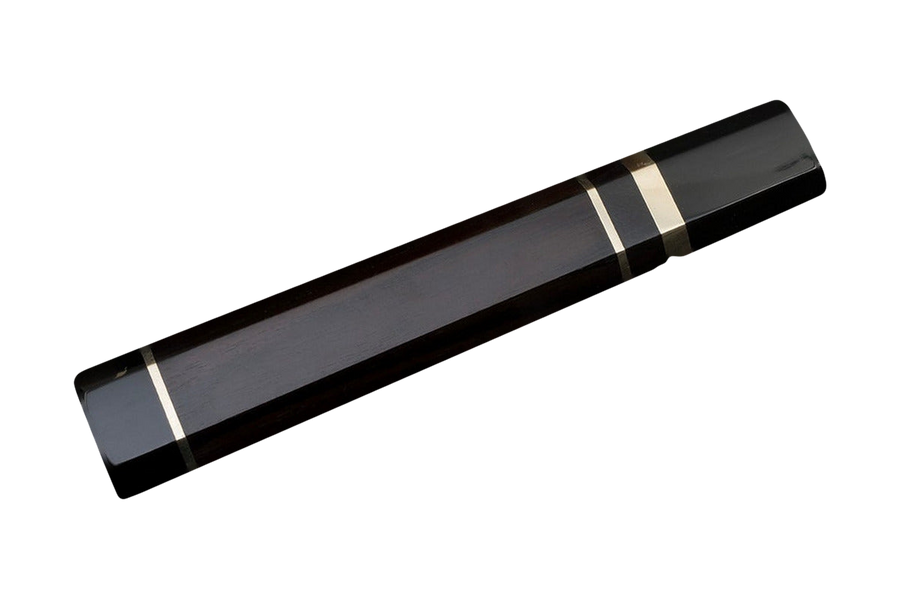
Handle triple spacer ebony
Region Kyushu
Best for
  • Collectors

World-wide shipping via DHL Express, 3 to 6 days (not available in the UK).


TBA

Pros Cons
  • Great artistic
  • High budget
Care Instruction
  1. Don't cut hard things! Japanese knives are brittle so bone hacking is a NO NO!
  2. Wash with neutral detergent after use, and wipe dry;
  3. Please don't wash knife with dishwasher, it will damage the wood handle;
  4. Be careful not to leave the knife close to a heat source for a long time;
  5. It is a lot more dangerous to cut with a blunt knife than a sharp knife!
  6. It is best to sharpen a Japanese knife regularly on a waterstone.
  7. Oil the (carbon) knife if storing for an extended period of time to prevent rust.

Genkai Masakuni

Genkai Masakuni (玄海正国), the blade name of Yoneo Mukō

Genkai Masakuni(玄海正国), a well-known name in the Japanese kitchen knife industry. Being one of the few makers that could produce the Mt. Fuji Hamon Honyaki, a Yanagiba utilising such a technique can be sold for a few thousand dollars easily. Behind the name Genkai Masakuni was the late Mukou Yoneo (向 米雄), who honed his skill in Sakai until he moved back to Kabe island, Karatsu city in Saga Prefecture at age of 40.

The origin of the name might be related to the location, as Genkai-Cho is located right next to Karatsu city. Although Genkai Masakuni is the name/engraving Mukou san used most often, he used a few other names on the blades he forged. One of them is Sakai Minamoto Hakuhou(堺源伯鳳)which is a brand name used by the sharpener Hakui Minoru(伯井 實). Following the traditional division of labour employed in Sakai, these two craftsmen worked closely as blacksmith and sharpener for each other even after Mukou san moved back to Saga, this collaboration continued for a long time until the retirement of Hakui san.

For those who are aware of the creation process of the Honyaki knife, the level of skill behind the name Genkai Masakuni should need no further explanation. But for people who are curious about the nature of these very pricy knives, it helps to explain again. The Honyaki process is a heat treatment process of mono steel blades, where the blade is cladded by clay in the spine to form an insulating layer and quenched to have a hardened edge and softer spine, just like how swords were done in the past. The “Hon” can be generally translated as “the real deal”, and “Yaki” is used for heat treatment related terminologies. Together Honyaki can be seen as the real deal heat treatment, which shows how much the method is valued.

For the intended use of a kitchen knife, it does not require a soft springy spine to prevent breakage in the fight, thus this method is mostly used to achieve a tempering line called Hamon. To create Hamon, a shallow quenching steel must be used with a fast quenching method to form a clear boundary. Often a combination of Hitachi White carbon steel and water quenching(Mizu-Honyaki) is used to achieve a Hamon, but the risk that comes with water quenching is the intense stress build-up in the blade due to different shrinking rate between the area that are covered by the clay and area left exposed. A failed Mizu-honyaki will have a dramatic, explosive failure that breaks the blade in pieces, and this is not uncommon to happen as the quenching temperature is very strict for this to not happen.

Blacksmiths that are trained in this trade for years rely on their eyes to tell the temperature of the blade by the color of the blade, and the heating is done usually in charcoal forge. If that doesn’t sound difficult enough, there is another technique to add to it: Fujiyama Hamon. As the name suggests, the Hamon is shaped like Mt. Fuji on the blade, and having this shape creates a significant point of failure due to the concentrated stress at the Mt. Fuji’s peak where the shape protrudes out the most. For this reason, there are only a few blacksmiths that are skillful enough to produce this Hamon with consistency, and you can count them by one hand.

Genkai Masakuni, being one of these smiths, could produce regular wavy hamon as well as the Mt, Fuji Hamon, paired with a mirror finish, the dynamic shape of the Hamon can look like flowing terrain or snow covered mountains, and needless to say, this level of control over a medium that is very difficult to work with has notable artistic value. With the retirement of Master Ikeda and Master Shiraki, Mukou san too had his retirement in 2020, his blades would continue to be sharpened and polished in the following years but eventually become depleted. He has since passed away, and the name Genkai Masakuni is remembered by collectors and knife enthusiasts.

“The blade name of the late smith Yoneo Mukō (向米雄), who worked on Kabeshima and specialised in water-quenched honyaki.”

Known for Water-quenched honyaki (mizu-honyaki)
Read more about Genkai Masakuni

Genkai Masakuni · Kyushu

Knife details

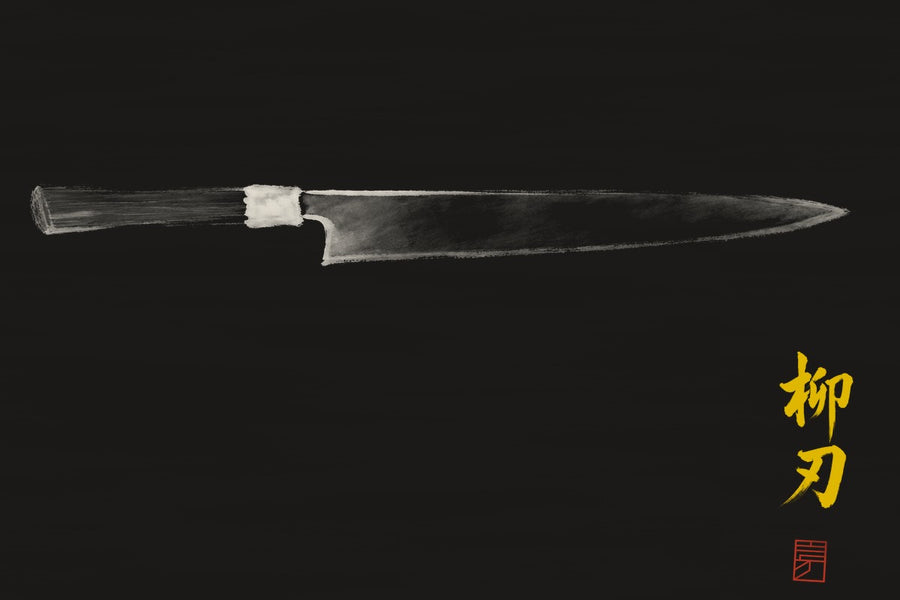
Yanagiba — knife profile
Profile

Yanagiba

柳刃

Sashimi knife · Single bevel

Long single-bevel sashimi slicer with a pointed tip. One clean draw cuts raw fish.

Read more
Steel properties
  1. Hardness Very good
  2. Edge retention Good
  3. Toughness Good
  4. Rust resistance Low
  5. Ease of sharpening High
  6. Sharpness Very high
Our ratings, inferred from published lab tests and composition.

Our edge-retention grade is a kitchen rating. It weighs the hardness each steel is sold at, which keeps a thin edge from rolling, twice as heavily as lab wear tests, and the final grade is our judgment from selling and sharpening these knives for over a decade. Lab card-cutting tests measure abrasive wear only, so they can rank carbon steels lower. Tap ? for the lab figure.

Steel

White 2 / Shirogami #2

白二鋼

Carbon · Hitachi Metals (now Proterial)

Proterial carbon steel, 1.05 to 1.15% carbon, no chromium or tungsten; not stainless.

Read more
ShinogiSofter spineHollow backHamonHardened edge
Construction

Honyaki

本焼

One steel · differential hardening

One steel, only the edge hardened, showing a hamon. Mostly carbon (rusts); some stainless.

Read more
Mirror Polish — blade surface finish
Finish

Mirror Polish

鏡面

Mirror polish

Polished to a true mirror that shows hamon or damascus clearly. Every scratch shows.

Read more
triple spacer ebony handle
Handle

triple spacer ebony

Octagonal WA

Octagonal ebony with horn fittings and three pale spacer bands, two at the ferrule end.

Frequently asked questions

What is a yanagiba knife used for in sushi preparation?

A yanagiba (柳刃包丁) is a sashimi knife for slicing raw fish. A knife maker's guide says a sashimi knife cuts without breaking the fibres of the flesh, and that it is longer and narrower than other knives because slicing sashimi with crisp edges needs the length.

The whole length goes through one pulling cut. The Sakai cutlery association calls the yanagiba the sashimi knife used mainly in the Kansai region.

What size yanagiba should I buy?

Size a yanagiba to the fish you prepare: a knife maker's guide gives 270 to 360 mm for professional use and 240 to 270 mm for home use, with 270 mm at home if you slice larger fish.

The guide says the whole length goes through one pulling cut, so do not choose too short a knife, and at home it points to the size of your board and your work space. We list the yanagiba (柳刃) from 210 to 360 mm, some made for left-handed use.

Can a yanagiba cut through fish bones?

No. The Sakai cutlery association describes the yanagiba (柳刃包丁) edge as so acute that it cannot be used on hard things such as bones.

For bones the association describes the deba (出刃包丁), whose heel is used to hit them.

Takohiki or yanagiba: what is the difference?

An encyclopedia describes sashimi knives as thin and narrow, calling the pointed ones yanagiba and the unpointed ones takohiki. A sakimaru takohiki is the rounded-tip variant, so it has a rounded point despite its takohiki name.

A trade body, the Sakai cutlery association, calls the takohiki (たこ引き包丁) the Kanto-type sashimi knife, and the yanagiba the sashimi knife used mainly in Kansai, with an acute edge that is not for bone.

Sujihiki or yanagiba: which do I need?

Most home cooks need the sujihiki. Choose the yanagiba when slicing raw fish for sashimi and sushi is the main job and you are prepared to learn single bevel sharpening.

A sujihiki is a long, narrow, double bevel slicer. Tojiro describes it as the knife for dividing large pieces of meat, known abroad as a slicer or carving knife, and says its length lets it cut sashimi as well. It carves roasts, trims sinew and portions fish, works in either hand and sharpens like any double bevel knife. Sujihiki run from about 210 to 300 mm, and 240 mm suits most home boards.

A yanagiba is the single bevel sashimi knife. It is ground on one side with a hollow back, and each slice is one long pull from heel to tip, so raw fish is cut cleanly rather than sawn. The edge is too fine for bones or anything hard. It is made for one hand and most are right handed, so check the listing if you are left handed. Sharpening means working the whole bevel and keeping the back flat. Yanagiba run from about 240 to 330 mm, with 270 and 300 mm the common sizes.

So for roasts, portioning meat and the occasional side of fish, buy a sujihiki. For regular sashimi and sushi work, buy a yanagiba and keep it for fish.

Why is the back of a single-bevel knife hollow, and how do I sharpen it?

The shallow hollow in the back is called urasuki (裏スキ). Tojiro explains that it means the whole back never has to be ground when you sharpen, makes it easier to keep the back flat, and stops sharpening the back from affecting the edge. Only the thin flat rim around the hollow touches the stone.

Sharpen the front bevel first, laying it flat on the stone. Then lay the back completely flat and take a few light strokes, just enough to remove the burr. Never lift the spine to put an angle on the back, and keep the stone itself flat.

Which knife do I need for sushi and sashimi at home?

For occasional sushi at home, a sharp sujihiki (筋引) does the job. Tojiro describes it as a long, double-bevel slicer that can also be used for sashimi, and a double bevel works in either hand.

If sashimi is the point of the meal, choose a yanagiba (柳刃). Tojiro calls it the Kansai-style sashimi knife, now used across Japan, and it slices in one long pull from heel to tip. It is single bevel, so buy the one made for your hand.

If you start from whole fish, add a deba (出刃). Tojiro describes it as very thick and heavy, made for breaking fish down. The deba takes the fish apart and the slicer then cuts the fillets.

Shirogami 1 vs Shirogami 2: what is the difference?

Shirogami 1 (White 1) has more carbon than Shirogami 2 (White 2): Proterial lists 1.25 to 1.35% carbon for Shirogami 1 and 1.05 to 1.15% for Shirogami 2, with the same silicon (0.10 to 0.20%) and manganese (0.20 to 0.30%) ranges for both.

Proterial describes both as carbon steel with minimum impurities, Shirogami 1 with the highest hardness and Shirogami 2 with high hardness, and gives a hardening hardness of over 60 HRC for both. It lists Shirogami 1 for the highest quality tipped tools, planes, chisels and razors, and Shirogami 2 for high quality tipped tools, chisels, razors, sickles, axes and gravers.