PRAHRAN STORE NOW OPEN · THU–MON · 10AM–6PM

Drag to spin · pinch or scroll to zoom

Hado  |  SKU: HD_SGSS_BU180

Hado Shiosai SG2 Tsuchime Bunka 180mm

Regular price $399.95

Sold out right now

Leave your email and we’ll send one message the moment it’s back in stock.

One email, no marketing. Privacy policy.

Availability

  • St Peters, NSW —
    2 Bishop St, Unit 2, St Peters NSW 2044
  • Crows Nest, NSW —
    107 West St, Shop 1, Crows Nest NSW 2065
    Pickup only
  • Prahran, VIC —
    180 Commercial Road, Shop 1, Prahran VIC 3181
    Pickup only
Detailed Specifications
Line Hado Shiosai SG2 Tsuchime
Profile Bunka / K-tip santoku
Bevel Type Double Bevel
Weight 155 g | 5.5 oz
Edge Length 171 mm | 6 47/64″
Heel Height 50 mm | 1 31/32″
Width @ Heel 2.0 mm | 5/64″
Width @ Mid 1.9 mm | 5/64″
Width @ 1cm from Tip 1.1 mm | 3/64″
Steel SG2 / R2 | Powdered | Stainless
Blade Construction Sanmai - Stainless Clad
Hardness (HRC) 62 - 64
Surface Finish Tsuchime
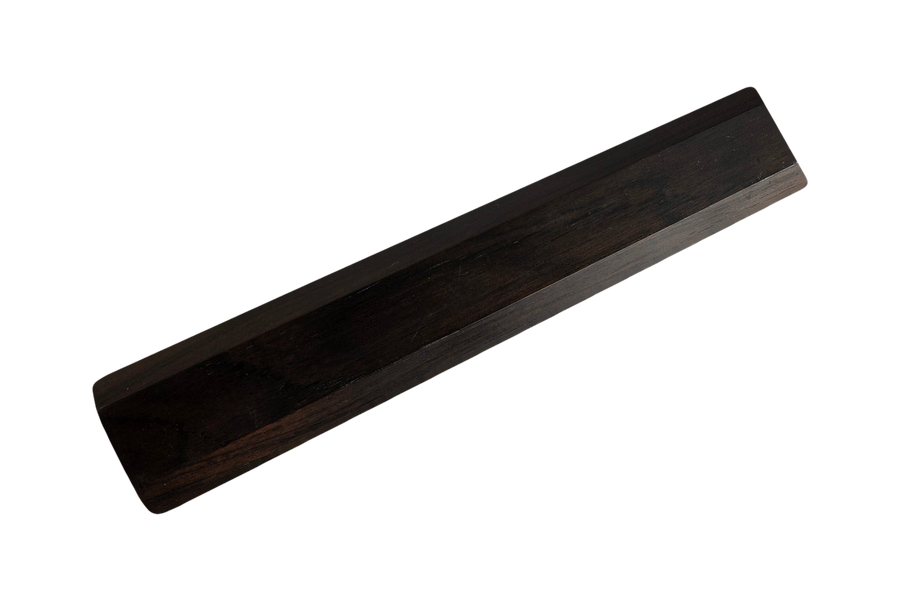
Handle Octagonal Ebony
Region Sakai
Best for
  • Pro chefs
  • Enthusiasts
  • Students
  • Free shipping for knives over AU$200 Australia wide.
  • World-wide shipping via DHL Express, 3 to 5 days.


Hado Shiosai(潮騒, Tide Sound) is the brand’s value lineup, compared with their more traditional carbon series like the Kirisame or Sumi, this line uses stamped billet to obtain a lower price. But from a practical point of view, this is a lower maintenance, better edge retention knife and you still can get the excellent thin blade produced by Hado, this is certainly a very competitive lineup in its price range.

The highlight of the knife would be its grind, as the sharpening company, Hado will design and order billets from different sources to sharpen and polish them, and their approach on the sharpening is what makes them stand out. At a glance, we would notice the Shinogi line is positioned very high up the blade, close to the spine, this is neither a flat grind nor a Traditional Sakai convex grind, paired with a pretty thin blade thickness, Hado produces some of the thinnest knives we can get. These “lasers” have minimal amount of resistance even when cutting into the toughest food, and if you are worrying about sticking issues over the wide bevel, I can confidently say it is mostly avoided by the subtle convex built behind the edge.

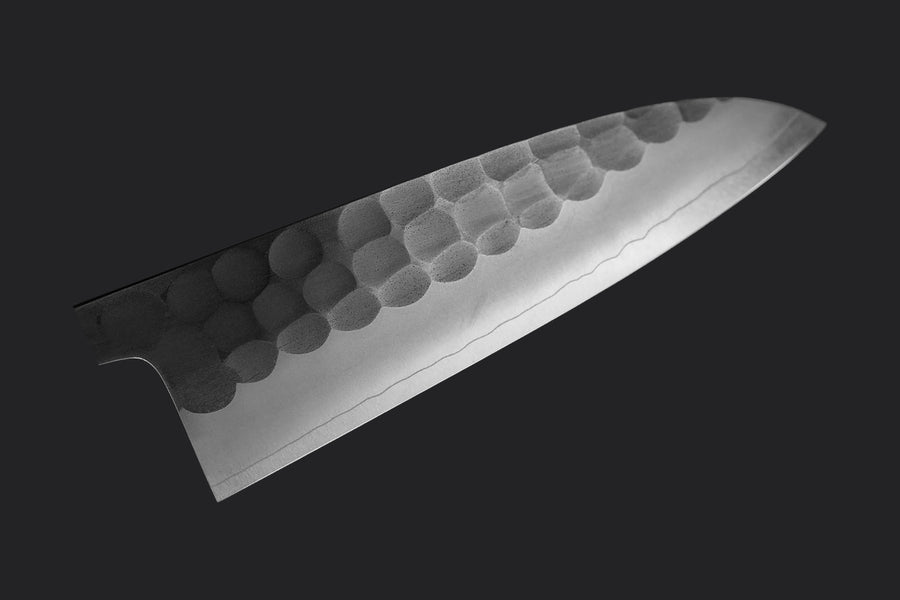
This very specialised and well designed geometry scores pretty high on performance, but Hado still leaves space for some aesthetic features. The stamped blade incorporates textures on its surface, covering the Hira with octagonal shapes of various sizes. Looking at the name of the line, these patterns easily link to the imagery of foamy bubbles created by the tide striking the shore, then the splashing sound of waves and bursting sound of bubbles just naturally comes forth in the brain. The surface of the knife combines a really refined brushing along the blade and sandblasting among the cladding, giving the knife a subtle and minimalistic look, the highly polished choil, spine and edge connects and forms a shiny edge, frames this knife using their contrast in textures. Despite the pricing, this is a very well thought after and well executed line in terms of appearances. 

The usage of SG2 billet is an excellent move in my opinion, although the traditional forged carbon steel can have a nice tapered spine and more aggressive edge, their pricing is still a bit too high and the maintenance can be tricky. Having a low maintenance stainless steel with premium level edge retention, while keeping the price reasonable shows that Hado is offering this line for the average user instead of enthusiasts, and from the availability of the Shiosai we see, there is also a more steady supply of these blades. We can clearly see Hado’s ambition in expanding their target markets, and Shiosai is a great addition in the superthin “laser” category as it is more available and carries some aesthetic features.

Pros Cons
  • Excellent performance
  • Great for professionals
  • Thin behind the edge
  • A little bit brittle
Care Instruction
  1. Don't cut hard things! Japanese knives are brittle so bone hacking is a NO NO!
  2. Wash with neutral detergent after use, and wipe dry;
  3. Please don't wash knife with dishwasher, it will damage the wood handle;
  4. Be careful not to leave the knife close to a heat source for a long time;
  5. It is a lot more dangerous to cut with a blunt knife than a sharp knife!
  6. It is best to sharpen a Japanese knife regularly on a waterstone.

HADO

HADO (刃道), Fukui Co.'s Sakai knife brand

HADO(刃道), a brand launched in 2021 under the banner of Fukui Co., Ltd. Its name translates directly to “The Path of Blade” and its founding has an interesting story to it. Being a company located in Sakai, its products are straight up a defiance to Sakai’s impression of old-school, traditional approach in knifemaking, and this young brand has shown us what Sakai is capable of in terms of innovation and breaking existing rules.

In 2015, Tadataka Maruyama, sales representative of Fukui Co. decided to quit his current position and pursue the craft of knife sharpening, particularly Hatsuke(刃付け)-the process of giving the knife its bevel geometry and edge. The then president Ryuichiro Fukui told him to properly train himself and return to the company after three years, and in 2021, under the support of Fukui Co., Hado was founded.

Typical Sakai approach in knifemaking would begin with a forged blade with intermediate thickness, sharpening in a lightly convex geometry where the bevel transitions smoothly to the Hira. After the finishing polish using a wooden wheel or sandblaster, the Kasumi finish would look like a uniform surface from the side. Hado took a very different approach in their knife design, staring with a slightly thinner blade that measure just above 2mm in the spine, they put a very aggressive bevel onto the blank, the Shinogi line is clear and defines, located close to the spine, which means a lot of material are removed and the bevel stays thin until very high up. This means minimal wedging in cutting even if you are dealing with a tough produce, and the sticking issue is solved via a subtle convex grind behind the edge.

The material choice is when you sense the tradition they the brand is clinging to, using mostly Blue, White and Ginsan, these blades forged with traditional materials are polished differently to create variety. What is consistent is their incredible sharpness and top notch fit and finish, with mirror polished spine and choil blends seamlessly into the organic Nashiji/Kurouchi blade and Kasumi finished bevel. Meanwhile, Hado is very open to newer material and manufacturing techniques too, the newly released Shiosai features a stamped SG2 billet and they can offer great value with the same Hado sharpening.

In July 2025, the sharpener Maruyama announced his independence from the company, and started his own store in Nara, his colleagues took over the sharpening task and held up the quality to the standard after the change. In the city of Sakai where tradition reigns supreme, we can still see innovation from a young brand. Initiating its journey backed up by the trust and faith of Fukui Co., Hado’s efforts have been proven effective by their popularity amongst knife lovers, their success have pointed out a path of innovation for the industry, and we will be happy to see more vitality getting brought into this market.

“The knife brand launched by Fukui Co. of Sakai in 2021.”

Est. 2021 | 令和3年
Known for Fukui Co.'s own knife brand from Sakai
Website hado-knife.jp Instagram @hado_knife Read more about HADO

HADO · Sakai

Knife details

Frequently asked questions

Why is it called a bunka knife?

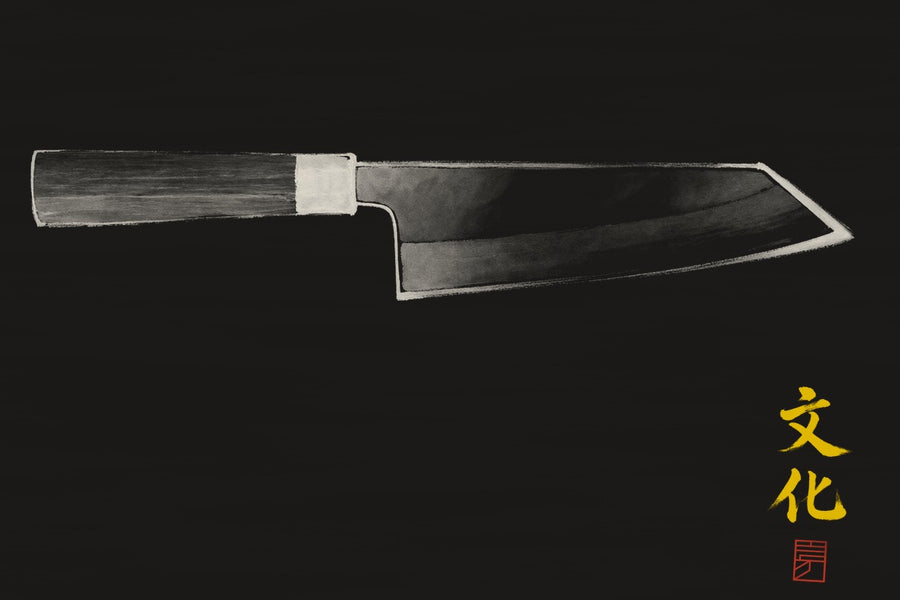
The bunka knife (文化包丁) takes its name from bunka, culture. A Sakai knife maker ties the name to Japan's modernisation, when Western culture and Japanese tradition merged, and says it stands for that new era and for the knife's wide range of uses.

The same maker says that as diets broadened to meat, fish and vegetables, an all-purpose knife was wanted, and the bunka took features from both Japanese and Western knives.

What is the difference between a bunka and a santoku?

The tip. One Japanese knife maker describes the bunka (文化包丁, kengata) as combining the good points of the gyuto and the nakiri with the tip cut at an angle, and the santoku as coming after it, by rounding that tip.

Both are all-purpose knives for the home; santoku (三徳) means three virtues, for the three foods it cuts: meat, fish and vegetables.

SG2 steel knives at Knives and Stones

SG2 is my go-to recommendation for anyone who wants a stainless knife that performs like carbon steel without the fuss. At 62 HRC or more (Takefu's figure), it takes a screaming edge and holds it far longer than VG-10 or AEB-L, all while being rust-resistant. You get the best of both worlds: no patina worry, but real cutting performance.

SG2 vs AS steel for kitchen knives — which is better?

Neither is objectively better, it just depends on whether you value stainless convenience or a laser-sharp carbon edge. Go with SG2 if you want a knife that holds a screaming edge without any babysitting. Choose AS if you are chasing the thinnest possible edge and don't mind wiping the blade down after every use.

SG2 is a powdered stainless steel from Takefu, rated at 62 HRC or more. It is tough and resists corrosion, which is why I reach for it when working with acidic foods. Aogami Super is high carbon, and Proterial gives it a hardening hardness of over 60 HRC. It sharpens to a hair-whittling edge that lasts slightly longer than SG2, but it will rust if you neglect it.

R2 steel vs SG2 — are they the same?

Yes, R2 and SG2 are the same steel — R2 is the name used by Kobelco Steel, and SG2 (Super Gold 2) is the name used by Takefu Special Steel for the identical powdered metallurgy formula. SG2 / R2 is a powder (PM) steel from Takefu Special Steel, Japan, with a composition of 1.25% carbon, 14.0% chromium, 1.8% vanadium, 2.3% molybdenum, and a hardness range of 62–64 HRC. So if you see a knife labeled R2 or SG2, you are getting the exact same material.

Is Hado a blacksmith or a brand?

Hado is a brand: its own site calls it a Sakai knife brand.

The company named on that site is Fukui Co.

You May Also Like