
PRAHRAN STORE NOW OPEN · THU–MON · 10AM–6PM

Hatsukokoro  |  SKU: HTNG-VGXDM-GY21

Hatsukokoro x Nigara VG XEOS Kurozome Damascus Gyuto 210mm w/ Saya

Regular price $699.95
Tax included Shipping calculated at checkout.

Sold out right now

Leave your email and we’ll send one message the moment it’s back in stock.

One email, no marketing. Privacy policy.

Availability

  • St Peters, NSW —
    2 Bishop St, Unit 2, St Peters NSW 2044
  • Crows Nest, NSW —
    107 West St, Shop 1, Crows Nest NSW 2065
    Pickup only
  • Prahran, VIC —
    180 Commercial Road, Shop 1, Prahran VIC 3181
    Pickup only
Detailed Specifications
Line Hatsukokoro by Nigara VG Xeos Full Polish
Profile Gyuto / Chef's knife
Bevel Type Double Bevel
Weight 180 g        6.35 oz
Edge Length 201 mm   .7.91 inch
Heel Height 49 mm     .1.93 inch
Width @ Spine 2.7 mm     0.11 inch
Width @ Mid 2.3 mm     0.09 inch
Width @ 1cm from Tip 1.3 mm     0.05 inch
Steel VG XEOS | Stainless
Blade Construction Sanmai - Stainless Damascus Clad
Hardness (HRC) 62 - 63
Surface Finish Etched
Handle
Region Aomori
Best for
  • Enthusiasts
  • Collectors
    • Free shipping for knives over AU$200 Australia wide.
    • World-wide shipping via DHL Express, 3 to 5 days.

    Hatsukokoro x Nigara VG XEOS Kurozome Damascus Gyuto

    The latest collaboration between Hatsukokoro and Nigara brings back the spirit of one of their most memorable early releases. For those who remember the first-generation Anmon series, this knife carries a familiar sense of depth, movement, and atmosphere — a true return to that expressive Nigara texture.

    The blade features a flowing Suminagashi Damascus pattern, moving across the surface like ink on paper. This is paired with Nigara’s signature Kurozome finish, adding a darker tone and greater visual depth to the blade face.

    Under the light, the surface reveals subtle silver, crystal-like details within the pattern, giving the knife a finish that feels both quiet and dynamic.

    At the core is VG XEOS, a next-generation stainless steel from Takefu Special Steel. Known for its outstanding corrosion resistance and high hardness, VG XEOS offers excellent edge retention while maintaining solid toughness for daily kitchen use. It takes on an incredibly sharp edge with ease, offering a clean and precise cutting experience.

    As a gyuto, this knife is designed as a versatile all-purpose chef’s knife, suitable for slicing, chopping, push-cutting, and general prep work. The combination of stainless performance, dramatic Damascus texture, and Nigara’s distinctive finishing makes this piece equally appealing as a serious kitchen tool and a visually captivating blade.

    Subtle, dynamic, and completely captivating — a modern Hatsukokoro x Nigara collaboration with the soul of a classic.

    Care Instruction
    1. Don't cut hard things! Japanese knives are brittle so bone hacking is a NO NO!
    2. Wash with neutral detergent after use, and wipe dry;
    3. Please don't wash knife with dishwasher, it will damage the wood handle;
    4. Be careful not to leave the knife close to a heat source for a long time;
    5. It is a lot more dangerous to cut with a blunt knife than a sharp knife!
    6. It is best to sharpen a Japanese knife regularly on a waterstone.
    Nigara

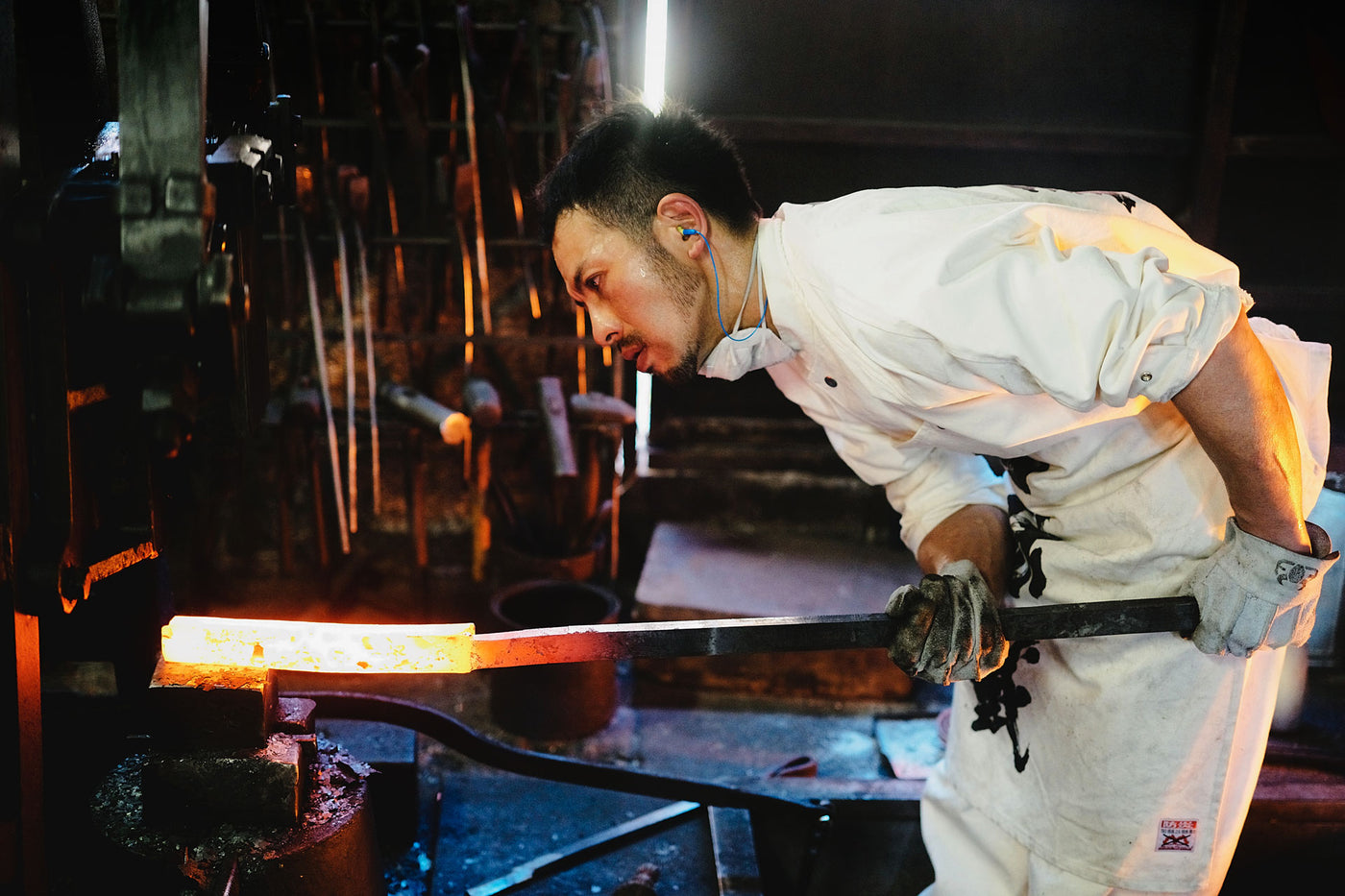
    Nigara (二唐刃物鍛造所) is a forge in Hirosaki, Aomori. Go Yoshizawa (吉澤剛) is its president and signs as the eighth generation; his father, Toshiju Yoshizawa (吉澤俊寿), the seventh generation, is chairman.

    Nigara dates its line to 1803, when the family began as gunsmiths in the service of the Tsugaru domain, and it made Japanese swords for generations. In the Edo period the domain took it on as its weapons works, and it made even cannon and warships. After the Second World War the forge turned from military swords to farm tools and kitchen knives; in those years it made knives in winter and sold them in summer.

    In the early Showa era a Nigara smith whose sword name was Kunitoshi (国俊) studied under Dr Kotaro Honda, director of Tohoku University's metals research institute. Nigara's company history says he excelled at sword making. He was recognised as a holder of an intangible cultural property of Aomori Prefecture and passed his skill on to the seventh generation. The sixth generation had no son, so Toshiju, a grandson through a daughter's line, joined as heir. The present company dates from 1949, and besides knives it does welding and steel construction work, with a welding department since 1963. Nigara showed at Maison et Objet in Paris in 2011 and at Ambiente in Frankfurt in 2013.

    We have visited Nigara several times, once for a few days of hands-on training at the forge.

    The Anmon Damascus knives we list come in SG2 as gyuto, kiritsuke gyuto, bunka, santoku, nakiri, petty and sujihiki, and as single-bevel yanagiba and takobiki in Blue 2 and Ginsan. SG2 tsuchime knives, kurouchi or matt migaki, cover gyuto, petty, santoku, nakiri, bunka and sujihiki, plus a double-bevel honesuki and a butcher. We also list VG10 Damascus tsuchime, Ginsan Kurozome Damascus and Aogami Super tsuchime knives, and an SPG STRIX tsuchime Damascus nakiri. The honyaki are Blue 2 with shaped hamon, as yanagiba, kiritsuke yanagiba and sakimaru, and a White 1 kiritsuke yanagiba.

    • Gyuto: Japanese knife profile, sumi ink on washi

      Profile: Gyuto

      Chef's knife

      A gyuto is the Japanese chef's knife: a double-bevel all-purpose blade with a pointed tip and a profile that reads like a slightly flatter, leaner French chef's knife. The name (牛刀) literally means 'beef knife', a reminder that the shape arrived with Western cooking. It is thinner behind the edge and ground to a keener angle than a Western chef's knife. Typical lengths run from 180mm to 270mm; 210mm and 240mm are the sizes most home cooks and chefs settle on.

      It is the knife most cooks reach for first: slicing meat, chopping and mincing vegetables, breaking down large boneless cuts. Compared with the santoku, it is longer, with a pointed tip and more belly, so it rocks through herbs and works into tight spots. Compared with the K-tip gyuto, it keeps the curved point. Compared with the gyuhiki, it is shorter and taller, more chopper than slicer.

      Slide for more >>

    • Steel: VG XEOS

      Takefu developed VG XEOS as a new grade of blade steel that combines high corrosion resistance and high hardness, a combination the company says had been difficult to achieve in the past. It describes a fine microstructure created by a special melting method, and says the method improves wear resistance, strength, and quenching properties.

      Takefu explains the name itself: the X marks a newly developed material combining corrosion resistance and hardness, and EOS points to a new steel grade heralding the dawn of a new stage in cutlery. Takefu does not publish its chemical composition.

      We list VG XEOS knives from Yu Kurosaki and Sukenari.

      Manufacturer:

      • Takefu Special Steel, Japan

      Nature: Stainless

      Hardness: 62- 63

      << Slide for more >>

    • Handle Specs

      Profile:

      Material:

      << Slide for more