PRAHRAN STORE NOW OPEN · THU–MON · 10AM–6PM

KAI  |  SKU: KAI-SHUNP-SA180

Shun Premier Utility Santoku 18cm (7")

Sale price $216.95 Regular price $259.95

Sold out right now

Leave your email and we’ll send one message the moment it’s back in stock.

One email, no marketing. Privacy policy.

Availability

  • St Peters, NSW —
    2 Bishop St, Unit 2, St Peters NSW 2044
  • Crows Nest, NSW —
    107 West St, Shop 1, Crows Nest NSW 2065
    Pickup only
  • Prahran, VIC —
    180 Commercial Road, Shop 1, Prahran VIC 3181
    Pickup only
Detailed Specifications
Line Shun Premier
Profile Santoku / Santoku
Bevel Type Double Bevel
Weight 223 g | 7.9 oz
Edge Length 180 mm | 7 3/32″
Heel Height 49 mm | 1 59/64″
Width @ Heel 2.0 mm | 5/64″
Width @ Mid 1.9 mm | 5/64″
Width @ 1cm from Tip 1.0 mm | 3/64″
Steel VG-MAX | Stainless
Blade Construction Sanmai - Stainless Damascus Clad
Hardness (HRC) 60 - 61
Surface Finish Tsuchime
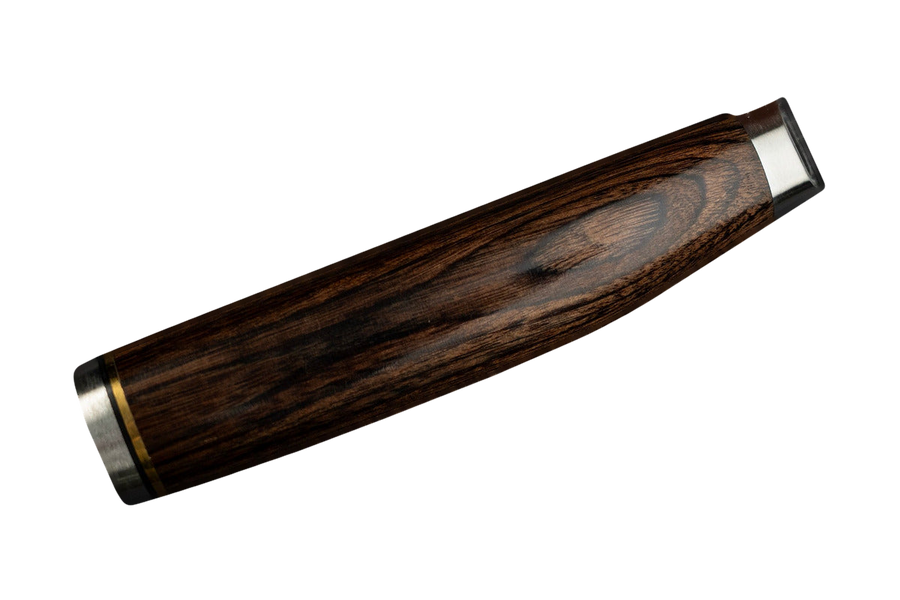
Handle Walnut Pakkawood
Region Seki
Best for
  • Pro chefs
  • Enthusiasts
  • Free shipping for knives over AU$200 Australia wide.
  • World-wide shipping via DHL Express, 3 to 5 days.


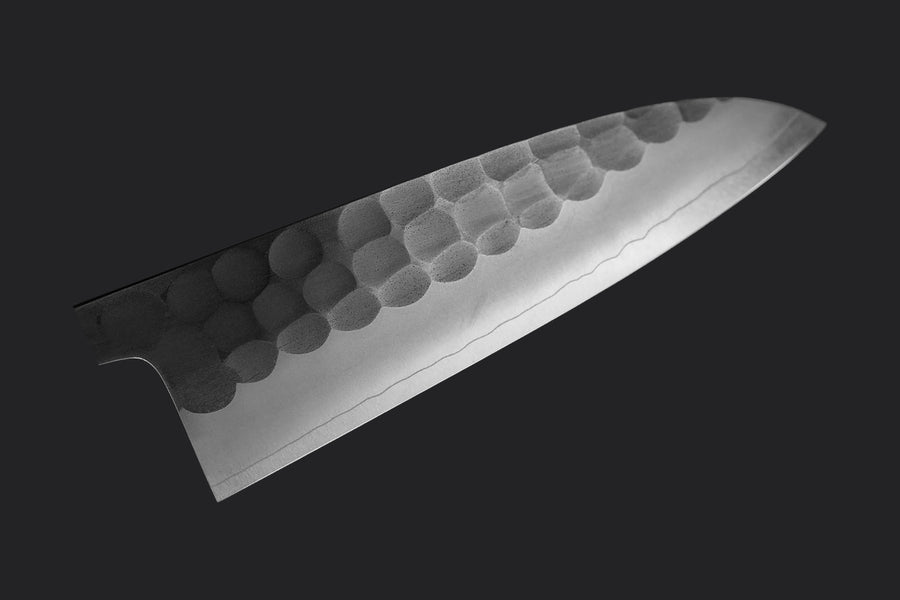
For a lot of people, a Shun was the knife that started it all — the first time they realised a kitchen knife could actually be sharp. The Premier line from KAI is arguably the most refined expression of that idea. Built around KAI's proprietary VG-MAX core steel — an evolution of VG10 with improved edge retention and corrosion resistance — the blade is clad in 68 layers of stainless Damascus and finished with a tsuchime (hammered) texture that isn't just for show. The dimples genuinely help with food release, which is a nice bonus on a blade that's already pretty well ground.

At around 60-61 HRC, the VG-MAX edge holds up noticeably longer than standard VG10 before needing a touch-up, and because everything here is fully stainless, maintenance is about as low as it gets — rinse, wipe, done. The contoured walnut-toned Pakkawood handle feels immediately comfortable in a Western grip and gives the Premier a warmer, more organic look compared to the Classic line's black D-shape.

The lineup covers the basics — chef's knife (20cm), santoku (18cm), utility (16cm), paring (10cm), and a bread knife — all with the same 16-degree edge geometry. These aren't artisan-forged knives and they don't pretend to be. What they are is remarkably well-engineered factory knives with excellent consistency, a genuinely sharp edge out of the box, and a fit and finish that most people will never need to look past. If you're buying your first serious knife, or you want something that just works without any fuss, the Premier is a very safe bet.

Pros Cons
  • Ideal for the household
  • Excellent fit and finish
  • Relatively hard to sharpen
  • High budget
Care Instruction
  1. Don't cut hard things! Japanese knives are brittle so bone hacking is a NO NO!
  2. Wash with neutral detergent after use, and wipe dry;
  3. Please don't wash knife with dishwasher, it will damage the wood handle;
  4. Be careful not to leave the knife close to a heat source for a long time;
  5. It is a lot more dangerous to cut with a blunt knife than a sharp knife!
  6. It is best to sharpen a Japanese knife regularly on a waterstone.

KAI

KAI (貝印), a Seki blade company since 1908

KAI (貝印) is a Japanese blade company founded in Seki in 1908, when Saijiro Endo began making pocket knives there. Its head office is now in Tokyo, and its group maker, KAI Industries, has its factories in Seki and Gujō.

We stock two of its knife brands, Shun and Seki Magoroku. The Seki Magoroku name comes from the swordsmith Seki no Magoroku.

Read more

KAI was established as a company in Seki, Gifu, in 1920, began making safety razor blades in 1932 and launched its Shun (旬) knives in 2000. Today KAI says it sells more than 10,000 products, covering cooking and grooming tools as well as medical and industrial blades.

Shun says each of its knives is crafted in Seki City through more than 100 steps, and that its Classic and Premier series use VG-MAX, a steel proprietary to Shun. Those are the two Shun lines we stock.

From Seki Magoroku we stock the Imayo (いまよう) line, which KAI describes as a series with a high-hardness blade and a three-step edge for long-lasting sharpness.

“A blade company founded in Seki in 1908, behind Shun and Seki Magoroku.”

Est. 1908 | 明治41年
Known for Shun and Seki Magoroku kitchen knives
Website kai-group.com Read more about KAI

KAI · Seki

Knife details

Frequently asked questions

Gyuto or santoku: which should I choose?

Both are all-purpose Japanese knives, and for most home cooks either will handle the bulk of daily prep. The choice comes down to length, blade shape, and how you like to cut.

A gyuto is the Japanese chef's knife, with a gently curved edge that lets you rock and slide through cuts as well as chop. Tojiro's guide to Western knife shapes gives 150 to 210mm as the household size for a gyuto and up to 360mm for professional use. The extra length and pointed tip give you reach and versatility, from proteins to large produce.

Tojiro's guide to Japanese knife shapes gives 165 to 170mm as the household size for a santoku, which has a flatter profile and a rounded sheep's-foot tip. It rewards a straight up-and-down push cut, feels nimble in smaller hands or tight kitchens, and is the classic Japanese household knife.

Rule of thumb: choose a gyuto if you want one do-everything knife with more reach, or a santoku if you prefer a compact, easy-to-control blade. Plenty of our customers end up owning both.

Rock chop or up-and-down chop: which knife shape suits me?

Match the shape to your stroke. Rock chopping keeps the tip on the board and rolls the curved belly through the food, so a gyuto or a Western chef's knife suits it, and Japanese knives rock fine as long as you rock gently.

Up-and-down chopping, the Chinese style, wants a straight run of edge, so a nakiri, usuba, santoku or bunka suits it better; a curved edge chopped straight down easily leaves pieces joined. Neither shape is better; it depends on how you cut.

What does santoku mean?

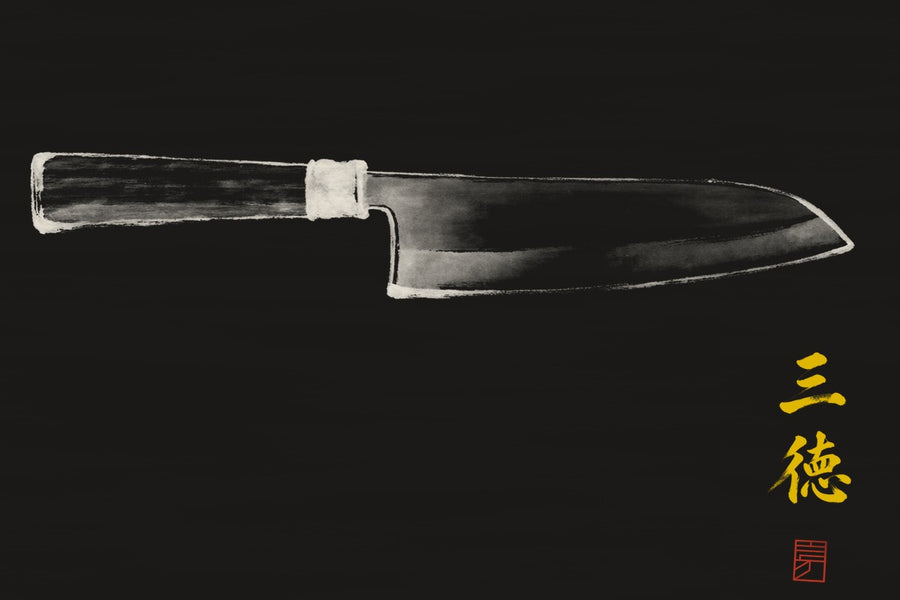
A Japanese dictionary explains the name of the santoku (三徳包丁) as coming from the three things it handles: meat, fish and vegetables. The same dictionary entry points from the santoku to the bunka (文化包丁), treating the two as one knife.

One Japanese knife maker guide distinguishes the two by the tip. It says that in the Showa era the bunka was made with its tip cut at an angle, and the santoku came after it by rounding that tip.

How is VG-MAX different from VG10?

KAI, the company behind Shun, says VG-MAX builds on the VG10 formula with more carbon for strength and durability, additional chromium for wear and corrosion resistance, and increased tungsten, which it says makes the steel very fine-grained so the edge can be extremely sharp.

KAI attributes corrosion resistance and strength to molybdenum, and impact resistance and carbide formation to vanadium. KAI uses VG-MAX in its Shun Classic and Premier series.

What steel is Shun Premier made from?

Shun Premier is made with a VG-MAX steel core clad in Damascus, and KAI calls VG-MAX Shun's own formula for edge retention, durability and corrosion resistance.

KAI's European site lists the series as made in Japan.

What does the hammered finish on Shun Premier do?

KAI says the hammered finish (tsuchime) makes the blade stronger, and that added strength allows a thinner grind.

KAI's European site adds that the hammered surface helps food come off the blade, thanks to the air pockets it creates.

Is Shun made by KAI, and how is it different from Seki Magoroku?

Yes, KAI launched its premium knife line Shun in 2000. KAI traces its history to 1908, when Saijiro Endo began making pocket knives, and the company was established in Seki, Gifu, in 1920.

Seki Magoroku is also a KAI brand. KAI says it carries the craft and spirit of the swordsmith Seki no Magoroku into modern knifemaking, fused with KAI's own technology, and its top tier is the Master Line.

What is the Seki Magoroku Imayo line?

Imayo (いまよう) is a series inside KAI's Seki Magoroku line. KAI describes it as a high-hardness blade body that takes a three-step edge, set up for sharpness that keeps going for a long time. It is one of the series on the Seki Magoroku knives page.

KAI's knives page lists Imayo alongside the all-stainless 10000ST and 匠創, the stainless three-layer 茜, the 10000CC in carbon steel, a 32-layer Damascus and the Master Line 要.

You May Also Like