PRAHRAN STORE NOW OPEN · THU–MON · 10AM–6PM

Tsunehisa  |  SKU: TNHS_A8TS_SU24_BRN

Tsunehisa AUS8 Tsuchime Sujihiki 240mm Brown Western Handle

Regular price $199.95

Sold out right now

Leave your email and we’ll send one message the moment it’s back in stock.

One email, no marketing. Privacy policy.

Availability

  • St Peters, NSW —
    2 Bishop St, Unit 2, St Peters NSW 2044
  • Crows Nest, NSW —
    107 West St, Shop 1, Crows Nest NSW 2065
    Pickup only
  • Prahran, VIC —
    180 Commercial Road, Shop 1, Prahran VIC 3181
    Pickup only
Detailed Specifications
Line Tsunehisa AUS8 Tsuchime Western Handle
Profile Sujihiki / Slicing knife
Bevel Type Double Bevel
Weight 147 g | 5.2 oz
Edge Length 246 mm | 9 11/16″
Heel Height 34 mm | 1 11/32″
Width @ Heel 1.7 mm | 1/16″
Width @ Mid 1.6 mm | 1/16″
Width @ 1cm from Tip 1.0 mm | 3/64″
Steel AUS-8 | Stainless
Blade Construction Sanmai - Stainless Clad
Hardness (HRC) 57 - 59
Surface Finish Tsuchime
Handle Western Pakka Wood with Bolster
Region Fukuyama
Best for
  • First-timers
  • Students
  • Free shipping for knives over AU$200 Australia wide.
  • World-wide shipping via DHL Express, 3 to 5 days.


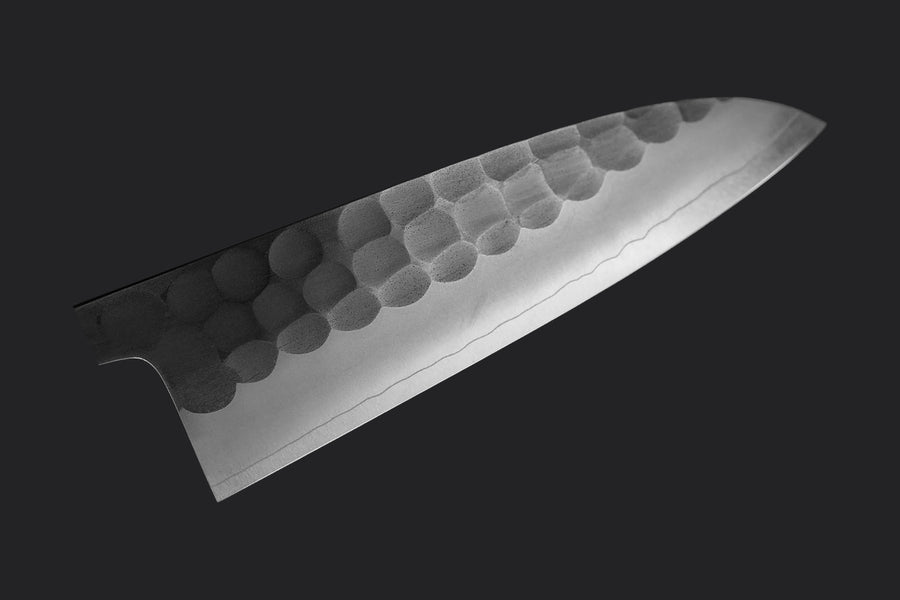
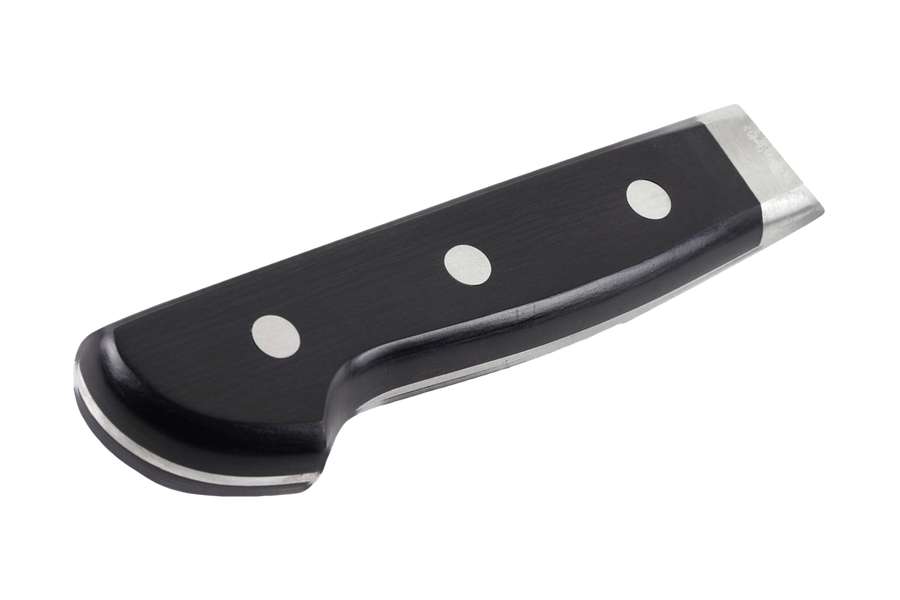
The blade of this Tsunehisa combines Tsuchime with a sandblasted Kasumi finish, a wave shaped mask is used at the Shinogi line to create a visually interesting pattern at the junction between the surface of the blade and the bevel. The full tang design has a metal bolster and although there are small gaps between the metal parts, the bolster, handle scale and the blade are all polished very well for a pleasing look and grip.

AUS-8 is commonly considered as a low budget steel and in many cases, it is not wrong, but it doesn’t necessarily mean it has a poor performance. The wear resistance is not as good as VG10 but in exchange, AUS-8 has noticeably better toughness. When getting a beginners oriented blade, this is something we do want to consider, many of the habits people built around European blades can result in chipping and breaking of the Japanese blade. Having a tougher steel that is more resistant to chipping can preserve the edge, avoiding the situation where the knife is immediately damaged after use. Although there is no numerical value about how much more beat this steel can take, I would feel more reassured when recommending this knife to a beginner or someone gifting to a friend.

The grind is decent too on these blades, although it doesn’t have a fancy geometry, the relative low blade thickness still makes the knives cut relatively easily, there is some thickness behind the edge but not something that affects the cut, the only downside might be the relative flat bevel, which can create some sticking cutting into some denser food.

This line would definitely be in the consideration when we recommend people a beginner knife, as the balance feature and performance is matched with a compelling price. In addition, the durable and western style full tang construction have a shape and balance that is close to a typical European knife, which makes switching into the Japanese awesomeness a bit easier for those who would like to dip their toes into this different world of cutting tools.

Pros Cons
  • Budget friendly
  • Ideal for the household
  • Easy to look after
  • Non-premium steel
Care Instruction
  1. Don't cut hard things! Japanese knives are brittle so bone hacking is a NO NO!
  2. Wash with neutral detergent after use, and wipe dry;
  3. Please don't wash knife with dishwasher, it will damage the wood handle;
  4. Be careful not to leave the knife close to a heat source for a long time;
  5. It is a lot more dangerous to cut with a blunt knife than a sharp knife!
  6. It is best to sharpen a Japanese knife regularly on a waterstone.

Tsunehisa

Tsunehisa, the house brand of Shibata Knives

Tsunehisa (恒久) is the house brand of Shibata Knives, the knife company Takayuki Shibata owns and runs. It is a brand rather than a single workshop.

The name means permanence, and Shibata Knives says it chooses knives that will have a long life. Takayuki Shibata started Tsunehisa in 2015 as his third knife brand, to help manage growing orders.

Read more

Shibata Knives describes Tsunehisa as a brand that inherits traditional Japanese forging techniques while taking in the latest materials and technologies, aiming at function and design for long use. It says its experienced staff inspect each knife under strict quality control, and it offers after-sales maintenance and sharpening.

The lines we list are grouped by steel. Ginsan comes in migaki, nashiji and nawame finishes, as gyuto, santoku, nakiri and petty, with a deba in the same steel. White 1 comes stainless clad as migaki and tsuchime gyuto, Aogami Super as kurouchi tsuchime sujihiki and petty, and Blue 2 as the Samurai sakimaru sujihiki.

The Damascus lines are in VG10, AUS10 and ZA18, the AUS10 also with a tsuchime finish. The rest are AUS8 tsuchime, a VG1 gyuto and an SLD Washiji santoku. Handles come in wa and yo styles.

“The house brand of Shibata Knives; the name means permanence.”

Est. 2015 | 平成27年
Known for Knives chosen and inspected by Shibata Knives
Read more about Tsunehisa

Tsunehisa · Fukuyama

Knife details

Frequently asked questions

What size sujihiki should I buy?

Between 210 and 270 mm, depending on where it will work. One Japanese maker lists 210 to 240 mm, double-bevel, for home use and 240 to 270 mm, single- or double-bevel, for professional kitchens.

Another, in Sakai, recommends 240 mm at home, with the size of your board in mind, and 270 mm for professional use.

Sujihiki or yanagiba: which do I need?

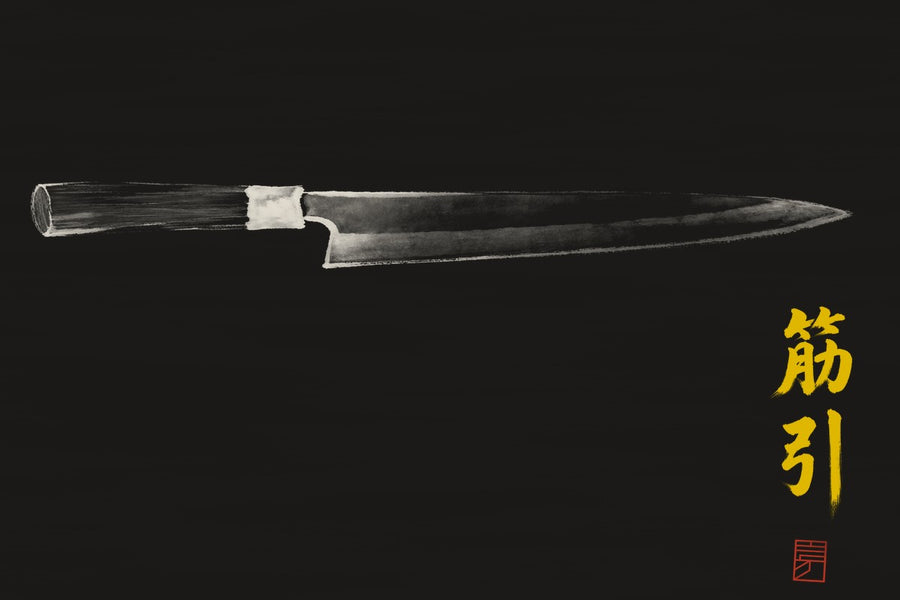
A sujihiki is a long, double-bevel knife for dividing larger pieces of meat into their parts, and its length lets it slice sashimi too; a yanagiba is the sashimi knife.

The Sakai cutlery association describes the yanagiba (柳刃包丁) edge as so acute that it cannot be used on bone or other hard things, so choose the sujihiki for meat and the yanagiba if sashimi is the main job.

Who makes AUS-8?

AUS-8 is made by Aichi Steel, whose page on stainless steels for blades groups the AUS grades with its 13-chromium steels. There, AUS-6M, AUS-8 and AUS-10 are the grades that add still more carbon and add vanadium and molybdenum, which Aichi says further improves hardness, wear resistance and tempering resistance.

By the JSSA's definition, stainless means 10.5% or more chromium, and the JSSA notes that stainless, strictly, means it rusts less, so wash the knife after use and dry it.

What does the name Tsunehisa mean?

Tsunehisa (恒久) means permanence. Shibata Knives describes Tsunehisa as its original brand, and says it selects knives that will have a long life, inspecting each one before delivery. Its own words are that it delivers knives worthy of a permanent position in your home.

The brand is built on traditional Japanese forging techniques with modern materials, and Shibata Knives offers after-sales maintenance and sharpening for the line.

Is Tsunehisa a brand or a blacksmith?

Tsunehisa is a brand, not a single smith or a workshop. Shibata Knives describes it as an original brand of the company, run by Takayuki Shibata, and Shibata Knives does not name the workshop that makes each line. The company inherits traditional Japanese forging techniques with modern materials, and experienced staff inspect each knife before it is delivered.

What stands behind each Tsunehisa knife is that selection and inspection, and the company offers after-sales maintenance and sharpening for the line.

You May Also Like