PRAHRAN STORE NOW OPEN · THU–MON · 10AM–6PM

Takeshi Saji  |  SKU: SJ-DIAMDMSG2-PT130

Takeshi Saji SG2 Diamond Damascus Petty 130mm

Sale price $339.98 Regular price $399.00

Sold out right now

Leave your email and we’ll send one message the moment it’s back in stock.

One email, no marketing. Privacy policy.

Availability

  • St Peters, NSW —
    2 Bishop St, Unit 2, St Peters NSW 2044
  • Crows Nest, NSW —
    107 West St, Shop 1, Crows Nest NSW 2065
    Pickup only
  • Prahran, VIC —
    180 Commercial Road, Shop 1, Prahran VIC 3181
    Pickup only

Goes well with

Detailed Specifications
Line Saji SG2 Diamond Damascus
Profile Petty / Utility knife
Steel SG2 / R2 | Powdered | Stainless
Blade Construction Sanmai - Stainless Clad
Typical working hardness 61 to 65 HRC
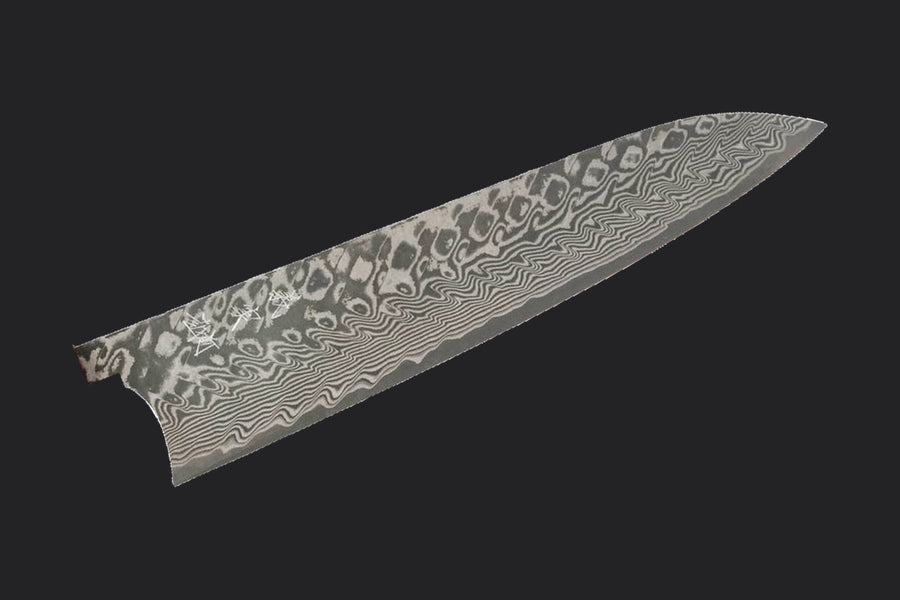
Surface Finish Etched
Handle
Region Takefu
Best for
  • Pro chefs
  • Enthusiasts
  • Collectors

Free shipping for knives over AU$200 Australia wide.

World-wide shipping via DHL Express, 3 to 6 days (not available in the UK).


There are plenty of Damascus knives on the market, but very few have the same visual impact as the SG2 Diamond Damascus from Takeshi Saji. Coming from the renowned Takefu Knife Village in Echizen, this line is a good example of Saji's approach to knifemaking, where traditional forging techniques are combined with modern steels and some rather adventurous designs. The first thing that catches your attention is naturally the Damascus finish, but beneath that beautiful surface is a serious kitchen knife with plenty of performance to offer.

The blade is built around an SG2 (also known as R2) powder metallurgy stainless steel core, heat treated to approximately 62–64 HRC. SG2 has become one of the most respected steels in high-end Japanese kitchen knives, offering excellent edge retention and corrosion resistance. Its fine and relatively uniform carbide structure allows the edge to be sharpened to a very fine level while maintaining good wear resistance. Compared with conventional stainless steels such as VG10, SG2 generally holds its sharpness longer, although it can require a little more effort when sharpening. For those looking for a high-performance knife without the maintenance demands of carbon steel, SG2 is a very attractive option.

The real signature of this line is its deeply etched Diamond Damascus finish. Unlike conventional Damascus patterns that feature relatively uniform flowing lines, Saji's Diamond Damascus combines fine, closely spaced waves with irregular, almost crystalline formations across the blade. The contrast between the polished highlights and darker recessed areas creates an impressive three-dimensional appearance, and the pattern changes considerably depending on the viewing angle. It is worth mentioning that the Damascus itself doesn't contribute directly to edge retention or cutting performance, as these properties are primarily determined by the SG2 core and blade geometry. The deep etching does, however, create a distinctive surface texture that adds another dimension to the knife's character.

In terms of construction, Saji's knives tend to have a more substantial presence than the lightweight, laser-style knives commonly seen from Takefu. The Diamond Damascus line follows this approach, with a relatively sturdy blade and a gradual taper towards the tip. This makes the knife feel reassuring in hand, particularly when working through larger ingredients or performing longer slicing strokes. The blade is not designed to be an ultra-thin laser, so some additional resistance can be expected when cutting very dense vegetables. On the other hand, the substantial construction, combined with the excellent edge retention of SG2, makes it a capable choice for regular kitchen preparation.

The Diamond Damascus line is offered in several profiles, including Gyuto and Santoku, with more specialised designs such as the Sakimaru Sujihiki also appearing in the range. For me, the appeal of this series is the combination of Saji's distinctive artistic style and the practicality of modern powdered steel. These are certainly not inexpensive knives, and a portion of the price goes towards the elaborate Damascus finish and craftsmanship rather than cutting performance alone. However, for collectors, enthusiasts, or anyone wanting a premium Japanese knife that is as interesting to look at as it is to use, this is one of Saji's most recognisable offerings.

Pros Cons
  • Great artistic
  • Easy to look after
  • Highly collectable
  • High budget
  • Relatively hard to sharpen
Care Instruction
  1. Don't cut hard things! Japanese knives are brittle so bone hacking is a NO NO!
  2. Wash with neutral detergent after use, and wipe dry;
  3. Please don't wash knife with dishwasher, it will damage the wood handle;
  4. Be careful not to leave the knife close to a heat source for a long time;
  5. It is a lot more dangerous to cut with a blunt knife than a sharp knife!
  6. It is best to sharpen a Japanese knife regularly on a waterstone.

Takeshi Saji

Takeshi Saji (佐治 武士), Saji Uchihamono, Echizen

Takeshi Saji (佐治 武士) is an Echizen smith and the third generation of Saji Uchihamono (佐治打刃物), a company founded in 1916 and a member of Takefu Knife Village. He is a certified traditional craftsman (伝統工芸士), and the Village calls him a pioneer of Japanese-style knives built on traditional techniques.

We stock his SG2 and VG10 damascus knives, his SRS13 knives and his maki-e lacquered VG10W knives, with handles that include ironwood, stag and turquoise.

Read more

According to Takefu Knife Village, Saji still goes to exhibitions and abroad himself, taking in new ideas and making new pieces. The Village lists what the family company makes: Japanese-style knives, custom knives, forged kitchen knives of various kinds, and nata, the Japanese hatchet.

Among the damascus knives we carry from Saji are black and diamond damascus in SG2, and rainbow damascus in VG10.

“Third generation of Saji Uchihamono, an Echizen knife company founded in 1916.”

Est. 1916 | 大正5年
Known for Japanese-style knives and damascus kitchen knives
Instagram @takeshi_saji Read more about Takeshi Saji

Takeshi Saji · Takefu

Knife details

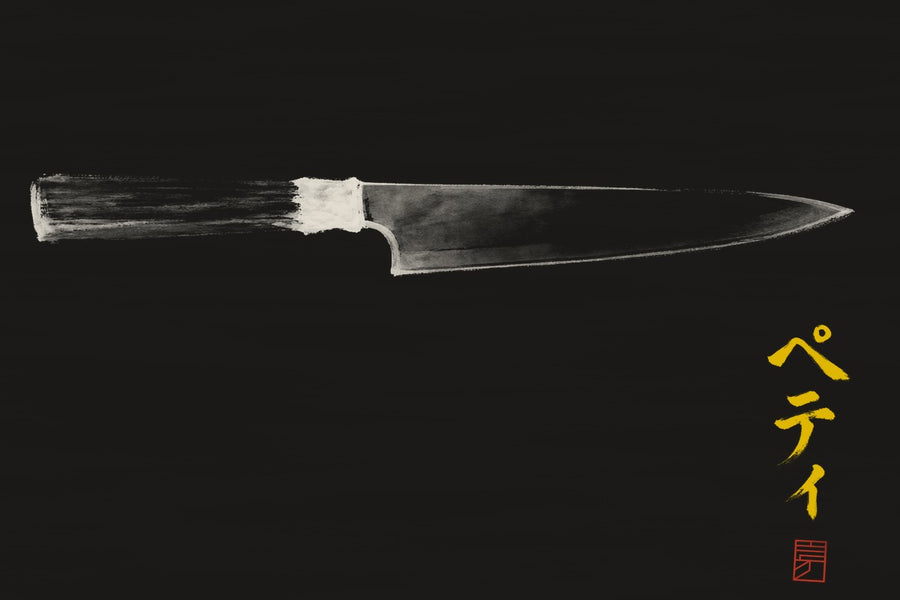
Petty — knife profile
Profile

Petty

ペティ

Utility knife · Double bevel

Small, slim double-bevel utility knife for peeling, trimming and small board jobs.

Read more
Steel properties
  1. Hardness Good
  2. Edge retention Good
  3. Toughness Fair
  4. Rust resistance High
  5. Ease of sharpening Fair
  6. Sharpness High

Our ratings, inferred from published lab tests and composition.

Steel

SG2 / R2

スーパーゴールド2

Stainless · Takefu Special Steel

Takefu powder stainless, 61 to 65 HRC. Long edge; resists rust.

Read more
CladdingCoreClad line
Construction

Sanmai - Stainless Clad

三枚

3 layers · stainless clad

Hard core between two stainless layers, bare only at the edge; the cladding resists rust.

Read more
Etched — blade surface finish
Finish

Etched

Acid-etched pattern

Acid darkens the layers at different rates to show the damascus. Heavy thinning fades it.

Read more

Frequently asked questions

What is a petty knife and when do I need one?

A petty is a small utility knife, from the French petit. It is commonly shaped like a small gyuto and runs from 120 to 150 mm, up to 180 mm. Its clearest role is detailed work where a larger knife feels cumbersome: fruit peeling, garnish work, condiments, and small board work beside a gyuto or santoku.

A knife maker, Tojiro, frames the petty as a useful second knife, not an automatic necessity, and recommends santoku plus petty or gyuto plus petty combinations. It is not a replacement for a full size chef's knife; it lacks the blade length and belly for efficient chopping, rocking, or breaking down larger proteins. Treat it as a precision tool, not an all-rounder.

How long is a petty knife?

Petty knife lengths vary by maker: KAI's guide defines a petty (ペティナイフ) as a small knife with a narrow blade measuring 150 mm or under. Its table gives 90 to 150 mm, and it describes the shape as a smaller gyuto with a pointed tip.

We list petty knives from 70 mm to 165 mm, including lengths above the limit used in KAI's guide.

What is a good second Japanese knife after a gyuto?

For most cooks the second knife after a gyuto is a small utility knife (petty) of about 150mm. If most of your cooking is vegetables, make it a vegetable knife (nakiri) instead; if you carve or slice a lot of meat or fish, a slicing knife (sujihiki).

A gyuto covers the main board work, so the gap it leaves is small work. A petty does the jobs where a full-size blade is clumsy: peeling, trimming and coring in the hand, and small board jobs such as shallots, fruit and herbs. Our petty knife FAQ covers the shape in detail.

A nakiri earns the second slot if you prep vegetables every day. Its flat edge meets the board along its whole length, so slices separate cleanly. It has no pointed tip, so the gyuto still does the tip work.

A sujihiki is the choice for carving roasts and portioning large pieces of meat or fish. The long, narrow blade has less surface touching the food than a gyuto, so slices come away cleaner. 240mm and 270mm are the popular lengths.

A santoku or a bunka is a weak second knife: both are all-purpose shapes that repeat what the gyuto does. If your gyuto already handles the small jobs comfortably, the second knife can wait, and a whetstone to keep the first one sharp is the better spend.

SG2 steel knives at Knives and Stones

SG2 (Super Gold 2, which Takefu writes as SPG2) is Takefu Special Steel's own blade steel, made by powder metallurgy. Takefu says it meets all four of what it calls the major requirements for a blade: high hardness, high toughness, good wear resistance and excellent corrosion resistance.

SG2 runs 61 to 65 HRC depending on the maker, and Takefu does not publish its composition. As of 18 October 2026, 291 of the knives we list have SG2 in their title.

SG2 vs AS steel for kitchen knives: which is better?

Neither is objectively better, it just depends on whether you value stainless convenience or a laser-sharp carbon edge. Go with SG2 if you want a stainless knife that holds its edge for a long time and needs little rust care. Choose AS if you are chasing the thinnest possible edge and don't mind wiping the blade down after every use.

SG2 is a powdered stainless steel from Takefu, 61 to 65 HRC depending on the maker. It is tough and resists corrosion, which is why I reach for it when working with acidic foods. Aogami Super is high carbon, and Proterial gives it a hardening hardness of over 60 HRC. It takes a very keen edge, but it will rust if you neglect it.

R2 steel vs SG2: are they the same?

We can't confirm that from a steelmaker. SG2 (Super Gold 2, which Takefu writes as SPG2) is Takefu Special Steel's own blade steel, made by powder metallurgy. Takefu does not publish its composition; SG2 runs 61 to 65 HRC depending on the maker.

As of 18 October 2026, we found no steelmaker page for a steel called R2. Some knives on our shelf are listed as SG2/R2: six as of 18 October 2026, from Kurosaki, Shiro Kamo and Yoshimi Kato.

What is the difference between VG10 and SG2?

Both are Takefu blade steels, and they differ in class and in what Takefu publishes about each. Takefu lists VG10 as a stainless steel with 1.00% carbon, 15.00% chromium, 1.00% molybdenum, 0.25% vanadium and 1.55% cobalt, at a hardening hardness of HRC 60 or more.

Takefu describes SG2, its Super Gold 2, as a blade steel created by powder metallurgy, lists its composition as not disclosed, and SG2 runs 61 to 65 HRC depending on the maker. Takefu also calls SG2 a powdered stainless high-speed steel.

You May Also Like