PRAHRAN STORE NOW OPEN · THU–MON · 10AM–6PM

Yoshimi Kato Kintaro  |  SKU: KT-HS2-PT150-CF

Yoshimi Kato Hyo SG2 Petty 150mm, Carbon Fibre Handle

Regular price $369.95

Sold out right now

Leave your email and we’ll send one message the moment it’s back in stock.

One email, no marketing. Privacy policy.

Availability

  • St Peters, NSW —
    2 Bishop St, Unit 2, St Peters NSW 2044
  • Crows Nest, NSW —
    107 West St, Shop 1, Crows Nest NSW 2065
    Pickup only
  • Prahran, VIC —
    180 Commercial Road, Shop 1, Prahran VIC 3181
    Pickup only
Detailed Specifications
Line Yoshimi Kato Hyo SG2
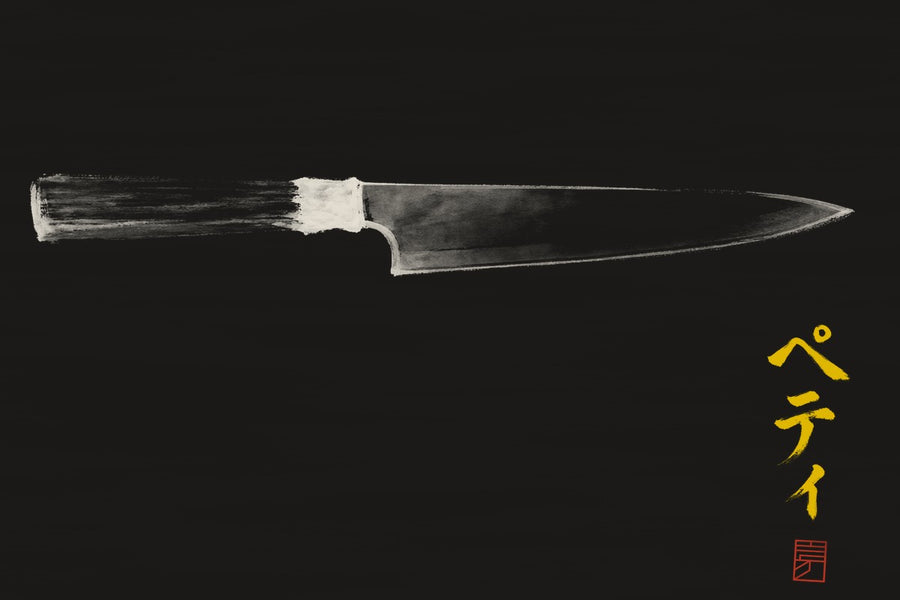
Profile Petty / Utility knife
Bevel Type Double Bevel
Weight 82 g | 2.9 oz
Edge Length 148 mm | 5 53/64″
Heel Height 29 mm | 1 9/64″
Width @ Heel 1.8 mm | 5/64″
Width @ Mid 1.7 mm | 1/16″
Width @ 1cm from Tip 0.9 mm | 1/32″
Steel SG2 / R2 | Powdered | Stainless
Blade Construction Sanmai - Stainless Clad
Hardness (HRC) 62 - 64
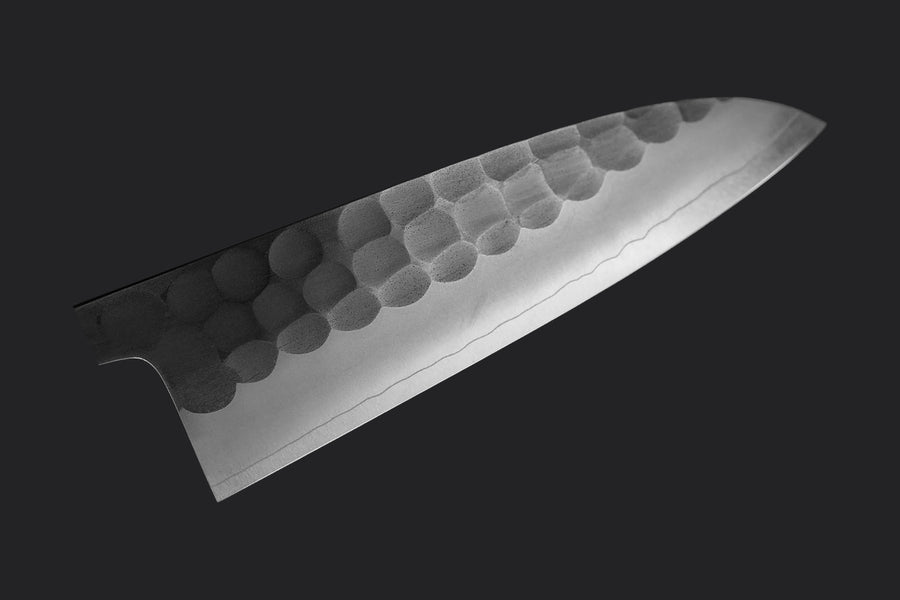
Surface Finish Tsuchime
Handle Special Handle
Region Echizen
Best for
  • Pro chefs
  • Enthusiasts
  • Free shipping for knives over AU$200 Australia wide.
  • World-wide shipping via DHL Express, 3 to 5 days.


Hyō (彪, Spotted Tiger) is not just a name for decoration,he Tsuchime pattern on this line takes the form of sharp, angular arrow-like marks rather than the rounded dimples you'd commonly find on hammered finishes — it's a deliberate visual choice that matches the character of its namesake. This kind of expressive, signature patterning has become something of a statement among certain Echizen makers — Yu Kurosaki, Makoto Kurosaki and Yoshimi Kato among them — where the Tsuchime design is as much a part of the knife's identity as the steel or the grind. The Hyo line follows in this tradition, distinguishable from Kato's previous Minamo SG2 line by this pattern alone, the two being otherwise near-identical in construction and performance.

That construction is built around SG2 powder stainless steel, one of the most capable cutlery steels available — excellent edge retention, full stainlessness, and a hardness that supports extremely thin edges without sacrificing stability. In Kato's hands this translates into one of the thinnest blades you'll find among Echizen makers, which is already a region known for pushing blade thickness to its limits. The knife is noticeably lightweight as a result, and that low mass makes it feel almost effortless when working through dense produce like daikon or sweet potato.

The grind is concave, which brings the bevel down to a very low thickness at the edge — even lower than a flat grind of equivalent spine thickness would achieve. Food release here is handled by the Shinogi line, where the geometrical transition between the primary bevel and the flat zone encourages slices to peel away as they reach that point. It's worth knowing that this food release activates when the ingredient is tall enough for the slice to reach the Shinogi line — on shorter cuts the bevel stays in contact with the food for longer, and some sticking can occur. For the kind of long, deliberate prep work this knife is built for though, it performs cleanly and with minimal resistance.

The price sits on the higher end of what Kato's lineup commands, justified by the SG2 material, the hand sharpening process, and the level of finish that Echizen production at this tier delivers. For professional chefs and enthusiasts who want a laser-focused cutting tool with a personality, the Hyo line is a compelling option.

Pros Cons
  • Excellent performance
  • Thin behind the edge
  • Great for professionals
  • High budget
Care Instruction
  1. Don't cut hard things! Japanese knives are brittle so bone hacking is a NO NO!
  2. Wash with neutral detergent after use, and wipe dry;
  3. Please don't wash knife with dishwasher, it will damage the wood handle;
  4. Be careful not to leave the knife close to a heat source for a long time;
  5. It is a lot more dangerous to cut with a blunt knife than a sharp knife!
  6. It is best to sharpen a Japanese knife regularly on a waterstone.

Yoshimi Kato

Yoshimi Kato: Damascus knives from Takefu

Kato Knife Manufacturing Inc. is Yoshimi Kato's workshop in the Takefu Knife Village. The company was founded in May 1948, and Yoshimi Kato, its third-generation representative, began knife smithing in July 2012. The workshop works in hand-forged Damascus and heat treatment of high-end steels.

Read more

Kato Knife Manufacturing, or カトウ打刃物製作所, traces back to 1948, when the Kato family first set up in what later became the Takefu Knife Village cooperative. Hiroshi Kato (加藤 弘), the second generation, spent over fifty years at the anvil and helped found the cooperative itself.

Yoshimi is the company's third-generation representative and began knife smithing in July 2012.

His Damascus patterns are multi-layered, and his heat treatment is consistent across a wide range of steels, from SG2 and VG10 to Aogami Super and Ginsan. Every step of production happens in-house.

The Kintaro and Kanehiro lines are made at the Kato workshop, and they have a following among cooks who want both looks and cutting performance.

“Three generations of Echizen knife making at Takefu Knife Village.”

Est. 1948 | 昭和23年
Known for Hand-forged Damascus, masterful heat treatment of SG2 and Aogami Super
Website kato-knife-mfg.jp Read more about Yoshimi Kato

Yoshimi Kato · Echizen

Knife details

Frequently asked questions

What is a petty knife and when do I need one?

A petty knife is a small Japanese utility knife, typically with a blade between 120mm and 180mm, designed for precision tasks like peeling, trimming, and slicing fruits and vegetables. You need one when your main chef’s knife feels too large for detail work, think deveining shrimp, cutting garnishes, or any in-hand peeling where a bigger blade gets in the way. Its slightly longer and slimmer profile than a Western paring knife gives you more control for intricate cuts without sacrificing the nimble feel you want for small jobs. If you regularly find yourself reaching for a smaller blade for finishing work, a petty fills that gap cleanly.

A petty is not a replacement for a gyuto or santoku. It lacks the blade length and belly for efficient chopping, rocking, or breaking down larger proteins. If your work is mostly bulk prep, like dicing onions or slicing roasts, a petty will feel slow and underpowered. It also won’t handle heavy tasks like splitting bones or prying, so treat it as a precision tool, not an all-rounder.

The petty’s role in a Japanese kitchen is as the smaller counterpart to the gyuto, built for tasks where a full-size blade is clumsy. At Knives and Stones, the petty category covers a range of steels including VG10, White#2, Swedish Steel, VG5, SG2, and MV, from makers like Sakai Takayuki, Masamoto Sohonten, Ryusen, Nigara, Hatsukokoro, and Sentan. Most are double-beveled, and the blade length runs from 120mm to 180mm, which is what gives it that balance of reach and precision. For more on how this fits into your knife kit, see the Knives and Stones Education Centre.

How long is a petty knife?

Petty knife lengths vary by maker: KAI's guide defines a petty (ペティナイフ) as a small knife with a narrow blade measuring 150 mm or under. Its table gives 90 to 150 mm, and it describes the shape as a smaller gyuto with a pointed tip.

We list petty knives from 70 mm to 165 mm, including lengths above the limit used in KAI's guide.

SG2 steel knives at Knives and Stones

SG2 is my go-to recommendation for anyone who wants a stainless knife that performs like carbon steel without the fuss. At 62 HRC or more (Takefu's figure), it takes a screaming edge and holds it far longer than VG-10 or AEB-L, all while being rust-resistant. You get the best of both worlds: no patina worry, but real cutting performance.

SG2 vs AS steel for kitchen knives — which is better?

Neither is objectively better, it just depends on whether you value stainless convenience or a laser-sharp carbon edge. Go with SG2 if you want a knife that holds a screaming edge without any babysitting. Choose AS if you are chasing the thinnest possible edge and don't mind wiping the blade down after every use.

SG2 is a powdered stainless steel from Takefu, rated at 62 HRC or more. It is tough and resists corrosion, which is why I reach for it when working with acidic foods. Aogami Super is high carbon, and Proterial gives it a hardening hardness of over 60 HRC. It sharpens to a hair-whittling edge that lasts slightly longer than SG2, but it will rust if you neglect it.

R2 steel vs SG2 — are they the same?

Yes, R2 and SG2 are the same steel — R2 is the name used by Kobelco Steel, and SG2 (Super Gold 2) is the name used by Takefu Special Steel for the identical powdered metallurgy formula. SG2 / R2 is a powder (PM) steel from Takefu Special Steel, Japan, with a composition of 1.25% carbon, 14.0% chromium, 1.8% vanadium, 2.3% molybdenum, and a hardness range of 62–64 HRC. So if you see a knife labeled R2 or SG2, you are getting the exact same material.

Yoshimi Kato knives — what are they known for?

Yoshimi Kato is known for hand-forged Damascus knives with thin geometry and strong cutting performance, working primarily in SG2 and Aogami Super steels from his workshop in Echizen's Takefu Knife Village. He is the third-generation representative of Kato Knife Manufacturing, which was established in 1948. His reputation rests on precise heat treatment of premium steels and distinctive Damascus patterns.

Kato also produces knives for the Masakage brand. In recent years he has drawn inspiration from his friend Yu Kurosaki, another Takefu Knife Village smith, and developed newer designs such as the Hyo line. His new gallery and workshop recently opened next to Kurosaki's gallery in Takefu, reflecting the close creative relationship between the two makers.

Is Yoshimi Kato part of a knife-making family?

Yes. Yoshimi Kato is the third generation of a smithing house in Echizen, Fukui, founded in May 1948, and he is its representative today.

The company, Kato Uchihamono Seisakusho, is in Echizen City, with its knife department at Takefu Knife Village. The first generation founder was a certified traditional craftsman, and the second generation began knife smithing in 1949.

You May Also Like