PRAHRAN STORE NOW OPEN · THU–MON · 10AM–6PM

Drag to spin · pinch or scroll to zoom

Iron Clad  |  SKU: SHBT-ARRSG-SA170-BLKCH

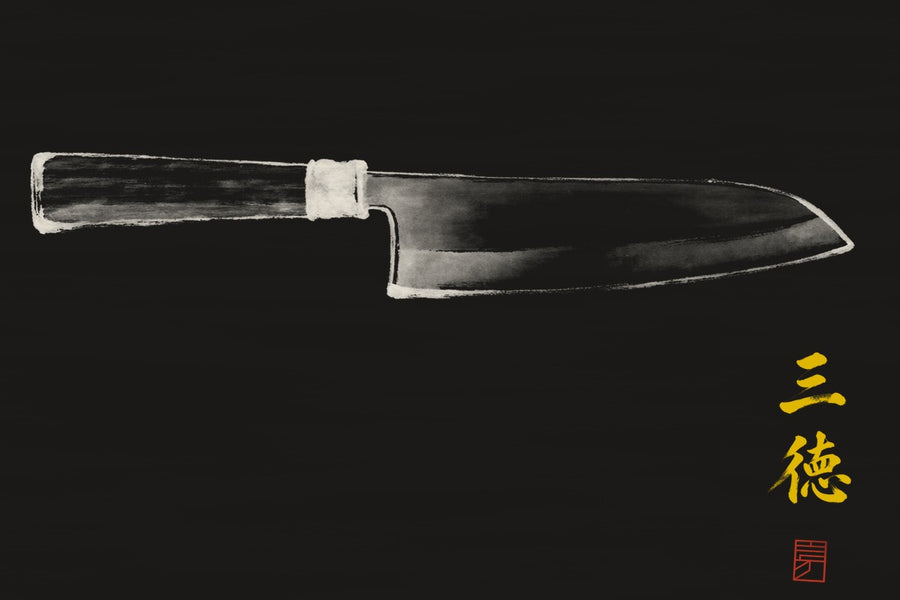
K&S Arare SG2 Santoku 170mm by Iron Clad, with Black Charcate Handle

Regular price $279.95

Sold out right now

Leave your email and we’ll send one message the moment it’s back in stock.

One email, no marketing. Privacy policy.

Availability

  • St Peters, NSW —
    2 Bishop St, Unit 2, St Peters NSW 2044
  • Crows Nest, NSW —
    107 West St, Shop 1, Crows Nest NSW 2065
    Pickup only
  • Prahran, VIC —
    180 Commercial Road, Shop 1, Prahran VIC 3181
    Pickup only
Detailed Specifications
Line Iron Clad Arare SG2 Tsuchime
Profile Santoku / Santoku
Weight 143 g | 5.0 oz
Edge Length 170 mm | 6 11/16″
Heel Height 49 mm | 1 59/64″
Width @ Heel 2.1 mm | 5/64″
Width @ Mid 2.0 mm | 5/64″
Width @ 1cm from Tip 1.6 mm | 1/16″
Steel SG2 / R2 | Powdered | Stainless
Blade Construction Sanmai - Stainless Clad
Hardness (HRC) 62 - 64
Surface Finish Tsuchime
Handle
Region Fukuyama
Best for
  • First-timers
  • Pro chefs
  • Enthusiasts
  • Household
  • Free shipping for knives over AU$200 Australia wide.
  • World-wide shipping via DHL Express, 3 to 5 days.


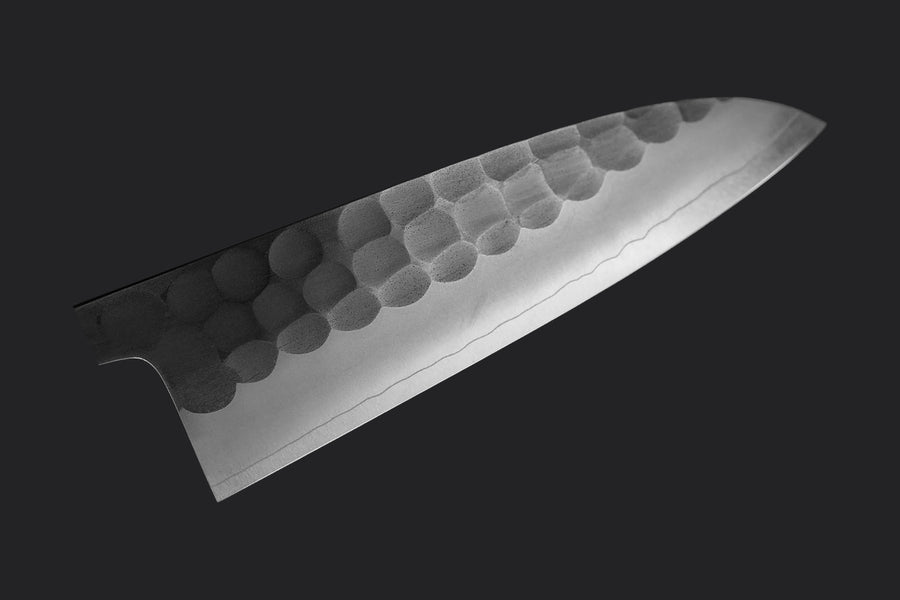
Arare (霰, Small Hail) is a fitting name — looking at the blade, the surface of the Hira is covered in a dense field of small, geometric square and diamond-shaped indentations with defined, sharp edges arranged in a tight repeating pattern. The texture meets the Shinogi line where it gradually fades as the bevel thins out during grinding and polishing, leaving the Migaki finished bevel below in clean contrast with the textured Hira above. It's a more considered and refined take on Tsuchime than the organic, irregular hammer marks you'd typically find, and if the pattern looks familiar, it's not a coincidence — a very similar texture appeared on a special edition of the Minamo SG2 line, which hints at a shared manufacturing origin, likely somewhere within the Takefu Knife Village network that Shibata has strong connections to.

The line is curated by Shibata, and the execution reflects his priorities clearly. The spine sits at a slim 2mm, paired with a concave grind that brings the bevel down to a low thickness behind the edge. Food release is handled by the Shinogi line — as the slice reaches that geometrical transition the food peels away cleanly, and the concave geometry keeps the thickness low enough that the knife doesn't wedge badly even in denser produce. It's a well-balanced geometry that performs beyond its price bracket and competes for the best value knife we sell.

The core steel is SG2 (also known as R2), one of the most capable powder stainless steels in the industry — excellent edge retention, full stainlessness, and a hardness that supports the thin geometry well. This is genuinely exceptional value for an SG2 knife with this level of finish and sharpening behind it, sitting at a lower price than the Ryuhyo line while offering an arguably more characterful surface and comparable cutting performance.

Pros Cons
  • Budget friendly
  • Excellent performance
  • Ideal entry point to Japanese knives
  • A little bit brittle
  • Relatively hard to sharpen
Care Instruction
  1. Don't cut hard things! Japanese knives are brittle so bone hacking is a NO NO!
  2. Wash with neutral detergent after use, and wipe dry;
  3. Please don't wash knife with dishwasher, it will damage the wood handle;
  4. Be careful not to leave the knife close to a heat source for a long time;
  5. It is a lot more dangerous to cut with a blunt knife than a sharp knife!
  6. It is best to sharpen a Japanese knife regularly on a waterstone.

Iron Clad

Iron Clad, Takayuki Shibata's company in Fukuyama

Iron Clad/Koutetsu is the made-in-house brand by Shibata Knives, bearing the motto “Art Over Beauty”, it’s a sharpening/grinding focus brand that known for its Hatsuke(刃付け, bevel-making) skill. The sharpener and leader Takayuki Shibata was the founder of Shibata Knives and other sister brands of Iron Clad, including the highly praised Masakage and the value-focused Tsunehisa.

The knife offered by Iron Clad are engraved with 崇行, which is Shibata’s first name Takayuki. Each Iron Clad knife is grinded by hand sharpening on rotary stone to produce the excellent geometry that Shibata-san developed through years of his experience on sharpening. These knives are generally referred as Koutetsu SG2/AS/Chromax, they share a similar profile, finished uniformly with Migaki finish and sharpened with Shibata’s unique differential grit sharpening technique to get a smooth yet bitey edge. The knives under the banner of Koutetsu are elegant and simple while great in performance, building Iron Clad a fame for its professional oriented designs.

“Takayuki Shibata's knife company in Fukuyama, behind the Koutetsu, Masakage and Tsunehisa brands.”

Est. 2009 | 平成21年
Known for Koutetsu knives, and the Masakage and Tsunehisa brands
Website shibataknives.com Instagram @knife_gallery.jp Read more about Iron Clad

Iron Clad · Fukuyama

Knife details

Frequently asked questions

Gyuto or santoku: which should I choose?

Both are all-purpose Japanese knives, and for most home cooks either will handle the bulk of daily prep. The choice comes down to length, blade shape, and how you like to cut.

A gyuto is the Japanese chef's knife, with a gently curved edge that lets you rock and slide through cuts as well as chop. Tojiro's guide to Western knife shapes gives 150 to 210mm as the household size for a gyuto and up to 360mm for professional use. The extra length and pointed tip give you reach and versatility, from proteins to large produce.

Tojiro's guide to Japanese knife shapes gives 165 to 170mm as the household size for a santoku, which has a flatter profile and a rounded sheep's-foot tip. It rewards a straight up-and-down push cut, feels nimble in smaller hands or tight kitchens, and is the classic Japanese household knife.

Rule of thumb: choose a gyuto if you want one do-everything knife with more reach, or a santoku if you prefer a compact, easy-to-control blade. Plenty of our customers end up owning both.

Rock chop or up-and-down chop: which knife shape suits me?

Match the shape to your stroke. Rock chopping keeps the tip on the board and rolls the curved belly through the food, so a gyuto or a Western chef's knife suits it, and Japanese knives rock fine as long as you rock gently.

Up-and-down chopping, the Chinese style, wants a straight run of edge, so a nakiri, usuba, santoku or bunka suits it better; a curved edge chopped straight down easily leaves pieces joined. Neither shape is better; it depends on how you cut.

What does santoku mean?

A Japanese dictionary explains the name of the santoku (三徳包丁) as coming from the three things it handles: meat, fish and vegetables. The same dictionary entry points from the santoku to the bunka (文化包丁), treating the two as one knife.

One Japanese knife maker guide distinguishes the two by the tip. It says that in the Showa era the bunka was made with its tip cut at an angle, and the santoku came after it by rounding that tip.

SG2 steel knives at Knives and Stones

SG2 is my go-to recommendation for anyone who wants a stainless knife that performs like carbon steel without the fuss. At 62 HRC or more (Takefu's figure), it takes a screaming edge and holds it far longer than VG-10 or AEB-L, all while being rust-resistant. You get the best of both worlds: no patina worry, but real cutting performance.

SG2 vs AS steel for kitchen knives — which is better?

Neither is objectively better, it just depends on whether you value stainless convenience or a laser-sharp carbon edge. Go with SG2 if you want a knife that holds a screaming edge without any babysitting. Choose AS if you are chasing the thinnest possible edge and don't mind wiping the blade down after every use.

SG2 is a powdered stainless steel from Takefu, rated at 62 HRC or more. It is tough and resists corrosion, which is why I reach for it when working with acidic foods. Aogami Super is high carbon, and Proterial gives it a hardening hardness of over 60 HRC. It sharpens to a hair-whittling edge that lasts slightly longer than SG2, but it will rust if you neglect it.

R2 steel vs SG2 — are they the same?

Yes, R2 and SG2 are the same steel — R2 is the name used by Kobelco Steel, and SG2 (Super Gold 2) is the name used by Takefu Special Steel for the identical powdered metallurgy formula. SG2 / R2 is a powder (PM) steel from Takefu Special Steel, Japan, with a composition of 1.25% carbon, 14.0% chromium, 1.8% vanadium, 2.3% molybdenum, and a hardness range of 62–64 HRC. So if you see a knife labeled R2 or SG2, you are getting the exact same material.

Does Iron Clad sharpen its knives itself?

Yes, in part. Takayuki Shibata's own page for the Koutetsu line says of those knives, "we carefully sharpen them one by one."

From our own dealings with Iron Clad, he does the sharpening himself on knives that carry his name, though probably not on each one.

Iron Clad's company page lists resharpening among its business, with the export, maintenance and making of knives.

You May Also Like