PRAHRAN STORE NOW OPEN · THU–MON · 10AM–6PM

Drag to spin · pinch or scroll to zoom

Hatsukokoro  |  SKU: HS-GINGAATS34DM-GY210BR

Hatsukokoro Ginga ATS34 Damascus Gyuto 210mm

Regular price $529.95

Sold out right now

Leave your email and we’ll send one message the moment it’s back in stock.

One email, no marketing. Privacy policy.

Availability

  • St Peters, NSW —
    2 Bishop St, Unit 2, St Peters NSW 2044
  • Crows Nest, NSW —
    107 West St, Shop 1, Crows Nest NSW 2065
    Pickup only
  • Prahran, VIC —
    180 Commercial Road, Shop 1, Prahran VIC 3181
    Pickup only
Detailed Specifications
Line Hatsukokoro By Yoshihiro Yauji Ginga ATS-34 Mirror Damascus
Profile Gyuto / Chef's knife
Bevel Type Double Bevel
Weight 194 g | 6.8 oz
Edge Length 213 mm | 8 25/64″
Heel Height 49 mm | 1 59/64″
Width @ Heel 3.2 mm | 1/8″
Width @ Mid 2.2 mm | 3/32″
Width @ 1cm from Tip 0.8 mm | 1/32″
Steel ATS34 | Stainless
Blade Construction Sanmai - Stainless Damascus Clad
Hardness (HRC) 60 - 61
Surface Finish Mirror Polish
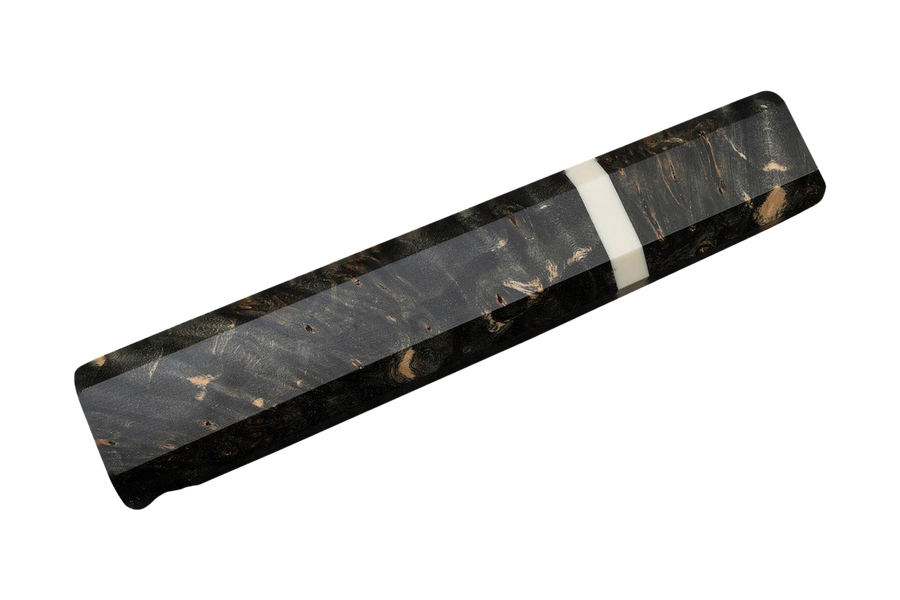
Handle Octagonal Birch Burl with Spacer
Region Takefu
Best for
  • Pro chefs
  • Enthusiasts
  • Free shipping for knives over AU$200 Australia wide.
  • World-wide shipping via DHL Express, 3 to 5 days.


Introducting the Hatsukokoro Ginga(銀河) ATS-34 line: an excellent steel forged by a highly talented young smith.

Hatsukorko, teamed up with Yoshihiro Yauji, one of the youngest Dentokogeshi (Traditional Craftsmen) in Takefu Knife Village, to create this beautiful line of knives that are extremely nimble yet tough enough to deal with every occasion in the kitchen. The high level of fit and finish is evident from the rounded and polished spine and choil, as well as the profile that tapers from heel to tip. The clean and uniform mirror polish across the entire blade not only displays the attention to detail, but also makes the damascus pop and shine, living up to its name Ginga(Milky Way).

The ATS-34 steel, manufacturerd by Hitachi Special Steel, is the Japanese equivalent of the 154CM, famous for its toughness, corrosion-resistance and "high-speed" properties. Bob Loveless brought the ATS-34 into fame in the 70s.

In recent years, the creation of the ATS-34 sanmai billets enabled the ATS-34 steel to appear in kitchen knife making. Notably introduced by RyuSen around 2015-2016.

Although this line has a mirror polish finish, the stickness found on typical mirror polished blade seems to be absent when cutting into a potato. It seems to us Yoshihiro Yauji put on a convex grind on the bevel, wich reduces the drag when the blade is contacting the food. Paring that with a rather thin grind, it glide effortlessly even when spliting a potato right through the middle.

One noteworthy freature about Yauji's knifes is that the Santoku he forges takes a rather unique profile, similar to a Sanjo Gyuto. These Santoku are thin and wide, offering them excellent stability when cutting vegetables. Their tips curves up significantly, resulting a round head compare with the flat belly of a typical Santoku. This geometry means that rocking motion is much easier to do on Yauji's Santoku, making them even better at handling vegetables of all kind, which is a perfect fit for Santoku's purpose.

This ATS34 line not only look good, but also cuts well, if you are fancying a shiny damascus knife, these blades can be a choice that pack some good performances.

Pros Cons
  • Great artistic
  • Thin behind the edge
  • Mirror polish can be hard to maintain
Care Instruction
  1. Don't cut hard things! Japanese knives are brittle so bone hacking is a NO NO!
  2. Wash with neutral detergent after use, and wipe dry;
  3. Please don't wash knife with dishwasher, it will damage the wood handle;
  4. Be careful not to leave the knife close to a heat source for a long time;
  5. It is a lot more dangerous to cut with a blunt knife than a sharp knife!
  6. It is best to sharpen a Japanese knife regularly on a waterstone.

Yoshihiro Yauji

Yoshihiro Yauji — Echizen's Rising Independent

Yauji Yoshihiro(弥氏 良寬), born in Echizen, Fukui Perfecture in 1983. At age of 20 in 2003, he entered Kitaoka Knives to apprentice under Kitaoka Hideo(北岡 英雄), the third generation bladesmith of Kitaoka Knives. In 2019, he acquired the Traditional Craftsman Certification, which is quite remarkable, considering by average it take 25 years for a bladesmith to accomplish this goal.

In April of 2021, Yoshihiro Yauji left Kitaoka Knives and set up his own independent knife workshop Kutsurogi(寬), which shares a same Kanji with part of his name. Kutsurogi along with Yoshihiro Yauji is now a part of the Takefu Knife Village, which is an association that consists 14 knife companies and more than 40 bladesmiths, all located in Echizen area. With big names like Yu Kurosaki, Shiro Kamo and Yoshimi Kato, the Takefu Knife Village has a total of 17 Certified Traditional Craftsman, working and communicating with each others, they make the association a remarkable force in the industry.

Yoshihiro Yauji's knives are often found in damascus, with a color that is usually brighter than what you find on other makers. These blades seems to be grinded with a convex bevel, wich helps prevently food sticking greatly, especially when paired with a more"sticky" finish like a mirror polish. With this skillfull grinding and great fit and finish, Yoshihiro quickly gained fame and reputation as a relatively young bladesmith in Takefu Knife Village.

“Echizen's youngest traditional craftsman — 15 years under Kitaoka, now forging solo at Takefu.”

Est. 2021 | 令和3年
Known for Solo one-man operation, certified traditional craftsman at unusually young age
Website takefu-knifevillage.jp Instagram @yoshihiro_yaichi Read more about Yoshihiro Yauji

Yoshihiro Yauji · Takefu

Knife details

Frequently asked questions

Gyuto or santoku - which should I choose?

Both are all-purpose Japanese knives, and for most home cooks either will handle the bulk of daily prep. The choice comes down to length, blade shape, and how you like to cut.

A gyuto is the Japanese chef's knife - typically 210 to 240mm with a gently curved edge that lets you rock and slide through cuts as well as chop. The extra length and pointed tip give you reach and versatility, from proteins to large produce.

A santoku is shorter, usually 165 to 180mm, with a flatter profile and a rounded sheep's-foot tip. It rewards a straight up-and-down push cut, feels nimble in smaller hands or tight kitchens, and is the classic Japanese household knife.

Rule of thumb: choose a gyuto if you want one do-everything knife with more reach, or a santoku if you prefer a compact, easy-to-control blade. Plenty of our customers end up owning both.

What is a Gyuto, and what is it used for?

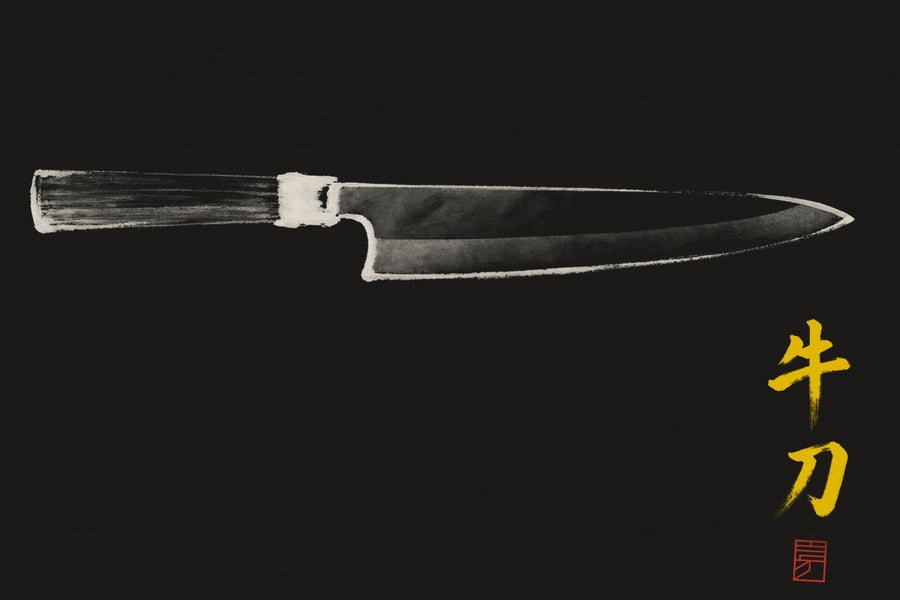
A gyuto is the Japanese chef's knife — a double-bevel general-purpose kitchen knife. The name literally means "beef sword," and it's still a fair job description: you use it to slice meat, chop vegetables, dice aromatics, and break down fish. If you own one good knife, this is the shape it should be.

Versus a typical Western chef's knife, a gyuto is thinner behind the edge, sharpened to a keener angle (roughly 15–18° rather than 20–22°), and usually made from harder steel — often above 60 HRC. That's what makes it slice so cleanly: less crushing, less tearing. The trade-off is a more brittle edge, so it asks to be honed and sharpened more attentively than a soft Western blade.

Blades run from compact 150mm to long 240mm, but for a home kitchen I'd start at 210mm — my sizing FAQ explains why.

What size gyuto should I buy?

In a home kitchen I'd pick a 210mm gyuto. It's the sweet spot: long enough for a full slicing stroke, short enough to stay nimble on a normal cutting board and easy to control while you're still building your technique.

Step up to a 240mm only if you regularly break down large cuts — roasts, whole fish, big vegetable prep. The extra length means longer strokes and fewer passes, but it also means more weight and a bigger board; if the tip is hanging off your bench you're fighting the knife, not cooking with it. If you're mainly doing vegetables and portions, the 240 gives you nothing you'll use.

For a first gyuto, buy a well-made stainless one around 210mm in the low hundreds. Traditional carbon steels (white and blue paper steel) cut and sharpen beautifully, but they rust if you leave them wet — learn one variable at a time. Better steel is step two.

240mm vs 210mm gyuto: which size should I choose?

Get the 210mm. We only point people to a 240mm when they have about 45cm of usable board, cook in volume, and regularly break down big roasts or whole fish.

On the gyutos we've measured for our product pages, the extra length is real. The 210s have a median edge of 213mm from heel to tip and the 240s 240mm. The 240s are also heavier, 195g against 163g at the median, and a touch taller at the heel, 51mm against 48mm. End to end a 240 runs about 39cm and a 210 about 36cm.

That length buys you a longer stroke. A 240 goes through a big piece of meat in one or two pulls and moves a board of chopped vegetables with less shuffling. It costs you board space and control. On a small board the tip hangs off the edge, and fine work like herbs and shallots feels like more knife than the job needs.

Japanese vs German kitchen knives — which should I buy?

If you want the sharpest possible edge and don't mind caring for a harder, more brittle blade, buy Japanese; if you want a tougher, more forgiving knife that can take abuse and be honed casually, buy German. Japanese knives, like the gyuto, are ground to a much sharper edge angle, typically 15 to 18 degrees compared to 20 to 22 degrees on a western chef's knife, and use harder steel that can exceed 60 HRC, which is why they cut with such precision but also chip more easily. German knives are softer and more ductile, so they resist chipping and bend rather than break, but they won't hold that razor-sharp edge as long.

A Japanese knife is not the right choice if you regularly cut through bones, frozen food, or hard squash, or if you're used to rocking the blade hard on a cutting board, that lateral stress and impact can chip the edge. German knives are the better everyday beater for heavy prep, but you'll trade away the effortless slicing and fine edge retention that make Japanese steel so satisfying.

The gyuto, literally "beef knife," is the Japanese take on a French chef's knife, with a flatter profile that suits push-cutting and slicing. That acute blade geometry is only possible because of the harder steel used, a typical western knife at 20 to 22 degrees would roll or dull quickly at 15 to 18 degrees, whereas the harder Japanese steel holds that finer edge. That's the core trade-off: hardness buys sharpness and edge retention, but it also makes the blade more brittle, so you need a gentler technique and a wooden or plastic board. For more on how these knives are built and what to look for, see the Knives and Stones Education Centre.

You May Also Like