PRAHRAN STORE NOW OPEN · THU–MON · 10AM–6PM

Drag to spin · pinch or scroll to zoom

Hatsukokoro  |  SKU: HATS_KRKZ_W2_KDE150

Hatsukokoro Kurokaze Blue 2 Kurouchi K-Tip Deba 150mm Double Bevel

Sale price $169.98 Regular price $199.95

IMPORTANT: Carbon steel knives can rust or patina quickly if not cared for properly. They require regular cleaning, drying, and oiling. If you are unfamiliar with carbon steel maintenance, we recommend choosing a stainless steel option instead.

Free knife guard with this knife until 30 Nov: plastic at no cost, or magnetic for A$14.00 more. Choose in your cart.

Availability

  • St Peters, NSW —
    2 Bishop St, Unit 2, St Peters NSW 2044
  • Crows Nest, NSW —
    107 West St, Shop 1, Crows Nest NSW 2065
    Pickup only
  • Prahran, VIC —
    180 Commercial Road, Shop 1, Prahran VIC 3181
    Pickup only

Goes well with

Detailed Specifications
Line Hatsukokoro Kurokaze Blue 2 Kurouchi Deba
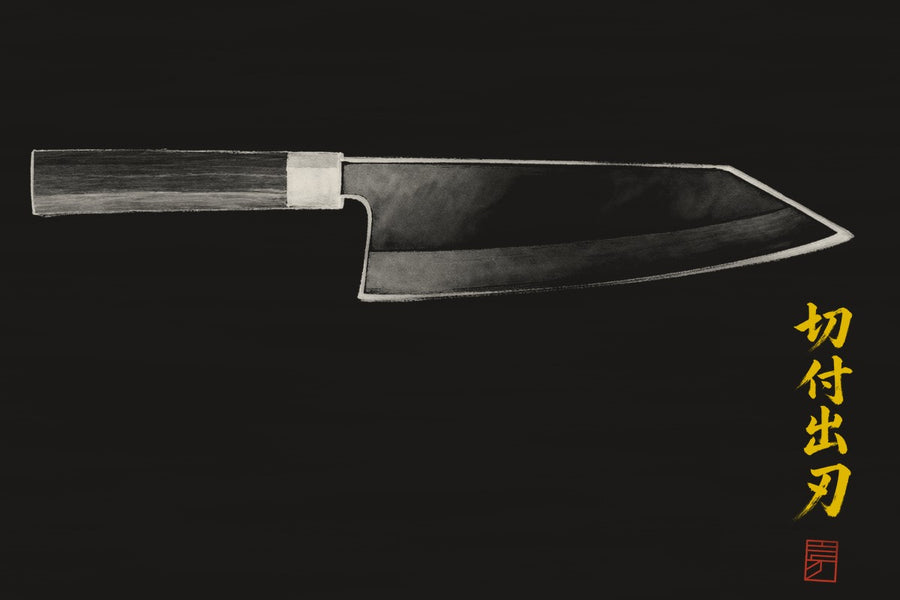
Profile K-tip Deba / K-tip fish knife
Bevel Type Double Bevel
Weight 279 g | 9.8 oz
Edge Length 154 mm | 6 1/16″
Heel Height 51 mm | 2 1/64″
Width @ Heel 7.7 mm | 19/64″
Width @ Mid 5.7 mm | 7/32″
Width @ 1cm from Tip 2.2 mm | 3/32″
Steel Blue 2 / Aogami #2 | Carbon
Blade Construction Sanmai - Soft Iron Clad
Typical hardness 61 to 63 HRC
Surface Finish Kurouchi
Handle Octagonal Wenge Handle Black Ferrule
Region Hyogo
Best for
  • First-timers
  • Pro chefs

Free shipping for knives over AU$200 Australia wide.

World-wide shipping via DHL Express, 3 to 6 days (not available in the UK).


The Yo-deba has existed as a category for a while — a double bevel interpretation of the traditional single bevel Deba, designed for fish butchery without the asymmetric grind that makes conventional Debas handed and technique-dependent. Hatsukokoro's Kurokaze (黒風, Black Wind) Blue 2 takes that concept and adds a K-tip, giving the knife a thin, precise point that opens up finer dissection work when breaking down a fish — the kind of detail work where a traditional Deba's blunter tip can feel limiting. It's a small but genuinely useful addition to a well-established format.

The double bevel construction makes this an ambidextrous knife, which removes the left or right hand distinction that comes with traditional single bevel Debas. For anyone who wants to experience Deba-style fish butchery without committing to the learning curve of single bevel technique, this is a very practical entry point. The trade-off compared to a traditional Deba is a slight increase in weight — the absence of the hollowed Urasuki on the back of the blade means there's more material present, which adds a little heft. For a Deba this isn't necessarily a drawback; the weight assists in the chopping and splitting motions the knife is designed for, though it's worth knowing before committing.

The construction is Sanmai with soft iron cladding over a Blue 2 (Aogami 2) core, and at this price point that's worth noting. Most Debas with a more refined finish at a similar price tend to use SK steel — a lower carbon general purpose steel — rather than a proper high carbon cutlery steel like Blue 2. The Kurouchi finish keeps things rustic and the fit and finish reflects that, but the steel underneath is the real story here. The entire blade requires regular maintenance to prevent rust, which is the standard commitment for any iron-clad carbon steel knife. For first-time Deba users and professional chefs who want an approachable, ambidextrous fish butchery knife with genuine carbon steel performance at an honest price, the Kurokaze Blue 2 is a well thought out option.

Pros Cons
  • Exceptional profile
  • Budget friendly
  • Ideal entry point to Japanese knives
  • Heavy
  • Prone to rust
Care Instruction
  1. Don't cut hard things! Japanese knives are brittle so bone hacking is a NO NO!
  2. Wash with neutral detergent after use, and wipe dry;
  3. Please don't wash knife with dishwasher, it will damage the wood handle;
  4. Be careful not to leave the knife close to a heat source for a long time;
  5. It is a lot more dangerous to cut with a blunt knife than a sharp knife!
  6. It is best to sharpen a Japanese knife regularly on a waterstone.
  7. Oil the (carbon) knife if storing for an extended period of time to prevent rust.

Hatsukokoro

Hatsukokoro, a knife brand from Amagasaki

Hatsukokoro (初心) is a knife brand from Amagasaki, Hyogo, launched in 2019. It is a brand rather than a forge: it works with knife makers instead of forging itself.

The name comes from the proverb 初心忘るべからず, roughly never forget your beginner's mind. For the same characters the brand chose the gentler reading hatsukokoro over shoshin.

The brand's own catalogue names the place behind some of its lines, and the maker behind a few: Shinkiro comes from Fukushima, and Hayabusa HAP40, Saihyo and Sunaarashi from Seki City, while for others the maker or the place stays private. Some of our listing titles also carry the maker alongside the brand, such as Hatsukokoro x Yoshikane and the Hatsukokoro x Yoshihiro Yauji collaboration.

The Hatsukokoro lines we list include both carbon and stainless steels. Our listings include Hayabusa in SG2 and Aogami Super, Saihyo in SG2 and Ginrei in Ginsan. Carbon steel kurouchi lines include Aosagi, Aokitae, Kurokaze and Kurogane.

“A knife brand from Amagasaki that works with knife makers rather than forging.”

Est. 2019 | 令和元年
Known for Lines made with partner makers, from Seki City to Fukushima
Website handk.co Instagram @handk_official Read more about Hatsukokoro

Hatsukokoro · Hyogo

Knife details

K-tip Deba — knife profile
Profile

K-tip Deba

K-tip fish knife · Single or double bevel

Deba with an angled tip.

Read more
Steel properties
  1. Hardness Very good
  2. Edge retention Very good
  3. Toughness Very good
  4. Rust resistance Low
  5. Ease of sharpening High
  6. Sharpness Very high
Our ratings, inferred from published lab tests and composition.

Our edge-retention grade is a kitchen rating. It weighs the hardness each steel is sold at, which keeps a thin edge from rolling, twice as heavily as lab wear tests, and the final grade is our judgment from selling and sharpening these knives for over a decade. Lab card-cutting tests measure abrasive wear only, so they can rank carbon steels lower. Tap ? for the lab figure.

Steel

Blue 2 / Aogami #2

青二鋼

Carbon · Hitachi Metals (now Proterial)

Proterial carbon steel, 1.05 to 1.15% carbon with chromium and tungsten; not stainless.

Read more
CladdingCoreClad line
Construction

Sanmai - Soft Iron Clad

三枚・軟鉄

3 layers · soft iron clad

Hard core between two soft iron layers, bare at the edge. The iron patinas and rusts.

Read more
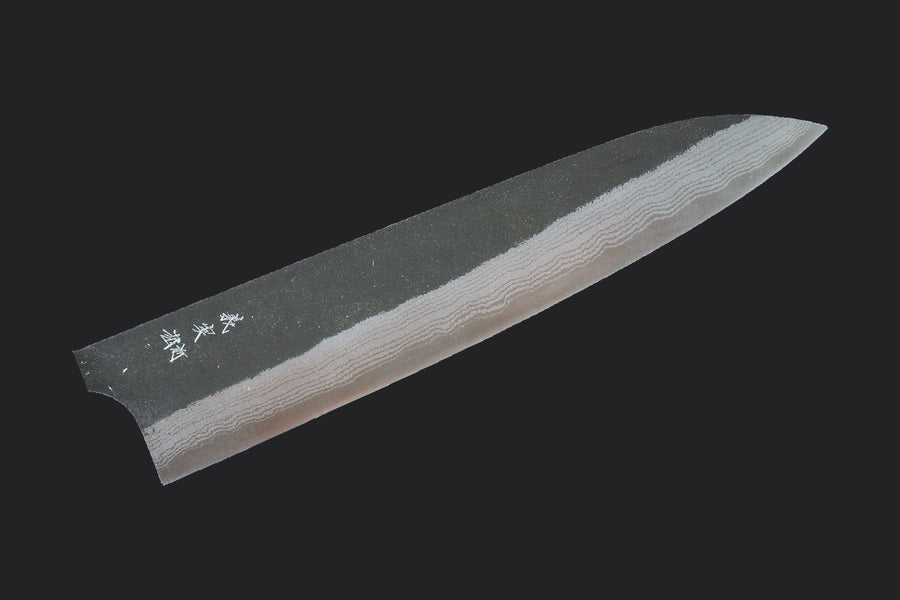
Kurouchi — blade surface finish
Finish

Kurouchi

黒打

Black forge scale

Dark forge scale left on the upper blade. The bevel and edge still need care.

Read more
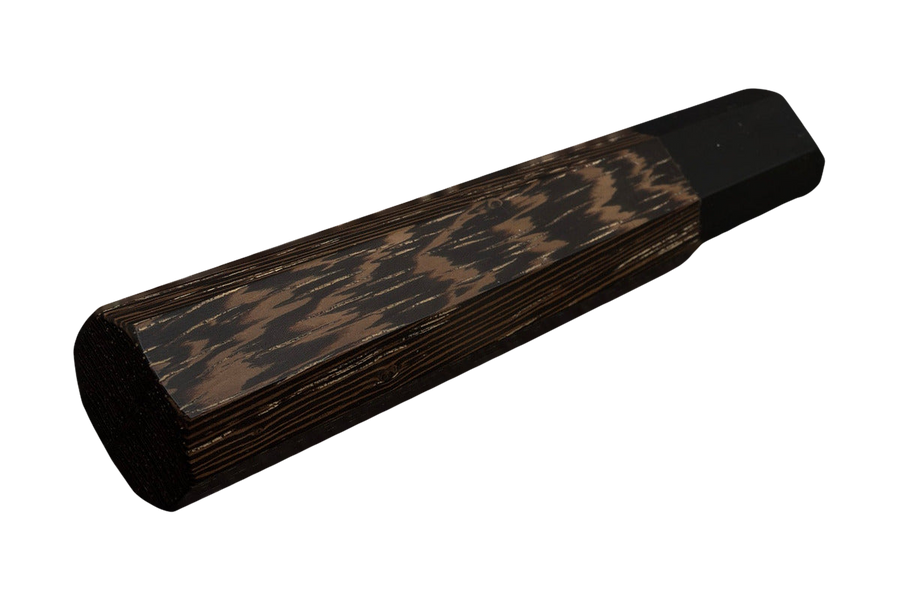
Octagonal Wenge Handle Black Ferrule handle
Handle

Octagonal Wenge Handle Black Ferrule

Octagonal WA

Wenge, eight-sided, with a black ferrule. The wood runs in dark and lighter brown streaks.

Frequently asked questions

Can a deba cut bone?

Yes, the bones of fish and fowl. Japanese dictionaries describe the deba (出刃包丁) as wide, thick-spined and heavy, used to fillet fish, to cut fish and fowl bone and all, and for rough chopping.

When you chop bone, use the heel of the blade (刃元), the Sakai cutlery association says. It is a fish and poultry knife, not a cleaver.

Will a carbon steel knife rust, and how do I look after it?

Yes, carbon steels such as Aogami (Blue) and Shirogami (White) are not stainless steels, so left wet they can spot or rust.

Care is simple once it becomes habit. Wipe the blade as you go, especially after acidic food like citrus, tomato or onion. When you finish, wash it in warm water with a little soap and dry it straight away with a towel. Do not let it air dry, leave it in the sink or the dish rack, or put it in the dishwasher. Store it dry: on a magnetic strip or in a ventilated block in a dry spot.

If the knife will sit unused for a while, wipe on a thin layer of oil before storing. In our video James shows that mineral oil can stand in for camellia (tsubaki) oil, and he picks one labelled medical grade; we list the Kitchen Knife / Cutting Board Mineral Oil Medical Grade for this. If you find light rust, lift it with a rust eraser and a little water, then dry and oil the blade; we list the CKK and Naniwa rust erasers.

What is the difference between Blue 2 and White 2 steel?

Blue 2 is White 2 with tungsten and a little chromium added. Blue 2 holds its edge longer. White 2 sharpens faster and takes a very keen edge. Both are carbon steels that will rust if left wet.

The figures come from Proterial, which makes both. Each has 1.05 to 1.15% carbon. Blue 2 (Aogami 2) adds 1.00 to 1.50% tungsten and 0.20 to 0.50% chromium. White 2 (Shirogami 2) lists neither, and Proterial describes it as a carbon steel with minimum impurities. Proterial says the tungsten and chromium improve heat treatment and wear resistance, and gives a hardening hardness over 60 HRC for both.

In use, the tungsten forms hard carbides that resist wear, so a Blue 2 edge lasts longer between sharpenings. White 2 has none, so it comes back on a whetstone very quickly. The chromium in Blue 2 is far below the 10.5% a steel needs to be stainless, so it gives no real rust protection. Wipe either steel dry after use and expect a patina.

Choose Blue 2 if you want to sharpen less often. Choose White 2 if you enjoy sharpening and want the keenest edge. We list both widely: Blue 2 from Nigara, Myojin Riki and Anryu, and White 2 from Masamoto Sohonten, Sakai Takayuki and Yoshikane.

Is Hatsukokoro a maker or a brand, and who makes the knives?

Hatsukokoro (初心) is a brand, not a forge. H&K, a company founded in 2013 and based in Amagasaki, Hyogo, created it in 2019.

H&K names the producer for some lines, for example Shinkiro by Takahiro Nihei in Fukushima, Ginyou by Yoshihiro Yauji in Echizen and Kurosagi by Motokyuichi Hamono in Nagasaki, and keeps others confidential. Some knives we stock carry the maker in the title, such as Hatsukokoro x Yoshikane SKD Nashiji.

What does the name Hatsukokoro mean?

Hatsukokoro is written 初心, the characters for first and heart: the frame of mind you start out with. H&K, the company behind the brand, says the name comes from the Japanese proverb 初心忘るべからず, which it translates as don't forget your original intention. The saying is usually traced back to the Noh master Zeami.

Those two characters are normally read shoshin. H&K says it chose the softer reading hatsukokoro instead.

H&K was set up in 2013 in Amagasaki, Hyogo, and launched Hatsukokoro as its knife brand in 2019. It is a brand rather than a single forge: the knives are made for it by workshops across Japan, which is why some of our listings carry both names, such as Hatsukokoro x Yoshikane.

Which Hatsukokoro line should I pick, carbon or stainless?

Pick by how much care you want to give. The carbon lines, Blue 1, Blue 2 and AS kurouchi, need drying and a little oil after use. The SG2, HAP40, Ginsan and VG10 lines are low maintenance, so they suit a busy kitchen or someone who just wants to cook.

Neither is better; it depends on your routine. If you will dry and oil the blade after each use, a carbon line can suit you, and if you want the least fuss, a stainless line is the easier choice.

You May Also Like