PRAHRAN STORE NOW OPEN · THU–MON · 10AM–6PM

Masamoto Sohonten  |  SKU: MASA_KK0430

Masamoto Sohonten Kasumi White 2 Yanagiba 300 mm KK0430

Sale price $458.98 Regular price $539.95

IMPORTANT: Carbon steel knives can rust or patina quickly if not cared for properly. They require regular cleaning, drying, and oiling. If you are unfamiliar with carbon steel maintenance, we recommend choosing a stainless steel option instead.

In Stock Now

Availability

  • St Peters, NSW —
    2 Bishop St, Unit 2, St Peters NSW 2044
  • Crows Nest, NSW —
    107 West St, Shop 1, Crows Nest NSW 2065
    Pickup only
  • Prahran, VIC —
    180 Commercial Road, Shop 1, Prahran VIC 3181
    Pickup only

Goes well with

Detailed Specifications
Line Masamoto KK
Profile Yanagiba / Sashimi knife
Steel White 2 / Shirogami #2 | Carbon
Blade Construction Nimai - Soft Iron Clad
Maker's hardening hardness 60 HRC or more
Surface Finish Kasumi
Handle
Region Tokyo
Best for
  • First-timers
  • Pro chefs
  • Students

Free shipping for knives over AU$200 Australia wide.

World-wide shipping via DHL Express, 3 to 6 days (not available in the UK).


The KK is Masamoto Sohonten's entry into traditional single bevel knives, sitting at the accessible end of the family. Each blade pairs a Hitachi White 2 (Shirogami) core with soft iron cladding in nimai construction, finished in kasumi (霞), the misty two-tone look of the classic Japanese kitchen blade. White steel has only carbon added, which is what lets it take an extremely keen edge while staying very easy to sharpen, and that patience on the stones is worth a lot to anyone learning single bevel work.

Being carbon steel under an iron cladding, these knives patina quickly and need wiping dry after use, but that is the whole bill of ownership at this level. The lineup covers deba from 150 to 210 mm, yanagiba from 240 to 300 mm, a takobiki, and usuba in 180 and 210 mm, all on wa handles of ho wood with buffalo horn ferrules.

Pros Cons
  • Budget friendly
  • Excellent performance
  • Prone to rust
  • Need extra care
Care Instruction
  1. Don't cut hard things! Japanese knives are brittle so bone hacking is a NO NO!
  2. Wash with neutral detergent after use, and wipe dry;
  3. Please don't wash knife with dishwasher, it will damage the wood handle;
  4. Be careful not to leave the knife close to a heat source for a long time;
  5. It is a lot more dangerous to cut with a blunt knife than a sharp knife!
  6. It is best to sharpen a Japanese knife regularly on a waterstone.
  7. Oil the (carbon) knife if storing for an extended period of time to prevent rust.

Masamoto Sohonten

Masamoto Sohonten of Azumabashi, Tokyo

Masamoto Sohonten (正本總本店) is the knife house at Azumabashi in Sumida-ku, Tokyo, and is the holder of the MASAMOTO registered trademark. The company says a separate Masamoto business was established independently in 1951 and that the two businesses have entirely different products and organisations.

It began with Minosuke Matsuzawa, born to a blacksmith in Osawa, Bushu (Saitama Prefecture). He went to Osaka in 1862 to learn genuine knife forging, came home to Osawa in 1866 and began making cooking knives. The company's history says it was the first in the Kanto region to make and sell genuine tempered blade cooking knives, in 1874. In 1890 it opened in present-day Azumabashi, Sumida-ku.

The name came from Minosuke's mark: he engraved the masa character (正) on his knives as proof he had made them himself. When trademark registration began in 1884, the second generation, Kichizo Hirano, tried to register that character, but a knife shop in Osaka already used it. On business partners' advice, since the knives used genuine steel, he placed the moto character (本), part of the Japanese word for genuine, under it. Masamoto was registered in 1903 as trademark No. 20269.

The company lists six generations: Minosuke Matsuzawa, then Kichizo Hirano, who led the house from 1891, Sakichi Hirano, Masakichi Hirano, Morisuke Hirano, who was conferred the Order of the Rising Sun, Gold Rays with Rosette, and Masahiro Hirano, the sixth generation. The company says only Masamoto Sohonten has carried on Minosuke's methods of hardening, tempering and polishing, and that its range grew from chefs' feedback. It marked its 150th anniversary in 2016.

The lines we list include White 2 Hongasumi (KS) single-bevel knives in yanagiba, takobiki, kiritsuke yanagiba, deba, mioroshi deba, usuba, kamagata usuba, mukimono and hamokiri, alongside KS sujihiki, petty and gyuto, including a K-tip gyuto. The White 2 Kasumi (KK) line includes deba, usuba, yanagiba and takobiki. White 1 appears in the KI Hongasumi yanagiba, Blue 2 in the Aoko Hongasumi yanagiba, and the honyaki yanagiba comes in both White 2 (HS) and Blue 2 (HA). The stainless lines include VG series gyuto, santoku, petty, sujihiki and honesuki, VG Cobalt yanagiba, and MV katana and kiritsuke shapes. The Swedish steel SW line includes gyuto, K-tip gyuto, sujihiki and petty.

“Six generations of knife making since 1866, at Azumabashi in Tokyo since 1890.”

Est. 1866 | 慶応2年
Known for Excellently built traditional single bevel knives and KS series Gyuto
Website masamoto-sohonten.co.jp Read more about Masamoto Sohonten

Masamoto Sohonten · Tokyo

Knife details

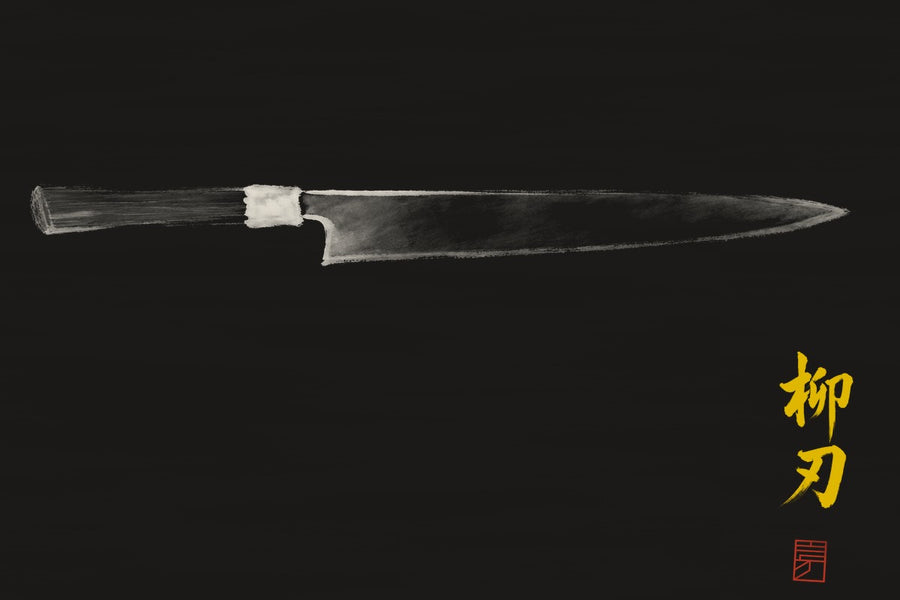
Yanagiba — knife profile
Profile

Yanagiba

柳刃

Sashimi knife · Single bevel

Long single-bevel sashimi slicer with a pointed tip. One clean draw cuts raw fish.

Read more
Steel properties
  1. Hardness Very good
  2. Edge retention Good
  3. Toughness Good
  4. Rust resistance Low
  5. Ease of sharpening High
  6. Sharpness Very high
Our ratings, inferred from published lab tests and composition.

Our edge-retention grade is a kitchen rating. It weighs the hardness each steel is sold at, which keeps a thin edge from rolling, twice as heavily as lab wear tests, and the final grade is our judgment from selling and sharpening these knives for over a decade. Lab card-cutting tests measure abrasive wear only, so they can rank carbon steels lower. Tap ? for the lab figure.

Steel

White 2 / Shirogami #2

白二鋼

Carbon · Hitachi Metals (now Proterial)

Proterial carbon steel, 1.05 to 1.15% carbon, no chromium or tungsten; not stainless.

Read more
ShinogiCladdingClad lineHard steelHollow back
Construction

Nimai - Soft Iron Clad

二枚・軟鉄

2 layers · single bevel

Two layers, single bevel: hard steel on the back, soft iron elsewhere; it patinas.

Read more
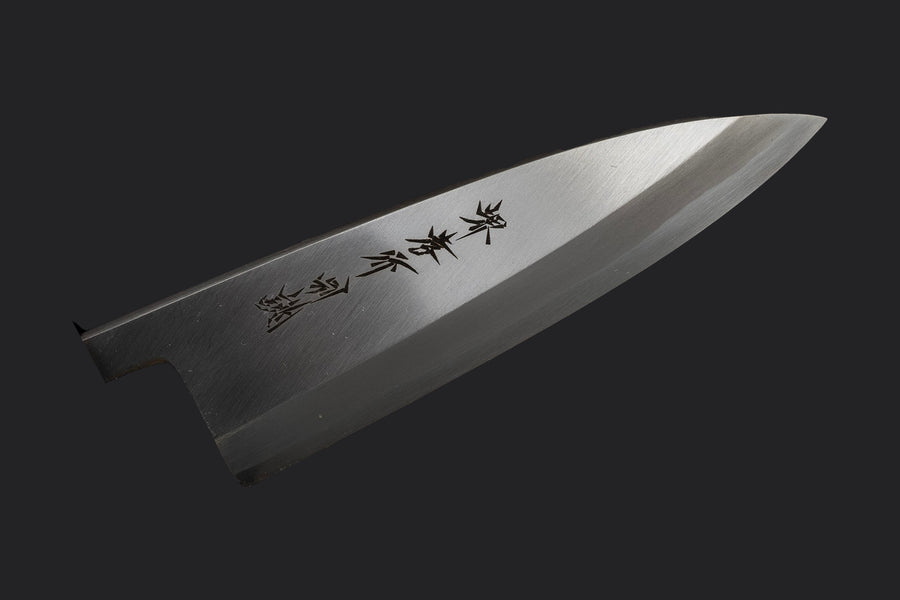
Kasumi — blade surface finish
Finish

Kasumi

霞

Misty polish

Hazy, matte bevel where soft iron meets hard core steel. The iron patinas and rusts.

Read more

Frequently asked questions

What is a yanagiba knife used for in sushi preparation?

A yanagiba (柳刃包丁) is a sashimi knife for slicing raw fish. A knife maker's guide says a sashimi knife cuts without breaking the fibres of the flesh, and that it is longer and narrower than other knives because slicing sashimi with crisp edges needs the length.

The whole length goes through one pulling cut. The Sakai cutlery association calls the yanagiba the sashimi knife used mainly in the Kansai region.

What size yanagiba should I buy?

Size a yanagiba to the fish you prepare: a knife maker's guide gives 270 to 360 mm for professional use and 240 to 270 mm for home use, with 270 mm at home if you slice larger fish.

The guide says the whole length goes through one pulling cut, so do not choose too short a knife, and at home it points to the size of your board and your work space. We list the yanagiba (柳刃) from 210 to 360 mm, some made for left-handed use.

Can a yanagiba cut through fish bones?

No. The Sakai cutlery association describes the yanagiba (柳刃包丁) edge as so acute that it cannot be used on hard things such as bones.

For bones the association describes the deba (出刃包丁), whose heel is used to hit them.

Takohiki or yanagiba: what is the difference?

An encyclopedia describes sashimi knives as thin and narrow, calling the pointed ones yanagiba and the unpointed ones takohiki. A sakimaru takohiki is the rounded-tip variant, so it has a rounded point despite its takohiki name.

A trade body, the Sakai cutlery association, calls the takohiki (たこ引き包丁) the Kanto-type sashimi knife, and the yanagiba the sashimi knife used mainly in Kansai, with an acute edge that is not for bone.

Sujihiki or yanagiba: which do I need?

Most home cooks need the sujihiki. Choose the yanagiba when slicing raw fish for sashimi and sushi is the main job and you are prepared to learn single bevel sharpening.

A sujihiki is a long, narrow, double bevel slicer. Tojiro describes it as the knife for dividing large pieces of meat, known abroad as a slicer or carving knife, and says its length lets it cut sashimi as well. It carves roasts, trims sinew and portions fish, works in either hand and sharpens like any double bevel knife. Sujihiki run from about 210 to 300 mm, and 240 mm suits most home boards.

A yanagiba is the single bevel sashimi knife. It is ground on one side with a hollow back, and each slice is one long pull from heel to tip, so raw fish is cut cleanly rather than sawn. The edge is too fine for bones or anything hard. It is made for one hand and most are right handed, so check the listing if you are left handed. Sharpening means working the whole bevel and keeping the back flat. Yanagiba run from about 240 to 330 mm, with 270 and 300 mm the common sizes.

So for roasts, portioning meat and the occasional side of fish, buy a sujihiki. For regular sashimi and sushi work, buy a yanagiba and keep it for fish.

Why is the back of a single-bevel knife hollow, and how do I sharpen it?

The shallow hollow in the back is called urasuki (裏スキ). Tojiro explains that it means the whole back never has to be ground when you sharpen, makes it easier to keep the back flat, and stops sharpening the back from affecting the edge. Only the thin flat rim around the hollow touches the stone.

Sharpen the front bevel first, laying it flat on the stone. Then lay the back completely flat and take a few light strokes, just enough to remove the burr. Never lift the spine to put an angle on the back, and keep the stone itself flat.

Which knife do I need for sushi and sashimi at home?

For occasional sushi at home, a sharp sujihiki (筋引) does the job. Tojiro describes it as a long, double-bevel slicer that can also be used for sashimi, and a double bevel works in either hand.

If sashimi is the point of the meal, choose a yanagiba (柳刃). Tojiro calls it the Kansai-style sashimi knife, now used across Japan, and it slices in one long pull from heel to tip. It is single bevel, so buy the one made for your hand.

If you start from whole fish, add a deba (出刃). Tojiro describes it as very thick and heavy, made for breaking fish down. The deba takes the fish apart and the slicer then cuts the fillets.

Shirogami 1 vs Shirogami 2: what is the difference?

Shirogami 1 (White 1) has more carbon than Shirogami 2 (White 2): Proterial lists 1.25 to 1.35% carbon for Shirogami 1 and 1.05 to 1.15% for Shirogami 2, with the same silicon (0.10 to 0.20%) and manganese (0.20 to 0.30%) ranges for both.

Proterial describes both as carbon steel with minimum impurities, Shirogami 1 with the highest hardness and Shirogami 2 with high hardness, and gives a hardening hardness of over 60 HRC for both. It lists Shirogami 1 for the highest quality tipped tools, planes, chisels and razors, and Shirogami 2 for high quality tipped tools, chisels, razors, sickles, axes and gravers.