PRAHRAN STORE NOW OPEN · THU–MON · 10AM–6PM

Masamoto Sohonten  |  SKU: MASA_VG5018

Masamoto Sohonten VG Series Gyuto 180 mm

Sale price $288.98 Regular price $339.95

Sold out right now

Leave your email and we’ll send one message the moment it’s back in stock.

One email, no marketing. Privacy policy.

Availability

  • St Peters, NSW —
    2 Bishop St, Unit 2, St Peters NSW 2044
  • Crows Nest, NSW —
    107 West St, Shop 1, Crows Nest NSW 2065
    Pickup only
  • Prahran, VIC —
    180 Commercial Road, Shop 1, Prahran VIC 3181
    Pickup only
Detailed Specifications
Line Masamoto VG
Profile Gyuto / Chef's knife
Steel MV (Molybdenum Vanadium) | Stainless
Blade Construction Monosteel
Typical hardness 54 to 60 HRC
Surface Finish Migaki
Handle
Region Tokyo
Best for
  • Pro chefs
  • Household
  • First-timers

Free shipping for knives over AU$200 Australia wide.

World-wide shipping via DHL Express, 3 to 6 days (not available in the UK).


The VG series is Masamoto Sohonten's stainless line for western-style kitchens, monosteel blades in their Hyper Molybdenum Vanadium steel, a stainless with around 1% carbon that the maker lists among the rust-resistant family. The bevel is set up as a 7:3 grind, and the handle is anti-bacterial POM, the sort a commercial kitchen prefers because it shrugs at water and sanitiser.

The range covers the whole prep board: gyuto from 180 to 270 mm, a santoku, petties in 120 and 150 mm, and a honesuki for breaking down protein. Because the whole blade is stainless, there is no rust drama at the end of a long shift, just a rinse and a dry. In price terms this is a working-knife line, the kind a professional or a serious home cook picks up and uses for years.

Pros Cons
  • Excellent performance
  • Easy to look after
  • Ideal for the household
Care Instruction
  1. Don't cut hard things! Japanese knives are brittle so bone hacking is a NO NO!
  2. Wash with neutral detergent after use, and wipe dry;
  3. Please don't wash knife with dishwasher, it will damage the wood handle;
  4. Be careful not to leave the knife close to a heat source for a long time;
  5. It is a lot more dangerous to cut with a blunt knife than a sharp knife!
  6. It is best to sharpen a Japanese knife regularly on a waterstone.

Masamoto Sohonten

Masamoto Sohonten of Azumabashi, Tokyo

Masamoto Sohonten (正本總本店) is the knife house at Azumabashi in Sumida-ku, Tokyo, and is the holder of the MASAMOTO registered trademark. The company says a separate Masamoto business was established independently in 1951 and that the two businesses have entirely different products and organisations.

It began with Minosuke Matsuzawa, born to a blacksmith in Osawa, Bushu (Saitama Prefecture). He went to Osaka in 1862 to learn genuine knife forging, came home to Osawa in 1866 and began making cooking knives. The company's history says it was the first in the Kanto region to make and sell genuine tempered blade cooking knives, in 1874. In 1890 it opened in present-day Azumabashi, Sumida-ku.

The name came from Minosuke's mark: he engraved the masa character (正) on his knives as proof he had made them himself. When trademark registration began in 1884, the second generation, Kichizo Hirano, tried to register that character, but a knife shop in Osaka already used it. On business partners' advice, since the knives used genuine steel, he placed the moto character (本), part of the Japanese word for genuine, under it. Masamoto was registered in 1903 as trademark No. 20269.

The company lists six generations: Minosuke Matsuzawa, then Kichizo Hirano, who led the house from 1891, Sakichi Hirano, Masakichi Hirano, Morisuke Hirano, who was conferred the Order of the Rising Sun, Gold Rays with Rosette, and Masahiro Hirano, the sixth generation. The company says only Masamoto Sohonten has carried on Minosuke's methods of hardening, tempering and polishing, and that its range grew from chefs' feedback. It marked its 150th anniversary in 2016.

The lines we list include White 2 Hongasumi (KS) single-bevel knives in yanagiba, takobiki, kiritsuke yanagiba, deba, mioroshi deba, usuba, kamagata usuba, mukimono and hamokiri, alongside KS sujihiki, petty and gyuto, including a K-tip gyuto. The White 2 Kasumi (KK) line includes deba, usuba, yanagiba and takobiki. White 1 appears in the KI Hongasumi yanagiba, Blue 2 in the Aoko Hongasumi yanagiba, and the honyaki yanagiba comes in both White 2 (HS) and Blue 2 (HA). The stainless lines include VG series gyuto, santoku, petty, sujihiki and honesuki, VG Cobalt yanagiba, and MV katana and kiritsuke shapes. The Swedish steel SW line includes gyuto, K-tip gyuto, sujihiki and petty.

“Six generations of knife making since 1866, at Azumabashi in Tokyo since 1890.”

Est. 1866 | 慶応2年
Known for Excellently built traditional single bevel knives and KS series Gyuto
Website masamoto-sohonten.co.jp Read more about Masamoto Sohonten

Masamoto Sohonten · Tokyo

Knife details

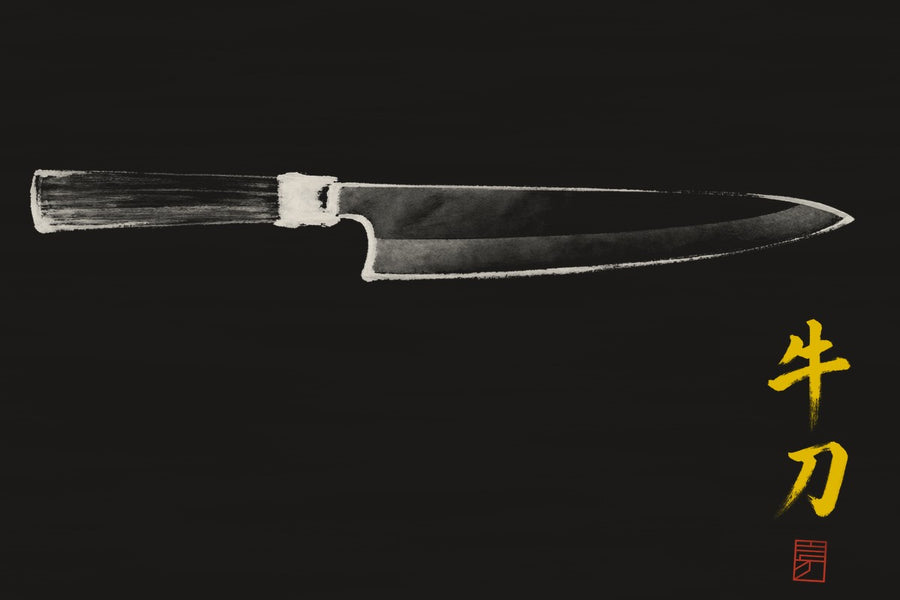
Gyuto — knife profile
Profile

Gyuto

牛刀

Chef's knife · Double bevel

Double-bevel all-purpose chef's knife with a pointed tip; thinner than a Western one.

Read more
Steel properties
  1. Hardness Low
  2. Edge retention Fair
  3. Toughness Fair
  4. Rust resistance High
  5. Ease of sharpening High
  6. Sharpness Good

Our ratings, inferred from published lab tests and composition.

Steel

MV (Molybdenum Vanadium)

モリブデンバナジウム鋼

Stainless

We list MV steel knives from Masamoto Sohonten, Tojiro, KAI and Sakai Takayuki.

Read more
Stainless steelfully hardened
Construction

Monosteel

モノスチール

One steel throughout · stainless

One steel hardened throughout, no cladding. Tough and simple; a little harder to thin.

Read more
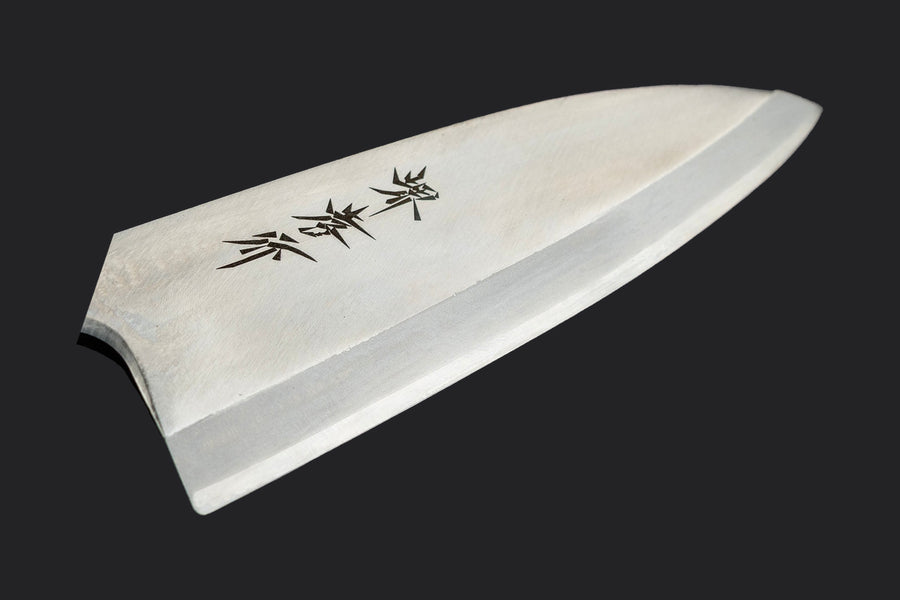
Migaki — blade surface finish
Finish

Migaki

Polished satin

Smooth polished surface, satin to soft sheen rather than mirror. Scratches show.

Read more

Frequently asked questions

Gyuto or santoku: which should I choose?

The gyuto came to Japan with the beef-eating culture of the Meiji era, and that is where its name comes from. Tojiro says it is used for all kinds of cooking, which is why it is also called the chef's knife.

The santoku is a household knife that combines the good points of the nakiri and the gyuto. Tojiro describes it as all-purpose, from vegetables to meat and fish, double-bevel and built on the same construction as a Western knife.

Choose a gyuto if you want more length and reach. Choose a santoku if you want a shorter all-purpose knife. Tojiro's own size figures: gyuto 150 to 210mm for household use and up to 360mm for professional use, santoku 165 to 170mm for household use.

What is a gyuto knife used for?

The gyuto (牛刀) is a chef's knife for all kinds of cooking, and it is basically double-bevel. A knife maker's guide says it came to Japan in the Meiji era with the culture of eating beef, which gave it its name, but it does not cut only meat.

A Japanese dictionary describes the gyuto as slimmer than a santoku, with a pointed tip, used widely for meat, fish and vegetables.

What gyuto length should I choose?

A knife maker's guide lists 150 to 210 mm, double-bevel, for home use, and 180 to 360 mm, single- or double-bevel, for professional kitchens.

We suggest starting with a 210 mm gyuto for a home kitchen, and stepping up to 240 mm if you regularly cut large pieces and have the board for it.

240mm vs 210mm gyuto: which size should I choose?

Get the 210mm. We only point people to a 240mm when they have about 45cm of usable board, cook in volume, and regularly break down big roasts or whole fish.

On the gyutos we've measured for our product pages, the extra length is real. As of October 2026, the 210mm gyutos we list have a median edge of 213mm from heel to tip, across the 111 we have measured; the 240mm ones have a median of 240mm, across 100. The 240s are also heavier, 212g against 175g at the median, and a touch taller at the heel, 50mm against 48mm, across the same 100 and 111 knives.

Weight overlaps between the two sizes. As of October 2026, 11 of the 100 measured 240s weigh less than the median 210 at 175g. The 240s we measured weigh 146 to 323g, and the 111 measured 210s 121 to 255g. The number in the name does not decide how heavy a knife is, so check the measured weight on the product page.

Japanese or German kitchen knives: which should I buy?

These are two design families, not a national specification, and many modern knives mix both. Japanese profiles are typically thinner, so they suit push and pull cuts; German profiles carry a fuller belly, which suits rocking. A given knife is its own evidence, so look at the blade you would buy rather than the country label.

Edges follow the same pattern. Many German knives ship at about 15 degrees per side, while many Japanese knives run about 10 to 15; check the model you are buying. A smaller angle is sharper but less forgiving. Hardness is a per model figure too. On two common Japanese steels the steel makers' own figures start at 60 HRC: Takefu Special Steel rates VG10 at 60 HRC or more, and Proterial lists the hardening hardness of Aogami 2 (Blue 2) as over 60 HRC.

A Japanese knife suits precision work where a sharp edge and nimble handling matter; a German knife suits heavier prep and rocking cuts where a substantial feel and a more forgiving edge matter. Whichever you choose, keep the edge off bone, frozen food and very hard squash, and use a wooden or plastic board.

What is the flat spot on a knife, and is it the same as the "sweet spot"?

The flat spot is the straight run of edge from the heel towards the middle, the part that meets the board along its length. It is commonly known as the sweet spot; some people also use "sweet spot" for the balance point, so ask which one someone means.

Past the flat, the edge curves up towards the tip (the belly), which suits a swinging or pulling stroke. Sharpeners also say "flat spot" for a worn patch of edge, so when you mean the shape, "the flat part of the edge" is clearer.

Gyuto or chef's knife: what is the difference?

A gyuto is a chef's knife, and its shape is largely modelled on the French chef's knife: a fairly flat run of edge near the heel, then a curve up to the tip. A German-style chef's knife has a bigger belly and curves along much more of its edge.

The flat run suits push and pull cuts, and the belly is made for rocking. That flat run is commonly known as the sweet spot.

Is Masamoto Sohonten the same company as Tsukiji Masamoto?

No. Masamoto Sohonten's own history page says Tsukiji Masamoto set up business independently in 1951. Its products and company organisation differ completely from the Sohonten house, and the MASAMOTO trademark is a registered trademark of Masamoto Sohonten, based in Azumabashi.

Both names carry Masamoto, so check which house made the knife: Masamoto Sohonten is the Azumabashi house in Tokyo, and Tsukiji Masamoto is a separate company.

You May Also Like