


Nakagawa White Steel Honyaki K-tip Yanagiba 300mm Mirror Polish
Nakagawa White Steel Honyaki K-tip Yanagiba 300mm Mirror Polish is backordered and will ship as soon as it is back in stock.
Pickup in Australia only
In Stock Now
-
Nakagawa Ginsan Yanagiba 270 / 300 / 330 mm Mirror Polished Finish, Left-HandedSale priceFrom $392.00 Regular price $461.00Unit price
-
Sukenari White 2 K-tip Yanagiba 300mm, Ebony Brass HandleSale price $293.00 Regular price $345.00Unit price
-
Yoshihiro Ginsan K-tip Yanagiba 390mm w/ Double Fuller and Ebony HandleSale price $1,151.00 Regular price $1,354.00Unit price
-
Nakagawa Blue 1 Kiritsuke Yanagiba 270/ 300/ 330 mmSale priceFrom $309.00 Regular price $363.00Unit price
-
Sukenari VG XEOS Nimai Kiritsuke Yanagiba 270mm, Ebony Handle with Single SpacerSale price $419.00 Regular price $493.00Unit price
-
Yoshihiro Ginsan K-tip Yanagiba 330mm w/Double Fuller, Ebony Handle Mosaic PinSale price $785.00 Regular price $923.00Unit price
-
Hatsukokoro x Myojin Shirasagi Ginsan K-tip Yanagiba 300mmSale price $220.00 Regular price $259.00Unit price
Availability
Delivery unavailable for this item. Available for in-store pickup only.
-
St Peters, NSW —2 Bishop St, Unit 2, St Peters NSW 2044
Goes well with
Detailed Specifications
| Line | Nakagawa Honyaki |
| Profile | K-tip Yanagiba / K-tip sashimi knife |
| Steel | White 3 / Shirogami #3 | Carbon |
| Blade Construction | Honyaki |
| Maker's hardening hardness | 60 HRC or more |
| Surface Finish | Mirror Polish |
| Handle | |
| Region | Sakai |
| Best for |
|
| Pros | Cons |
|
|
- Don't cut hard things! Japanese knives are brittle so bone hacking is a NO NO!
- Wash with neutral detergent after use, and wipe dry;
- Please don't wash knife with dishwasher, it will damage the wood handle;
- Be careful not to leave the knife close to a heat source for a long time;
- It is a lot more dangerous to cut with a blunt knife than a sharp knife!
- It is best to sharpen a Japanese knife regularly on a waterstone.
- Oil the (carbon) knife if storing for an extended period of time to prevent rust.
Knife details
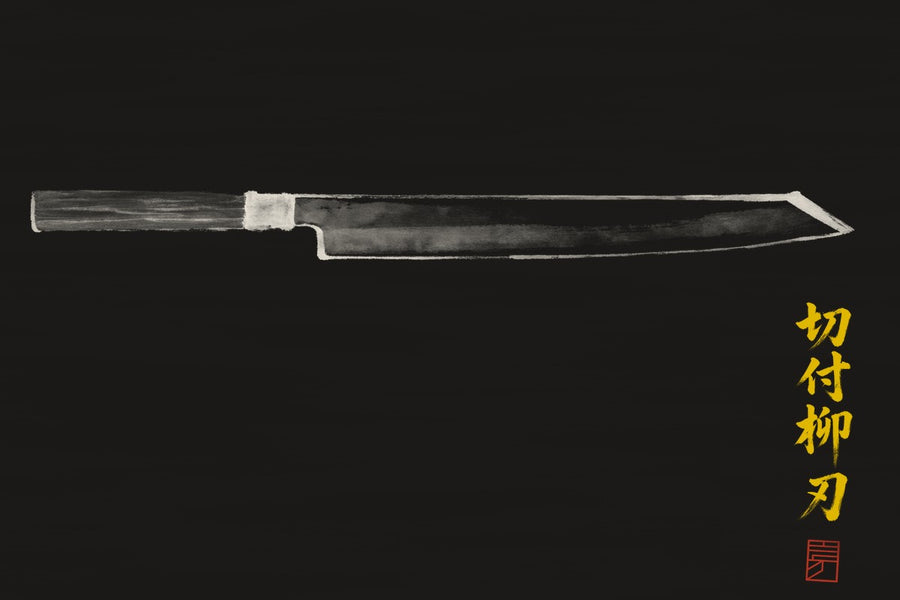
K-tip Yanagiba
切付柳刃
K-tip sashimi knife · Single bevel
Single-bevel sashimi slicer with an angled tip and flatter front; also does garnish work.
Read more-
Hardness
Good
How hard the steel is after heat treatment, measured in HRC. Harder steel can take a thinner, sharper edge but is more likely to chip. Maker's hardening hardness: 60 HRC or more
-
Edge retention
Good
How long the edge stays sharp in kitchen use before it needs sharpening. Not lab-tested; estimated from 1095 (316 mm of test card cut at 61.8 HRC, Knife Steel Nerds CATRA test, 2020). Hardness used: 60.5 HRC, as listed by us. Carbon steels score lower on this abrasive test, which is why our grade also counts hardness.
-
Toughness
Extremely high
How well the steel resists chipping and cracking from bones, hard boards or twisting.
-
Rust resistance
Low
How slowly the steel rusts or stains when left wet.
-
Ease of sharpening
Very high
How quickly the steel comes back to sharp on a whetstone.
-
Sharpness
Very high
How fine an edge the steel can take and hold. Judged from the hard carbides inside it: smaller and fewer carbides allow a keener edge.
Our ratings, inferred from published lab tests and composition.
Our edge-retention grade is a kitchen rating. It weighs the hardness each steel is sold at, which keeps a thin edge from rolling, twice as heavily as lab wear tests, and the final grade is our judgment from selling and sharpening these knives for over a decade. Lab card-cutting tests measure abrasive wear only, so they can rank carbon steels lower. Tap ? for the lab figure.
White 3 / Shirogami #3
白三鋼
Carbon · Hitachi Metals (now Proterial)
Proterial (formerly Hitachi Metals) carbon steel, 0.8% carbon, hardening hardness over 60 HRC. More forgiving than White 1 or 2; rusts.
Read moreHonyaki
本焼
One steel · differential hardening
One steel, only the edge hardened, showing a hamon. Mostly carbon (rusts); some stainless.
Read more
Mirror Polish
鏡面
Mirror polish
Polished to a true mirror that shows hamon or damascus clearly. Every scratch shows.
Read more