PRAHRAN STORE NOW OPEN · THU–MON · 10AM–6PM

Masutani  |  SKU: MASU_VGKKR_-BCNA165

Masutani Kokuryu VG10 Damascus Nakiri 165mm Black Chacate Handle

Regular price $159.95

Sold out right now

Leave your email and we’ll send one message the moment it’s back in stock.

One email, no marketing. Privacy policy.

Availability

  • St Peters, NSW —
    2 Bishop St, Unit 2, St Peters NSW 2044
  • Crows Nest, NSW —
    107 West St, Shop 1, Crows Nest NSW 2065
    Pickup only
  • Prahran, VIC —
    180 Commercial Road, Shop 1, Prahran VIC 3181
    Pickup only
Detailed Specifications
Line Masutani Kokuryu VG10 Tsuchime Damascus
Profile Nakiri / Japanese vegetable knife
Weight 158 g | 5.6 oz
Edge Length 165 mm | 6 1/2″
Heel Height 52 mm | 2 3/64″
Width @ Heel 1.7 mm | 1/16″
Width @ Mid 1.7 mm | 1/16″
Width @ 1cm from Tip 1.7 mm | 1/16″
Steel VG10 | Stainless
Blade Construction Sanmai - Stainless Damascus Clad
Hardness (HRC) 59 - 61
Surface Finish Tsuchime
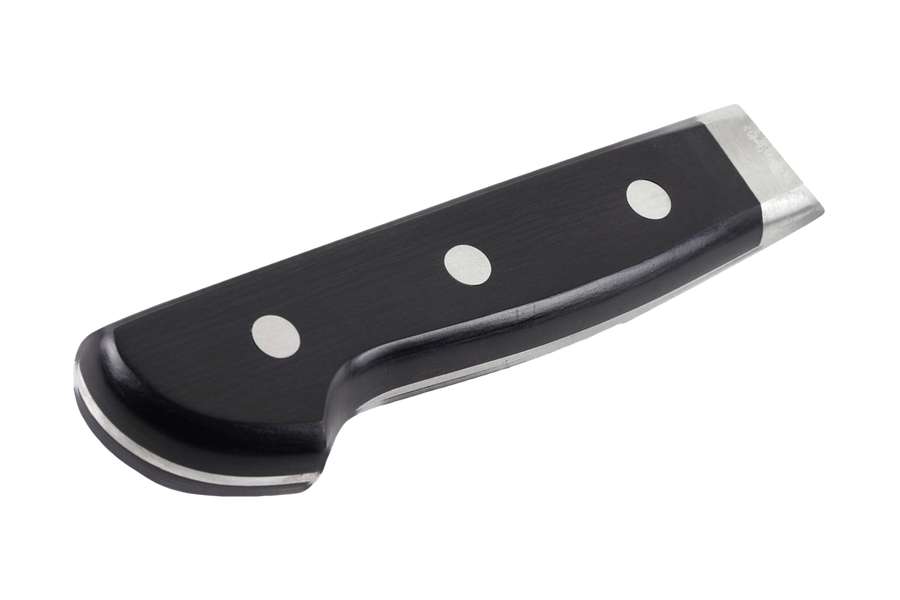
Handle Western Pakka Wood with Bolster
Region Echizen
Best for
  • First-timers
  • Gift buyers
  • Students
  • Free shipping for knives over AU$200 Australia wide.
  • World-wide shipping via DHL Express, 3 to 5 days.


At a modest price for every model in the range, the Kokuryu (刻流, Engraved Flow) line from Masutani is one of those knives that's genuinely hard to argue with. Hand sharpened in Echizen with a VG10 core, it delivers a cutting smoothness that most knives at this price simply can't match — and that gap becomes obvious the first time you run it through something dense.

The geometry is the real story here. The concave grind comes down from the Shinogi line to a very low thickness behind the edge, a level of refinement that you'd typically only find on significantly more expensive knives. This kind of sharpening is achieved on an Ento — a round grinding stone — and requires a level of skill that most budget production lines don't invest in. The result is a blade that enters food cleanly and releases it well, without the resistance and drag that plagues many knives in this price bracket. It's a geometry that also holds up well over repeated sharpenings, which means the performance you get out of the box isn't a one-time experience.

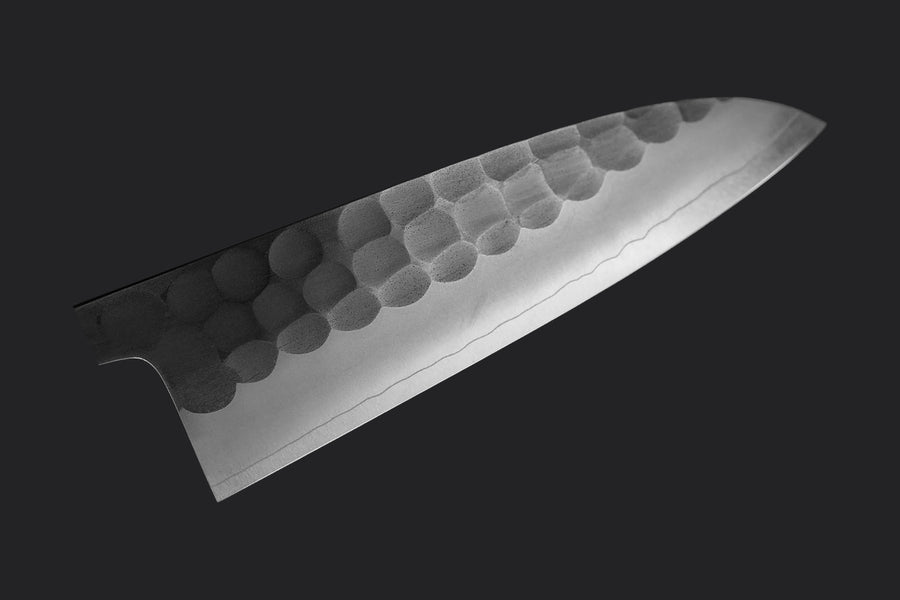
The cladding is a stainless Damascus with a light Tsuchime pattern over it — subtle rather than showy, which suits the knife's character. The focus here is clearly on what the knife does rather than how it looks, though the Damascus texture gives it enough visual interest to feel like a proper Japanese knife rather than a generic budget option. VG10 keeps maintenance simple and the edge retention honest, which makes this a particularly sensible first Japanese knife for anyone not ready to commit to carbon steel.

The one genuine limitation worth knowing is that Masutani doesn't produce this line beyond 185mm — a deliberate decision by the family business rather than an oversight. For home cooks and students who don't need the reach of a 210mm or 240mm, that's a non-issue. The spine and choil can feel a little sharp out of the box, which is easy enough to address with some sandpaper. For first-timers, gift buyers and anyone looking for an honest, high-performing entry point into Japanese kitchen knives, the Kokuryu is a very easy recommendation.

Pros Cons
  • Budget friendly
  • Thin behind the edge
  • Excellent performance
  • A little bit brittle
Care Instruction
  1. Don't cut hard things! Japanese knives are brittle so bone hacking is a NO NO!
  2. Wash with neutral detergent after use, and wipe dry;
  3. Please don't wash knife with dishwasher, it will damage the wood handle;
  4. Be careful not to leave the knife close to a heat source for a long time;
  5. It is a lot more dangerous to cut with a blunt knife than a sharp knife!
  6. It is best to sharpen a Japanese knife regularly on a waterstone.

Masutani

Masutani Hamono, a knife workshop in Echizen

Masutani Hamono Seisaku (増谷刃物製作) is a knife workshop in Takefu, Echizen City, Fukui, headed by its president, Kunio Masutani, whom we have met; it forges under its own mark. The company says it has carried Echizen's forged-knife tradition through four generations, and that it makes knives of the kind professionals use as knives for the home, by its craftsmen's hands: thin with spring, tough and supple.

Read more

Masutani sets out its own range as VG1 stainless in tsuchime, nashiji and migaki finishes, and VG10 stainless in a layered Damascus pattern. Its shop page adds a new Sekka (雪華) pattern and says the VG10 stainless it uses keeps its edge long.

Among the lines we list, the VG10 Damascus knives are Kokuryu, in nakiri, slim nakiri, tsuchime gyuto, tsuchime santoku and small santoku, with a wa or Western handle; Sairyu (彩流), in gyuto, nakiri, santoku and small santoku; and a Sekka VG10 nashiji Damascus santoku.

In VG1 we list nashiji and tsuchime knives in gyuto, santoku, small santoku, nakiri and slim nakiri, and there is a chef knife starter set.

“A Takefu knife workshop in its fourth generation, by its own account.”

Est. 1974 | 昭和49年
Known for VG1 and VG10 stainless knives, including Damascus
Website masutani-hamono.shop Read more about Masutani

Masutani · Echizen

Knife details

Frequently asked questions

Why won't my knife cut all the way through? The slices stay joined at the bottom.

Part of the edge never reaches the board, so the cut never finishes. At our counter we put it simply: there is not enough flat at the heel. A knife with a long curve is built for rock chopping, not for the Chinese or Eastern up-and-down chop.

A straight edge, like a nakiri's, meets the board along its whole length and finishes the cut. On any knife, a dip worn near the heel or a dull section can cause the same thing.

Nakiri or usuba: what is the difference?

The bevel. A Japanese dictionary describes the nakiri (菜切包丁) as shaped like an usuba but double-bevel and relatively easy to handle; the Sakai cutlery association describes the usuba (薄刃包丁) as an acute, wide knife for vegetables, in a square Kanto type and a kamagata Kansai type.

The names overlap, since another dictionary records the usuba as also called nakiri, so check the bevel rather than the name.

Does VG10 rust?

Yes, it can, though it rusts less readily. VG10 (V金10号) is a stainless steel, and stainless strictly means a steel that rusts less, not one that never rusts.

Takefu, which makes VG10, lists 15% chromium, above the 10.5% that defines stainless steel, and describes its corrosion resistance as excellent. Dry the knife after washing.

How hard is VG10?

Takefu, the steelmaker behind VG10, gives HRC 60 or more as a standard value. The hardness of a finished knife depends on its maker.

Takefu says the steel's 15% chromium, 1% molybdenum and 1.55% cobalt give it high hardness and a long-lasting edge, and that it is easy to sharpen.

How many generations has Masutani been making knives?

Four. Masutani's own page says it has carried the 700-year tradition of Echizen forged knives, Echizen uchihamono, across four generations.

The workshop, 増谷刃物製作, works in Takefu, Echizen City, Fukui.

You May Also Like