


Hatsukokoro Itadaki Blue2 & White2 Dual Core Damascus Tsuchime Petty 150mm with Saya
Hatsukokoro Itadaki Blue2 & White2 Dual Core Damascus Tsuchime Petty 150mm with Saya is backordered and will ship as soon as it is back in stock.
Pickup in Australia only
In Stock Now
-
Nigara Anmon (暗紋) SG2 Raindrop Damascus K-tip Sujihiki 240mm Mother-of-pearl WesternSale price $470.00 Regular price $553.00Unit price
-
Nigara SG2 Tsuchime K-tip Nakiri 165mm Kurouchi Turquoise HandleSale price $330.00 Regular price $387.00Unit price
-
Nigara SG2 Kurouchi Tsuchime Gyuto 210mm Western IronwoodSale price $334.00 Regular price $393.00Unit price
-
Nigara SG2 Kurouchi Tsuchime K-tip Gyuto 210mm Western IronwoodSale price $314.00 Regular price $369.00Unit price
-
Nigara SG2 Kurouchi Tsuchime K-tip Gyuto 240mm Western Ironwood w/ SayaSale price $366.00 Regular price $430.00Unit price
-
Hatsukokoro x Myojin Shirasagi Blue 2 Kurouchi Sakimaru Takohiki 300mmSale price $230.00 Regular price $271.00Unit price
-
Myojin Riki x Hatsukokoro Shirasagi Blue 2 Kurouchi K-Tip Deba 165mmSale price $172.00 Regular price $202.00Unit price
-
Myojin Riki x Hatsukokoro Shirasagi Blue 2 Kurouchi K-Tip Deba 150mmSale price $167.00 Regular price $196.00Unit price
Availability
Delivery unavailable for this item. Available for in-store pickup only.
-
St Peters, NSW —2 Bishop St, Unit 2, St Peters NSW 2044
Goes well with
Detailed Specifications
| Line | Hatsukokoro x Nigara Itadaki Blue 2/White 2 Coreless Kurouchi Tsuchime Damascus |
| Profile | Petty / Utility knife |
| Bevel Type | Double Bevel |
| Weight | 97 g | 3.4 oz |
| Edge Length | 141 mm | 5 35/64″ |
| Heel Height | 32 mm | 1 17/64″ |
| Width @ Heel | 2.5 mm | 3/32″ |
| Width @ Mid | 2.3 mm | 3/32″ |
| Width @ 1cm from Tip | 1.0 mm | 3/64″ |
| Steel | Blue 2 / Aogami #2 | Carbon |
| Blade Construction | Coreless |
| Typical hardness | 61 to 63 HRC |
| Surface Finish | Kurouchi Tsuchime |
| Handle | Octagonal Birch Burl with Spacer |
| Region | Aomori |
| Best for |
|

| Pros | Cons |
|
|
- Don't cut hard things! Japanese knives are brittle so bone hacking is a NO NO!
- Wash with neutral detergent after use, and wipe dry;
- Please don't wash knife with dishwasher, it will damage the wood handle;
- Be careful not to leave the knife close to a heat source for a long time;
- It is a lot more dangerous to cut with a blunt knife than a sharp knife!
- It is best to sharpen a Japanese knife regularly on a waterstone.
- Oil the (carbon) knife if storing for an extended period of time to prevent rust.
Knife details
Petty
ペティ
Utility knife · Double bevel
Small, slim double-bevel utility knife for peeling, trimming and small board jobs.
Read more-
Hardness
Very good
How hard the steel is after heat treatment, measured in HRC. Harder steel can take a thinner, sharper edge but is more likely to chip. Typical hardness: 61 to 63 HRC
-
Edge retention
Very good
How long the edge stays sharp in kitchen use before it needs sharpening. Not lab-tested; estimated from V-Toku2 (314 mm of test card cut at 63.6 HRC, Knife Steel Nerds CATRA test, 2020). Hardness used: 62.5 HRC, the usual hardness makers sell it at. Carbon steels score lower on this abrasive test, which is why our grade also counts hardness.
-
Toughness
Very good
How well the steel resists chipping and cracking from bones, hard boards or twisting.
-
Rust resistance
Low
How slowly the steel rusts or stains when left wet.
-
Ease of sharpening
High
How quickly the steel comes back to sharp on a whetstone.
-
Sharpness
Very high
How fine an edge the steel can take and hold. Judged from the hard carbides inside it: smaller and fewer carbides allow a keener edge.
Our ratings, inferred from published lab tests and composition.
Our edge-retention grade is a kitchen rating. It weighs the hardness each steel is sold at, which keeps a thin edge from rolling, twice as heavily as lab wear tests, and the final grade is our judgment from selling and sharpening these knives for over a decade. Lab card-cutting tests measure abrasive wear only, so they can rank carbon steels lower. Tap ? for the lab figure.
Blue 2 / Aogami #2
青二鋼
Carbon · Hitachi Metals (now Proterial)
Proterial carbon steel, 1.05 to 1.15% carbon with chromium and tungsten; not stainless.
Read moreCoreless
無芯
Laminated through · no core
Layers of hardenable steels with no separate core; the pattern runs right to the edge.
Read more
Kurouchi Tsuchime
Forge scale · hammered
Hammer marks under dark forge scale. May help food release; bevel and edge need care.
Read more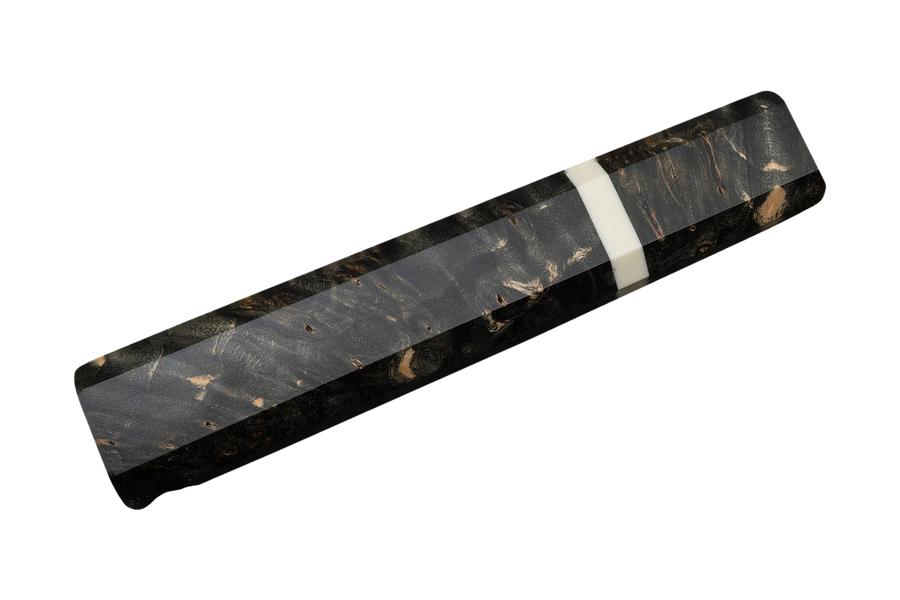
Octagonal Birch Burl with Spacer
Octagonal WA
Stabilised birch burl, eight-sided, with a spacer. Resin-stabilised wood resists water.
