Crows Nest store now open from Friday to Tuesday, 10am till 6pm.

Shigeki Tanaka  |  SKU: TANA_B2KU_ST170

Tanaka Blue 2 Damascus Santoku 170mm Kurouchi

Regular price $229.95

IMPORTANT: Carbon steel knives can rust or patina quickly if not cared for properly. They require regular cleaning, drying, and oiling. If you are unfamiliar with carbon steel maintenance, we recommend choosing a stainless steel option instead.

Add a saya or K&S Knife Roll to receive $20 bundle discount!

Detailed Specifications
Line Shigeki Tanaka Blue 2 Kurouchi Damscus
Profile Santoku / Santoku
Bevel Type Double Bevel
Weight 154 g | 5.4 oz
Edge Length 169 mm | 6 21/32″
Heel Height 49 mm | 1 59/64″
Width @ Heel 2.4 mm | 3/32″
Width @ Mid 1.7 mm | 1/16″
Width @ 1cm from Tip 0.7 mm | 1/32″
Steel Blue 2 / Aogami #2 | Carbon
Blade Construction Sanmai - Stainless Damascus Clad
Hardness (HRC) 61 - 63
Surface Finish Kurouchi
Handle Octagonal Black Chacate
Region Miki
Best for
  • Pro chefs
  • Gift buyers
  • Free shipping for knives over AU$200 Australia wide.
  • World-wide shipping via DHL Express, 3 to 5 days.


Shigeki Tanaka is based in Miki city — not a name that comes up as often as Sakai or Takefu in knife conversations, though Miki has its own quiet place in Japanese blade culture as the home of Nagao Kanekoma, the legendary Higonokami makers. What makes Tanaka's story particularly interesting is that his training took him to Takefu Knife Village, giving him a grounding in the Echizen forging tradition before he returned to establish his own workshop in Miki. That cross-regional background shows in his work — the hand forged taper and rigidity you'd associate with Echizen production, expressed through a design that is distinctly his own.

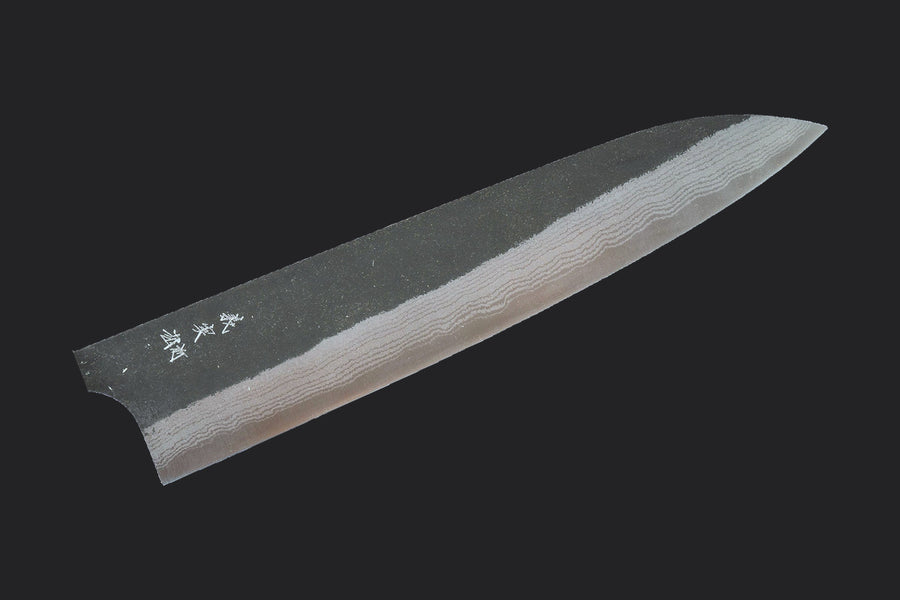
The Blue 2 Kurouchi Damascus line leads with a finish that rewards a closer look. The Kurouchi surface has that weathered, uneven quality — bright and dark patches sitting together like aged paint, organic and characterful in the way only a forge scale finish can be. The Damascus cladding beneath it doesn't announce itself over the Kurouchi surface, but at the bevel, where the geometry cuts through the iron Damascus layers, the pattern is revealed in a sandblasted contrast. It's a more understated treatment than an etched Damascus, which suits the overall character of the knife well.

The blade is hand forged with a noticeably thick spine and strong distal taper, lending it good rigidity and a confident feel in the hand. The primary bevel is concave, which brings the edge down to a low thickness and makes for decent food penetration. The narrow bevel creates a steeper angle from the Hira, which causes more wedging when pushing through dense, tough produce — this is not a knife for splitting blocks of hard root vegetables. Where it performs well is in producing clean, precise slices, where the Shinogi line transition encourages food to peel away reliably. The overall blade thickness keeps the edge reasonably robust despite the concave grind, making it a practical workhorse rather than a delicate laser.

For the price, this combination is genuinely hard to find elsewhere — a hand forged Blue 2 knife with iron Damascus cladding, from a legacy maker, at a price point where most alternatives are either machine fabricated stainless or hand forged with plain iron cladding. For professional chefs and gift buyers looking for something with real craft and character behind it, the Shigeki Tanaka Blue 2 Kurouchi Damascus is a very easy recommendation, but be sure that you can look after these reactive blades.

Pros Cons
  • Budget friendly
  • Workhorse grind
  • Great for professionals
  • Prone to rust
  • On the thicker side
Care Instruction
  1. Don't cut hard things! Japanese knives are brittle so bone hacking is a NO NO!
  2. Wash with neutral detergent after use, and wipe dry;
  3. Please don't wash knife with dishwasher, it will damage the wood handle;
  4. Be careful not to leave the knife close to a heat source for a long time;
  5. It is a lot more dangerous to cut with a blunt knife than a sharp knife!
  6. It is best to sharpen a Japanese knife regularly on a waterstone.
  7. Oil the (carbon) knife if storing for an extended period of time to prevent rust.

Shigeki Tanaka

Shigeki Tanaka - Miki's unicorn knife maker.

Crafted in Miki City, Hyogo—Japan’s historic blade-making heartland—Shigeki Tanaka knives embody generations of blacksmithing expertise. Known for their exceptional sharpness and balance, these blades are forged using high-carbon steel (like Aogami #2) and traditional techniques, ensuring outstanding edge retention. The brand’s signature kurouchi (blacksmith’s finish) gives each knife a rustic, hand-forged look while protecting the blade.

Tanaka’s knives are favored by chefs and collectors for their precision, durability, and exceptional performance. Many feature elegant wa (Japanese-style) handles made from magnolia or ebony, along with his signature Bob loveless inspired coke-shaped western ironwood handle, designed for comfort and control. With a focus on pure craftsmanship over flashy aesthetics, Shigeki Tanaka delivers professional-grade blades that honor Hyogo’s samurai sword-making legacy.

Read more

Forged in Miki City, Hyogo—the heart of Japan's blade-making tradition—Shigeki Tanaka knives represent generations of masterful blacksmithing. Each blade is handcrafted from premium high-carbon steels like Aogami #2, delivering exceptional sharpness and long-lasting edge retention. The distinctive kurouchi finish preserves the knife's rugged, hand-forged character while protecting the steel.

Renowned for their precision and balance, Tanaka's knives feature both traditional wa handles in magnolia or ebony and his signature Western-style ironwood handle—inspired by Bob Loveless's iconic "coke bottle" design—for superior grip and comfort. Favored by professional chefs and discerning collectors, these blades blend time-honored techniques with subtle modern refinements, staying true to Hyogo's samurai sword-making heritage. No flashy gimmicks—just flawless cutting performance and enduring craftsmanship.

(Handmade in Miki City, Hyogo—home to Japan's finest bladesmiths for centuries.)

“Japanese steel, Loveless soul — where desert ironwood meets the master's edge.”

Est. 1946 | 昭和21年
Known for Perfect balance of cutting performance and knife balance. Bob Loveless style western handle.
Website kanegen4th.com Read more about Shigeki Tanaka
Shigeki Tanaka — Miki
Profile: Santoku
Profile

Santoku

Santoku

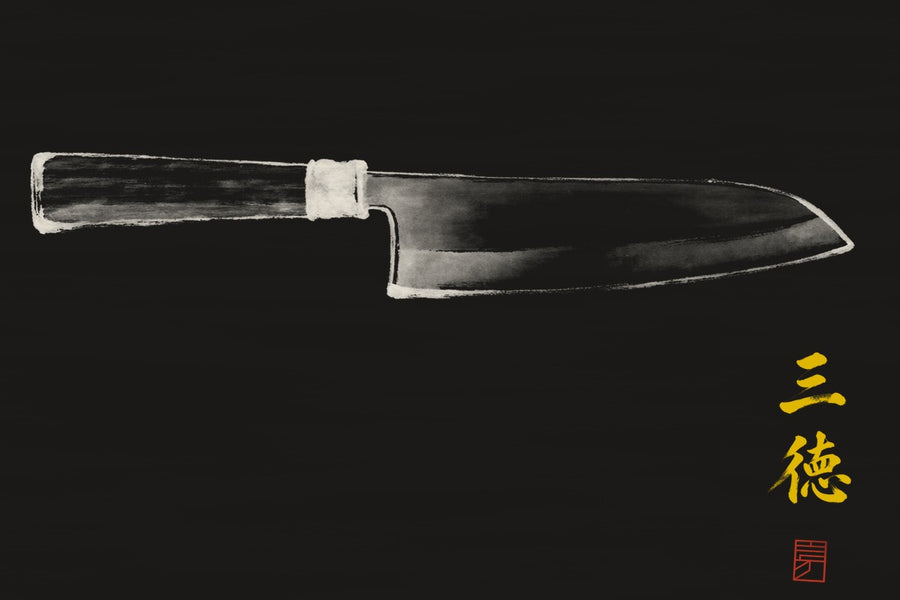
The Santoku(三徳) knife, embodying the meaning "three uses," is a cornerstone in Japanese kitchens, adept at slicing, dicing, and mincing. Esteemed for its versatility, it features a blade length typically between 15cm and 20cm (6 to 8 inches), catering to a wide array of culinary tasks. Distinguished by its less pointy tip compared to the Gyuto, the Santoku boasts a unique profile that contributes to its functionality and popularity. Its design is more controllable in chopping and slicing, and the profile is less aggressive, for those reasons, it has bacame a preferred choice for home cooks.
Composition

Blue 2 / Aogami #2 Element Composition

Compare with
    Blue 2 / Aogami #2
    1.05% 0.8% 0.5% 0.3% 0
    C Carbon 1.05%
    Primary hardening element. Raises hardness and wear resistance — but too much increases brittleness and corrosion susceptibility. As a reference: German 1.4112 (~0.5%) sits at the low end; VG-10 (~1.0%) is a common mid-range; SG2 (1.25–1.45%) and ZDP-189 (~3.0%) represent high and extreme ends respectively.
    C
    1.05%
    Cr Chromium 0.2%
    Raises corrosion resistance; 13%+ qualifies steel as stainless. Also improves hardenability and wear resistance. In kitchen use, higher chromium levels contribute to a slight drag or sticking sensation when cutting — a trade-off for the rust resistance it provides.
    Cr
    0.2%
    W Tungsten 1.0%
    Forms hard carbides for wear resistance and edge retention. Gives the steel hardness even at elevated temperatures.
    W
    1.0%
    Mn Manganese 0.2%
    Aids hardenability and strength. Acts as a deoxidiser during smelting. Excess can reduce toughness.
    Mn
    0.2%
    Si Silicon 0.1%
    Strengthens the steel matrix and acts as a deoxidiser. Improves hardness and resistance to oxidation.
    Si
    0.1%
    P Phosphorus 0.025%
    Impurity from the smelting process. Even small amounts cause brittleness — steelmakers keep this as low as possible.
    P
    0.025%
    S Sulfur 0.004%
    Impurity that reduces toughness and promotes brittleness. Intentionally added only in free-machining steels.
    S
    0.004%
    C — Carbon Cr — Chromium W — Tungsten Mn — Manganese Si — Silicon P — Phosphorus S — Sulfur
    Hardness 61–63 HRC
    555759616365+
    Steel
    Blue 2 / Aogami #2
    Category
    Carbon
    Manufacturer
    Hitachi Special Steel, Japan 🇯🇵
    Hardness
    61–63 HRC
    Steel

    Blue 2 / Aogami #2

    • Manufacturer
      • Hitachi Special Steel, Japan
    • Nature Carbon
    • Hardness61–63 HRC
    Blue Steel No.2, also recognized as Aogami No.2, is a distinguished high carbon steel produced by Hitachi Metals Ltd, enhanced by the addition of chromium and tungsten to the base of White Steel No.2. This modification brings about an improvement in toughness and the creation of hard carbide molecules, which significantly boost edge retention. Although its sharpness is comparable to that of White Steel No.2, Blue Steel No.2 offers a slight advantage in maintaining its edge.

    Widely favored for its versatility, Aogami No.2 is celebrated for its ease of sharpening and robust resistance to chipping, making it an ideal choice for those new to Aogami steel knives. Containing 1.0–1.2% carbon and achieving a typical hardness of 62–63 HRC on the Rockwell scale, it stands as the benchmark in evaluating Aogami steel cutlery.
    Construction: Sanmai - Stainless Damascus Clad
    Construction

    Sanmai - Stainless Damascus Clad

    Sanmai(Three-Piece) is a common construction for double bevel knives where two pieces of softer cladding steel are forgewelded to each side of a harder core steel. The harder but more brittle core steel will form the hard cutting edge after heat treating, and the softer cladding will support the core to increase the overall strength of the blade.

    Damascus Sanmai utilize damascus steel as the cladding material for the Sanmai construction, which adds aesthetic feature to the blade. On the Kitchen knives with stainless core steel, the damascus cladding will be stainless, this means they will also protect the carbon/semi-stainless core from rusting/discolouration.

    The soft cladding enables the thinning process to be a lot easier than a honyaki or monosteel construction. However, when the cladding is made of damascus, whether etched, polished or mirror polished, the thinning process will take a toll on the cladding, meaning the damascus won't look the same as when it was taken out of the box.

    Finish: Kurouchi
    Finish

    Kurouchi

    Kurouchi refers to the rustic, unpolished finish found on the blade of many traditional Japanese kitchen knives. This blacksmith's finish is characterized by its dark, textured appearance, which is the result of leaving the blade forge-scale on the steel during production. Kurouchi finish not only adds a unique aesthetic appeal but also provides certain practical benefits. It acts as a protective layer against rust and corrosion, and helps to reduce food sticking to the blade during cutting. Commonly seen on high-quality, hand-forged knives, the kurouchi finish emphasizes the artisanal nature of the knife and its heritage, making each piece distinctively unique.

    Handle
    Handle

    Octagonal Black Chacate

    • Profile Octagonal WA
    • Material
      • Black Chacate

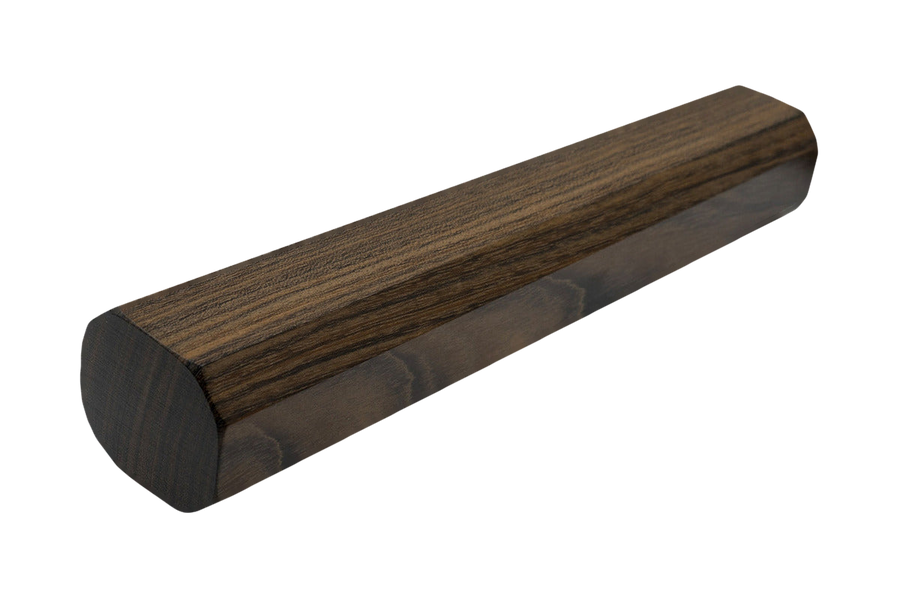
    Black Chacate is a highly valued timber known for its deep, rich brown to almost black coloration, fine texture, and exceptional durability. It polishes well, offering an exquisite finish that highlights its subtle, elegant grain patterns. This wood is often used in fine woodworking projects, including luxury furniture, decorative items, and high-end knife handles.

    An octagonal wa handle made from Black Chacate wood would exhibit a sleek, geometric shape that fits comfortably in the hand, enhancing the user's grip and control. The deep hues and natural luster of Black Chacate add a touch of sophistication and unparalleled beauty to the handle, making it not only a functional component of a kitchen knife but also a piece of art. The durability and stability of Black Chacate ensure that the handle withstands the rigors of kitchen use while maintaining its aesthetic appeal over time.

    1 / 5

    You May Also Like