Crows Nest store now open from Friday to Tuesday, 10am till 6pm.

Nigara Hamono  |  SKU: NG-SG2TSUMAT-KGY210-EB

Nigara SG2 Tsuchime Matt Migaki K-tip Gyuto 210mm Ebony

Sale price $356.99 Regular price $419.95

Availability

  • St Peters (Online/Showroom)
    2 Bishop St Unit 2 St Peters NSW 2044
  • Crows Nest (Storefront)
    107 West St, Crows Nest NSW 2065
    Pickup only
Detailed Specifications
Line Nigara SG2 Matt Migaki Tsuchime
Profile K-tip Gyuto / Chefs Knife
Bevel Type Double Bevel
Weight 171 g | 6.0 oz
Edge Length 195 mm | 7 43/64″
Heel Height 49 mm | 1 59/64″
Width @ Heel 2.4 mm | 3/32″
Width @ Mid 2.4 mm | 3/32″
Width @ 1cm from Tip 1.0 mm | 3/64″
Steel SG2 / R2 | Powdered | Stainless
Blade Construction Sanmai - Stainless Clad
Hardness (HRC) 62 - 64
Handle Octagonal Black Chacate
Region Aomori
Best for
  • First-timers
  • Pro chefs
  • Free shipping for knives over AU$200 Australia wide.
  • World-wide shipping via DHL Express, 3 to 5 days.


This is a line up of knives produced by Nigara have excellent performance  for how much they cost. Just like their well known VG10 line, these blades employed optimised fabrication procedures, allowing users to obtain a combination of sharp edge geometry and a powder stainless steel edge at a very acceptable cost.

The SG2/R2 being the most commonly used powder stainless steel in the Japanese kitchen knife industry can offer a reliable toughness and edge retention. However, the higher cost of the steel means it’s usually hard to get knives made with it under 350 AUD(210mm Gyuto). The SG2 Hayabusa produced by Hatsukokoro offers a very low price for those who want to experience this steel and its ability to hold its edge, but the Matt Migaki Tsuchime line from Nigara would have a better sharpness and food release due to its hand-sharpened, sabre grind concave edge geometry. 

The overall fit and finish is just like other knives produced in similar fashion by Nigara, you can expect very consistent surface condition, straightness and rigidity throughout different profiles. The soft stainless cladding has a very pretty smooth matt finish while the core steel still has parallel polish marks left from Migaki finish. Compare to the VG10 line with Damascus cladding, this is a very simple yet elegant design, if you are looking for a slightly different look, there is a twin sister line by Nigara that comes with Kurouchi finish. 

The slightly thicker thickness of the blade gives the knife more sturdiness, combining with the ease of maintenance,  it allows this lineup of knives to be an excellent starting point for those who want to get into Japanese knife with have a bit more budget. And for the VG10 users looking for an upgrade, these blades offer better core steel with only a slight increase in price, but more importantly maintain a very good fit and finish and sharpness.

Pros Cons
  • Excellent performance
  • Easy to look after
  • Relatively hard to sharpen
Care Instruction
  1. Don't cut hard things! Japanese knives are brittle so bone hacking is a NO NO!
  2. Wash with neutral detergent after use, and wipe dry;
  3. Please don't wash knife with dishwasher, it will damage the wood handle;
  4. Be careful not to leave the knife close to a heat source for a long time;
  5. It is a lot more dangerous to cut with a blunt knife than a sharp knife!
  6. It is best to sharpen a Japanese knife regularly on a waterstone.

Nigara

Hirosaki sword and knife artisan

Based in the small yet beautiful city of Hirosaki in the northern prefecture of  Aomori, Nigara hamono has been making samurai swords for 350 yearas, with master Kunitoshi  (國俊) being one of the most famous sword smith in his generation. Now headed by the 8th generation mastersmith Go Yoshizawa (吉澤 剛) supported by his father Toshiju Yoshizawa (吉澤 俊寿), Nigara is becoming very popular thanks of its exquisite forging skills and second to none quality control. 

“Katana making family in Aomori carrying their linage with creativity and innovation, known for the striking "Anmon" design and striking high-end, hand forged damascus items”

Est. 1949 | 昭和24年
Known for Glamorous and innovative knife design, inherited forging skills.
Website nigaraknives.com Read more about Nigara
Nigara — Aomori
Profile: K-tip Gyuto
Profile

K-tip Gyuto

Chefs Knife

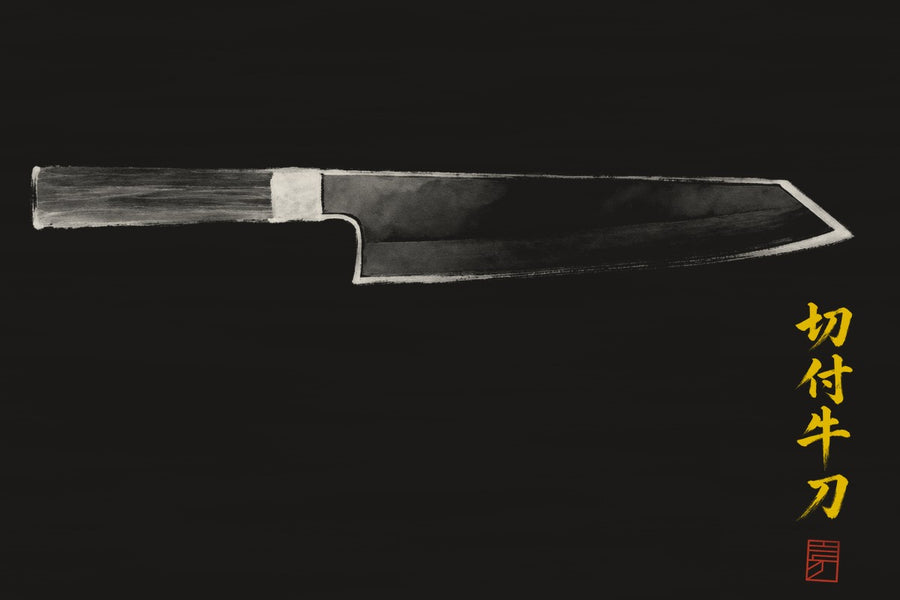
The K-tip Gyuto — known in Japanese as kiritsuke gyuto (切付牛刀) — is a double-bevelled chef's knife that pairs the all-purpose body of a standard gyuto with a kiritsuke-style tip: an angled, clipped "k-tip" point in place of the gyuto's curved belly. Combined with a flatter edge profile, this gives two advantages. The sharply defined tip excels at precise work — scoring, detailing and picking — while the flatter edge is optimised for clean push-cutting and long slicing strokes. It remains a versatile general-purpose knife, but rewards a chef who works with deliberate, tip-led precision.

A note on naming: the K-tip (or "Kiritsuke") Gyuto is a double-bevelled knife and should not be confused with the traditional Kiritsuke (切付け) — a single-bevelled knife that is a genuinely different tool. Many retailers list the two interchangeably; at Knives and Stones we keep them distinct so you know exactly what you're buying.
Composition

SG2 / R2 Element Composition

Compare with
    SG2 / R2
    14.0% 10.5% 7.0% 3.5% 0
    C Carbon 1.25%
    Primary hardening element. Raises hardness and wear resistance — but too much increases brittleness and corrosion susceptibility. As a reference: German 1.4112 (~0.5%) sits at the low end; VG-10 (~1.0%) is a common mid-range; SG2 (1.25–1.45%) and ZDP-189 (~3.0%) represent high and extreme ends respectively.
    C
    1.25%
    Cr Chromium 14.0%
    Raises corrosion resistance; 13%+ qualifies steel as stainless. Also improves hardenability and wear resistance. In kitchen use, higher chromium levels contribute to a slight drag or sticking sensation when cutting — a trade-off for the rust resistance it provides.
    Cr
    14.0%
    V Vanadium 1.8%
    Forms extremely hard carbides for superior edge retention. Also refines grain structure, improving toughness.
    V
    1.8%
    Mo Molybdenum 2.3%
    Improves hardenability and toughness. Boosts corrosion resistance and helps the steel hold hardness under heat.
    Mo
    2.3%
    Mn Manganese 0.4%
    Aids hardenability and strength. Acts as a deoxidiser during smelting. Excess can reduce toughness.
    Mn
    0.4%
    Si Silicon 0.5%
    Strengthens the steel matrix and acts as a deoxidiser. Improves hardness and resistance to oxidation.
    Si
    0.5%
    P Phosphorus 0.03%
    Impurity from the smelting process. Even small amounts cause brittleness — steelmakers keep this as low as possible.
    P
    0.03%
    S Sulfur 0.03%
    Impurity that reduces toughness and promotes brittleness. Intentionally added only in free-machining steels.
    S
    0.03%
    C — Carbon Cr — Chromium V — Vanadium Mo — Molybdenum Mn — Manganese Si — Silicon P — Phosphorus S — Sulfur
    Hardness 62–64 HRC
    555759616365+
    Steel
    SG2 / R2
    Category
    Stainless
    Process
    Powder Metallurgy (PM)
    Manufacturer
    Takefu Special Steel, Japan 🇯🇵
    Hardness
    62–64 HRC
    Steel

    SG2 / R2

    • Manufacturer
      • Takefu Special Steel, Japan
    • Nature Stainless
    • Hardness62–64 HRC
    SG2, also known as Super Gold 2 or R2 steel, is a high-end powdered tool steel by Takefu Special Steel, known for its excellent edge retention, wear resistance, and ability to achieve a hardness of up to 64 HRC. Identical to Kobelco Steel's R2, it's prized in premium knife making for its fine edge sharpness and durability. The powdered nature ensures uniform carbide distribution, enhancing toughness and reducing chipping risks. SG2/R2 is ideal for those seeking top performance and longevity in their cutting tools.
    Construction: Sanmai - Stainless Clad
    Construction

    Sanmai - Stainless Clad

    Sanmai(Three-Piece) is a common construction for double bevel knives where two pieces of softer cladding steel are forgewelded to each side of a harder core steel. The harder but more brittle core steel will form the hard cutting edge after heat treating, and the softer cladding will support the core to increase the overall strength of the blade.

    The soft cladding enables the thinning process to be a lot easier than a honyaki or monosteel construction. And in the case where the cladding steel are stainless in nature, it can offer protection for the carbon or semi-stainless cores against rusting and discoluoring.

    Handle
    Handle

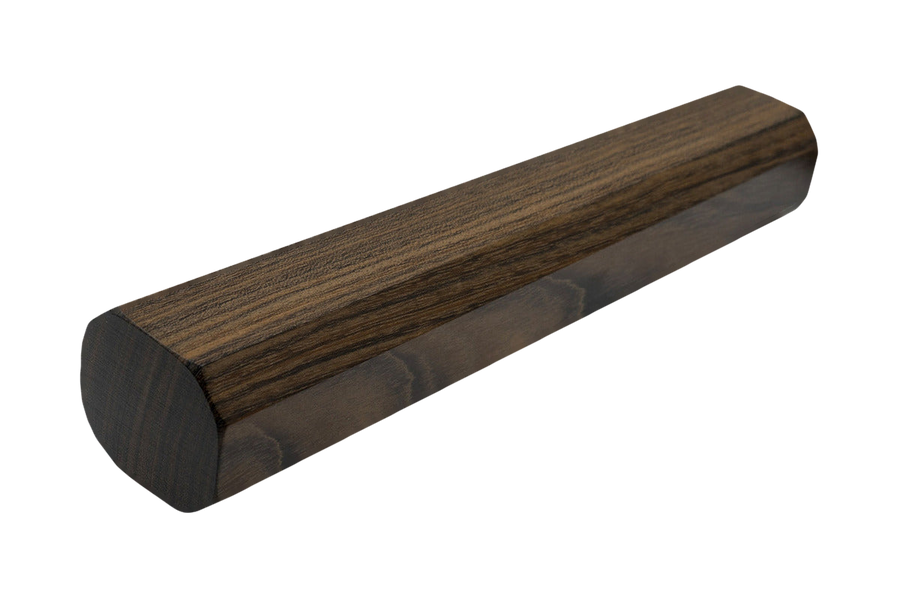
    Octagonal Black Chacate

    • Profile Octagonal WA
    • Material
      • Black Chacate

    Black Chacate is a highly valued timber known for its deep, rich brown to almost black coloration, fine texture, and exceptional durability. It polishes well, offering an exquisite finish that highlights its subtle, elegant grain patterns. This wood is often used in fine woodworking projects, including luxury furniture, decorative items, and high-end knife handles.

    An octagonal wa handle made from Black Chacate wood would exhibit a sleek, geometric shape that fits comfortably in the hand, enhancing the user's grip and control. The deep hues and natural luster of Black Chacate add a touch of sophistication and unparalleled beauty to the handle, making it not only a functional component of a kitchen knife but also a piece of art. The durability and stability of Black Chacate ensure that the handle withstands the rigors of kitchen use while maintaining its aesthetic appeal over time.

    1 / 4

    Frequently asked questions

    Is a K-tip Gyuto the same as a traditional Kiritsuke?

    Not quite - and it is the single most common point of confusion when people shop for a kiritsuke. The two knives share the same striking angled, reverse-tanto tip, but underneath that tip they are very different tools.

    A K-tip gyuto is a double-bevel knife: it is ground on both sides like any Western-style chef's knife, so it is ambidextrous, forgiving to use, and sharpened exactly the way you would sharpen a normal gyuto. You get the dramatic kiritsuke look with the everyday usability of an all-purpose chef's knife.

    A traditional kiritsuke - including the kiritsuke-yanagiba (slicer) and kiritsuke-gyuto shapes - is a single-bevel knife, ground on one side only. It is historically a master chef's knife: it takes real practice to use well, is set up for right-handed users by default, and needs single-bevel sharpening technique to maintain.

    So if you want the kiritsuke silhouette with no learning curve, choose a K-tip gyuto. If you specifically want the traditional single-bevel discipline - and the precision it allows on fish and vegetables - choose a true kiritsuke. At Knives and Stones we stock both, and each product page tells you which construction you are looking at.

    ✓ Verified by Knives and Stones · James Zhang · Reviewed 29 May 2026

    SG2 steel knives at Knives and Stones

    SG2 is my go-to recommendation for anyone who wants a stainless knife that performs like carbon steel without the fuss. At 1.25% carbon and HRC 62-64, it takes a screaming edge and holds it far longer than VG-10 or AEB-L, all while being fully rust-resistant. You get the best of both worlds: no patina worry, but real cutting performance.

    ✓ Verified by Knives and Stones · K&S Staff · Reviewed 30 May 2026

    SG2 vs AS steel for kitchen knives — which is better?

    Neither is objectively better, it just depends on whether you value stainless convenience or a laser-sharp carbon edge. Go with SG2 if you want a knife that holds a screaming edge without any babysitting. Choose AS if you are chasing the thinnest possible edge and don't mind wiping the blade down after every use.

    SG2 is a powdered stainless steel from Takefu, usually sitting around 62-64 HRC. It is tough and resists corrosion, which is why I reach for it when working with acidic foods. Aogami Super is high carbon and typically harder at 64-66 HRC. It sharpens to a hair-whittling edge that lasts slightly longer than SG2, but it will rust if you neglect it.

    ✓ Verified by Knives and Stones · K&S Staff · Reviewed 31 May 2026

    You May Also Like