PRAHRAN STORE NOW OPEN · THU–MON · 10AM–6PM

Hatsukokoro  |  SKU: HT-GIYOG3D-GY240

Hatsukokoro Ginyo Ginsan Damascus Gyuto 240mm

Sale price $509.98 Regular price $599.95

Sold out right now

Leave your email and we’ll send one message the moment it’s back in stock.

One email, no marketing. Privacy policy.

Availability

  • St Peters, NSW —
    2 Bishop St, Unit 2, St Peters NSW 2044
  • Crows Nest, NSW —
    107 West St, Shop 1, Crows Nest NSW 2065
    Pickup only
  • Prahran, VIC —
    180 Commercial Road, Shop 1, Prahran VIC 3181
    Pickup only

Goes well with

Detailed Specifications
Line Hatsukokoro By Yoshihiro Yauji Ginyo Ginsan Damascus
Profile Gyuto / Chef's knife
Steel Ginsan / Silver #3 | Stainless
Blade Construction Sanmai - Stainless Damascus Clad
Typical hardness 60 to 62 HRC
Surface Finish Migaki
Handle
Region Takefu
Best for
  • Collectors
  • Enthusiasts
  • Pro chefs

Free shipping for knives over AU$200 Australia wide.

World-wide shipping via DHL Express, 3 to 6 days (not available in the UK).


Hatsukokoro's Ginyo(銀葉, silver leaf) line is forged by Yoshihiro Yauji, a relatively young bladesmith who acquired the Traditional Craftsman Certificate in 2019. His personal style is well reflected on this line: dazzling damascus pattern, solid fit and finish and a grind that packs performance.

The Ginyo is has a Ginsan stainless core steel and stainless damascus cladding. The pattern on this cladding is very dense, covering up almost the entirety of the blade and leaves very little core steel exposed. Combining with the Migaki finish, the blade gets a metallic grey look from afar, with some of the blades having a wide than usual profile, they indeed like leaves made of silver.

Just like the leaf reveal its veins upon close inspection, the Ginyo shows more details when you pick them up for a closer look. Not only the damascus pattern is beautiful to look at, the choil and spine, although having no visible rounding, are well polished, the Migaki finish is very fine with only light grind marks can be seen, and finally, the bevel is done in a convex grind, which greatly enhances the strength of the cutting edge and reduces food sticking and resistance when cutting something thick.

The Ginsan steel that the line receives is a high carbon stainless steel, it is surprisingly easy to sharpen and does have a performance on par with VG10. Although when picking these knives up, the thick spine and extra material left from convex grind will leave an impression of the blade bring too thick to cut well, but the blade geometry does seems to do the user a favour and indeed make food penetration easier. The grind on this line will be categorized as a workhorse due to this thickness and strength, but I believe this doesn't necessarily means these knives don't cut well.

If you enjoy the benefits that the Ginsan offers and looking for a series with good performance, this Ginyo line should be something that you keep on the list.

Pros Cons
  • Great artistic
  • Excellent performance
  • Easy to look after
  • High budget
  • Heavy
Care Instruction
  1. Don't cut hard things! Japanese knives are brittle so bone hacking is a NO NO!
  2. Wash with neutral detergent after use, and wipe dry;
  3. Please don't wash knife with dishwasher, it will damage the wood handle;
  4. Be careful not to leave the knife close to a heat source for a long time;
  5. It is a lot more dangerous to cut with a blunt knife than a sharp knife!
  6. It is best to sharpen a Japanese knife regularly on a waterstone.

Yoshihiro Yauji

Yoshihiro Yauji (弥氏 良寛), Kutsurogi (寬), Echizen

Yauji Yoshihiro(弥氏 良寛), born in Echizen, Fukui Prefecture in 1983. At age of 20 in 2003, he entered Kitaoka Knives to apprentice under Kitaoka Hideo(北岡 英雄), the third generation bladesmith of Kitaoka Knives. In fiscal 2018, he was certified as a traditional craftsman.

In April of 2021, Yoshihiro Yauji left Kitaoka Knives and set up his own independent knife workshop Kutsurogi(寬), which shares a same Kanji with part of his name. Kutsurogi along with Yoshihiro Yauji is now a part of the Takefu Knife Village, which is an association that consists 14 knife companies and more than 40 bladesmiths, all located in Echizen area. With big names like Yu Kurosaki, Shiro Kamo and Yoshimi Kato, the Takefu Knife Village has a total of 17 Certified Traditional Craftsman, working and communicating with each others, they make the association a remarkable force in the industry.

Yoshihiro Yauji's knives are often found in damascus, with a color that is usually brighter than what you find on other makers. These blades seems to be grinded with a convex bevel, which helps prevent food sticking greatly, especially when paired with a more"sticky" finish like a mirror polish.

“Traditional craftsman certified in fiscal 2018, listed with Kutsurogi (寬) at Takefu Knife Village.”

Est. 2021 | 令和3年
Known for Traditional craftsman certification, Kutsurogi (寬)
Website takefu-knifevillage.jp Instagram @yoshihiro_yaichi Read more about Yoshihiro Yauji

Yoshihiro Yauji · Takefu

Knife details

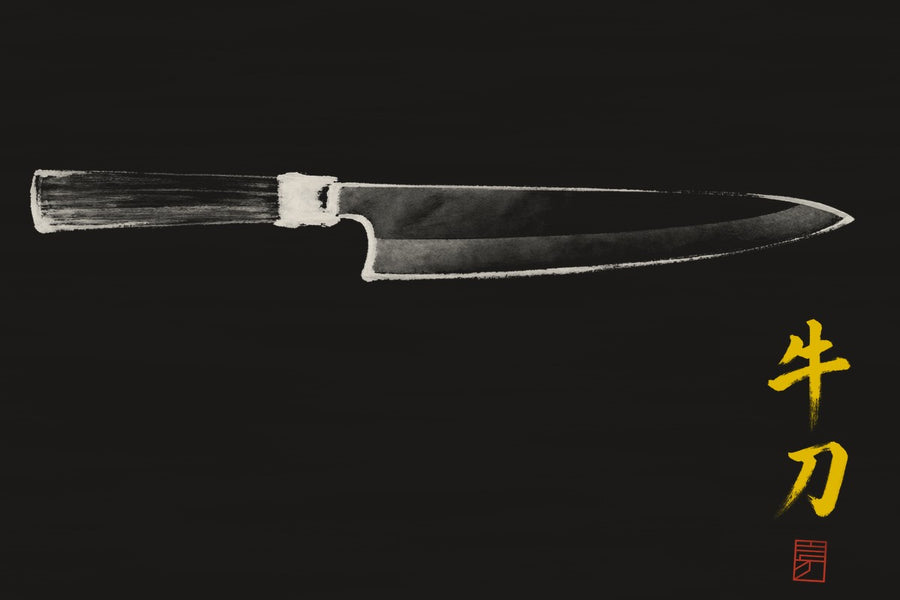
Gyuto — knife profile
Profile

Gyuto

牛刀

Chef's knife · Double bevel

Double-bevel all-purpose chef's knife with a pointed tip; thinner than a Western one.

Read more
Steel properties
  1. Hardness Fair
  2. Edge retention Fair
  3. Toughness High
  4. Rust resistance High
  5. Ease of sharpening High
  6. Sharpness High

Our ratings, inferred from published lab tests and composition.

Steel

Ginsan / Silver #3

GIN3

Stainless · Hitachi Metals (now Proterial)

Proterial's GIN 3 stainless: 0.95 to 1.10% carbon, 13.00 to 14.50% chromium, hardening hardness over 59 HRC.

Read more
CladdingCoreClad line
Construction

Sanmai - Stainless Damascus Clad

三枚ダマスカス

3 layers · damascus clad

Hard core between stainless damascus layers, bare at the edge. Thinning wears the pattern.

Read more
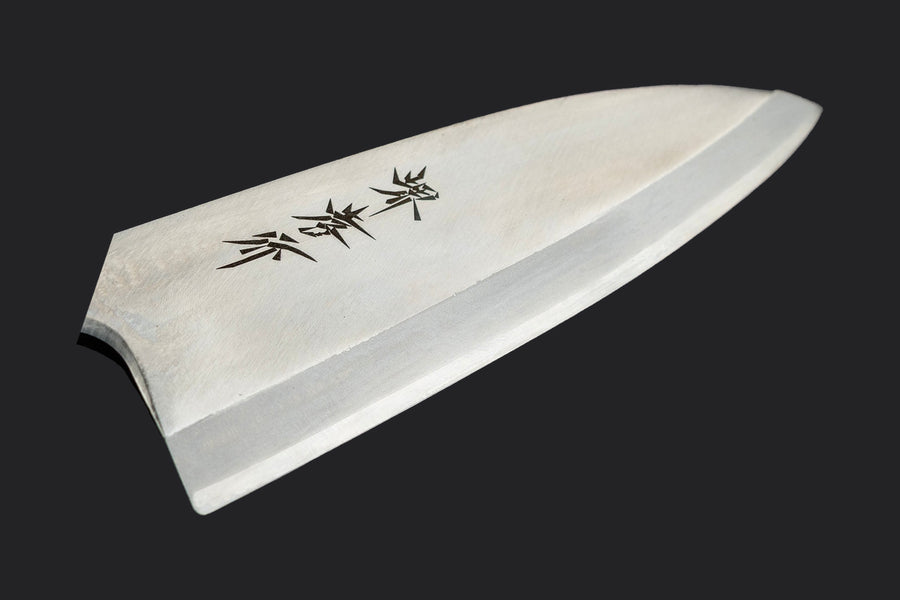
Migaki — blade surface finish
Finish

Migaki

Polished satin

Smooth polished surface, satin to soft sheen rather than mirror. Scratches show.

Read more

Frequently asked questions

Gyuto or santoku: which should I choose?

The gyuto came to Japan with the beef-eating culture of the Meiji era, and that is where its name comes from. Tojiro says it is used for all kinds of cooking, which is why it is also called the chef's knife.

The santoku is a household knife that combines the good points of the nakiri and the gyuto. Tojiro describes it as all-purpose, from vegetables to meat and fish, double-bevel and built on the same construction as a Western knife.

Choose a gyuto if you want more length and reach. Choose a santoku if you want a shorter all-purpose knife. Tojiro's own size figures: gyuto 150 to 210mm for household use and up to 360mm for professional use, santoku 165 to 170mm for household use.

What is a gyuto knife used for?

The gyuto (牛刀) is a chef's knife for all kinds of cooking, and it is basically double-bevel. A knife maker's guide says it came to Japan in the Meiji era with the culture of eating beef, which gave it its name, but it does not cut only meat.

A Japanese dictionary describes the gyuto as slimmer than a santoku, with a pointed tip, used widely for meat, fish and vegetables.

What gyuto length should I choose?

A knife maker's guide lists 150 to 210 mm, double-bevel, for home use, and 180 to 360 mm, single- or double-bevel, for professional kitchens.

We suggest starting with a 210 mm gyuto for a home kitchen, and stepping up to 240 mm if you regularly cut large pieces and have the board for it.

240mm vs 210mm gyuto: which size should I choose?

Get the 210mm. We only point people to a 240mm when they have about 45cm of usable board, cook in volume, and regularly break down big roasts or whole fish.

On the gyutos we've measured for our product pages, the extra length is real. As of October 2026, the 210mm gyutos we list have a median edge of 213mm from heel to tip, across the 111 we have measured; the 240mm ones have a median of 240mm, across 100. The 240s are also heavier, 212g against 175g at the median, and a touch taller at the heel, 50mm against 48mm, across the same 100 and 111 knives.

Weight overlaps between the two sizes. As of October 2026, 11 of the 100 measured 240s weigh less than the median 210 at 175g. The 240s we measured weigh 146 to 323g, and the 111 measured 210s 121 to 255g. The number in the name does not decide how heavy a knife is, so check the measured weight on the product page.

Japanese or German kitchen knives: which should I buy?

These are two design families, not a national specification, and many modern knives mix both. Japanese profiles are typically thinner, so they suit push and pull cuts; German profiles carry a fuller belly, which suits rocking. A given knife is its own evidence, so look at the blade you would buy rather than the country label.

Edges follow the same pattern. Many German knives ship at about 15 degrees per side, while many Japanese knives run about 10 to 15; check the model you are buying. A smaller angle is sharper but less forgiving. Hardness is a per model figure too. On two common Japanese steels the steel makers' own figures start at 60 HRC: Takefu Special Steel rates VG10 at 60 HRC or more, and Proterial lists the hardening hardness of Aogami 2 (Blue 2) as over 60 HRC.

A Japanese knife suits precision work where a sharp edge and nimble handling matter; a German knife suits heavier prep and rocking cuts where a substantial feel and a more forgiving edge matter. Whichever you choose, keep the edge off bone, frozen food and very hard squash, and use a wooden or plastic board.

What is the flat spot on a knife, and is it the same as the "sweet spot"?

The flat spot is the straight run of edge from the heel towards the middle, the part that meets the board along its length. It is commonly known as the sweet spot; some people also use "sweet spot" for the balance point, so ask which one someone means.

Past the flat, the edge curves up towards the tip (the belly), which suits a swinging or pulling stroke. Sharpeners also say "flat spot" for a worn patch of edge, so when you mean the shape, "the flat part of the edge" is clearer.

Gyuto or chef's knife: what is the difference?

A gyuto is a chef's knife, and its shape is largely modelled on the French chef's knife: a fairly flat run of edge near the heel, then a curve up to the tip. A German-style chef's knife has a bigger belly and curves along much more of its edge.

The flat run suits push and pull cuts, and the belly is made for rocking. That flat run is commonly known as the sweet spot.

What is Ginsan steel, and why do some Japanese knives use it?

Ginsan, also known as Silver 3, is a stainless steel from Proterial, the Yasugi Specialty Steel division. Proterial describes it as a stainless steel which has hardness and sharpness comparable to carbon steel, and lists its uses as kitchen knives and scissors.

Knife makers use it when they want the corrosion resistance of a stainless together with the hardness and sharpness that Proterial compares to carbon steel. The steel maker lists 59 HRC or over after hardening, but that is a heat treatment figure, not a finished knife figure.

Dry it after use, like any stainless knife. Its performance depends on the heat treatment and construction of the specific knife, not the steel name alone.

You May Also Like