PRAHRAN STORE NOW OPEN · THU–MON · 10AM–6PM

Kisuke Manaka  |  SKU: KISU-ATS34TSMK-SJHK240-XG

Kisuke x Xinguo ATS34 Sujihiki Tsuchime Mirror Kasumi 240mm w Knife Guard

Sale price $790.98 Regular price $929.95

Sold out right now

Leave your email and we’ll send one message the moment it’s back in stock.

One email, no marketing. Privacy policy.

Availability

  • St Peters, NSW —
    2 Bishop St, Unit 2, St Peters NSW 2044
  • Crows Nest, NSW —
    107 West St, Shop 1, Crows Nest NSW 2065
    Pickup only
  • Prahran, VIC —
    180 Commercial Road, Shop 1, Prahran VIC 3181
    Pickup only

Goes well with

Detailed Specifications
Line Manaka ATS34 x Xinguo
Profile Sujihiki / Slicing knife
Bevel Type Double Bevel
Weight 229 g | 8.1 oz
Edge Length 244 mm | 9 39/64″
Heel Height 43 mm | 1 11/16″
Width @ Heel 3.4 mm | 9/64″
Width @ Mid 3.2 mm | 1/8″
Width @ 1cm from Tip 1.2 mm | 3/64″
Steel ATS34 | Stainless
Blade Construction Warikomi - Stainless Clad
Typical hardness 60 to 61 HRC
Surface Finish Tsuchime
Handle Special Handle
Region Sanjo
Best for
  • Enthusiasts
  • Collectors

Free shipping for knives over AU$200 Australia wide.

World-wide shipping via DHL Express, 3 to 6 days (not available in the UK).


This is what happens when two very different skill sets come together and the result is greater than the sum of its parts. Kisuke Manaka hand-welds and forges each blade using ATS-34 stainless core steel in a traditional warikomi construction with a stainless jacket. On the other end, Xinguo, an emerging bladesmith from China who's been quietly building a serious reputation, takes over with finishing work that is frankly on another level.

If Xinguo's name rings a bell, it might be because he handled the sharpening on our last batch of Manaka ENN Damascus. His sharpening and polishing work is immaculate — on these blades, you won't find a single visible machining line. The edge comes out extremely straight, the choil and spine are polished and rounded to a degree that makes the knife genuinely comfortable to choke up on, and the deep tsuchime (hammered) texture across the blade face adds both visual character and food release. It's a high-polish, high-effort finish that you rarely see at any price point.

In the hand, these are hefty, no-nonsense workhorses. They run long, tall, and carry real weight — the kind of knives that feel planted on the board and power through dense roots and heavy prep without flinching. But despite the robust build, the cutting performance is surprisingly refined. ATS-34 is a well-proven stainless steel that holds an edge reliably and sharpens up without drama, making it a practical choice for cooks who want a knife that works as hard as they do.

The lineup covers pretty much the full range — gyuto, petty, chuka, santoku and more — so there's something here regardless of your preferred profile. These sit firmly in the high-budget category, but for a hand-forged Manaka with this level of finishing, the proposition is a compelling one. Collectors and enthusiasts who value the intersection of traditional Japanese forging and exceptional hand-finishing will find a lot to love here.

Pros Cons
  • Excellent performance
  • Great artistic
  • Highly collectable
  • Mirror polish can be hard to maintain
  • High budget
Care Instruction
  1. Don't cut hard things! Japanese knives are brittle so bone hacking is a NO NO!
  2. Wash with neutral detergent after use, and wipe dry;
  3. Please don't wash knife with dishwasher, it will damage the wood handle;
  4. Be careful not to leave the knife close to a heat source for a long time;
  5. It is a lot more dangerous to cut with a blunt knife than a sharp knife!
  6. It is best to sharpen a Japanese knife regularly on a waterstone.

Kisuke Manaka

Kisuke Manaka Tanrenjo, a one-man workshop (est. 1872)

Kisuke Manaka is the fifth generation of Manaka Hamono Tanrenjo (間中刃物鍛錬所), a knife workshop founded in 1872 and now working in Sanjo.

His own site says the workshop uses no clad stock, no stainless or iron already joined to steel, and that Kisuke works alone on every step: forge welding the steel onto each blade himself, then the annealing, quenching, tempering, sub-zero treatment, sharpening and handle fitting.

Read more

In February 2026 we visited Kisuke at his new workshop in Sanjo. The new workshop is spacious and bright, and in winter the view from its window is scenic. On why Sanjo, his own reason was plain: he simply wanted to move, and friends in Sanjo offered help.

His site describes the techniques behind his work, among them honwarikomi (本割込), where soft iron is split open with a chisel, the steel inserted and the blade forge welded, and the forge welding of stainless to steel. His Blue 1 page lists Blue 1 with a soft iron jigane, honwarikomi construction and a water quench, and his site lists about 64 HRC for it. His ATS-34 series page lists ATS-34 edge steel with an 18Cr stainless jigane, warikomi construction and sub-zero treatment, again with about 64 HRC listed.

Because his output is limited, we asked Xinguo, a Chinese workshop team, to sharpen and polish his blades, and that arrangement is the Kisuke x Xinguo line. The regular line we list is the Kisuke x Xinguo ATS34 tsuchime with a mirror kasumi finish and a knife guard, in gyuto, K-tip gyuto, bunka, sujihiki, petty, honesuki and chuka. Alongside it sits the flagship, the Kisuke x Xinguo Blue 1 Byakku Enn Damascus gyuto.

“A fifth-generation smith working alone in Sanjo.”

Est. 1872 | 明治5年
Known for One-man workshop; his site describes honwarikomi and forge-welded blades
Website manaka-hamono.com Instagram @manaka_hamono_tanrenjo Read more about Kisuke Manaka

Kisuke Manaka · Sanjo

Knife details

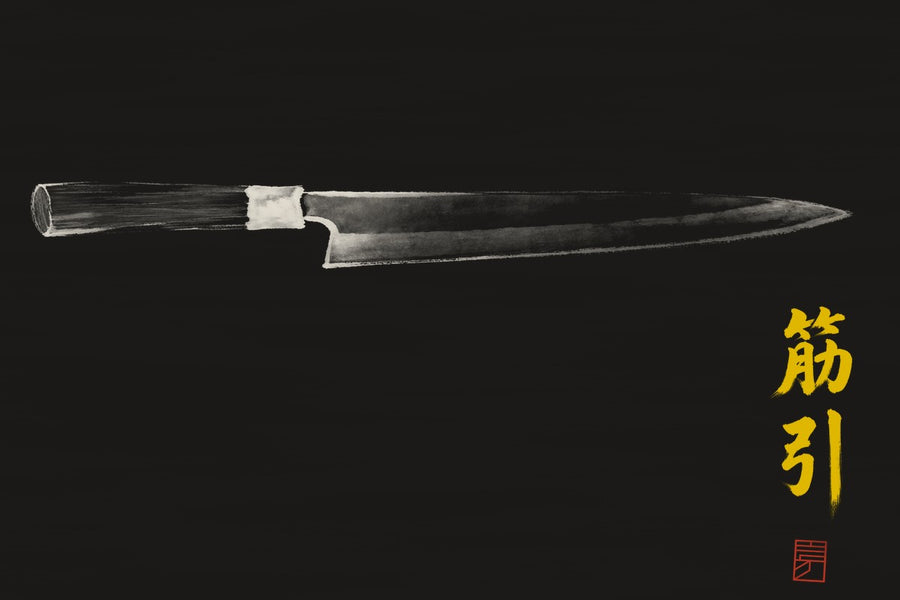
Sujihiki — knife profile
Profile

Sujihiki

筋引

Slicing knife · Double bevel

A long, narrow slicer for dividing large meat; Tojiro says it cuts sashimi too.

Read more
Steel properties
  1. Hardness Fair
  2. Edge retention Good
  3. Toughness Fair
  4. Rust resistance Good
  5. Ease of sharpening Good
  6. Sharpness Fair

Our ratings, inferred from published lab tests and composition.

Steel

ATS34

ATS-34

Stainless · Hitachi Metals (now Proterial)

Proterial stainless, 14% chromium, 4% molybdenum, hardening hardness over 59 HRC. Stainless rusts less; dry it after washing.

Read more
CladdingCore set inClad line
Construction

Warikomi - Stainless Clad

割込・ステンレス

Core set into stainless

Hard steel set into a split in stainless cladding, from the edge. Only the edge can rust.

Read more
Tsuchime — blade surface finish
Finish

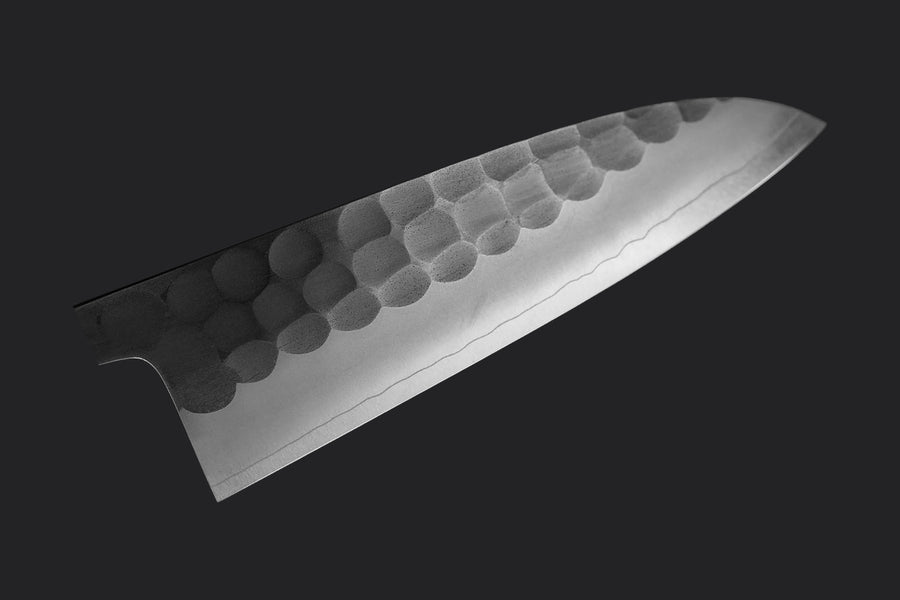
Tsuchime

Hammered surface

Hammer marks across the upper blade. The dimples may help food release.

Read more
Handle

Special Handle

Octagonal WA

The maker's own handle; material not disclosed. See the product photos for its look.

Frequently asked questions

What size sujihiki should I buy?

Between 210 and 270 mm, depending on where it will work. One Japanese maker lists 210 to 240 mm, double-bevel, for home use and 240 to 270 mm, single- or double-bevel, for professional kitchens.

Another, in Sakai, recommends 240 mm at home, with the size of your board in mind, and 270 mm for professional use.

Sujihiki or yanagiba: which do I need?

A sujihiki is a double bevel meat slicer: long, narrow, and made for dividing larger pieces of meat into their parts and for slicing roasts. A Sakai knife maker notes that some cooks also use its shape as a double bevel sashimi knife, so it is not limited to meat.

A yanagiba is the single bevel sashimi knife, cut in one pulling stroke from heel to tip. A single bevel cuts thinner, but it needs practice and is handed. A yanagiba edge is too acute for bone or other hard things, so it stays in the sashimi role. The usual lengths differ by job: sujihiki around 240 to 300 mm, yanagiba around 270 to 330 mm.

Choose the sujihiki for meat and general slicing, with sashimi as a secondary use. Choose the yanagiba when traditional single bevel sashimi work is the main job and you are ready for the handling and sharpening that construction requires.

Who makes ATS-34, and is it stainless?

Proterial makes ATS-34, a stainless blade steel. Its YSS page describes it as one for custom knives and high-quality cutlery tools, listing 14.00% chromium and 4.00% molybdenum and keeping the carbon figure closed.

That chromium is above the JSSA's 10.5% minimum for stainless steel, and the association notes that stainless, strictly, means it rusts less. Wash the knife and dry it after use.

What steel are the Kisuke x Xinguo knives made of?

The Kisuke x Xinguo knives are made with ATS-34, a steel Proterial lists with 14.00% chromium, 4.00% molybdenum and a hardening hardness of over 59 HRC.

Our listings give the construction as warikomi (stainless clad) and the finish as tsuchime.

Are the Kisuke x Xinguo knives stainless?

Yes, based on its chromium content: Proterial lists 14.00% chromium for ATS-34, above the Japan Stainless Steel Association's 10.5% minimum for stainless steel.

In the association's terms that means steel that rusts less, not steel that cannot rust, so dry the knife after washing. Our listings give the construction as stainless clad.

How long has the Manaka family been making knives?

The Manaka forge dates its founding to 1872, the fifth year of the Meiji era.

Kisuke Manaka, of Manaka Hamono Forge in Sanjo, is the fifth generation smith to carry the house.

What is honwarikomi (本割込) in a Manaka knife?

Honwarikomi (本割込) is a forging technique listed on Kisuke Manaka's own site. The smith chisels the soft iron open, inserts the steel, and forge welds the two together.

His site names it alongside his forge welding of stainless steel to steel.

You May Also Like