PRAHRAN STORE NOW OPEN · THU–MON · 10AM–6PM

Yu Kurosaki  |  SKU: KS-SACO-SU240

Kurosaki Sasame COSP Sujihiki 240mm

Sale price $467.98 Regular price $549.95

Sold out right now

Leave your email and we’ll send one message the moment it’s back in stock.

One email, no marketing. Privacy policy.

Availability

  • St Peters, NSW —
    2 Bishop St, Unit 2, St Peters NSW 2044
  • Crows Nest, NSW —
    107 West St, Shop 1, Crows Nest NSW 2065
    Pickup only
  • Prahran, VIC —
    180 Commercial Road, Shop 1, Prahran VIC 3181
    Pickup only

Goes well with

Detailed Specifications
Line Kurosaki Sasame COSP Tsuchime
Profile Sujihiki / Slicing knife
Bevel Type Double Bevel
Weight 172 g | 6.1 oz
Edge Length 240 mm | 9 29/64″
Heel Height 39 mm | 1 17/32″
Width @ Heel 2.6 mm | 7/64″
Width @ Mid 2.1 mm | 5/64″
Width @ 1cm from Tip 1.0 mm | 3/64″
Steel COSP (Cobalt Special) | Stainless
Blade Construction Sanmai - Stainless Clad
Maker's hardening hardness 60 HRC or more
Surface Finish Tsuchime
Handle Octagonal Ebony
Region Takefu
Best for
  • Pro chefs
  • Enthusiasts

Free shipping for knives over AU$200 Australia wide.

World-wide shipping via DHL Express, 3 to 6 days (not available in the UK).


Sasame(笹目, Bamboo Pattern) a line crafted by Yu Kurosaki that is built a little bit different. With the Gekko, Senko and Kokusen using stamping method to produce the blank, the knives from the Sasame are all forged, which can be identified by its thick Machi(neck) and distal taper in the spine. This adds rigidity to the blade and made it feel very confident and precise to use, and the stainless nature will make this a line highly suitable for professionals in busy kitchen.

The combination of forging and stainless steel may seems simple, but it is something worth noting. When steel is heated up for forging, the stainless steel will be harder and deform less compare to carbon steel, there is also a smaller temperature zone you can forge them at. For these reasons, you would rarely see forged stainless steel knives.

When forging, many blacksmiths would like to thin down the blade but kept the neck and tang thick, which increases the rigidity of the blade against bending and torsion and gives some weight to the knife. As the result, the knife will feel very responsive and follow your desired cutting trajectory especially when cutting hard objects, and thin, high performance blade(that Kurosaki san and other Echizen smiths are known for) won't feel gossamery.

The Sasame itself inherent some of the features that we love about Kurosaki san's knives: great finish, thin and aggressive bevel geometry and a bamboo leaf pattern that proudly display its identity. The nuance is, the bevel of Sasame is not a concave grind, but a convex instead, which does improve the food release and smoothness of the cut. Pairing with the highly polished bevel surface, Sasame is the best gliding knife I've every tested from Kurosaki.

Using the Cobalt Special as the core steel, the Sasame wouldn't be as pricy as the R2/SG2 Shizuku/Fujin that are also forged, it is a successor to the previous COSP line Raijin, and is a great option for professionals and knife enthusiasts.

Pros Cons
  • Great for professionals
  • Excellent performance
  • Thin behind the edge
  • High budget
  • A little bit brittle
Care Instruction
  1. Don't cut hard things! Japanese knives are brittle so bone hacking is a NO NO!
  2. Wash with neutral detergent after use, and wipe dry;
  3. Please don't wash knife with dishwasher, it will damage the wood handle;
  4. Be careful not to leave the knife close to a heat source for a long time;
  5. It is a lot more dangerous to cut with a blunt knife than a sharp knife!
  6. It is best to sharpen a Japanese knife regularly on a waterstone.

Yu Kurosaki

Yu Kurosaki, Echizen smith

Yu Kurosaki (黒崎優) is an Echizen smith who has run his own workshop, Kurosaki Uchihamono (黒﨑打刃物), since founding it in 2014, and who was certified as a traditional craftsman in 2019.

His site describes his knives as Echizen forged knives made one by one by a craftsman's hand, with time and care.

Read more

Before going out on his own, Yu Kurosaki spent twelve years at Kanehiro Uchihamono, from 2002 to 2014. He trained under Hiroshi Kato and Takeshi Saji. The Takefu Knife Village profile lists his work as double-bevel forged knives and custom knives.

In a 2022 interview with the magazine NIHONMONO he describes his knives in his own words as thin, sharp and tough. The same interview credits him with five original designs: Shizuku, Fujin, Raijin, Juhyo and Senko.

We carry a lot of his work, and we list two of those designs: the Raijin in VG10W and the Shizuku in SG2.

“An Echizen smith with his own workshop since 2014.”

Est. 2014 | 平成26年
Known for Raijin and Shizuku knives, forged by hand
Website kurosakiknives.jp Instagram @kurosakiknives Read more about Yu Kurosaki

Yu Kurosaki · Takefu

Knife details

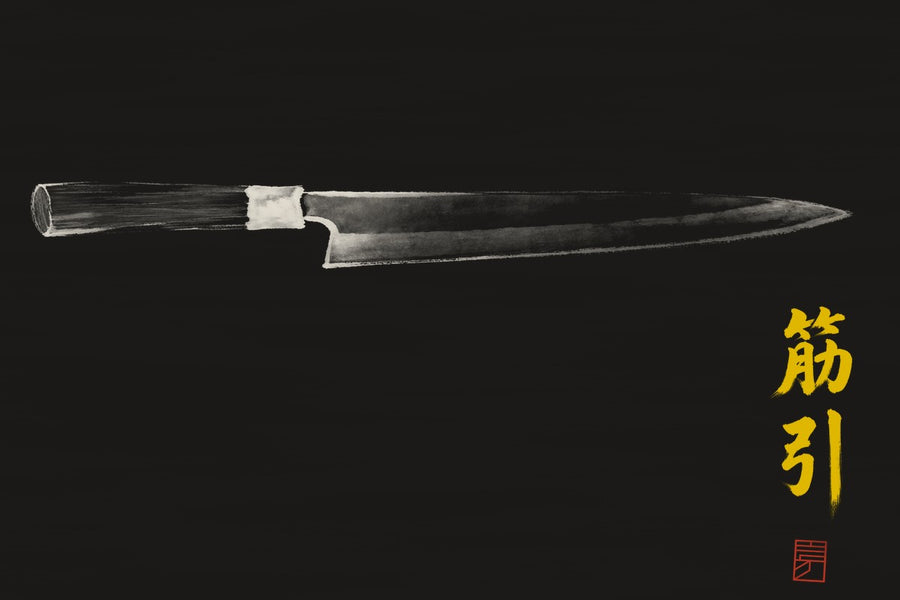
Sujihiki — knife profile
Profile

Sujihiki

筋引

Slicing knife · Double bevel

A long, narrow slicer for dividing large meat; Tojiro says it cuts sashimi too.

Read more
Steel properties
  1. Hardness Fair
  2. Edge retention Good
  3. Toughness Fair
  4. Rust resistance High
  5. Ease of sharpening Good
  6. Sharpness Good

Our ratings, inferred from published lab tests and composition.

Steel

COSP (Cobalt Special)

コバルトスペシャル鋼

Stainless · Takefu Special Steel

Takefu stainless with 2.50% cobalt; Takefu says the cobalt helps the edge last.

Read more
CladdingCoreClad line
Construction

Sanmai - Stainless Clad

三枚

3 layers · stainless clad

Hard core between two stainless layers, bare only at the edge; the cladding resists rust.

Read more
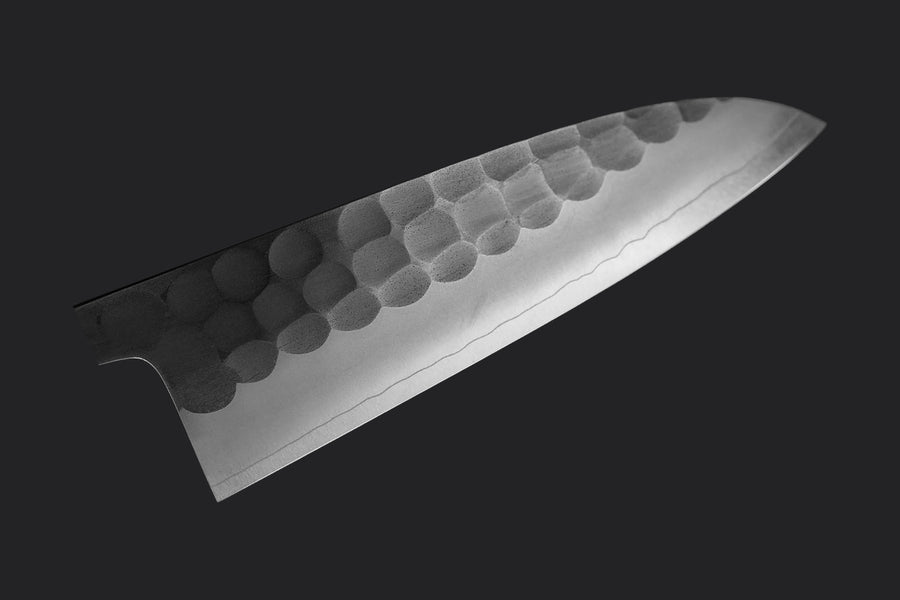
Tsuchime — blade surface finish
Finish

Tsuchime

Hammered surface

Hammer marks across the upper blade. The dimples may help food release.

Read more
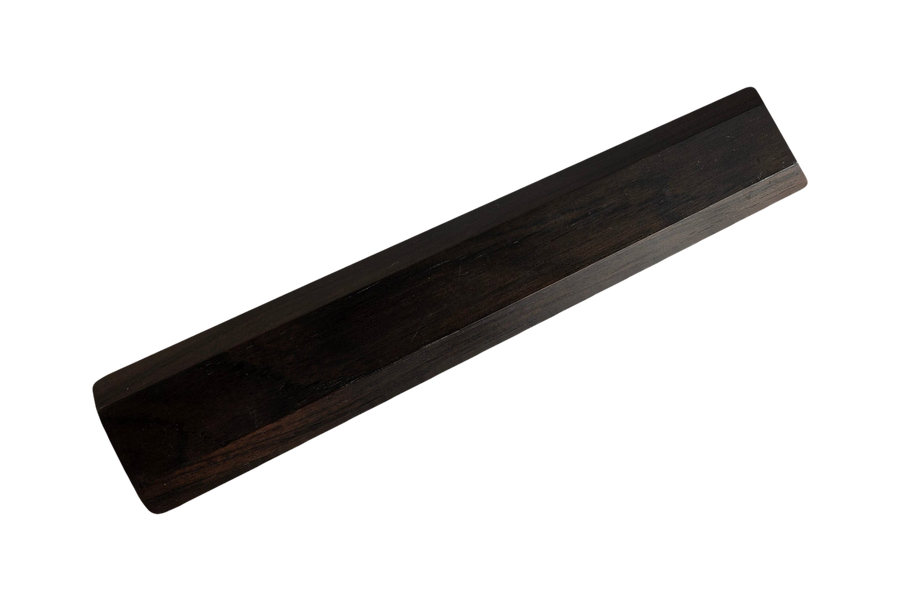
Octagonal Ebony handle
Handle

Octagonal Ebony

Octagonal WA

Dense, dark ebony in the eight-sided wa shape. The flats give a sure grip for either hand.

Frequently asked questions

What size sujihiki should I buy?

Between 210 and 270 mm, depending on where it will work. One Japanese maker lists 210 to 240 mm, double-bevel, for home use and 240 to 270 mm, single- or double-bevel, for professional kitchens.

Another, in Sakai, recommends 240 mm at home, with the size of your board in mind, and 270 mm for professional use.

Sujihiki or yanagiba: which do I need?

A sujihiki is a double bevel meat slicer: long, narrow, and made for dividing larger pieces of meat into their parts and for slicing roasts. A Sakai knife maker notes that some cooks also use its shape as a double bevel sashimi knife, so it is not limited to meat.

A yanagiba is the single bevel sashimi knife, cut in one pulling stroke from heel to tip. A single bevel cuts thinner, but it needs practice and is handed. A yanagiba edge is too acute for bone or other hard things, so it stays in the sashimi role. The usual lengths differ by job: sujihiki around 240 to 300 mm, yanagiba around 270 to 330 mm.

Choose the sujihiki for meat and general slicing, with sashimi as a secondary use. Choose the yanagiba when traditional single bevel sashimi work is the main job and you are ready for the handling and sharpening that construction requires.

What is Cobalt Special (CoSP) steel?

Cobalt Special (CoSP) is Takefu's stainless blade steel for cutlery: Takefu's page describes it as super high-grade and made by a special remelting process that gives a uniform composition and finely dispersed carbides.

Takefu's table gives 1.05% carbon, 16.00% chromium, 1.50% molybdenum, 0.25% vanadium, 0.25% tungsten and 2.50% cobalt, with a hardening hardness of HRC 60 or more. In Takefu's description, tungsten improves tempering resistance, molybdenum adds corrosion resistance, vanadium gives a finer microstructure, and cobalt strengthens the matrix and helps keep a long-lasting edge. Its 16.00% chromium is above the JSSA's 10.5% minimum for stainless, which the JSSA says strictly means rusts less; wash and dry the knife after use.

Is Yu Kurosaki a good Japanese knife maker?

We think so. Yu Kurosaki established his own workshop in 2014 after twelve years at Kanehiro Uchihamono (カネ弘打刃物), and he was certified as a traditional craftsman (伝統工芸士) in 2019. In a 2022 interview with the magazine Nihonmono, he described his knives as thin, sharp and tough.

We list his knives in steels such as SG2 and Blue Super. For a closer look at his work and approach, you can explore the Yu Kurosaki maker page on the Knives and Stones site.

What is the difference between Kurosaki Senko, Fujin, Raijin and Shizuku?

All four are Yu Kurosaki's own designs. In a 2022 interview with the magazine Nihonmono he named his five original designs, Shizuku, Fujin, Raijin, Juhyo and Senko, and described his knives as thin, sharp and tough.

In our range the steel is in the product title: Senko and Fujin are made in SG2 and Raijin in VG10W. So pick the design you like first, then check the steel in its title.

Are Yu Kurosaki knives handmade?

Yes. Yu Kurosaki worked at Kanehiro Uchihamono from 2002 to 2014, then founded his own workshop, 黒﨑打刃物 (Kurosaki Uchihamono), in 2014, and he is certified as a traditional craftsman. The trade body's profile of him lists double-bevel forged knives and custom knives, and his own site says his Echizen forged knives are made one by one by a craftsman's hand.

The Kurosaki knives we stock, such as the Senko SG2, Fujin SG2, Raijin VG10W and Shizuku lines, carry his name in the title.

You May Also Like