PRAHRAN STORE NOW OPEN · THU–MON · 10AM–6PM

Tojiro  |  SKU: TO-DP-DE210

Tojiro DP3 Yo-Deba 210mm F-814

Sale price $254.98 Regular price $299.95

In Stock Now

Availability

  • St Peters, NSW —
    2 Bishop St, Unit 2, St Peters NSW 2044
  • Crows Nest, NSW —
    107 West St, Shop 1, Crows Nest NSW 2065
    Pickup only
  • Prahran, VIC —
    180 Commercial Road, Shop 1, Prahran VIC 3181
    Pickup only

Goes well with

Detailed Specifications
Line Tojiro DP
Profile Deba / Japanese fish knife
Steel VG10 | Stainless
Blade Construction Sanmai - Stainless Clad
Maker's hardening hardness 60 HRC or more
Surface Finish Migaki
Handle
Region Tsubame
Best for
  • First-timers
  • Students

Free shipping for knives over AU$200 Australia wide.

World-wide shipping via DHL Express, 3 to 6 days (not available in the UK).


Tojiro DP is what I consider as the white Toyota equivalent in the Japanese knife market, it is affordable, massively produced by reputable manufacture with a long track record of being reliable for what you pay.

The core steel is the Takefu VG10, a middle to high tier stainless stainless steel that is widely adopted by many makers. However, Tojiro managed to get these knives to a very low price, to a price point where you can only find steel like AUS-8. The lowered price isn't achieved by compromising on performance, as the scale of the manufacturing can still ensure the quality of the heat treating and grinding, therefore, you are still getting a blade with sharpness and edge retention on par with some other VG-10 knives that are quite more expensive.

The trade-offs are the fit and finish of these knives, they are fine at first glance, but a closer inspection will reveals some small issues. The spine sometimes have scratches, same for joint between blade and bolsters, glue can be seen on the edge of handle scales and the choil is not rounded and you can peel potato with it... You can usually find one or two tiny unfinished details like these on a Tojiro DP, but usually they aretn't something that can't be fixed by a set of sandpaper in 20mins.

At the end of the day, the Tojiro DP will stay sharp and serve you well on chopping board, its low price and relative easy of sharpening can make it a good knife to learn sharpening on, the stainless Migaki finish can handle some beating and scratches, these features combine into a very good entry level user knife with outstanding affordability. Just like your first generic white Toyota, it may not have Alcntara interior, twin-turbo V8 and 4WD, but it is reliable, and able to handle 99% of the task with a very low price.

Pros Cons
  • Budget friendly
  • Easy to look after
  • Ideal for the household
  • Fit and finish can be improved
Care Instruction
  1. Don't cut hard things! Japanese knives are brittle so bone hacking is a NO NO!
  2. Wash with neutral detergent after use, and wipe dry;
  3. Please don't wash knife with dishwasher, it will damage the wood handle;
  4. Be careful not to leave the knife close to a heat source for a long time;
  5. It is a lot more dangerous to cut with a blunt knife than a sharp knife!
  6. It is best to sharpen a Japanese knife regularly on a waterstone.

Tojiro

Tojiro (藤次郎), Tsubame, Niigata

Tojiro (藤次郎株式会社) is a knife maker in Tsubame, Niigata, founded on 1 May 1953. Its president's message says that since its founding the company has pursued sharpness, the basic quality of a knife, carrying on traditional techniques while taking on new ones.

Read more

We stock Tojiro's DP3 knives in shapes from a paring knife to a sujihiki, its Zen series, its SG2 powdered steel gyuto and santoku, and its MV stainless deba and yanagiba, along with some of its kitchen tools.

“Tsubame knife maker since 1953.”

Est. 1953 | 昭和28年
Known for The DP, Zen and SG2 knife lines
Website tojiro-japan.com Instagram @tojiro_jp Read more about Tojiro

Tojiro · Tsubame

Knife details

Deba — knife profile
Profile

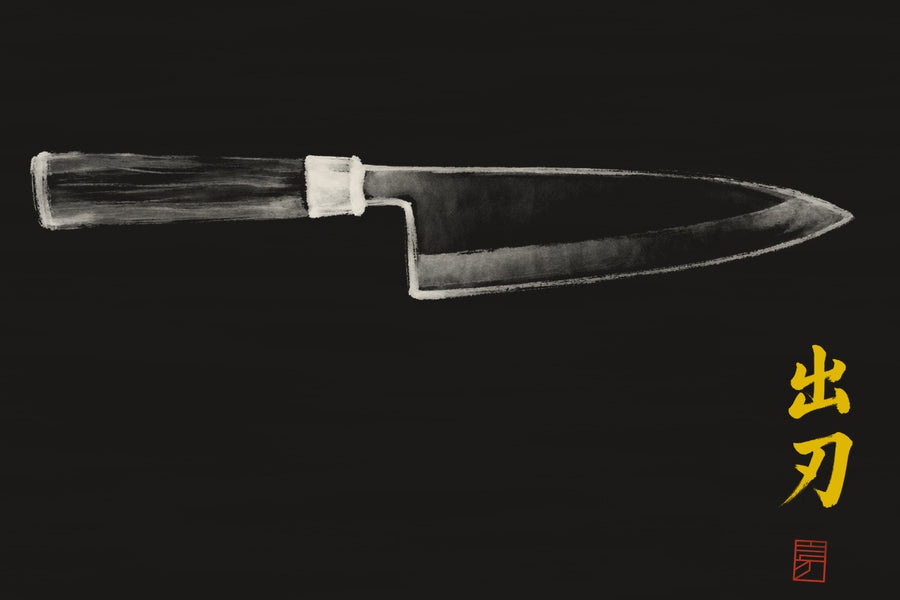
Deba

出刃

Japanese fish knife · Single or double bevel

A thick, heavy fish knife; dictionaries say it fillets and cuts fish and fowl bones.

Read more
Steel properties
  1. Hardness Good
  2. Edge retention Good
  3. Toughness Good
  4. Rust resistance High
  5. Ease of sharpening Good
  6. Sharpness Good
Our ratings, inferred from published lab tests and composition.

Our edge-retention grade is a kitchen rating. It weighs the hardness each steel is sold at, which keeps a thin edge from rolling, twice as heavily as lab wear tests, and the final grade is our judgment from selling and sharpening these knives for over a decade. Lab card-cutting tests measure abrasive wear only, so they can rank carbon steels lower. Tap ? for the lab figure.

Steel

VG10

V金10

Stainless · Takefu Special Steel

Takefu stainless, 1% carbon, 15% chromium, 1.55% cobalt. Easy to sharpen.

Read more
CladdingCoreClad line
Construction

Sanmai - Stainless Clad

三枚

3 layers · stainless clad

Hard core between two stainless layers, bare only at the edge; the cladding resists rust.

Read more
Migaki — blade surface finish
Finish

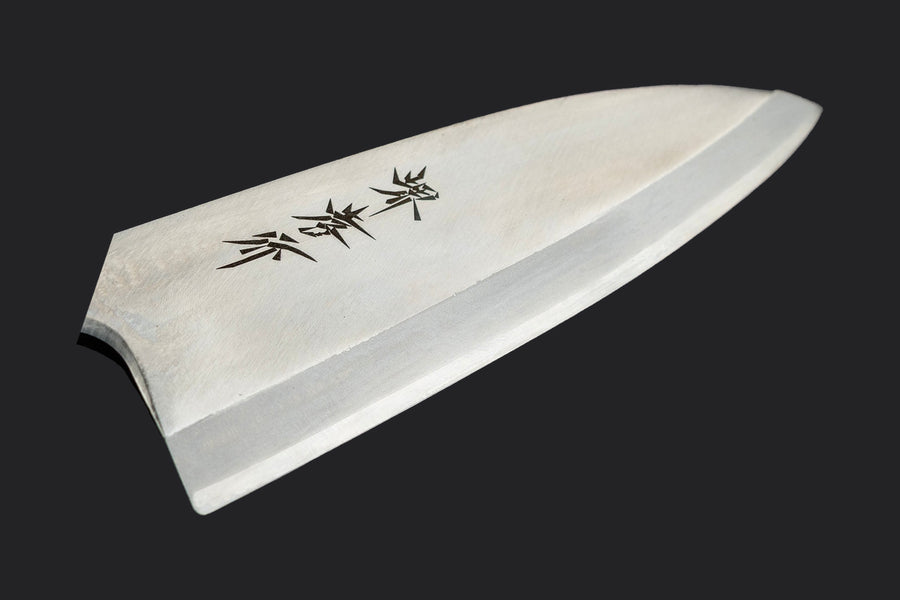
Migaki

磨き

Polished satin

Smooth polished surface, satin to soft sheen rather than mirror. Scratches show.

Read more

Frequently asked questions

Can a deba cut bone?

Yes, the bones of fish and fowl. Japanese dictionaries describe the deba (出刃包丁) as wide, thick-spined and heavy, used to fillet fish, to cut fish and fowl bone and all, and for rough chopping.

When you chop bone, use the heel of the blade (刃元), the Sakai cutlery association says. It is a fish and poultry knife, not a cleaver.

Can left-handed cooks use single bevel knives?

A standard single bevel knife is ground for right-handed use, and a left-handed one is made with the bevel reversed. Some makers offer left-handed versions.

Contact us and we will check what we can order or have in stock.

What is a mioroshi deba?

A mioroshi deba is a longer, slimmer version of the Japanese fish-butchering knife (deba), made for filleting. It keeps the deba's single bevel but is narrower, thinner at the spine and much lighter for its length.

A standard deba is thick and heavy, deep at the heel, and typically 150mm to 210mm long. Its weight and thick spine do the work when you take off a head or cut through a spine. The mioroshi deba gives up some of that weight for length: the ones we list are 210mm, 240mm and 270mm.

Our measurements show the difference. In Masamoto Sohonten's KS line, the 210mm mioroshi deba weighs 209g against 382g for the 210mm deba, and its spine above the heel is 4.8mm thick against 7.1mm.

Like the deba it is single bevel, so each knife is made for one hand. Most are right-handed, and we list left-handed ones too. Ours come from Sakai Takayuki, Masamoto Sohonten, Nakagawa and the Hatsukokoro Shirasagi line, in White 2 and Blue 1 carbon steel and in stainless.

Choose the standard deba if most of your work is heads and spines, because that work needs the weight. Choose the mioroshi deba when filleting is most of the job. Our deba guide explains the family, and both are listed with our deba and fish filleting knives.

Why is the back of a single-bevel knife hollow, and how do I sharpen it?

The shallow hollow in the back is called urasuki (裏スキ). Tojiro explains that it means the whole back never has to be ground when you sharpen, makes it easier to keep the back flat, and stops sharpening the back from affecting the edge. Only the thin flat rim around the hollow touches the stone.

Sharpen the front bevel first, laying it flat on the stone. Then lay the back completely flat and take a few light strokes, just enough to remove the burr. Never lift the spine to put an angle on the back, and keep the stone itself flat.

Which knife do I need for sushi and sashimi at home?

For occasional sushi at home, a sharp sujihiki (筋引) does the job. Tojiro describes it as a long, double-bevel slicer that can also be used for sashimi, and a double bevel works in either hand.

If sashimi is the point of the meal, choose a yanagiba (柳刃). Tojiro calls it the Kansai-style sashimi knife, now used across Japan, and it slices in one long pull from heel to tip. It is single bevel, so buy the one made for your hand.

If you start from whole fish, add a deba (出刃). Tojiro describes it as very thick and heavy, made for breaking fish down. The deba takes the fish apart and the slicer then cuts the fillets.

Does VG10 rust?

Yes, it can. Takefu, which makes VG10 (V金10), lists it among its stainless steels, and the JSSA notes that stainless strictly means rust-resistant, not rust-proof.

Takefu lists VG10's chromium content as 15% and describes its corrosion resistance as excellent. We recommend drying the knife after washing.

How hard is VG10?

Takefu, the steelmaker behind VG10, gives HRC 60 or more as its hardening hardness, measured straight after quenching. The hardness of a finished knife depends on its maker.

Takefu says the steel's 15% chromium, 1% molybdenum and 1.55% cobalt give it high hardness and a long-lasting edge, and that it is easy to sharpen.

What is the difference between VG10 and SG2?

Both are Takefu blade steels, and they differ in class and in what Takefu publishes about each. Takefu lists VG10 as a stainless steel with 1.00% carbon, 15.00% chromium, 1.00% molybdenum, 0.25% vanadium and 1.55% cobalt, at a hardening hardness of HRC 60 or more.

Takefu describes SG2, its Super Gold 2, as a blade steel created by powder metallurgy, lists its composition as not disclosed, and SG2 runs 61 to 65 HRC depending on the maker. Takefu also calls SG2 a powdered stainless high-speed steel.