PRAHRAN STORE NOW OPEN · THU–MON · 10AM–6PM

Knives and Stones  |  SKU: KNS-V10TCM-PE150

K&S VG10 Tsuchime Sanmai Petty 150mm Western Handle

Sale price $110.98 Regular price $129.95

Sold out right now

Leave your email and we’ll send one message the moment it’s back in stock.

One email, no marketing. Privacy policy.

Availability

  • St Peters, NSW —
    2 Bishop St, Unit 2, St Peters NSW 2044
  • Crows Nest, NSW —
    107 West St, Shop 1, Crows Nest NSW 2065
    Pickup only
  • Prahran, VIC —
    180 Commercial Road, Shop 1, Prahran VIC 3181
    Pickup only

Goes well with

Detailed Specifications
Line KnS VG10 Tsuchime Sanmai
Profile Petty / Utility knife
Bevel Type Double Bevel
Weight 63 g | 2.2 oz
Edge Length 149 mm | 5 55/64″
Heel Height 30 mm | 1 3/16″
Width @ Heel 1.8 mm | 5/64″
Width @ Mid 1.6 mm | 1/16″
Width @ 1cm from Tip 1.0 mm | 3/64″
Steel VG10 | Stainless
Blade Construction Sanmai - Stainless Clad
Maker's hardening hardness 60 HRC or more
Surface Finish Tsuchime
Handle Coke-bottle Shaped Western
Region Other
Best for
  • Pro chefs
  • First-timers
  • Students

Free shipping for knives over AU$200 Australia wide.

World-wide shipping via DHL Express, 3 to 6 days (not available in the UK).


The KnS Tsuchime Sanmai is the first model that Knives and Stones carries with our own branding 岩刃(Stone/Blade). Bearing this name means we are putting our reputation on these knives, and you can expect that we only gonna pick the items that can hold up to our standards and stand out in their categories.

These VG10 blades are produced in Seki, which is known for operating large machineries in factory blade manufacturing. What's unique about this VG10 line is the exceptional cutting performance. I had an impression that the machine manufactured blades tend to have less optimised geometry that results wedging and sticking, creating resistance and lead to worst cutting performance(Kireaji), however, the smooth cut offered by these blades proved me wrong. They have a very low thickness behind the edge that leads to excellent food penetration, and a well-polished bevel that release food off at Shinogi line halfway across the blade.

This kind of smooth cut is not rare in a store that specialise in high performance Japanese kitchen knives, but what excites me is that we can now see this level of performance on a factory manufactured knife, with a price tag that matches a typical European counterpart of same size. As much as I enjoy viewing or owning the collector pieces and the "Unicorn Knives", an affordable knife that cut well is what benefits most users at the end of the day.

The first line that bears the KnS name is not a statement piece, but rather a entry level item. Its the excellent performance is a combination of optimised design and manufacturing procedure with a low maintenance, solid performing steel. And they are a series of knives that I can comfortably recommend to anyone that seek the amazing experience that Japanese cutlery can offer.

Pros Cons
  • Budget friendly
  • Excellent performance
  • Great OOTB
Care Instruction
  1. Don't cut hard things! Japanese knives are brittle so bone hacking is a NO NO!
  2. Wash with neutral detergent after use, and wipe dry;
  3. Please don't wash knife with dishwasher, it will damage the wood handle;
  4. Be careful not to leave the knife close to a heat source for a long time;
  5. It is a lot more dangerous to cut with a blunt knife than a sharp knife!
  6. It is best to sharpen a Japanese knife regularly on a waterstone.

Knives and Stones (K&S)

Established in 2014 and based in Sydney, Australia, Knives and Stones (K&S) is an Australian kitchen knife retailer with international customers. Through close relationships with Japanese blacksmiths, K&S directly imports Japanese kitchen knives.

Founder James Zhang’s Chinese heritage also brings a unique dimension to the business: collaborating with Chinese craftsmen to forge high-performance cleavers using Japanese steels—what James proudly calls “the real deal.”

Read more

Founded in 2014 and headquartered in Sydney, Australia, Knives and Stones (K&S) has grown from a small project into a kitchen knife retailer with customers in Australia, the USA, and China. What started as a small business dedicated to sourcing Japanese blades now serves chefs, collectors, and home enthusiasts across three countries.

At the heart of K&S is a personal connection with Japanese blacksmiths. Over the years, we have built relationships with established and new blacksmiths, allowing us to import their knives directly. This not only keeps each knife's origin clear and its craftsmanship intact, but also delivers outstanding value to our customers by removing unnecessary layers between the maker and the end user. K&S stocks both well-known and smaller Japanese knife brands.

Our international outlook is also shaped by founder James Zhang’s Chinese heritage. With a vision to bridge traditions, James has introduced Japanese steel to skilled Chinese makers to create a series of Japanese-steel cleavers. These blades, which James calls “the real deal”, combine Japanese steel with Chinese cooking use.

With physical presence and distribution networks in Australia, the USA, and China, Knives and Stones brings Japanese kitchen knives to customers in those three countries. Whether you’re a professional chef seeking a reliable workhorse, a collector chasing rare masterpieces, or a home cook ready to elevate your craft, K&S is committed to delivering tools that inspire confidence and creativity in the kitchen.

Est. 2014
Website knivesandstones.com.au Instagram @knivesandstones Facebook knivesandstones Read more about Knives and Stones (K&S)

Knife details

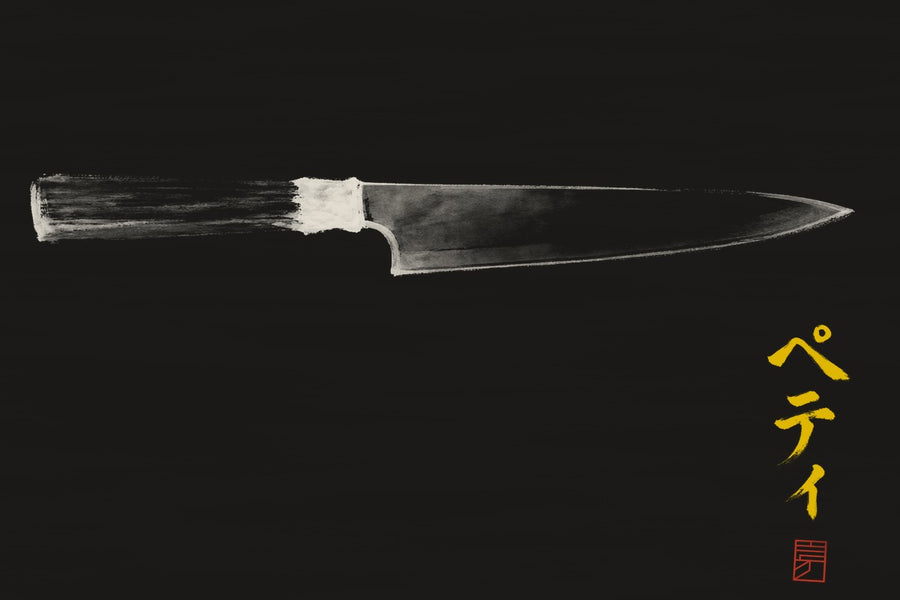
Petty — knife profile
Profile

Petty

ペティ

Utility knife · Double bevel

Small, slim double-bevel utility knife for peeling, trimming and small board jobs.

Read more
Steel properties
  1. Hardness Fair
  2. Edge retention Good
  3. Toughness Fair
  4. Rust resistance High
  5. Ease of sharpening Good
  6. Sharpness Good

Our ratings, inferred from published lab tests and composition.

Steel

VG10

V金10

Stainless · Takefu Special Steel

Takefu stainless, 1% carbon, 15% chromium, 1.55% cobalt. Easy to sharpen.

Read more
CladdingCoreClad line
Construction

Sanmai - Stainless Clad

三枚

3 layers · stainless clad

Hard core between two stainless layers, bare only at the edge; the cladding resists rust.

Read more
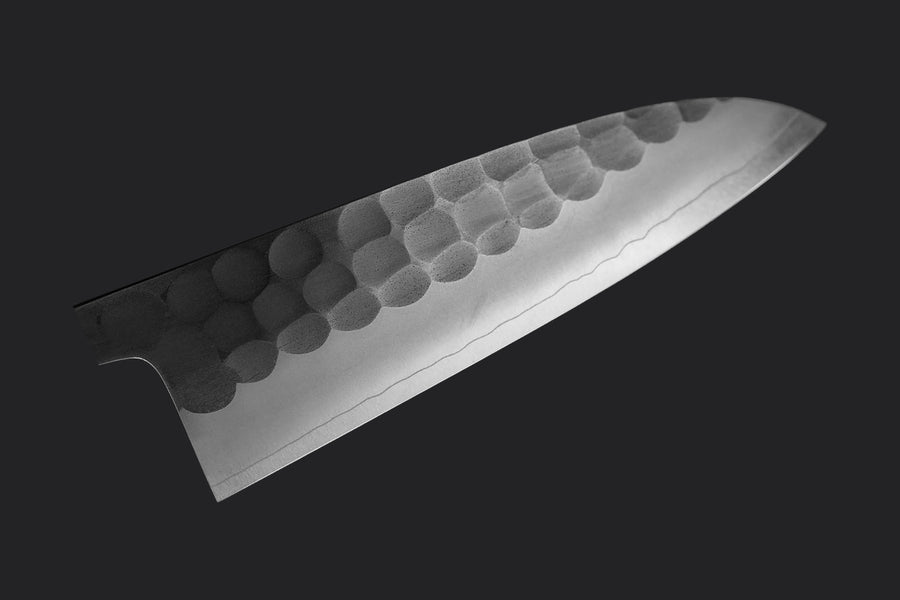
Tsuchime — blade surface finish
Finish

Tsuchime

Hammered surface

Hammer marks across the upper blade. The dimples may help food release.

Read more
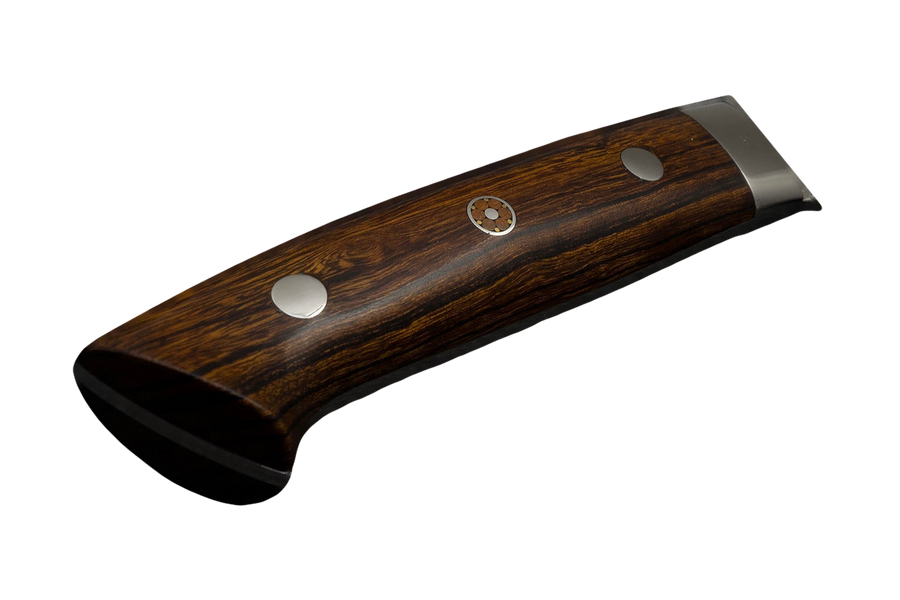
Coke-bottle Shaped Western handle
Handle

Coke-bottle Shaped Western

Coke-bottle shaped western

Western grip: wide middle, tapered ends.

Frequently asked questions

What is a petty knife and when do I need one?

A petty is a small utility knife, from the French petit. It is commonly shaped like a small gyuto and runs from 120 to 150 mm, up to 180 mm. Its clearest role is detailed work where a larger knife feels cumbersome: fruit peeling, garnish work, condiments, and small board work beside a gyuto or santoku.

A knife maker, Tojiro, frames the petty as a useful second knife, not an automatic necessity, and recommends santoku plus petty or gyuto plus petty combinations. It is not a replacement for a full size chef's knife; it lacks the blade length and belly for efficient chopping, rocking, or breaking down larger proteins. Treat it as a precision tool, not an all-rounder.

How long is a petty knife?

Petty knife lengths vary by maker: KAI's guide defines a petty (ペティナイフ) as a small knife with a narrow blade measuring 150 mm or under. Its table gives 90 to 150 mm, and it describes the shape as a smaller gyuto with a pointed tip.

We list petty knives from 70 mm to 165 mm, including lengths above the limit used in KAI's guide.

Does VG10 rust?

Yes, it can. Takefu, which makes VG10 (V金10), lists it among its stainless steels, and the JSSA notes that stainless strictly means rust-resistant, not rust-proof.

Takefu lists VG10's chromium content as 15% and describes its corrosion resistance as excellent. We recommend drying the knife after washing.

How hard is VG10?

Takefu, the steelmaker behind VG10, gives HRC 60 or more as its hardening hardness, measured straight after quenching. The hardness of a finished knife depends on its maker.

Takefu says the steel's 15% chromium, 1% molybdenum and 1.55% cobalt give it high hardness and a long-lasting edge, and that it is easy to sharpen.

What is the difference between VG10 and SG2?

Both are Takefu blade steels, and they differ in class and in what Takefu publishes about each. Takefu lists VG10 as a stainless steel with 1.00% carbon, 15.00% chromium, 1.00% molybdenum, 0.25% vanadium and 1.55% cobalt, at a hardening hardness of HRC 60 or more.

Takefu describes SG2, its Super Gold 2, as a blade steel created by powder metallurgy, lists its composition as not disclosed, and SG2 runs 61 to 65 HRC depending on the maker. Takefu also calls SG2 a powdered stainless high-speed steel.

You May Also Like